Top Stories Daily Listen Now
RawStory

Science

Companies are increasingly tracking eye movements — but is it ethical?

When Facebook reinvented itself into Meta in October 2021, it was widely reported that Meta would be focusing on virtual reality (VR) by being at the forefront of the metaverse.

But Meta has not given up on the world of bricks and mortar yet, as reflected by the company’s massive investment in augmented reality (AR) glasses.

Keep reading... Show less

We tested Einstein’s theory of gravity on the scale of the universe – here’s what we found

Everything in the universe has gravity – and feels it too. Yet this most common of all fundamental forces is also the one that presents the biggest challenges to physicists. Albert Einstein’s theory of general relativity has been remarkably successful in describing the gravity of stars and planets, but it doesn’t seem to apply perfectly on all scales.

General relativity has passed many years of observational tests, from Eddington’s measurement of the deflection of starlight by the Sun in 1919 to the recent detection of gravitational waves. However, gaps in our understanding start to appear when we try to apply it to extremely small distances, where the laws of quantum mechanics operate, or when we try to describe the entire universe.

Keep reading... Show less

'Deeply depressing' study shows planet-warming emissions continue to rise

Rapid and drastic cuts to global greenhouse gas emissions are needed to curb warming and prevent the most dire climate scenarios from becoming reality.

But a new study released Friday by the Global Carbon Project finds "no sign of the decrease that is urgently needed" as emissions remain at record levels this year, with fossil fuel giants and governments plowing ahead with new extraction efforts that could push critical climate targets out of reach.

Keep reading... Show less

People who earn less than they think they should tend to attribute this to unfairness of the economy

An online experiment on thousands of U.S. residents shows that people who are made to realize that their earnings are lower than their self-assessed earning ability tend to attribute this to the unfairness of the economy. They tend to believe that other people also earn less than their abilities merit. The study was published in theEuropean Journal of Political Economy. People tend to be overconfident about their abilities in many situations. For example, a 1981 study in the US showed that 88% of respondents considered themselves safer than the median driver. In a similar manner, workers tend ...

New research disputes the “lazy stoner” stereotype

New research casts doubts on claims that chronic cannabis use results in “amotivational syndrome,” which is characterized by a lack of enjoyment of everyday life and a loss of motivation. The study, published in the International Journal of Neuropsychopharmacology, found no difference in anhedonia, apathy, or motivation between cannabis users and non-users. “Cannabis is the third most commonly used controlled substance worldwide, and with its legal profile currently changing in many countries it is more important than ever to know how cannabis affects the brain and cognition,” said study autho...

‘One of the greatest damn mysteries of physics’: we studied distant suns in the most precise astronomical test of electromagnetism yet

There’s an awkward, irksome problem with our understanding of nature’s laws which physicists have been trying to explain for decades. It’s about electromagnetism, the law of how atoms and light interact, which explains everything from why you don’t fall through the floor to why the sky is blue.

Our theory of electromagnetism is arguably the best physical theory humans have ever made – but it has no answer for why electromagnetism is as strong as it is. Only experiments can tell you electromagnetism’s strength, which is measured by a number called α (aka alpha, or the fine-structure constant).

Keep reading... Show less

Confidence in science has plummeted. Here’s why we might want to rethink that

At the start of the pandemic, concerned friends and family turned to Jennifer Dixon for all of their COVID-19 questions: Should I wipe down my groceries? Are packages from China dangerous? But just a few months later, Dixon, an infection prevention specialist of nearly two decades at WakeMed, noticed a shift. Some of the neighbors and friends who texted and called her for advice were suddenly deeply suspicious about her intentions and qualifications. “Those same people are the ones who now look at me and go, ‘Yeah, I don’t believe you,’” she said. Acquaintances unfriended her on Facebook when ...

The study of evolution is fracturing – and that may be a good thing

How will life on Earth and the ecosystems that support it adapt to climate change? Which species will go extinct – or evolve into something new? How will microbes develop further resistance to antibiotics?

These kinds of questions, which are of fundamental importance to our way of life, are all a focus for researchers who study evolution and will prove increasingly important as the planet heats up.

Keep reading... Show less

Repeat Covid infections increase risk of health problems: study

People who have had Covid more than once are two or three times more likely to have a range of serious health problems than those who have only had it once, the first major study on the subject said Thursday.

Multiple infections have surged as the pandemic rumbles on and the virus mutates into new strains, but the long-term health effects of reinfection have not been clear.

Keep reading... Show less

Vaccine advocate on science, truth, and why he’s not a fan of the latest COVID boosters

PHILADELPHIA -- Philadelphia’s most prominent immunization expert isn’t planning to get the latest COVID-19 booster shot, and doesn’t think most others need to either. Paul Offit, who is among the Food and Drug Administration’s advisers on which vaccines the public should receive, disagrees with the current recommendations of the White House, FDA, and Centers for Disease Control and Prevention that everyone over the age of 5 should get the new vaccine. Offit says he is standing up for science. He has dedicated his career to advancing vaccines to save children from preventable illnesses. He thi...

Thinning Greenland ice sheet may mean more sea level rise: study

Part of Greenland's ice sheet is thinning further inland than previously believed, which will likely lead to greater sea level rise by the end of this century, a new study found Wednesday.

The findings pertain to a northeast section of the giant ice block covering, but the trend is likely happening elsewhere on Greenland and Earth's other ice sheet, in Antarctica.

Keep reading... Show less

New research shows ancestral Māori adapted quickly in the face of rapid climate change

When the ancestors of Māori made landfall in Aotearoa some 750 years ago, it marked the final stop of the greatest expansion of human migration in prehistory.

Much of their story – exactly when they arrived and where they initially settled, how quickly the population grew, and how they sustained themselves and adapted during rapidly changing climate conditions – has remained elusive until now.

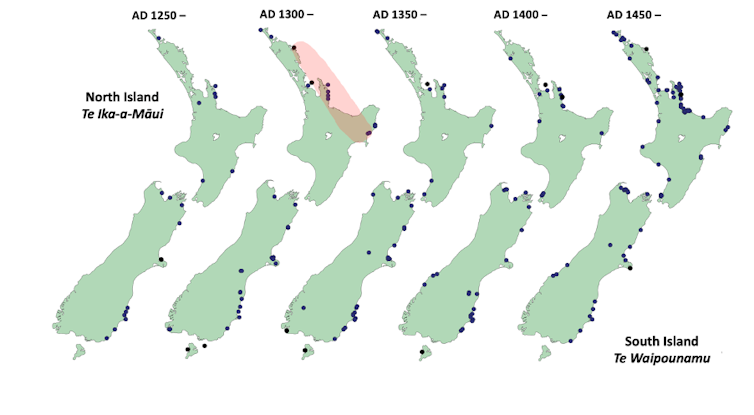
Our research traces the first 250 years of settlement, including changes in resource availability and population growth. It provides a more precise timeline for arrival and settlement, beginning as early as 1250-1270.

We also demonstrate for the first time a difference in the age of settlements in the North and South islands. The research shows that Māori adapted quickly to their new environment and again during later periods when temperature and rainfall changed significantly.

A map of the earliest settlement of Aotearoa.

The changing distribution of archaeological sites across Aotearoa. The red ellipse marks the distribution of the volcanic deposits from the Kaharoa eruption around 1314.

Authors provided, CC BY-ND

A more precise timeline of arrival

People travelled from tropical islands in East Polynesia at a time when a warm climate facilitated travel across the world’s largest ocean.

Researchers have long debated the exact timing of their first settlement, with estimates varying between the 12th and 14th centuries, depending on the material selected for radiocarbon dating.

We show that early settlers reached the North Island first, between 1250 and 1270, a decade before the South Island became more popular.

At the time of settlement, the south had colonies of the large flightless moa. The early settlers rapidly adapted to this temperate climate, living on a diet of moa, seafood and vegetables grown in their garden plots.

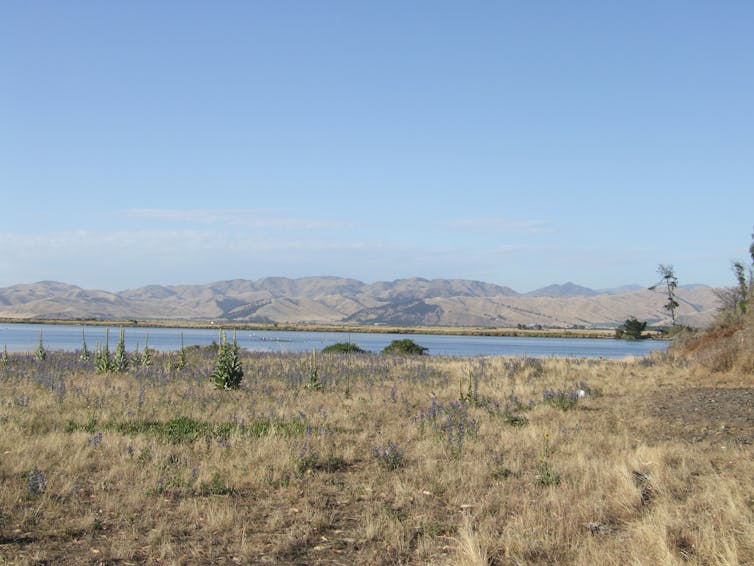
A landscape image of Wairau Bar, a coastal site of early settlemnt in the South Island.

Wairau Bar in Marlborough is thought to be one of the earliest sites of settlement in the South Island.

Fiona Petchey, CC BY-SA

But then the Little Ice Age interfered with this lifestyle. After 1350, conditions became significantly colder in the south. By around 1400-1420, moa hunting became uneconomic and put these fledgling communities under immense pressure. Once again, people had to adapt quickly.

Models developed from radiocarbon dates and the distribution of archaeological sites indicate the population shifted back to the north and grew between 1350 and 1450. In the north, soils were ideal for agriculture and temperatures were warmer.

New scientific approach

Estimates of arrival and settlement in earlier studies and models vary depending on the material they used. For example, radiocarbon dates of the Pacific rat (Rattus exulans or kiore) tell a story about the spread of rats following the introduction by Māori ancestors. This study documents an explosion in the rat population but not information on the earliest human settlement date.

Likewise, radiocarbon dates on moa eggshell and bone tell us about the timing of moa-hunting activities but little about activities elsewhere.

This piecemeal approach has blurred the settlement chronology and contributed to the notion of a “mass migration” event. These studies also ignored dates on marine materials, one of the most commonly dated sample types.

In a previous study, we demonstrated that dates of midden shells could increase the accuracy of models if we had a better understanding of how radiocarbon in the ocean changed over time.

The development of a regional marine calibration curve that mapped this change allowed us to include more than 800 shell radiocarbon dates in the current study. This curve doubled the number of dates available for analysis.

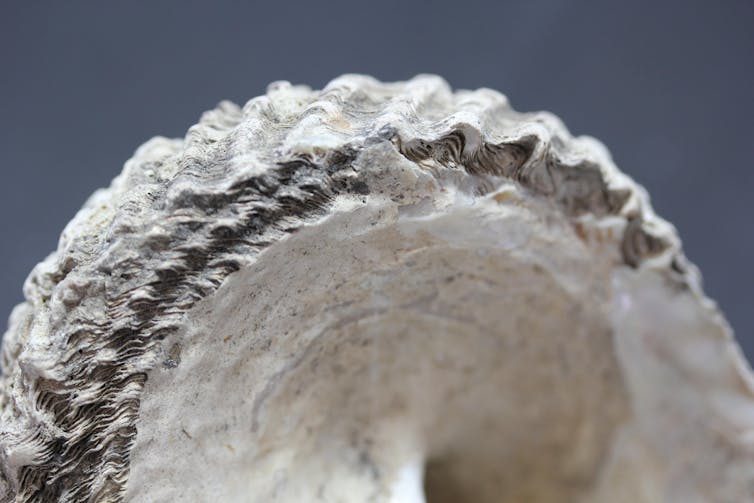
An image showing the edge of a shell

Toitoi (Cookia sulcata) shell from an early archaeological site.

Fiona Petchey, CC BY-SA

It was also necessary to develop a new approach to modelling that combined terrestrial and marine radiocarbon data sets. The increased precision and accuracy of these new models enabled us to draw links between the number and distribution of archaeological sites, climate, resources and deforestation trends.

Why our results are more precise

We scoured journal papers and books to assemble more than 2,250 dates, the largest radiocarbon data set from any island context. We carefully evaluated the archaeological context and scientific reliability of each date and removed almost 700 problematic dates before modelling began.

Differences between the terrestrial and marine calibration curves used to convert radiocarbon measurements into calendar ages enabled us to refine “wiggles” that result in multiple ranges for some early settlement events.

This research goes only a small way to providing a time baseline for understanding the complexity of ancestral Māori society. Future work aims to achieve the precision needed to establish more links between people, climate and time.

Keep reading... Show less

Please don't lick psychedelic toads, warn US park officials

US park officials have asked visitors to stop licking psychedelic toads, warning that anyone seeking a hallucinogenic high from the wart-covered amphibians is more likely to end up seriously ill.

The National Park Service posted cautionary messages on social media last week against licking Sonoran Desert toads, a practice long depicted on popular animated television shows including "The Simpsons" and "Family Guy."

Keep reading... Show less