Mystery crater potentially caused by relative of dinosaur-killing asteroid
The finding, published in Science Advances, raises the question of whether the crater might be related to Chicxulub in some way. If confirmed, it would also be of huge general scientific interest as it would be one of a very small number of known marine asteroid impacts and so give unique new insights into what happens during such a collision.
The crater was identified using “seismic reflection” as part of a wider project to reconstruct the tectonic separation of South America from Africa back in the Cretaceous period. Seismic reflection works in a similar manner to ultrasound data, sending pressure waves through the ocean and its floor and detecting the energy that is reflected back. This data allows geophysicists and geologists to reconstruct the architecture of the rocks and sediments.
Scrolling through this data at the end of 2020, we came across a highly unusual feature. Among the flat, layered sediments of the Guinea Plateau, west of Africa, was what appeared to be a large crater, a little under 10km wide and several hundred meters deep, buried below several hundred meters of sediment.
Many of its features are consistent with an impact origin, including the scale of the crater, the ratio of height to width and the height of the crater rim. The presence of chaotic deposits outside of the crater floor also look like “ejecta” – material expelled from the crater immediately following a collision.
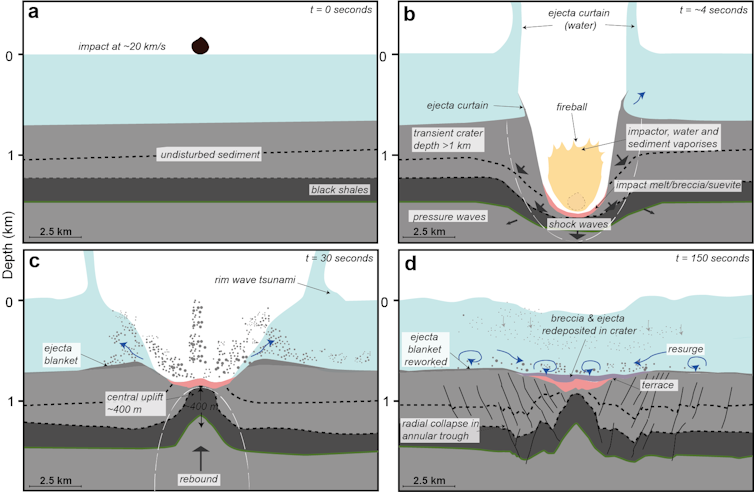
How the crater may have formed.
We did consider other possible processes that could have formed such a crater, such as the collapse of a submarine volcano or a pillar (or diapir) of salt below the seabed. An explosive release of gas from below the surface could also be a cause. But none of these possibilities are consistent with the local geology or the geometry of the crater.
Earthquakes, airblast, fireball and tsunamis
After identifying and characterizing the crater, we built computer models of an impact event to see if we could replicate the crater and characterize the asteroid and its impact.
The simulation that best fits the crater shape is for an asteroid 400 meters in diameter hitting an ocean that was 800 meters deep. The consequences of an impact in the ocean at such water depths are dramatic. It would result in an 800-meter thick water column, as well as the asteroid and a substantial volume of sediment being instantly vaporized – with a large fireball visible hundreds of kilometers away.
Shock waves from the impact would be equivalent to a magnitude 6.5 or 7 earthquake, which would likely trigger underwater landslides around the region. A train of tsunami waves would form.
The air blast from the explosion would be larger than anything heard on Earth in recorded history. The energy released would be approximately a thousand times larger than that from the recent Tonga eruption. It is also possible that the pressure waves in the atmosphere would further amplify the tsunami waves far away from the crater.
Chicxulub relative?
One of the most intriguing aspects of this crater is that it is the same age as the giant Chicxulub event, give or take one million years, at the boundary between the Cretaceous and Paleogene periods 66 million years ago. Again, if this really is an impact crater, might there be some relationship between them?
We have three ideas as to their possible relationship. The first is that they might have formed from the break-up of a parent asteroid, with the larger fragment resulting in the Chicxulub event and a smaller fragment (the “little sister”) forming the Nadir crater. If so, the damaging effects of the Chicxulub impact could have been added to by the Nadir impact, exacerbating the severity of the mass extinction event.
The break-up event could have formed by an earlier near-collision, when the asteroid or comet passed close enough to Earth to experience gravitational forces strong enough to pull it apart. The actual collision could then have occurred on a subsequent orbit.
Although, this is less likely for a rocky asteroid, this pull-apart is exactly what happened to the Shoemaker-Levy 9 comet that collided with Jupiter back in 1994, where multiple comet fragments collided with the planet over the course of several days.
Another possibility is that Nadir was part of a longer lived “impact cluster”, formed by a collision in the asteroid belt earlier in solar system history. This is known as the “little cousin” hypothesis link coming.
This collision may have sent a shower of asteroids into the inner solar system, which may have collided with the Earth and other inner planets over a more extended time period, perhaps a million years or more. We have a precedent for such an event back in the Ordovician period – over 400 million years ago – when there were numerous impact events in a short period of time.
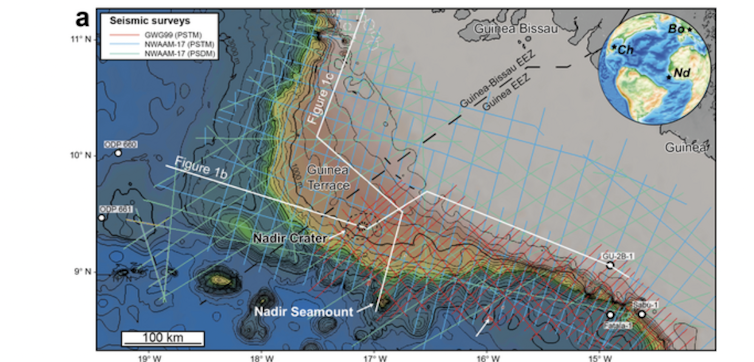
Nadir crater.
Finally, of course, this may just be a coincidence. We do expect a collision of a Nadir-sized asteroid every 700,000 years or so. For now, however, we cannot definitively state that the Nadir crater was formed by an asteroid impact until we physically recover samples from the crater floor, and identify minerals that can only be formed by extreme shock pressures. To that end, we have recently submitted a proposal to drill the crater through the International Ocean Discovery Program.
As with the main impact crater hypothesis, we can only test the little sister and little cousin hypotheses by accurately dating the crater using these samples, as well as by looking for other candidate craters of a similar age.
Perhaps more importantly, could such an event happen in the near future? It is unlikely, but the size of the asteroid that we model is very similar to the Bennu asteroid currently in near-Earth orbit. This asteroid is considered to be one of the two most hazardous objects in the solar system, with a one-in-1,750 chance of collision with Earth in the next couple of centuries.
Uisdean Nicholson, Associate Professor of Geoscience, Heriot-Watt University; Sean Gulick, Research Professor of Geoscience, University of Texas at Austin, and Veronica Bray, Research Scientist, Lunar & Planetary Laboratory, University of Arizona
This article is republished from The Conversation under a Creative Commons license. Read the original article.