The central United States has seen persistent hot and dry conditions this summer, resulting in dozens of wildfires. The heat wave is a result of a high pressure ridge impacting the region since June, which pushes air toward the Earth’s surface, diminishing cloud cover and rain opportunities, Tom Bradshaw, National Weather Service meteorologist, told the Fort Worth Star-Telegram. High pressure and drought are not new occurrences for Texas, said Arne Winguth, The University of Texas at Arlington earth and environmental professor, but the conditions occur more frequently due to climate change. Wi...
Chemicals leaking from plastic waste make bacteria grow faster in European lakes, according to research published Tuesday that authors said could provide a natural way to remove plastic pollution from freshwater ecosystems.
Microplastics have been found in virtually every corner of the globe -- from the highest glaciers to the bottom of the deepest sea trench -- but the impact of plastic pollution in lakes is less well researched than in oceans.
When plastic materials such as carrier bags break down in water, they release simple carbon compounds slightly different to those produced when organic matter such as twigs and leaves disintegrate.
Researchers from the University of Cambridge wanted to see what effect these compounds had on bacteria populations in 29 lakes across Scandinavia.
They cut up plastic bags from four major British shopping chains and mixed them with water until the carbon compounds were released.
They then filled glass bottles with water from each lake, mixing a small amount of the plastic water into half of these samples.
In the water with plastic-derived compounds, the bacteria had doubled in mass within 72 hours and already absorbed around half of the carbon present in the samples.
Overall, they found that the bacteria in the plastic water samples grew nearly twice as easily (1.72 times) as the lake bacteria with no plastic water added.
Andrew Tanentzap, from the University of Cambridge's Department of Plant Sciences, said the study showed the profound impact plastic pollution is likely having on bodies of freshwater where the waste is present.
"It's almost like the plastic pollution is getting the bacteria's appetite going," he said.
"This suggests that plastic pollution is stimulating the whole food web in lakes, because more bacteria means more food for the bigger organisms like ducks and fish."
The study examined how bacteria react to plastic carbon compounds in lakes with different depths, locations, surface temperatures and organic matter content.
It showed that bacteria were better at removing plastic pollution in lakes with fewer unique natural carbon compounds because there were fewer natural food sources.
The results suggested that in some places, specific types of bacteria could be harnessed to help break down plastic waste.
"But you'd want to know more about the ecosystem balance before committing to doing that," first study author Eleanor Sheridan told AFP.
She also cautioned against assuming that bacteria alone could solve the growing ecological disaster posed by plastic waste.
Plastics are "not only damaging to ecosystems on a macro level, they also contain chemicals that leach out and last beyond when a plastic bag is fished out of the water," Sheridan said.
"I hope that this increases awareness of the multitude of different effects that just one type of pollution can have on the environment."
Paleontology is undergoing a new renaissance. Since the mid-20th century, genomics has become the main focus of evolutionary biology. But the last few decades have shown how the study of fossils can complement genomic data and improve our understanding of the history of life on Earth.
Every fossil site provides information about the ecology and evolution of ancient life, but a handful of fossil sites are providing unique, critical data. These sites of exceptional preservation are known as laggerstätte. These sites can contain fossils with soft tissues, which are unmineralized structures that would normally decay is most conditions, thus usually becoming absent from the fossil record.
This surprising find sheds light on what the Ordovician Period (the second period of the Paleozoic Era) may have looked like. It also adds a new puzzle piece to one of the most enigmatic arthropod groups in the fossil record.
Rare find
The Royal Ontario Museum holds fossils from a plethora of sites around Canada. One of them is the Kirkfield Formation of Southern Ontario. Around 450 million years old, the Kirkfield was a shallow tropical ocean at the end of the Ordovician Period. The formation is well-known for its hard-shelled fauna, which includes trilobites, brachiopods and complete, exquisitely preserved sea lilies (crinoids).
Fossil collector George Kampouris and his team were working a Kirkfield site near Brechin and discovered, for the first time, evidence of soft tissues. Later, paleontologists at the University of Toronto under the direction of Jean-Bernard Caron analyzed the new fossil specimens.
Despite the fairly limited number of specimens, the findings show organisms that, in normal conditions, would not have been preserved. Among them were macroscopic branched algae, which confirmed that this was indeed a shallow-water environment; a carapace that could be the remains of a shrimp-like animal; and, most importantly, a marrellomorph. With less than a dozen species known worldwide, marrellomorphs are one of the rarest arthropod groups in the world.
Identifying fossils
Arthropods are the most diverse group of animals in the world. They can be easily classified into a handful of groups: chelicerates (which includes spiders and mites), myriapods (like centipedes and millipedes), crustaceans (like crabs and shrimps) and insects.
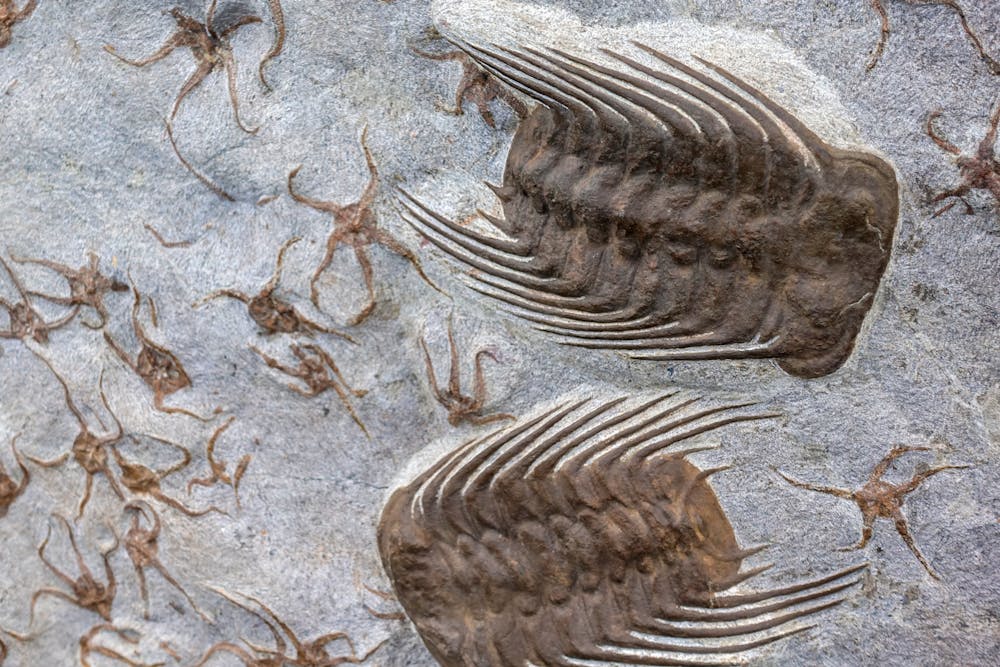
The hard exoskeletons of trilobites have been remarkably preserved.
(Shutterstock)
The evolutionary success of arthropods is an intriguing question that traces back to the beginnings of the Cambrian period, more than 520 million years ago. Sites of exceptional preservation include the 506-million-year-old Burgess Shale in British Columbia. There, the fossil record shows a “burst” of innovation in the first steps of arthropod evolution, with the emergence of many groups that later became extinct.
One of the most common and well-known species at the Burgess Shale is Marrella. Marrellomorphs are characterized by a big spiny shield, one or two pairs of large appendages, and a short multisegmented thorax. Despite the abundance of Marrella fossils, there is no consensus on where marrellomorphs place in the evolution of arthropods.
The segmentation of the head is usually considered a good tool to recognize and reconstruct the evolution of arthropods, but the head of marrellomorphs is nothing like any other arthropods we know of. We know marrellomorphs survived until the Devonian, around 410 million years ago, but only a handful of species have been discovered, with fossils found in Argentina, Morocco and Germany. Finding any new fossil of this group of arthropods, then, is critical to understand what they really were.
The new marrellomorph from Ontario, named Tomlinsonus dimitrii gives us a new piece in the puzzle of this group. While Tomlinsonus dimitrii does not solve the identity of this group, it shows certain morphological and functional similarities with sea spiders.
These present-day relatives of spiders and horseshoe crabs live on seafloors and use their elongated limbs to propel themselves. These limbs are particularly similar to those in Tomlinsonus, and so it is possible that Tomlinsonus followed a similar strategy.
The fossil of the marrellomorph Tomlinsonus dimitri. Tomlinsonus had a shield with four elongated spines bearing smaller spines. This shield covered its head, which had one pair of large legs that resembled stilts.
(Moysiuk, J., Izquierdo-López, A., Kampouris, G., & J. Caron/Journal of Paleontology), Author provided
Whether this has evolutionary implications will depend on further marrellomorph discoveries, as the puzzle of their evolutionary history is still far from its first stages.
Revisiting archives
Soft-tissue fossils require particular environmental conditions for their preservation. As we continue to explore sites of exceptional preservation, we will reveal additional information about the fossil record and fill in some of the evolutionary gaps.
The discovery of Tomlinsonus dimitrii at Brechin shows that even previously known sites can still produce new discoveries. With time and more hands, new discoveries are guaranteed.
In many busy households around the world, it’s not uncommon for children to shout out directives to Apple’s Siri or Amazon’s Alexa. They may make a game out of asking the voice-activated personal assistant (VAPA) what time it is, or requesting a popular song. While this may seem like a mundane part of domestic life, there is much more going on.
The VAPAs are continuously listening, recording and processing acoustic happenings in a process that has been dubbed “eavesmining,” a portmanteau of eavesdropping and datamining. This raises significant concerns pertaining to issues of privacy and surveillance, as well as discrimination, as the sonic traces of peoples’ lives become datafied and scrutinized by algorithms.
These concerns intensify as we apply them to children. Their data is accumulated over lifetimes in ways that go well beyond what was ever collected on their parents with far-reaching consequences that we haven’t even begun to understand.
There are pressing issues that derive from the collection, storage and analysis of sonic data as they pertain to parents, youth and children. Alarms have been raised in the past — in 2014, privacy advocates raised concerns on how much the Amazon Echo was listening to, what data was being collected and how the data would be used by Amazon’s recommendation engines.
Information about acoustic environments (like a noisy apartment) or particular sonic events (like breaking glass) can also be gleaned through “auditory scene analysis” to make judgments about what is happening in that environment.
For example, smart speaker data may be used to create profiles such as “noisy households,” “disciplinary parenting styles” or “troubled youth.” This could, in the future, be used by governments to profile those reliant on social assistance or families in crisis with potentially dire consequences.
There are also new eavesmining systems presented as a solution to keep children safe called “aggression detectors.” These technologies consist of microphone systems loaded with machine learning software, dubiously claiming that they can help anticipate incidents of violence by listening for signs of raising volume and emotions in voices, and for other sounds such as glass breaking.
Monitoring schools
Aggression detectors are advertised in school safety magazines and at law enforcement conventions. They have been deployed in public spaces, hospitals and high schools under the guise of being able to pre-empt and detect mass shootings and other cases of lethal violence.
Halcyon Lawrence, a technical communication scholar, expresses grave concerns about the potential deadly consequences that the use of voice technology alongside emotion recognition software will have on Black and brown people.
We can anticipate that the speech and voices of racialized children and youth will be disproportionately misinterpreted as aggressive sounding. This troubling prediction should come as no surprise as it follows the deeply entrenched colonial and white supremacist histories that consistently police a “sonic color line.”
Sound policy
Eavesmining is a rich site of information and surveillance as children and families’ sonic activities have become valuable sources of data to be collected, monitored, stored, analyzed and sold without the subject’s knowledge to thousands of third parties. These companies are profit-driven, with few ethical obligations to children and their data.
With no legal requirement to erase this data, the data accumulates over children’s lifetimes, potentially lasting forever. It is unknown how long and how far-reaching these digital traces will follow children as they age, how widespread this data will be shared or how much this data will be cross-referenced with other data. These questions have serious implications on children’s lives both presently and as they age.
There are a myriad threats posed by eavesmining in terms of privacy, surveillance and discrimination. Individualized recommendations, such as informational privacy education and digital literacy training, will be ineffective in addressing these problems and place too great a responsibility on families to develop the necessary literacies to counter eavesmining in public and private spaces.
We need to consider the advancement of a collective framework that combats the unique risks and realities of eavesmining. Perhaps the development of a Fair Listening Practice Principles — an auditory spin on the “Fair Information Practice Principles” — would help evaluate the platforms and processes that impact the sonic lives of children and families.
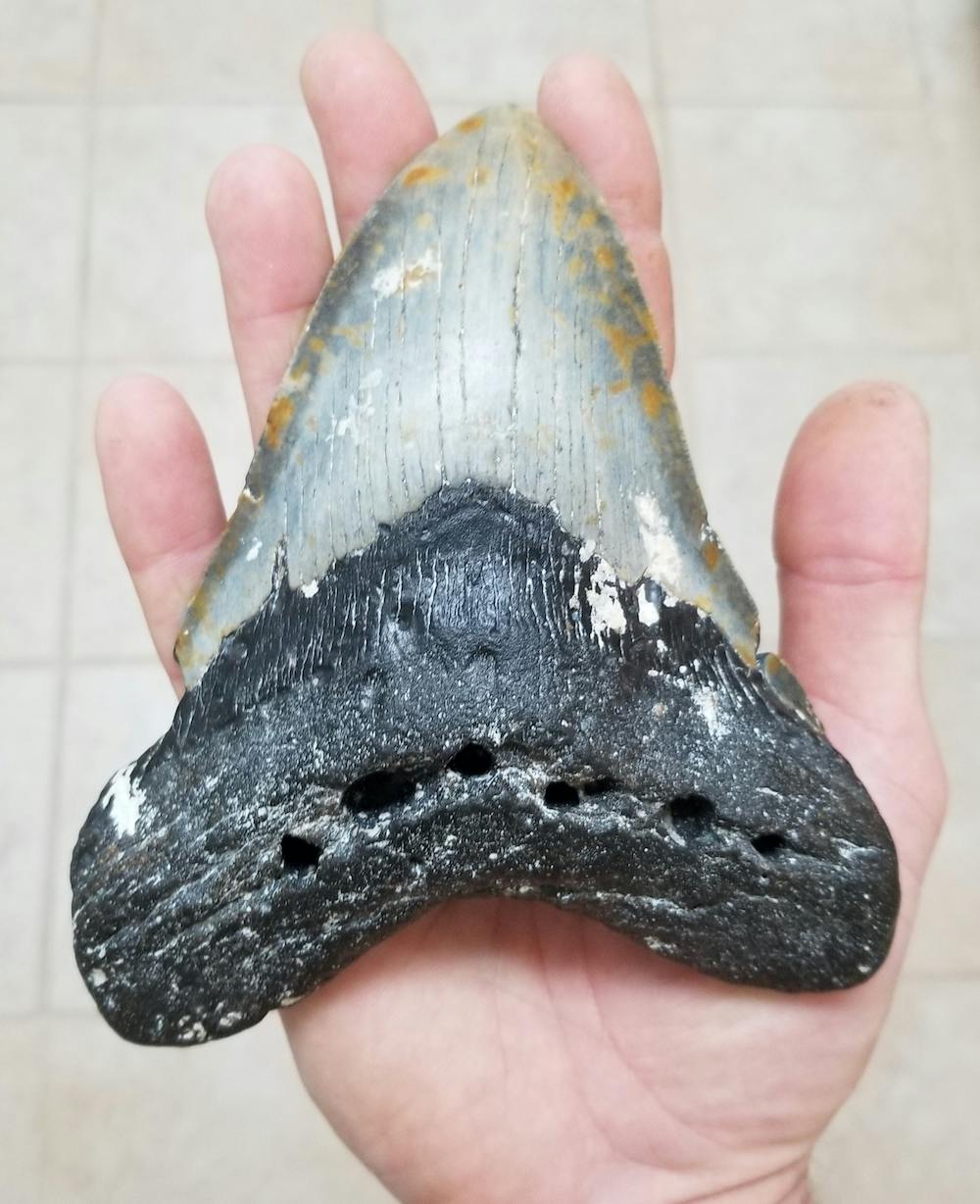
Millions of years ago, giant sharks three times larger than today’s great whites stalked the world’s ocean. They’re long gone now, but occasionally, someone walking on a beach spots an odd triangular shape in the sand. On closer inspection, they realize it’s a fossilized tooth as large as a human hand, with sharp serrated edges. And they have to wonder: What was that beast eating?
These fossilized teeth hold clues to a mystery about a legend of the seas, a mammoth creature that was at the apex of the food chain – and then vanished.
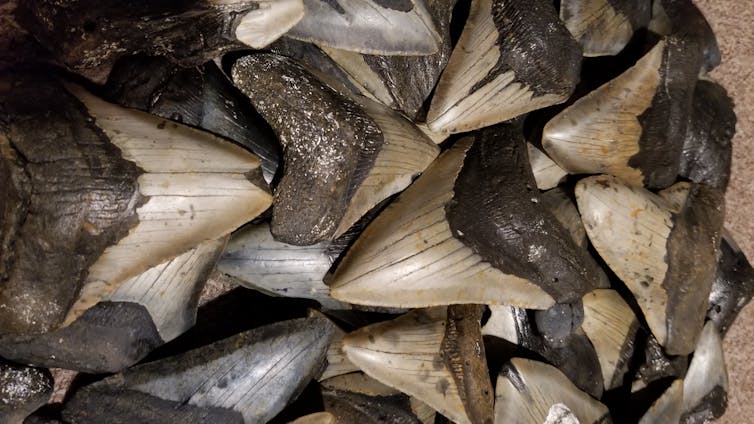
A megalodon tooth found on the North Carolina coast.Harry Maisch
It’s known as the megalodon, believed to be the largest shark species to ever exist. Evidence in the teeth and bite marks found on fossilized bones suggest these ancient sharks were swimming the ocean between 23 million and 3.5 million years ago. Scientists have estimated they reached lengths upwards of 50 feet (15 meters) – longer than a city bus.
The megalodon was the last species of a group of sharks called the megatooth sharks. We study the chemistry of fossils to better understand ancient animals, and while many mysteries remain about megalodon’s life and eventual extinction, its teeth are revealing some answers.
What did ancient sharks eat?
There are tantalizing clues about the diet of ancient sharks in the fossil record.
The shape and structure of their teeth can indicate general eating styles. Broad serrated megalodon teeth are thought to be particularly well adapted to gnawing on marine mammals, while the sharp and pointy teeth of other sharks lend themselves to piercing and tearing fish.
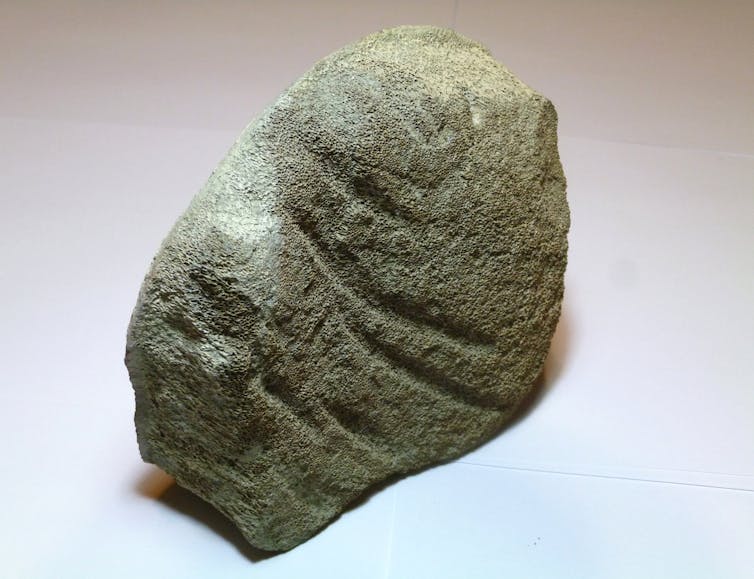
In some exceptional cases, fossil marine mammal bones have been found with the bitemarksof a megalodon. Some sperm whale bones have evidence of megalodon attacks on their foreheads, a part of the whale that would have been rich in fats. Dolphin tailbones have also been found with deep megalodon tooth marks. Each of these incredible fossils offers a snapshot of one megalodon’s meal on one day millions of years ago.
Were marine mammals a part of megalodon’s regular diet, or just a special snack that day? And what else may have fallen prey to this massive shark?
Finding answers in the chemistry of fossil teeth
Using newly developed tools, we have been able to analyze the chemical composition of these fossil teeth, including samples from the United States, western Europe and Japan.
The results, published in two recent studies, tell us about the diet of each ancient shark and about the environment it lived in long before humans walked the Earth.
When animals eat, they acquire nutrients from their meals, including nitrogen and zinc. Because of this, nitrogen and zinc are passed up the food web from prey to predator.
Both nitrogen and zinc have multiple stable isotopes, forms whose atoms contain the same number of protons but different numbers of neutrons. For nitrogen, the ratio of the 15-nitrogen isotope to the 14-nitrogen isotope increases with each step up the food web because animals tend to discard more of the 14-nitrogen isotope in their waste. On the other hand, the ratio of 66-zinc to 64-zinc decreases within animals higher up in the food web.
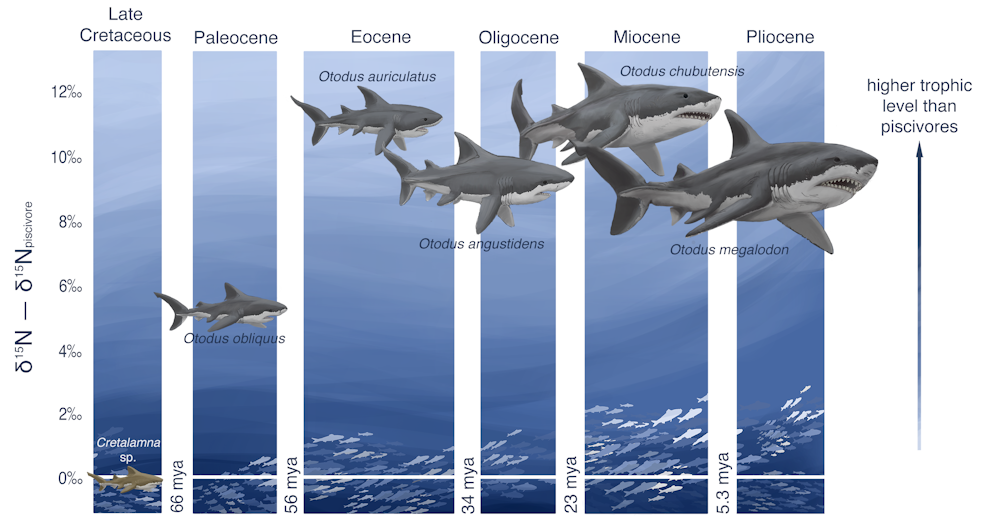
When megalodon and its megatooth ancestors lived, and their position in the food web as apex predators compared with sharks that primarily eat fish. Christina Spence Morgan
Very small amounts of nitrogen and zinc are preserved deep inside the mineral layers of fossil teeth. We can extract and purify these elements from the teeth, measure the isotope ratios, and then estimate the position in the food web, for each ancient shark.
While nitrogen isotopes are often measured in modern protein tissues, these decompose rapidly and cannot be measured in the fossil record. This new method of measuring nitrogen isotopes can analyze the trace amount of nitrogen preserved in the mineral layers of fossil teeth over millions of years. The zinc isotope method is also new; this study marks the first time it has been applied to sharks and fossils more than 86,000 years old.
Together, the isotopes of nitrogen and zinc in fossil teeth tell us about the diet of extinct animals living in ecosystems that vanished millions of years ago. In our studies, we used nitrogen and zinc isotopes to reconstruct the diets of sharks.
Megalodon’s extinction: Competition with the white shark?
Understanding the diet of the megalodon can help us unravel the mystery of its extinction, and the possible ripple effects of its disappearance on marine ecology.
Both measurements show that the megalodon – and its slightly smaller megatooth ancestors – were feeding at an extraordinarily high position in ancient food webs. In fact, at least according to the nitrogen isotopes, they may have been higher than any apex predator existing today.
To be in such a high position they may have been eating now-extinct marine mammals, such as predatory sperm whales. Megalodon might also have been cannibalistic, maybe with larger adults eating juveniles. It’s very likely that the megalodon was a true apex predator, not targeted as prey by any other marine animal.
Megalodon was here. Several of the shark’s giant teeth have been found along the North Carolina coast.Harry Maisch
The emergence of the modern white shark around 5 million years ago has been hypothesized as one factor that could have contributed to megalodon’s extinction.
The isotopes offer conflicting answers. The comparison of nitrogen isotopes between great whites and megalodon from around the same time period placed these predators at different positions in the food web, meaning that they were not competing for the same prey. The zinc isotopes, however, do not reject the competition hypothesis, placing these two sharks at similar positions in the food web instead.
The disappearance of the giant sharks could have been caused by other factors, too, such as temperature changes, the loss of shelf environments due to sea-level fall, or, likely, a combination of influences.
Future research combining both methods may help resolve this conundrum and finally solve the mystery of why the largest shark on Earth vanished.
Michael Griffiths of William Paterson University and Kenshu Shimada of DePaul University contributed to this article.
However, the more we study the cosmos, the more we begin to realize planetary systems like our own might be more of an exception than a rule.
Imagine a system with one gaseous planet, a little larger than Saturn, skimming the surface of its host star on an extremely fast orbit. It’s hellishly hot and glows a dull red, baking in stellar radiation.
Then imagine another giant planet farther out, larger than Jupiter, moving on a distant and highly elongated orbit which makes it look more like a comet than a traditional planet.
It doesn’t sound much like home, does it? Yet that’s what we found.
Introducing the HD83443 planetary system
The story of the HD83443 system begins in the late 20th century, when astronomers began obsessively observing stars similar to the Sun. They were looking for evidence of those stars wobbling back and forth under the influence of unseen planetary companions.
But that’s where the similarities ended. HD83443b is a “hot Jupiter”: a giant gas planet skimming the surface of its host star (which is a little smaller and cooler than the Sun), and completing each lap in less than three Earth days!
For two decades since its discovery, we have continued to monitor the HD83443’s movements. In recent years, we’ve been conducting this work at the University of Southern Queensland’s Mt Kent Observatory.
By combining our observations with others, we discovered a strange new planet in the system, which we describe in a paper published last month.
This world, HD83443c, takes more than 22 years to orbit its host star, and is some 200 times more distant than its hellish sibling. Since HD83443c’s “year” is so long, we needed more than two decades of observations to confirm its existence – by tracking a single lap around its host star.
But what’s really unusual is the eccentricity of its orbit. While the planets in the Solar System follow near-circular orbits, HD83443c follows a much more elongated path reminiscent of comets in our Solar System.
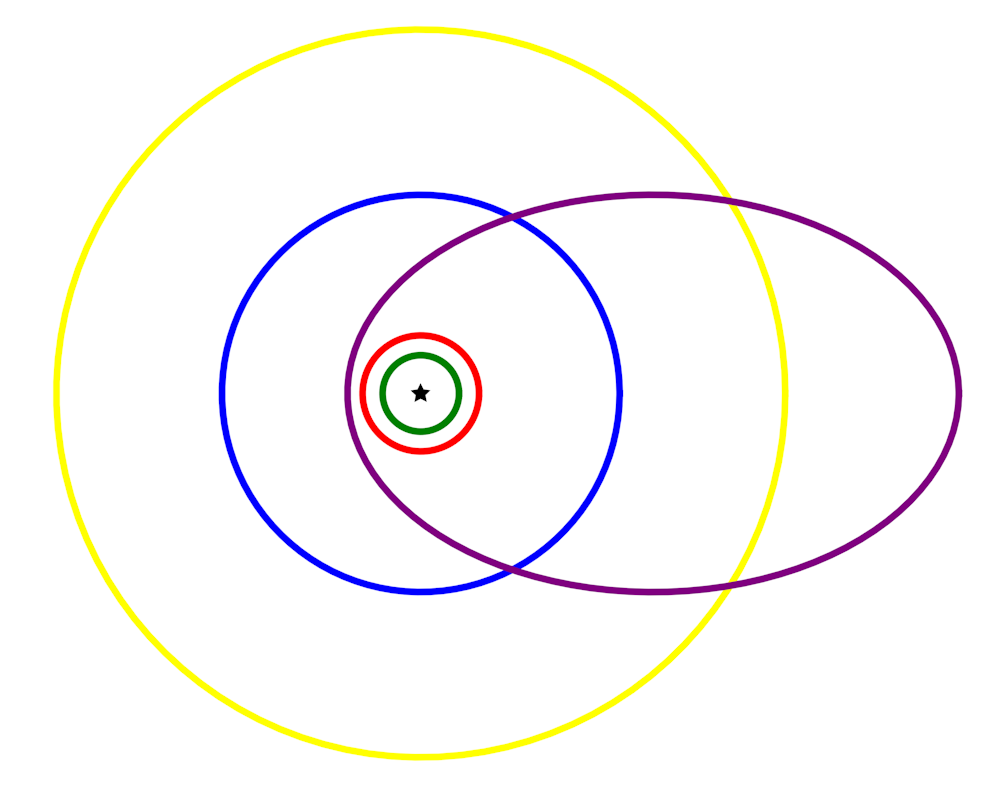
If HD83443c was in the Solar System, it would approach the Sun almost to the orbit of Mars, then swing outwards, ending up between the orbits of Saturn and Uranus, before falling Sunward once again. Color code: purple = HD83443c, green = Earth, red = Mars, blue = Jupiter and yellow = Saturn.
The aftermath of a planetary tango
Planets such as the “hot Jupiter”, HD83443b, are particularly interesting to astronomers as they’re unlike anything close to home. Gas giants such as Jupiter begin their lives far from their host star where ices are abundant.
Those ices allow them to rapidly grow, gaining enough mass to shroud themselves in huge atmospheres.
Unlike the Solar System’s giant planets, as HD83443b grew to maturity, it must have migrated inwards to end up close to its host star. What caused this migration?
Well, over the years, astronomers have found many hot Jupiters. In trying to understand those weird planets, several mechanisms have been proposed to explain their migration – but in most cases, any evidence of the cause of the migration is lost in the distant past.
In the specific case of HD83443b, however, it seems our new discovery might have provided the evidence of the smoking gun. The newly-discovered world, HD83443c, might be the reason its sibling ended up on its current hellish orbit.
Imagine HD83443c and HD83443b first forming in the icy depths of the HD83443 system. They would have been buried in the massive disc of gas and dust surrounding the star, called a “protoplanetary disk”.
As the planets moved through the disc, they fed from it, growing ever more massive, and drifting slowly inward as they interact with the disc around them.
Eventually they came too close together. They didn’t quite collide, but as they swung past one another, their immense gravitational pulls acted like a slingshot, catapulting them both onto new orbits.
HD83443b, the hot Jupiter, was flung inwards onto an orbit that skims the star’s surface at its closest approach, before swinging back outwards towards the initial scene of near collision. The other planet, HD83443c, is flung outwards onto its current elongated path.
Over millennia, something remarkable happened. Every time HD83443b swung close to its host star, its presence raised tides on the star, and in turn the host star caused tides to rise on it. This would have essentially “applied the brakes” to HD83443b’s motion.
This means HD83443b lost a tiny bit of speed each time it swung past the host star. As it flew back outwards again, it failed to travel as far as before and its orbit was slowly circularised. It was dragged inwards until it reached its current tiny, circular orbit – on which it will spend the rest of its life.
HD83443c, however, experienced no such fate. After having been flung outwards during the initial encounter with HD83443b, it remained so distant from the central star that its orbit was never impacted.
Its very slow and elongated orbit is evidence of that initial planetary encounter from when the system was young.
Is there no place like home?
This story is a fascinating one – but the main goal of our ongoing search for alien worlds is to find places much more like home.
We’re using the same tools that led us to HD83443c to find planetary systems like our own – with giant planets on orbits far from their host stars. We may need to gaze out at distance stars for decades at a time, watching their graceful celestial waltz.
We will no doubt find many more surprising systems akin to HD83443, that reveal more about the true variety of planetary systems out there.
This video, by NASA, shows the story of the first 30 years of the Exoplanet Era, and the first 5,000 known exoplanets. Future research will hopefully reveal tens of thousands more – including systems like our Solar System.
Australian scientists are making strides towards solving one of the greatest mysteries of the universe: the nature of invisible “dark matter”.
The ORGAN Experiment, Australia’s first major dark matter detector, recently completed a search for a hypothetical particle called an axion – a popular candidate among theories that try to explain dark matter.
ORGAN has placed new limits on the possible characteristics of axions and thus helped narrow the search for them. But before we get ahead of ourselves …
Let’s start with a story
About 14 billion years ago, all the little pieces of matter – the fundamental particles that would later become you, the planet and the galaxy – were compressed into one very dense, hot region.
Then the Big Bang happened and everything flew apart. The particles combined into atoms, which eventually clumped together to make stars, which exploded and created all kinds of exotic matter.
After a few billion years came Earth, which was eventually crawling with little things called humans. Cool story, right? Turns out it’s not the whole story; it’s not even half.
People, planets, stars and galaxies are all made of “regular matter”. But we know regular matter makes up just one-sixth of all the matter in the universe.
The rest is made of what we call “dark matter”. Its name tells you almost everything we know about it. It doesn’t emit light (so we call it “dark”) and it has mass (so we call it “matter”).
If it’s invisible, how do we know it’s there?
When we observe the way things move in space, we find time and again that we can’t explain our observations if we consider only what we can see.
Spinning galaxies are a great example. Most galaxies spin at speeds that can’t be explained by the gravitational pull from visible matter alone.
So there must be dark matter in these galaxies, providing extra gravity and allowing them to spin faster – without parts being flung off into space. We think dark matter literally holds galaxies together.
The ‘Bullet Cluster’ is a massive cluster of galaxies which has been interpreted as being strong evidence for the existence of dark matter.
So there must be an enormous amount of dark matter in the universe, pulling on all the things we can see. It’s passing through you, too, like some kind of cosmic ghost. You just can’t feel it.
How could we detect it?
Many scientists believe dark matter could be composed of hypothetical particles called axions. Axions were originally proposed as part of a solution to another major problem in particle physics called the “strong CP problem” (which we could write a whole article about).
Anyway, after the axion was proposed, scientists realised the particle could also make up dark matter under certain conditions. That’s because axions are expected to have very weak interactions with regular matter, but still have some mass: the two conditions needed for dark matter.
So how do you go about searching for axions?
Well, since dark matter is thought to be all around us, we can build detectors right here on Earth. And, luckily, the theory that predicts axions also predicts that axions can convert into photons (particles of light) under the right conditions.
This is good news, because we’re great at detecting photons. And this is exactly what ORGAN does. It engineers the correct conditions for axion–photon conversion and looks for weak photon signals – little flashes of light generated by dark matter passing through the detector.
This kind of experiment is called an axion haloscope and was first proposed in the 1980s. There are a few in the world today, each one slightly different in important ways.
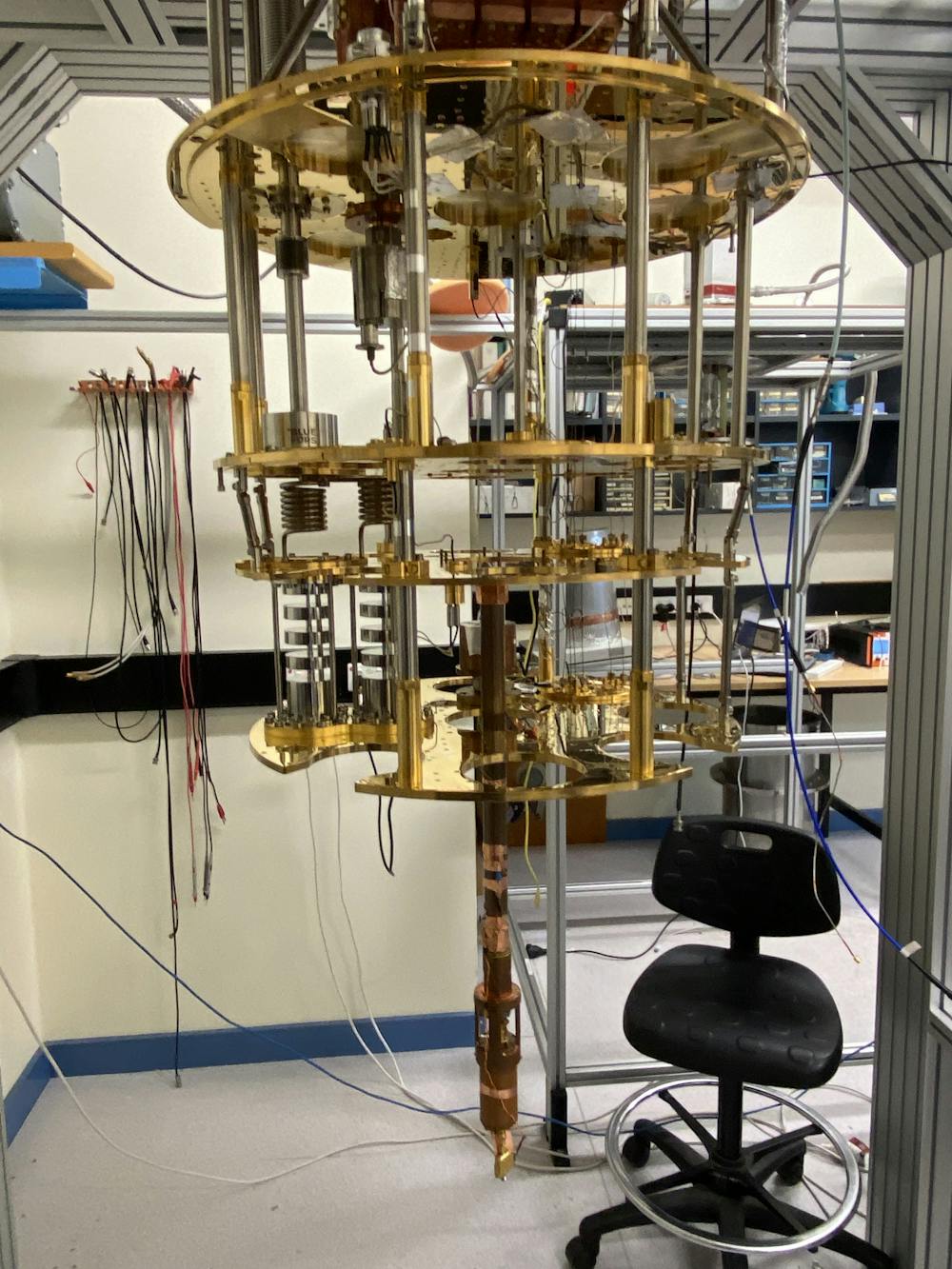
The ORGAN Experiment’s main detector. A small copper cylinder called a ‘resonant cavity’ traps photons generated during dark matter conversion. The cylinder is bolted to a ‘dilution refrigerator’ which cools the experiment to very low temperatures.
Author provided
Shining a light on dark matter
An axion is believed to convert into a photon in the presence of a strong magnetic field. In a typical haloscope, we generate this magnetic field using a big electromagnet called a “superconducting solenoid”.
Inside the magnetic field we place one or several hollow chambers of metal, which are meant to trap the photons and cause them to bounce around inside, making them easier to detect.
However, there is one hiccup. Everything that has a temperature constantly emits small random flashes of light (which is why thermal imaging cameras work). These random emissions, or “noise”, make it harder to detect the faint dark matter signals we’re looking for.
To work around this, we’ve placed our resonator in a “dilution refrigerator”. This fancy fridge cools the experiment to cryogenic temperatures, about −273°C, which greatly reduces the noise.
The colder the experiment is, the better we can “listen” for faint photons produced during dark matter conversion.
Targeting mass regions
An axion of a certain mass will convert into a photon of a certain frequency, or colour. But since the mass of axions is unknown, experiments must target their search to different regions, focusing on those where dark matter is considered more likely to exist.
If no dark matter signal is found, then either the experiment is not sensitive enough to hear the signal above the noise, or there’s no dark matter in the corresponding axion mass region.
When this happens, we set an “exclusion limit” – which is just a way of saying “we didn’t find any dark matter in this mass range, to this level of sensitivity”. This tells the rest of the dark matter research community to direct their searches elsewhere.
ORGAN is the most sensitive experiment in its targeted frequency range. Its recent run detected no dark matter signals. This result has set an important exclusion limit on the possible characteristics of axions.
This is the first phase of a multi-year plan to search for axions. We’re currently preparing the next experiment, which will be more sensitive and target a new, as-yet-unexplored mass range.
But why does dark matter matter?
Well, for one, we know from history that when we invest in fundamental physics, we end up developing important technologies. For instance, all modern computing relies on our understanding of quantum mechanics.
We never would have discovered electricity, or radio waves, if we didn’t pursue things that, at the time, appeared to be strange physical phenomena beyond our understanding. Dark matter is the same.
Consider everything humans have accomplished by understanding just one-sixth of the matter in the universe – and imagine what we could do if we unlocked the rest.
With our planet heating up, we all need help coping with increasing temperatures in our day-to-day lives. The UK provisionally recorded its highest ever temperature, 40.3℃, on July 19 2022, and records are being broken across the world.
In 2021, I said that it was very likely that temperatures would reach 40℃ in the UK within the next 10 years. It was clear then how unprepared many parts of the world were for these spiralling temperatures.
But, there are lots of ways to try and adapt to extreme heat. Here are some suggestions that temperate countries can learn from hotter ones.
1. Midday break
The European siesta has its origins in Spain where field workers took a break to escape the heat of the day, but it also has links back to the Romans in Italy, who also took some time out in the afternoon. Although 60% of Spaniards no longer take a siesta, taking a break in the middle of the day is practised by many countries globally. This avoids working in the hottest part of the day. Allowing time for a short nap of 30 minutes could also benefit our health and wellbeing and give us energy for the rest of the day.
2. Cool clothes
There are some accounts of European explorers encountering the dress of those in more tropical regions and being surprised at the loose fitting nature of people’s clothing.
Switch to running in the evening if the temperatures get hotter.
Denis Belitsky/Shutterstock
What we wear has a big influence on our ability to be able to cool down, and loose, light-coloured clothes help. Clothing changes how sweat is lost from the body and how we gain or loose heat from factors like the wind and the sun.
Examples that work well can be found around the world. The thawb or tobe is a traditional item of clothing from the United Arab Emirates and other parts of the Middle East and North Africa. It is thought that the air flow around this garment cools the wearer.
Exercise is important to keep us healthy. For those into running outside, learn from hotter countries, such as Australia, where the recommendation is to run in the evening or morning, because they are the coolest parts of the day.
Pregnant women are one group that are thought to be vulnerable to extreme heat, and at one point were recommended not to exercise in hot countries. But there’s some evidence that pregnant women can exercise for up to 45 minutes at a temperature of up to 32℃ with a humidity (the amount of moisture in the air) of 40% with low risk.
4. Building design
Ventilation is a key part of building design to promote cool air flow in hot weather. A good example is the Mactan Cebu international airport in the Philippines, with its high ceilings and low eaves. The open, undulated design gives maximum space for air to flow around the building and allows hot air to rise.
In Gulf countries, traditional buildings often have small alleys around the outside so that the smallest area possible is exposed to the sun. In addition, large windows are very rarely found in traditional buildings in the Middle East to keep temperatures low, and let less sun in.
Other elements can be used in building design. In some southern European countries, for instance, you see shutters on the outside of windows. Shutters help to absorb sunlight cooling the inside. In cooler countries windows often open outwards, so shutters or blinds would have to be added inside buildings, until home design changes.
Although these practices from hotter countries can be used by cooler countries to reduce the effect of heat, it is important to remember that heatwaves (a period of three or more days in a region’s warm season, or any when in the tropics) occur in hot regions too. Recent record temperatures in India and Pakistan resulted in crops dying and increased death rates.
With this in mind, the world needs a global early warning system for heatwaves and investment in infrastructure, as well as continuing to work towards tackling climate change.
The New York patient reportedly contracted a form of polio that can be traced back to the live, but weakened, poliovirus used in the oral polio vaccine. This version of the vaccine has not been used in the U.S. since 2000. Health officials said the virus affecting the male patient, who has muscle weakness and paralysis, likely originated somewhere overseas, where oral vaccines are still administered.
William Petri is an infectious disease specialist and chair of the World Health Organization’s Polio Research Committee. Here he explains what vaccine-derived poliovirus is and why the inactivated polio vaccine administered in the U.S. today can’t cause it.
What are the two kinds of polio vaccine?
Vaccines introduce a harmless version of a pathogen to your body. The idea is that they train your immune system to fight off the real germ if you ever encounter it.
The oral polio vaccine, originally developed by Albert Sabin, uses a live but weakened poliovirus that one swallows in a sugar cube or droplet. Scientists weaken – or attenuate – the virus so it can no longer cause disease.
The other kind of polio vaccine was originally developed by Jonas Salk. It contains inactivated, dead virus. It is administered by an injection.
In the U.S., children receive the inactivated polio vaccine at 2, 4 and 6 months of age. It provides nearly complete protection from paralytic polio.
A boy in Pakistan receives a dose of the oral polio vaccine.
The weakened form of the live virus in the oral vaccine cannot cause disease. However, because the vaccine is given orally, the weakened virus is excreted in the feces and can spread from someone who is vaccinated to their close contacts. If the weakened virus circulates person to person for long enough, it can mutate and regain its ability to cause paralysis.
This is an exceedingly rare occurrence. With more than 10 billion doses of the oral polio vaccine administered since 2000, there have been fewer than 800 cases of vaccine-derived polio reported.
Apparently, the current patient in New York was somehow exposed to a mutated poliovirus that had been transmitted after vaccination overseas. Earlier this summer, routine surveillance spotted vaccine-derived poliovirus in London’s sewage system, but no cases have been reported there.
Why use the oral vaccine anywhere if it comes with this risk?
There’s a positive aspect to the fact that the weakened live virus can circulate in the community once oral vaccine recipients shed it in their feces. Traveling a feces-to-oral route, it can help induce immunity even in people who weren’t directly vaccinated. The oral polio vaccine is also cheaper and easier to administer than inactivated polio vaccines.
Most importantly, the live-virus vaccine stops transmission of wild poliovirus in a way that the inactivated-virus vaccine does not. The eradication of polio in the Americas, Europe and Africa has been accomplished solely through the use of the live oral vaccine. Once polio has been wiped from a continent, then it is safe to stop using the oral live vaccine and use only the inactivated vaccine, which does prevent disease in recipients and does not pose the rare risk of vaccine-derived paralytic polio.
WHO: Polio Eradication – Reaching Every Last Child.
How close is the world to eradicating polio?
Thanks to tremendous global effort, two of the three viruses that cause polio have been eradicated. The world is now on the verge of eradicating the final one, wild poliovirus 1 (WPV1).
Today endemic polio is found only in Pakistan, with 12 cases of paralytic polio so far in 2022, and Afghanistan, with just one case this year. Africa has two cases, imported from overseas, which are being contained by additional vaccination campaigns.
Once wild poliovirus has been eradicated from the planet, vaccination efforts may be able to switch to the inactivated polio vaccine, eliminating the risk of any future vaccine-derived cases.
Sun lotion, insect repellant, and the Sharktivity app are this summer's must-have beach accessories along the US East Coast as human-shark encounters increase.
Ironically, conservation wins for vulnerable species might be behind the unfortunate uptick, say experts, while there might also be a link to climate as the apex predators' prey move to new waters.
Every summer, great whites move up the Atlantic coast of the United States, toward New England, their number peaking between August and October.
"There's a general increase in the population that we think is the population rebounding after being protected," Gregory Skomal, a senior fisheries scientist for the state of Massachusetts, told AFP.
Around 300 of the animals have been tagged over the years, with roughly a hundred or so passing through the waters around Cape Cod every year.
The iconic movie "Jaws" was shot in this region, and the creatures are a major tourism draw, adorning baseball caps and t-shirts. On the flipside, however, there have already been temporary beach closures this year after confirmed sightings close to shore.
A major part of the reason is their main prey, seals, are also rebounding thanks to increased protections.
"If you have more sharks feeding close to land and you have more people swimming, the chances for those kinds of negative interactions increases," said Skomal.
Enter the Atlantic White Shark Conservancy Sharktivity app, which was developed with input from Massachusetts wildlife officials to provide information on shark sightings from researchers, safety officials, and user reports.
Surveillance patrols
In New York state, the governor has just announced additional surveillance patrols, including via drones and helicopters.
On the tourist beaches of Long Island, half a dozen shark bites have already come to light, after three years of none at all.
Here, great whites are less likely to be the culprits than other species of shark that operate in the region, in particular tiger sharks, sand tiger sharks and bull sharks.
Nick Whitney, a senior scientist at the New England Aquarium, believes the increasing encounters here might be linked to the sharks' bait fish -- menhaden, also known as porgies or bunkers, recovering.
This might be because of cleaner waters off New York and New Jersey, "but it's tricky to figure out how much of it is increasing populations or just populations moving around as a result of changing ocean conditions from climate change."
But if things can thus vary greatly from one year to another on a local level, the global level remains steady at around 75 shark attacks recorded each year, said Gavin Naylor, director of a research program on sharks at the University of Florida.
This follows a brief drop to around 60 during the two first years of the Covid-19 pandemic.
Annual global deaths are around five. In the past twenty years, only two deaths have been reported north of Delaware in the United States, in Cape Cod in 2018, and in Maine in 2020.
But in the future, it is reasonable to think that the number of victims will increase.
"We are going to get more fatalities. There's more white sharks, the probability is going to increase," predicts Naylor, even though the trend isn't yet statistically significant.
Surfers, who venture farther into the water, accounted for half of unprovoked attacks in 2021. Farther south, Florida, with its many tourist beaches and tropical climate, is still where 60 percent of US and 40 percent of world attacks occur.
Take precautions
Sharks are far from the bloodthirsty beasts sometimes portrayed in movies.
Studies have shown that they can mistake surfers or swimmers for their usual prey -- notably white sharks, which have rather poor eyesight.
"With so many people on a global scale in the water, if sharks preferred to feed on prey upon humans, we would have tens of thousands of attacks each year," said Skomal.
With climate change, the expert expects that the increase in ocean temperatures will gradually lengthen the season during which sharks are present in the northern United States.
So what can be done to limit the risks? People should download the Sharktivity app to track sightings.
"Another thing we tell people is just to be aware of your surroundings," said Whitney. Look around for birds flying around schools of baitfish, for example.
Don't swim alone, stick to areas with cell phone coverage, and if bitten, the real danger is bleeding out, so it's important to get to shore and control the bleeding until help arrives.
CHICAGO -- More than a dozen images of butterflies adorn the front of Claudia Galeno-Sanchez’s home in the Pilsen neighborhood. There are monarch butterflies spreading their wings and many other colorful ones sprinkled in between. The small house stands out from the tall buildings on the block. It is filled with milkweed plants and other flowers that have helped raise monarchs for nearly five years. Galeno-Sanchez and her husband and two children decided to create a butterfly sanctuary after learning that they could help raise and preserve the beloved species in the city. Though Galeno-Sanchez...
Florida is facing several disease outbreaks — COVID, monkeypox, dengue fever. But meningococcal disease is now on the minds of health experts, too. So you may be wondering: What should you know and what can you do about it? In a discussion with reporters, Dr. Ulyee Choe, statewide medical director for the Florida Department of Health, compared the adverse effects of monkeypox with meningococcal disease that can lead to fatal meningitis. He didn’t like what he was seeing in the Sunshine State. “Meningococcal disease, to some degree, concerns me more given the severity of the disease,” Choe said...
Is it tumbleweed? A piece of fishing line? Spaghetti?
A tangled object discovered by NASA's Mars Perseverance rover has intrigued space watchers, leaving some musing tongue-in-cheek about the quality of Italian dining on the Red Planet.
But the most plausible explanation is more prosaic: it's likely remnants of a component used to lower the robotic explorer to the Martian surface in February 2021.
"We have been discussing where it's from, but there's been speculation that it's a piece of cord from the parachute or from the landing system that lowers the rover to the ground," a spokesman for NASA's Jet Propulsion Laboratory told AFP.
"Note that we don't have confirmation that it's one or the other," he added.
The bundle of debris was first spotted July 12 by the rover's front left hazard avoidance camera -- but when Perseverance returned to the same spot four days later, it was gone.
It was probably carried away by wind, like a piece of a thermal blanket that might have come from the rocket-powered landing system, which was spotted last month.
The accumulating trash left behind by Perseverance is considered a small price to pay for the rover's noble scientific goals of searching for biosignatures of ancient microbial life forms.
And these items may one day become valuable artifacts for future Mars colonists.
"In a hundred years or so Martians will be eagerly collecting up all this stuff and either putting it on display in museums or making it into 'historical jewelry,'" tweeted amateur astronomer Stuart Atkinson.