Transcript
This is a rush transcript. Copy may not be in its final form.AMY GOODMAN: This is Democracy Now!, democracynow.org, The War and Peace Report. I’m Amy Goodman.
This week NASA released the first images from its new flagship James Webb Space Telescope, the JWST, revealing an unprecedented view of the cosmos, from galaxies that formed just a few hundred million years after the Big Bang to the births of stars in vast nebulas of gas and dust.
The telescope is named after James Webb, who led NASA during the '60s in the run-up to the Apollo moon landings. Earlier this year, NASA administrator Bill Nelson rejected a petition signed by over 1,200 astronomers and astrophysicists, demanding a change to the telescope's name amidst new revelations about how Webb helped to purge NASA of LGBTQ+ workers as part of federal policy. We’ll have more on that coming up.
But first, we want to turn to the science coming from the JWST, which is already revolutionizing the fields of astronomy and cosmology.
Dr. Katie Mack joins us. She’s a theoretical astrophysicist and the Hawking chair in cosmology and science communication at the Perimeter Institute for Theoretical Physics in Canada. She’s author of The End of Everything (Astrophysically Speaking).
Welcome to Democracy Now!, Dr. Katie Mack. These pictures have been spectacular, but so many of us don’t know what we’re looking at. So, if, in very lay terms, you can explain what was released this week?
KATIE MACK: Sure, yeah. So, the pictures that were released this week are really some astonishing versions of the range of things that this telescope is able to do. So, it got a deep field looking deep into the cosmos, the farthest reaches of the cosmos, very, very distant galaxies. It got a picture of interacting galaxies, galaxies that are crashing into each other, to show how this telescope is able to tease out the details of the gas and dust that star is forming. And it gave us images of a couple of nebulae, one where stars are forming, newborn stars are forming out of the gas and dust, and one where the remains of a dying star are sort of blowing up this bubble in space. And both of those are also spectacular pictures that we’re going to learn a lot from when trying to understand the process of stellar death and stellar birth.
AMY GOODMAN: Can you explain how it is we have gotten these pictures, how the JWST is different from the Hubble Space Telescope, its predecessor?
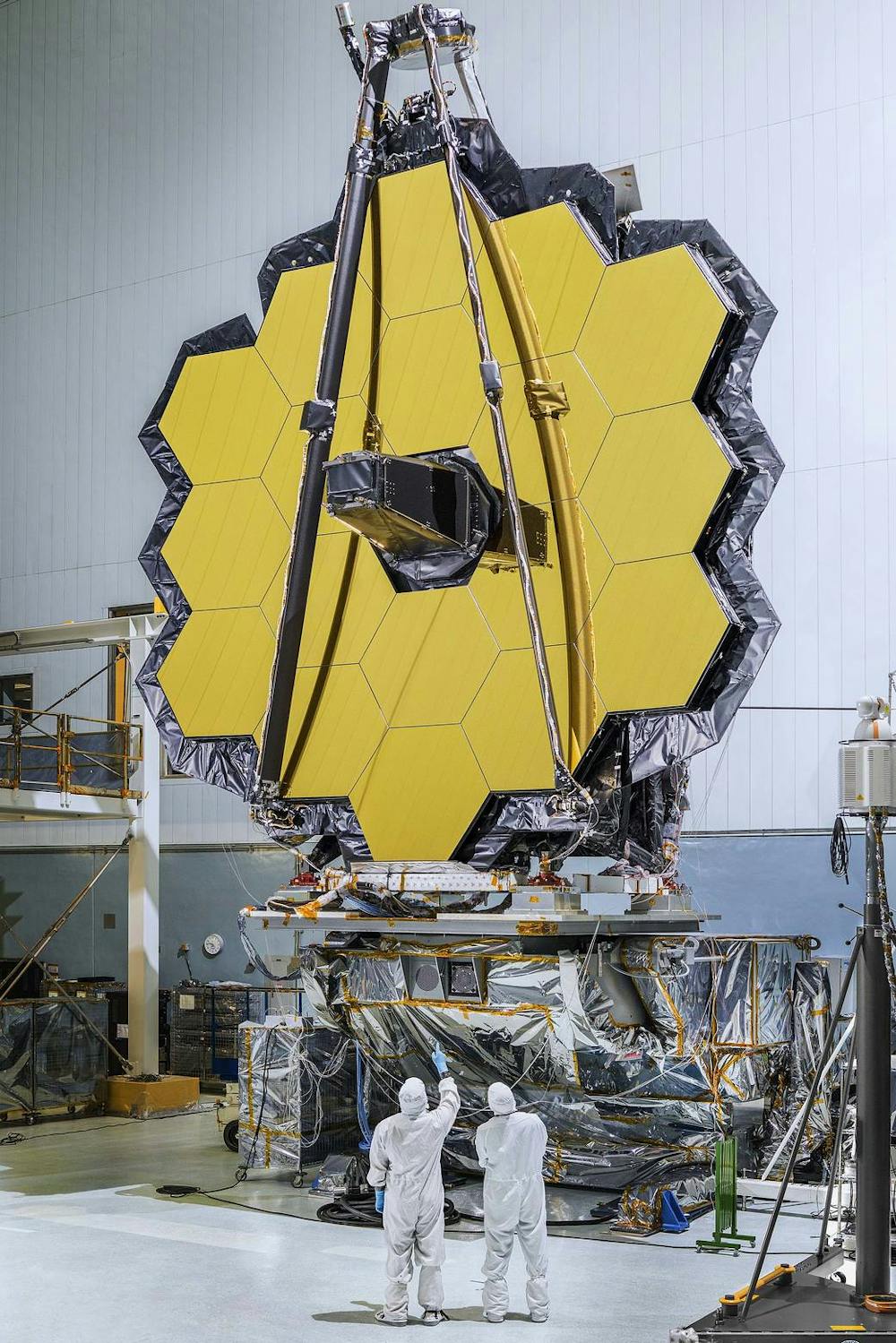
KATIE MACK: Yeah. So, it’s a lot bigger, for one thing. The mirror is a lot bigger. So, whereas the Hubble Space Telescope had a mirror of about two-and-a-half meters in diameter, this one has a mirror of something like six-and-a-half meters in diameter. So it’s a much bigger mirror, so that means it collects more light.
And it also sees in a different kind of light. So, the Hubble Space Telescope would give us pictures in visible light and some infrared light. And this telescope, JWST, is all infrared, so it shows us light that’s a longer wavelength than we can see with our eyes, but that allows us to see farther into the universe, and it allows us to see features of astronomical objects that you really can’t see with ordinary light. So it allows you to kind of look through dust and gas to see the stars forming inside these dust clouds, and it allows us to see some of the galaxies that are so far away that their light has taken billions of years to reach us, and that means that we can see galaxies that were forming in the very, very early universe. And that’s also tremendously exciting.
AMY GOODMAN: Let’s turn to the first full-color image returned by the telescope. And for our radio audience, you can go to our website, democracynow.org, but I know that Dr. Mack will be very descriptive in explaining. You have, on Monday, President Biden unveiling this unprecedented view of the cosmos, known as a “deep field” image, as you’ve said, showing these thousands of galaxies, some 13 billion years old, formed a few hundred million years after the universe formed in the Big Bang. And if you can even explain the Big Bang? But as we see these images, describe that first picture.
KATIE MACK: Yeah. So, the first picture, it’s an image of a cluster of galaxies, so that’s a bunch of galaxies that are gravitationally bound to each other, they’re orbiting each other. So, each of these galaxies is a collection of stars and gas and dust, you know, like our own Milky Way galaxy. And those are sort of swirling around each other in space. And then, behind that cluster of galaxies, there is — you can see sort of the background of the distant galaxies far behind that. So, there’s the cluster of galaxies, and then all around it are these little colored dots and smudges that are very, very distant galaxies. So, what’s happening is, because we’re looking so far into the distance, we’re looking back in time, because light takes time to travel. And so, the farther away we look, the farther back in time we’re looking. And so we’re looking at things that are so far away that they’re almost at the time of the Big Bang.
So, the Big Bang was an event that happened in the early universe that sort of started the universe. We have really good reason to believe that the beginning of the universe, the universe was hot and dense and kind of full of plasma and sort of glowing with heat. And then, over time, it expanded, and that plasma cooled, and then there was a lot of hydrogen gas, and then that gas came together and started to form stars and galaxies and so on. And we’re able to see some of the first galaxies that formed, by looking at an image like this at really deep field, looking far, far into the distance. We can see some of those first galaxies.
And it’s even better because, because this image has a galaxy cluster in it, that galaxy cluster has so much mass, has so much matter, that it actually distorts the space that it’s in. It bends the space that it’s in. And that means that it distorts the images of some of those background galaxies. And so we can see these, like, arcs around the cluster in the center of the image, and those arcs are the distorted view of very distant galaxies that are behind the cluster. So we’re actually seeing behind the cluster, and it’s magnifying and distorting the images of these background galaxies. And that actually gives us an extra boost to be able to see even more distant things, because of this magnification effect called gravitational lensing.
So, it’s an amazing image with so just much in it, with all of these very distant galaxies. And astronomers are going to spend a long time analyzing each of those galaxies and learning about how those galaxies formed and sort of how this amazing diversity of galaxies that exists in the universe, how those came to be.
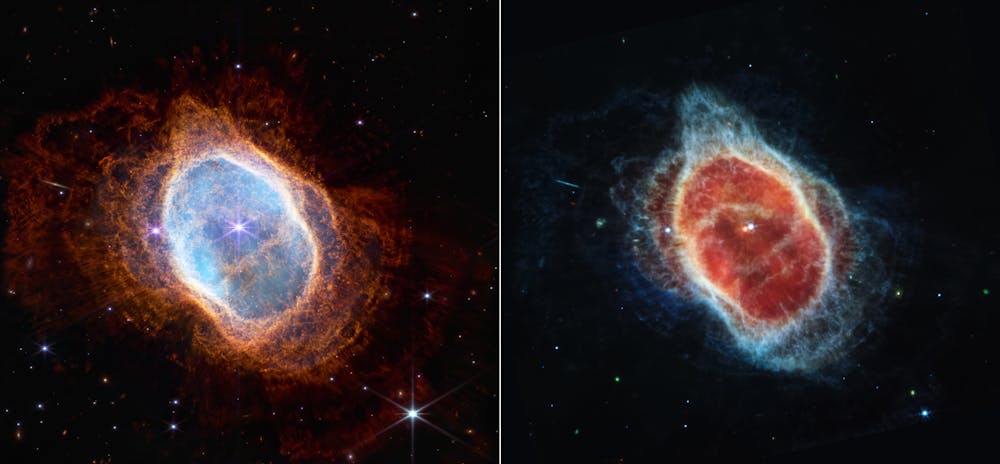
AMY GOODMAN: So, another image from the new telescope shows the Southern Ring Nebula. Unlike the deep field image, which shows the most distant galaxies ever observed, this image is of something much closer to home, inside our own Milky Way galaxy, still incredibly distant at like 2,000 light years from Earth.
KATIE MACK: Yeah.
AMY GOODMAN: And again, this is a planetary nebula, that ring of gas and dust you describe surrounding the core of a dying star that can no longer sustain nuclear fusion. Tell us what it teaches about the origin of our own solar system and the chemical elements that make us all up and everything around us, not to mention the fate of our sun.
KATIE MACK: Yeah. So, this is an amazing image because it shows that kind of bubble that’s produced when a star is dying, a star like our sun. When a star like our sun is dying, it sort of blows off layers of gas. It blows off its atmosphere in these layers and kind of creates this bubble of gas and dust around it. And that’s what we see in this image. We actually see — with this telescope, we’re able to see that it’s a double star system. One of the stars is dying, and the other one is still kind of burning. And this telescope is so powerful that it’s actually able to distinguish those two stars in the center.
But it’s a beautiful view of, as you say, the future of our sun, because our sun is a star that’s going to blow off its outer layers, going to create a planetary nebula like this. It’s called a planetary nebula. It’s not anything to do with planets, but it’s a historical thing that it’s called that. And our sun, when it eventually dies, will sort of blow out these layers and sort of illuminate a sort of pocket of the universe.
And so, the nice thing about these images is, because we have this infrared information, we have many different sort of frequencies of light we can look at, we can really examine what that gas is made of and learn about what the atmosphere of the star was when it blew out all those layers, and learn about sort of how it’s been moving around and what that process was like as it was dying. So, it’s a really rich image.
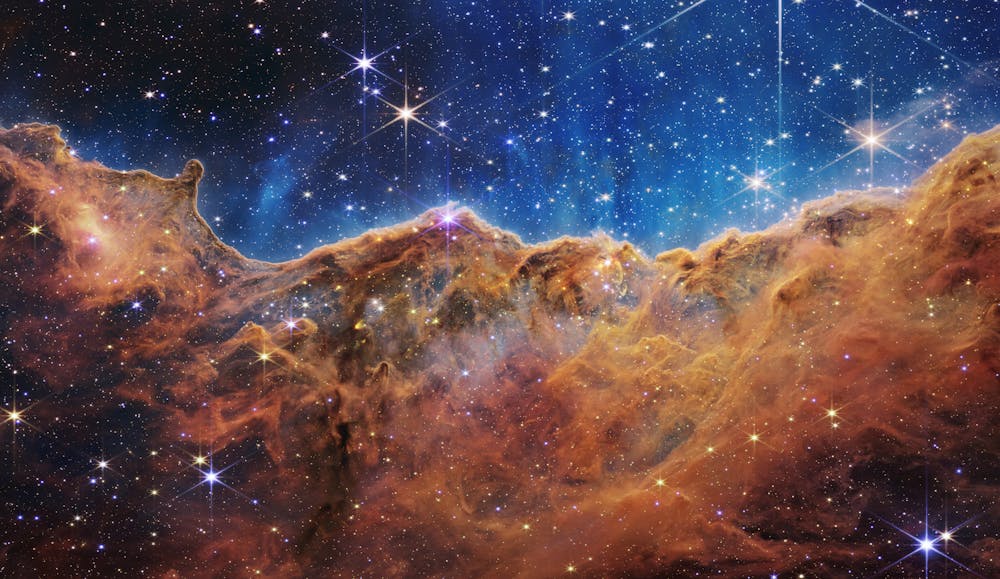
AMY GOODMAN: And what about — well, one of the most beautiful of the first images of this new telescope has been dubbed Cosmic Cliffs. It’s the Carina Nebula, a gigantic cloud of gas and dust several thousand light years away in our own Milky Way galaxy, the Hubble telescope making this nebula famous a generation ago, now the new telescope imaging it with unprecedented clarity using the infrared part of the spectrum, showing it contains hundreds of previously hidden stars.
KATIE MACK: Yeah.
AMY GOODMAN: Can you talk about this, and our own sun born in a stellar nursery like the ones we’re seeing in this image?
KATIE MACK: Yeah, this really is an amazing image, and it’s one, I think, that has emotionally affected a lot of people, because, yeah, you are seeing a stellar nursery. You’re seeing these clouds of gas and dust where stars form. So, I mentioned before that, you know, the early universe was a bunch of hydrogen, and then stars started to form. In the present-day universe, stars also form in clouds of gas and dust, in things called nebulae. In this case, this is a star-forming nebula.
And so, you can see in this image there’s a sort of area of a bunch of gas with these sort of tendrils of gas and dust, and then above that in the picture is a kind of blue glow. And what’s happening there is there are some really bright stars above that are kind of irradiating the gas below and kind of carving out these cliffs, these sort of features in that gas. And the amazing thing about what we see with the JWST is that we can actually see through that gas and dust, and we can see the baby stars being born.
And so, we can actually essentially watch the formation of stars, because we have so many stars in this picture. It’s such a large image with so much in it, so many individual stars being born, so many little pockets of gas, that we can kind of watch the progress of stars forming. And that, again, it really does tell us something about, you know, how our star formed. Our star formed in a cloud of gas and dust in the same kind of way. It might not have looked exactly like this, but it was the same kind of process, where there was the cloud of gas and dust, and it came together, and gravity pulled it together, and then it sort of ignited. And so, we can watch that process by looking at this picture.
AMY GOODMAN: Dr. Mack, we just have 20 seconds before we go to our next guest, another astronomer, but I wanted to ask you: Could this telescope show us the first — be the first scientific instrument to detect life elsewhere in the universe?
KATIE MACK: Well, that’s a great question. We’re not sure, but one of the things that it can do — and another thing that I didn’t get a chance to talk about — is it can take the spectra of exoplanet atmospheres, meaning it can look at the gas in the atmospheres of planets around other stars. And there’s a chance that it might find signatures consistent with life in the atmospheres of other stars. So, we have to stay tuned. It’s not entirely clear how well we’ll be able to know what kind of gases life makes, but we can tell what the atmospheres of other planets might have in them. And we saw one example of an exoplanet atmosphere in this first release, so it’s a very exciting prospect.
AMY GOODMAN: Well, Dr. Katie Mack, I want to thank you for being with us, Stephen Hawking chair in cosmology and science communication at the Perimeter Institute for Theoretical Physics in Canada, joining us from Waterloo there.
KATIE MACK: Thank you.