And not all of them were modern humans.
The tip of the spear
500,000 years ago in southern Africa, primitive Homo sapiens first bound stone blades to wooden spears, creating the spearpoint. Spearpoints were revolutionary as weaponry, and as the first “composite tools” – combining components.
The spearpoint spread, appearing 300,000 years ago in East Africa and the Mideast, then 250,000 years ago in Europe, wielded by Neanderthals. That pattern suggests the spearpoint was gradually passed on from one people to another, all the way from Africa to Europe.
Catching fire
400,000 years ago hints of fire, including charcoal and burnt bones, became common in Europe, the Mideast and Africa. It happened roughly the same time everywhere – rather than randomly in disconnected places – suggesting invention, then rapid spread. Fire’s utility is obvious, and keeping a fire going is easy. Starting a fire is harder, however, and was probably the main barrier. If so, widespread use of fire likely marked the invention of the fire-drill – a stick spun against another piece of wood to create friction, a tool still used today by hunter-gatherers.
Curiously, the oldest evidence for regular fire use comes from Europe – then inhabited by Neanderthals. Did Neanderthals master fire first? Why not? Their brains were as big as ours; they used them for something, and living through Europe’s ice-age winters, Neanderthals needed fire more than African Homo sapiens.
The axe
270,000 years ago in central Africa, hand-axes began to disappear, replaced by a new technology, the core-axe. Core-axes looked like small, fat hand-axes, but were radically different tools. Microscopic scratches show core-axes were bound to wooden handles – making a true, hafted axe. Axes quickly spread through Africa, then were carried by modern humans into the Arabian peninsula, Australia, and ultimately Europe.
Ornamentation
The oldest beads are 140,000 years old, and come from Morocco. They were made by piercing snail shells, then stringing them on a cord. At the time, archaic Homo sapiens inhabited North Africa, so their makers weren’t modern humans.
Beads then appeared in Europe, 115,000-120,000 years ago, worn by Neanderthals, and were finally adopted by modern humans in southern Africa 70,000 years ago.
Bow and arrow
The oldest arrowheads appeared in southern Africa over 70,000 years ago, likely made by the ancestors of the Bushmen, who’ve lived there for 200,000 years. Bows then spread to modern humans in East Africa, to south Asia 48,000 years ago, on to Europe 40,000 years ago, and finally to Alaska and the Americas, 12,000 years ago.
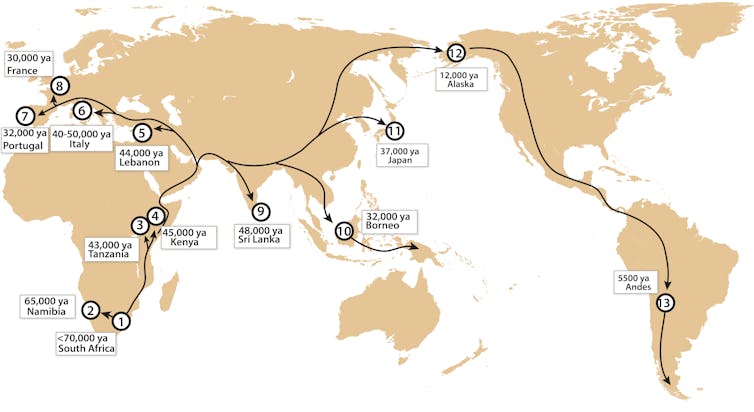
Diffusion of Bow and Arrow out of Africa. (Wikipedia (map) & Nick Longrich)
Neanderthals never adopted bows, but the timing of the bow’s spread means it was likely used by Homo sapiens against them.
Trading technology
It’s not impossible that people invented similar technologies in different parts of the world at roughly the same time, and in some cases, this must have happened. But the simplest explanation for the archaeological data we have is that instead of reinventing technologies, many advances were made just once, then spread widely. After all, assuming fewer innovations requires fewer assumptions.
But how did technology spread? It’s unlikely individual prehistoric people travelled long distances through lands held by hostile tribes (although there were obviously major migrations over generations), so African humans probably didn’t meet Neanderthals in Europe, or vice versa. Instead, technology and ideas diffused – transferred from one band and tribe to the next, and the next, in a vast chain linking modern Homo sapiens in southern Africa to archaic humans in North and East Africa, and Neanderthals in Europe.
Conflict could have driven exchange, with people stealing or capturing tools and weapons. Native Americans, for example, got horses by capturing them from the Spanish. But it’s likely that people often just traded technologies, simply because it was safer and easier. Even today, modern hunter-gatherers, who lack money, still trade – Hadzabe hunters exchange honey for iron arrowheads made by neighbouring tribes, for example.
Archaeology shows such trade is ancient. Ostrich eggshell beads from South Africa, up to 30,000 years old, have been found over 300 kilometres from where they were made. 200,000—300,000 years ago, archaic Homo sapiens in East Africa used tools from obsidian sourced from 50-150 kilometres away, further than modern hunter-gatherers typically travel.
Last, we shouldn’t overlook human generosity – some exchanges may simply have been gifts. Human history and prehistory were doubtless full of conflict, but then as now, tribes may have had peaceful interactions – treaties, marriages, friendships – and may simply have gifted technology to their neighbours.
Stone Age geniuses
The pattern seen here – single origin, then spread of innovations – has another remarkable implication. Progress may have been highly dependent on single individuals, rather than being the inevitable outcome of larger cultural forces.
Consider the bow. It’s so useful that its invention seems both obvious and inevitable. But if it really was obvious, we’d see bows invented repeatedly in different parts of the world. But Native Americans didn’t invent the bow - neither did Australian Aborigines, nor people in Europe and Asia.
Instead, it seems one clever Bushman invented the bow, and then everyone else adopted it. That hunter’s invention would change the course of human history for thousands of years to come, determining the fates of peoples and empires.
The prehistoric pattern resembles what we’ve seen in historic times. Some innovations were developed repeatedly – farming, civilisation, calendars, pyramids, mathematics, writing, and beer were invented independently around the world, for example. Certain inventions may be obvious enough to emerge in a predictable fashion in response to people’s needs.
But many key innovations – the wheel, gunpowder, the printing press, stirrups, the compass – seem to have been invented just once, before becoming widespread.
And likewise a handful of individuals – Steve Jobs, Thomas Edison, Nikola Tesla, the Wright Brothers, James Watt, Archimedes – played outsized roles in driving our technological evolution, which implies highly creative individuals had a huge impact.
That suggests the odds of hitting on a major technological innovation are low. Perhaps it wasn’t inevitable that fire, spearpoints, axes, beads or bows would be discovered when they were.
Then, as now, one person could literally change the course of history, with nothing more than an idea.
By Nicholas R. Longrich, Senior Lecturer in Paleontology and Evolutionary Biology, University of Bath
This article is republished from The Conversation under a Creative Commons license. Read the original article.