The National Institute of Health is lifting a previous moratorium banning scientists from creating animal embryos that have human organs or cells, National Public Radio reports.
But now scientists can get federal dollars to create "chimera" embryos -- as long as they follow a carefully-crafted set of rules. A chimera is an organism that has DNA from one or more organisms. The name comes from Greek mythology -- a winged fire-breathing monster with a lion's head and goat's body that served as a bad omen for looming disasters.
Scientists hope to use human organs grown in animals like pigs, sheep and cows for transplants and use the embryos for medical research.
According to Science Magazine, the controversy started when Professor Juan Carlos Izpisúa Belmonte at the Salk Institute for Biological Studies, in San Diego, learned that he was a top-ranked applicant for the NIH's Pioneer Award -- which bestows $500,000 for five years of research. But late last year, he was told his application was on hold.
The NIH put research using chimera embryos on hold in September “while the Agency considers a possible policy revision in this area.”
"I’m not upset," Belmonte told Science in October. "Quite the opposite. I think it is great that we openly discuss this and hope that a conclusion is reached."
At issue are the use of pluripotent cells -- a powerful stem cell that can develop into any kind of cell in the body. While the medical promises seem obvious, scientists worried the cells could develop into brain or reproductive cells in animal-human offspring.
To prevent this science fiction horror movie scenario from coming to life, scientists have put stringent restrictions in place. For example, policy prohibits the introduction of human cells into non-human primate embryos, like monkeys and chimpanzees. Some experiments will go through an extra layer of government review before commencing. Or animals created with human sperm or egg cells could prove useful in understanding human development -- but special steps would be taken to prevent such creatures from breeding.
"At the end of the day, we want to make sure this research progresses because its very important to our understanding of disease. It's important to our mission to improve human health,"Carrie Wolinetz, associate director for science policy for NIH said in an interview with NIH. "But we also want to make sure there's an extra set of eyes on these projects because they do have this ethical set of concerns associated with them."
The new research horizons are not without vocal critics, who fear scientists are charting dangerous new territory.
"Science fiction writers might have imagined worlds like this — like The Island of Dr. Moreau, Brave New World, Frankenstein," Stuart Newman, a biologist at New York Medical College, told NPR. "There have been speculations. But now they're becoming more real. And I think that we just can't say that since it's possible then let's do it."
Recent calls for the introduction of a vaccine against chickenpox (varicella-zoster virus infection) following a severe case of the disease in Cambridge, England may surprise many parents who consider the disease to be a mild illness that “everyone gets”. But serious complications of chickenpox do occur – for this reason most paediatricians are enthusiastic about the prevention of the disease and vaccination is routine in many countries, including the US and Australia, but not currently in the UK.
Chickenpox symptoms appear 10-21 days after exposure of a person who hasn’t met the disease before to an individual who is suffering from the disease. Individuals are infectious from one day before the onset of the rash until the spots have crusted over.
The first symptom is usually a high temperature, which settles over the next few days. About a day after the fever starts, the typical chickenpox rash appears. The rash appears as “crops” of new spots over the next few days and after five days most people stop cropping new spots and their fever has settled.
For the majority of children, chickenpox is just a rather unpleasant illness and a nuisance for their parents who have to take time off work to look after them. Most people develop the illness in childhood, but for those who don’t, the illness is far more severe among adults. It is especially dangerous, and may even be fatal, if contracted in late pregnancy.
The disease can also be life-threatening for children and adults who are born with a poorly functioning immune system, in those receiving treatment for cancer and in patients with other conditions for which treatments are given to suppress the immune system (foe example, steroids).
Dangerous complications
Most children admitted to hospital with severe chickenpox, have developed the most common complication of the disease, which is secondary bacterial infection. We think that these bacteria gain entry to the body through the breach in the skin barrier that is caused by the spots. The usual germ that causes these infections is the Strep sore throat bacterium (Group A Streptococcus), which, in association with chickenpox, can cause skin infections, swollen glands (lymphadenitis), severe sepsis (septicaemia, necrotising fasciitis or toxic shock syndrome) and even kill.
Other serious complications include haemorrhagic chickenpox, brain infections with the varicella virus (encephalitis), chickenpox pneumonia and an assortment of other rare complications.
The chickenpox vaccine is usually administered to children at the same time as the MMR vaccine (around 12 months of age with a booster at three-and-a-half to five years of age in some countries) and effectively prevents severe chickenpox.
It is a live viral vaccine – and about 5% of children who are vaccinated develop a mild chickenpox rash after vaccination and fever can occur, especially with the vaccine that is combined with MMR, MMRV. Some children who are susceptible to “febrile fits” may have a seizure with these fevers, which can be frightening for the parents.
Nevertheless, the burden of severe and life-threatening complications has essentially disappeared in countries where the vaccine is routinely used. The protection from the vaccine does wane over time and some breakthrough cases of chickenpox do occur, particularly among those who only get one dose. However, in those who have been vaccinated, the breakthrough cases are mild.
In those of us who are not vaccinated, after we experience chickenpox infection, the varicella virus stays with us for the whole of our lives. It is kept under control by our immune system, but hides in our nerve roots. As immunity wanes over time, the virus can reactivate causing the disease known as shingles (zoster).
Shingles usually appears as a painful rash in a line on one side of the body with spots that look like chickenpox spots. Shingles becomes increasingly common with age and in those over 55 years of age, there is also an increasing risk of the pain persisting even after the spots have completely healed.
This is very expensive for the health system to manage as the treatments generally don’t work very well and are costly. Some studies have indicated that the risk of shingles in older adults is reduced by exposure to children who have chickenpox during the adult’s life. This results in a boost of immune responses against the virus and delays the waning of immunity which would eventually lead to shingles.
So why reject the vaccine?
So why doesn’t the UK use the chickenpox vaccine for children if it is safe and effective at preventing severe disease? All vaccines in the UK are assessed for their cost-effectiveness to ensure that the health budget spent on services which provide the greatest health benefit for the population as a whole.
In the last review of the chickenpox vaccine by the committee which advises the government on vaccines (the Joint Committee on Vaccination and Immunisation, JCVI), the future modelling of the impact of vaccination indicated that there could be an increase in the rate of shingles in adults over time, which would make the vaccine programme not cost-effective.
This is because, if chickenpox in children disappears as a result of a vaccine programme, adults would no longer have their immunity boosted by exposure to their chickenpox-suffering children and grandchildren and would be more likely to get shingles. Put simply, the conclusion of the previous review was that it would not be cost-effective for the NHS to immunise children against chickenpox.
JCVI keeps all current and potential vaccine programmes under review and is currently reviewing the latest information on the chickenpox vaccine impact on chickenpox and on shingles using data from other countries where the vaccine has been in routine use over the past decade or two. It will advise the government on whether there should be any change to the current advice on chickenpox vaccine in due course.
A shingles vaccine is used in a number of countries, including the UK, for older adults (over 70 years of age in the UK) to improve immunity, suppress the virus and prevent shingles, and new shingles vaccines are likely to become available in the next few years.
For now, however, a review of chickenpox vaccine for British children is pending.
A Florida-based company won U.S. government permission on Wednesday to send a robotic lander to the moon next year, the firm's founder said, marking the first time the United States has cleared a private space mission to fly beyond Earth’s orbit.
The Federal Aviation Administration's unprecedented go-ahead for the Moon Express mission also sets a legal and regulatory framework for a host of other commercial expeditions to the moon, asteroids and Mars.
As approved by the FAA's Office of Commercial Space Transportation, the privately held Moon Express, headquartered in Cape Canaveral, plans to fly a suitcase-sized lander to the moon for a two-week mission in 2017, said the company founder and chief executive Bob Richards.
The spacecraft will carry a number of science experiments and some commercial cargo on its one-way trip to the lunar surface, including cremated human remains, and will beam back pictures and video to Earth, the company said.
Before now, no government agency was recognized as having authority to oversee private missions beyond Earth's orbit, though a 1967 international treaty holds the United States responsible for any flights into space by its non-government entities.
So far, only government agencies have flown spacecraft beyond the orbit of the Earth.
To address the conundrum, the FAA, which already exercises jurisdiction over commercial rocket launches in the United States, led an interagency review of the Moon Express proposal, which included steps the company would take to ensure compliance with the 1967 Outer Space Treaty.
“It’s been a very steep mountain,” Richards said in a telephone interview. “We had to lay the track at the same time that we wanted to do the mission.”
Other companies are expected to soon follow the same framework.
Elon Musk, founder and chief executive of Space Exploration Technologies, plans to fly a spacecraft to Mars in 2018, a mission that raises a host of issues dealing with protecting potential indigenous life on the planet from contamination by Earth microbes.
Among other private space ventures in the works are missions to mine asteroids, operate science labs and repair and service satellites.
Planetary protection is less of a concern on the moon, but Moon Express did have to contend with concerns about disturbing Apollo and other historic lunar landing sites, among other issues.
“We proposed a scenario that built on the existing FAA mission-approval framework," Richards said.
NASA and other agencies, including the Defense, State and Commerce departments, ultimately agreed that no new law was necessary, Richards said.
As part of the agreement, NASA will advise, but not regulate, Moon Express activities on the lunar surface.
The warming of the world’s climate has reached a fever pitch in recent years, causing records to fall like dominoes. In 2015, the planet saw a number of such records set, from the hottest global temperature measured to the largest annual increase in carbon dioxide.
Those records — along with numerous other indicators of the considerable change wrought on land, in the oceans and air, and to ecosystems — are detailed in the annual State of the Climate Report released Tuesday by the U.S. National Oceanic and Atmospheric Administration.
The report, now in its 26th year and published as a special edition of the journal Bulletin of the American Meteorological Society, was put together by 456 authors in 62 countries and provides a checkup of Earth’s health.
“We have to understand how the planet is changing and varying . . . in order to understand where we may be going in the future,” Thomas Karl, director of NOAA’s National Centers for Environmental Information, said during a press teleconference.
While a strong El Niño provided a boost to global temperatures last year, the main driver of the planet’s temperature surge, as well as other climate trends, is the warming caused by the buildup of greenhouse gases in the atmosphere.
And just as many of the records of 2015 broke those set only one year earlier, 2016 has broken or is poised to break several of 2015’s records:
Global Temperature
The average temperature for the world in 2015 was record warm in all four major datasets, which are run independently by different U.S. and international agencies. The year beat out 2014 by 0.2°F (0.1°C) — the highest margin for such a record since 1998.
From the perspective of how much temperatures have risen since preindustrial times, 2015 was more than 1°C (1.8°F) above temperatures from the mid- to late-19th century. Nations have pledged to limit warming to 2°C above preindustrial temperatures by the end of this century, with some discussion of tightening that cap to 1.5°C.
Global temperatures have continued to soar in 2016, which for the first half of the year is ahead of 2015 by a long shot and has nudged the planet even closer to the 1.5°C benchmark.
Whether 2016 takes the title of hottest year or not depends on how the second half of the year plays out, with a La Niña event possibly forming in the wake of the exceptionally strong El Niño that held sway in 2015 and early 2016. La Niñas have a cooling effect on global temperatures. The latest model forecasts are less confident that a La Niña will form, which would mean 2016 has a better chance of besting 2015.
“It’s quite possible that 2016 will set a new global temperature record,” Jessica Blunden, a NOAA climatologist and lead author of the report, said.
Carbon Dioxide
Greenhouse gas levels — the driver behind the steady warming of the planet — also set records in 2015.
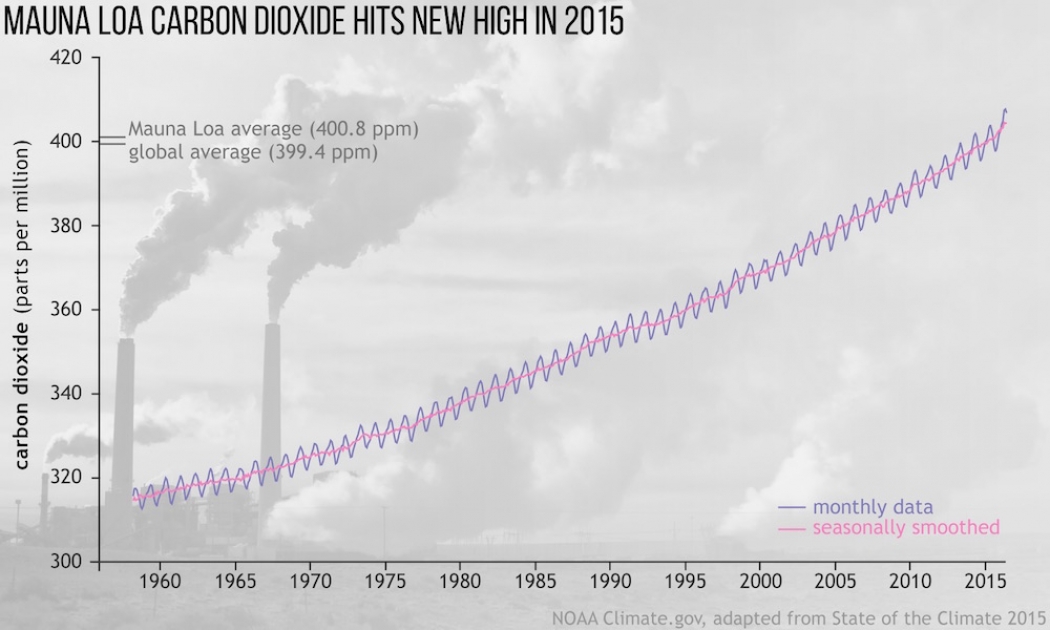
The annual average of carbon dioxide levels at the Mauna Loa Observatory in Hawaii, which keeps the longest-running record of atmospheric CO2, was 400.8 parts per million. That was the first time the measurement was over 400 ppm for the year. While that benchmark is somewhat symbolic, it shows how far those levels have risen since preindustrial times, when CO2 measured about 280 ppm.
The rise of carbon dioxide levels in the atmosphere. (Credit: NOAA)
The year also saw the biggest year-over-year increase on record at Mauna Loa, 3.1 ppm. While 2016 is only halfway over, it is slightly ahead of 2015 by this measure.
The global CO2 average for 2015 was just under 400 ppm, “which means that 2016 is easily going to surpass this milestone,” Blunden said. In fact, one of the last places on Earth that had yet to cross that mark, the South Pole, finally did so this year.
Ocean Heat
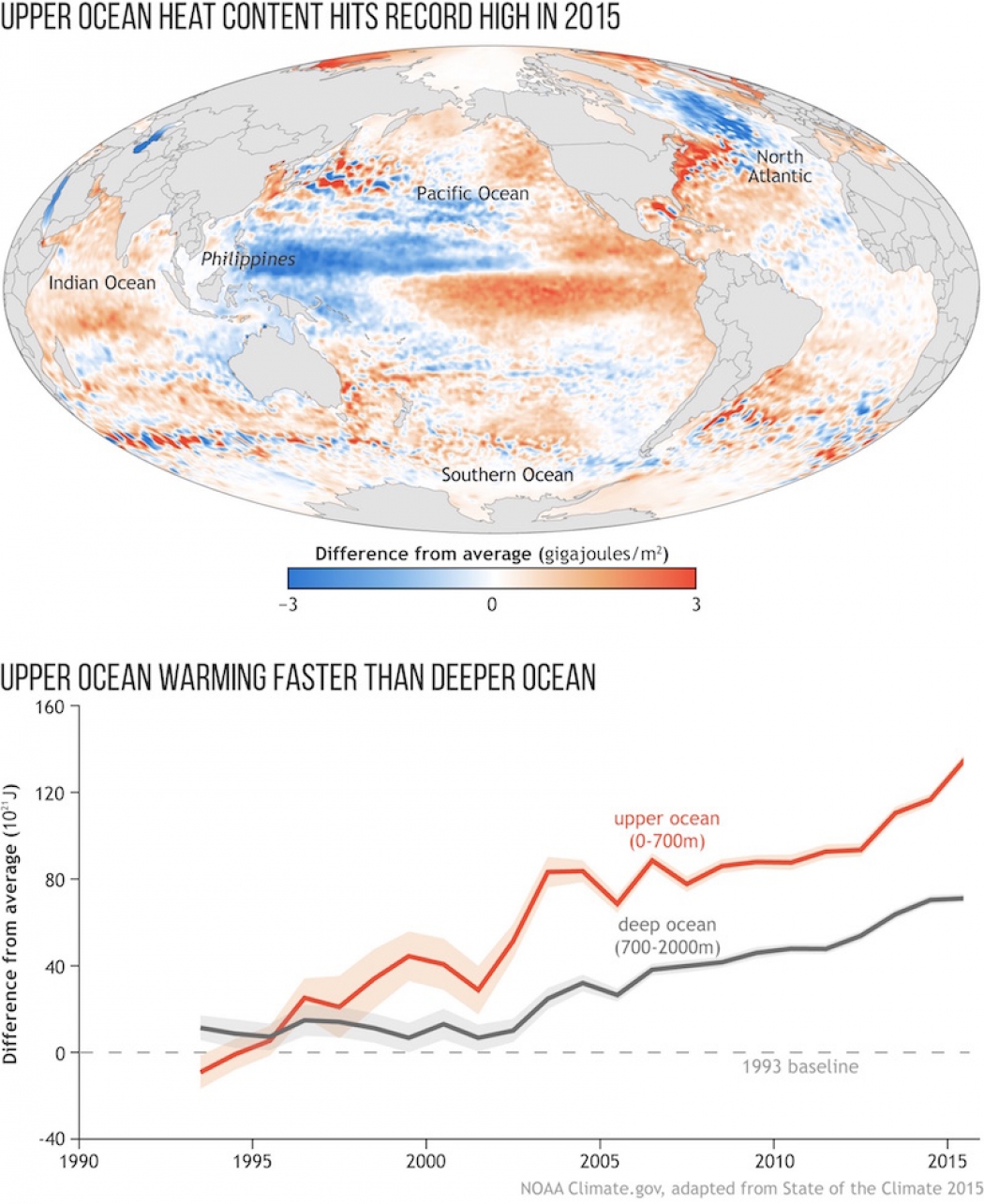
One of the key drivers of 2015’s record heat was the global oceans, which take up 90 percent of the excess heat trapped by the atmosphere.
Sea surface temperatures and the heat contained in the upper portion of the oceans both set global records, surpassing those set in 2014.
Ocean heat content in 2015 and trends over time. (Credit: NOAA)
Because water expands as it warms, that heat also meant that sea surface heights were record high, measuring about 2.75 inches higher than at the beginning of the satellite altimeter record in 1993. Rising seas are one of the key concerns of global warming, as they stand to inundate coastal areas that are currently home to millions.
Arctic Sea Ice
One of the planet’s hotspots has been the outsized warming in the Arctic, which is seeing a temperature rise double that of the global average.
This rapid warming has caused substantial changes, perhaps most notably to the ice that covers the Arctic Ocean. Loss of this ice has ramifications for polar ecosystems, as well as potentially to weather patterns in Europe, Asia, and North America..
May and June this year also saw record low sea ice levels, though the decline eased off in July. Still, sea ice is far below the long-term average and stands to rank among the lowest years on record at its end-of-summer nadir.
This spate of records won’t necessarily continue over the next few years, particularly if a La Niña does materialize. Even with a long-term background trend of rising temperatures, other climate factors contribute to yearly ups and downs. But as long as greenhouse gases continue to build up in the atmosphere unabated, the scales are heavily weighted toward more record heat, ever lower sea ice levels and ever higher seas.
Would you want to alter your future children’s genes to make them smarter, stronger or better-looking? As the state of the science brings prospects like these closer to reality, an international debate has been raging over the ethics of enhancing human capacities with biotechnologies such as so-called smart pills, brain implants and gene editing. This discussion has only intensified in the past year with the advent of the CRISPR-cas9 gene editing tool, which raises the specter of tinkering with our DNA to improve traits like intelligence, athleticism and even moral reasoning.
So are we on the brink of a brave new world of genetically enhanced humanity? Perhaps. And there’s an interesting wrinkle: It’s reasonable to believe that any seismic shift toward genetic enhancement will not be centered in Western countries like the U.S. or the U.K., where many modern technologies are pioneered. Instead, genetic enhancement is more likely to emerge out of China.
Attitudes toward enhancement
Numerous surveys among Western populations have found significant opposition to many forms of human enhancement. For example, a recent Pew study of 4,726 Americans found that most would not want to use a brain chip to improve their memory, and a plurality view such interventions as morally unacceptable.
A broader review of public opinion studies found significant opposition in countries like Germany, the U.S. and the U.K. to selecting the best embryos for implantation based on nonmedical traits like appearance or intelligence. There is even less support for editing genes directly to improve traits in so-called designer babies.
Opposition to enhancement, especially genetic enhancement, has several sources. The above-mentioned Pew poll found that safety is a big concern – in line with experts who say that tinkering with the human genome carries significant risks. These risks may be accepted when treating medical conditions, but less so for enhancing nonmedical traits like intelligence and appearance. At the same time, ethical objections often arise. Scientists can be seen as “playing God” and tampering with nature. There are also worries about inequality, creating a new generation of enhanced individuals who are heavily advantaged over others. “Brave New World” is a dystopia, after all.
However, those studies have focused on Western attitudes. There has been much less polling in non-Western countries. There is some evidence that in Japan there is similar opposition to enhancement as in the West. Other countries, such as China and India, are more positive toward enhancement. In China, this may be linked to more generally approving attitudes toward old-fashioned eugenics programs such as selective abortion of fetuses with severe genetic disorders, though more research is needed to fully explain the difference. This has led Darryl Macer of the Eubios Ethics Institute to posit that Asia will be at the forefront of expansion of human enhancement.
Restrictions on gene editing
In the meantime, the biggest barrier to genetic enhancement will be broader statutes banning gene editing. A recent study found bans on germline genetic modification – that is, those that are passed on to descendants – are in effect throughout Europe, Canada and Australia. China, India and other non-Western countries, however, have laxer regulatory regimes – restrictions, if they exist, are often in the form of guidelines rather than statutes.
There are, then, two primary factors contributing to emergence of genetic enhancement technologies – research to develop the technologies and popular opinion to support their deployment. In both areas, Western countries are well behind China.
Different countries have different expectations about working with human genes.
Michael Dalder/Reuters
What makes China a probable petri dish
A further, more political factor may be at play. Western democracies are, by design, sensitive to popular opinion. Elected politicians will be less likely to fund controversial projects, and more likely to restrict them. By contrast, countries like China that lack direct democratic systems are thereby less sensitive to opinion, and officials can play an outsize role in shaping public opinion to align with government priorities. This would include residual opposition to human enhancement, even if it were present. International norms are arguably emerging against genetic enhancement, but in other arenas China has proven willing to reject international norms in order to promote its own interests.
Indeed, if we set ethical and safety objections aside, genetic enhancement has the potential to bring about significant national advantages. Even marginal increases in intelligence via gene editing could have significant effects on a nation’s economic growth. Certain genes could give some athletes an edge in intense international competitions. Other genes may have an effect on violent tendencies, suggesting genetic engineering could reduce crime rates.
Many of these potential benefits of enhancement are speculative, but as research advances they may move into the realm of reality. If further studies bear out the reliability of gene editing in improving such traits, China is well-poised to become a leader in the area of human enhancement.
Does this matter?
Aside from a preoccupation with being the best in everything, is there reason for Westerners to be concerned by the likelihood that genetic enhancement is apt to emerge out of China?
If the critics are correct that human enhancement is unethical, dangerous or both, then yes, emergence in China would be worrying. From this critical perspective, the Chinese people would be subject to an unethical and dangerous intervention – a cause for international concern. Given China’s human rights record in other areas, it is questionable whether international pressure would have much effect. In turn, enhancement of its population may make China more competitive on the world stage. An unenviable dilemma for opponents of enhancement could emerge – fail to enhance and fall behind, or enhance and suffer the moral and physical consequences.
Conversely, if one believes that human enhancement is actually desirable, this trend should be welcomed. As Western governments hem and haw, delaying development of potentially great advances for humanity, China leads the way forward. Their increased competitiveness, in turn, would pressure Western countries to relax restrictions and thereby allow humanity as a whole to progress – becoming healthier, more productive and generally capable.
Either way, this trend is an important development. We will see if it is sustained – public opinion in the U.S. and other countries could shift, or funding could dry up in China. But for now, it appears that China holds the future of genetic enhancement in its hands.
Billionaire PayPal founder Peter Thiel said that he believes transfusions of blood from young people can reverse his aging process and allow him to live a vastly extended lifespan.
In an interview with Inc.com's Jeff Bercovici, Thiel said that the practice -- known as parabiosis -- is the closest modern science has come to creating an anti-aging panacea.
Thiel -- a hedge funder who acted as a delegate for Donald Trump and spoke at the 2016 Republican National Convention -- is reportedly obsessed with defying death and extending the human lifespan. He has injected funds into startups that are experimenting with ways to forestall the body's inevitable decline and death.
"I’m looking into parabiosis stuff," Thiel told Bercovici, "where they [injected] the young blood into older mice and they found that had a massive rejuvenating effect. ... I think there are a lot of these things that have been strangely underexplored."
Parabiosis experiments began in the 1950s with crude exercises in which rats were cut open and their circulatory systems restructured and manipulated. Recently, some companies have been advancing human trials with parabiosis. Bercovici wrote that U.S. studies in the field are currently lagging behind trials in China and Korea.
A California company called Amrbosia is conducting human trials in which healthy people aged 35 or older receive transfusions of blood plasma from people under 25. Participants pay $8,000 to take part and their health is closely monitored for the two years they receive the transfusions. Participants must live in or have the means to travel to Monterey, CA.
Ambrosia's founder Jesse Karmazin told Bercovici that participants experience a reversal of aging systems across every major organ system. Furthermore, the results appear to be long-lasting, he said, if not permanent.
"The effects seem to be almost permanent," Karmazin said. "It's almost like there's a resetting of gene expression."
Jason Camm -- chief medical officer at Thiel Capital -- reached out to Karmazin, saying that the company is interested in his studies. Camm is listed on his LinkedIn page as, "Personal Health Director to Peter Thiel ... and a number of other prominent Silicon Valley business leaders and investors."
In an interview last year, Thiel told Bercovici that our culture is "a little too biased against all these things" that purportedly prolong life. When the reporter asked Thiel if he was looking at parabiosis as a business opportunity or a personal medical decision, Thiel said the latter. The practice, he said, isn't necessarily patentable, which compromises its potential money-making value.
However, he said, the FDA needn't get involved or study the practice because, "it's just blood transfusions."
There are rumors that some wealthy individuals in Silicon Valley are doing courses of parabiosis, but Thiel said last year that he hadn't "quite, quite, quite started yet." A spokesman for Thiel capital said that nothing has changed since then.
Gawker reported that it received a tip claiming Thiel “spends $40,000 per quarter to get an infusion of blood from an 18-year-old based on research conducted at Stanford on extending the lives of mice.”
Thiel is locked in a grudge match with Gawker after the website outed him as gay in 2007. Resenting the intrusion into his private life, Thiel quietly funded a multimillion dollar lawsuit against the website by pro wrestler Hulk Hogan.
The lawsuit was successful and Gawker is now struggling against bankruptcy and is due to go up for auction later this summer. On Monday, Gawker editor in chief Nick Denton filed for personal bankruptcy after a Florida court refused to grant him an emergency stay on the verdict.
Love them or hate them, ring-necked parakeets have invaded Europe and they’re here to stay. Already a staple of many urban parks and gardens around the UK, some of these charismatic bright green birds are now so comfortable in their new surroundings that they will happily sit and feed from your hand.
Parakeets are Britain’s fastest growing bird population and are on a trajectory to global domination. Outside of their native southern Asia and sub-Saharan Africa, breeding populations are now established in at least 65 cities around Europe, and more than 30 countries across five continents.
Such non-native, or “invasive” species are one of the biggest causes of biodiversity loss in the world today, and can cause severe economic damage. Understanding these species is incredibly useful for any attempt to design environment policy and prevent further invasions. Populations of invasive ring-necked parakeets (Psittacula krameri) provide an excellent case study, owing to their patterns of rapid growth and spread.
Parakeet feeding time in Kensington Gardens, central London.
These parakeets were introduced into the UK in the late 1960s and now number well over 32,000 birds. They were originally concentrated around Greater London and nearby Kent, but these areas are now saturated which has resulted in parakeets spreading around the country, reaching as far north as Inverness in Scotland.
Many popular stories exist to explain how these exotic parakeets came to live in the UK, including their escape from the film set of the African Queen, and my personal favourite: their deliberate release by Jimi Hendrix to inject some psychedelic colour into the streets of London. More likely it is a result of the popularity of keeping ring-necked parakeets as pets.
The global transportation of wild ring-necked parakeets in addition to in-country breeding, has led to their successful establishment outside their native range. Between 1984 and 2007 a staggering 146,539 ring-necked parakeets were imported to Europe, before an EU ban on the trade of wild birds. The UK alone imported more than 16,000.
We know how they got to Europe’s cities, but what makes ring-necked parakeets so good at adapting to new environments? The climate is likely to play a strong role in their ability to survive outside of their native range. Despite their incredibly large native range, spanning two continents, the parakeets found across Britain and Europe originate predominately from across the colder foothills of the Himalayas, largely in Pakistan.
The distinct lack of parakeets from warmer areas in Africa suggests similarities in temperature and rainfall between the native and invasive ranges made life easy for them. It seems the parakeets were already well adapted to survive in northern Europe.
Interestingly, back in the late 1800s wild ring-necked parakeets were observed in the UK, but they failed to survive. So what’s different now? Perhaps warmer winters due to climate change, in combination with our love of feeding birds thus giving them a year-round supply of energy, have provided ideal conditions for parakeets to thrive around the country.
Let’s also not overlook the lack of natural predators outside their native range. Unsurprisingly, Asian black eagles aren’t a concern in London’s parks. However, it seems Britain’s urban peregrines and sparrow hawks have now started to notice the exotic new meat on the menu. Yet despite native falcons' success at preying on wild parakeets, they’re unlikely to make a dent on the growing numbers of invasive parakeets.
Despite parakeets being well established in the UK, we still don’t fully understand their potential impact, good or bad. Do they affect native wildlife by competing for nest holes and food? Preliminary reports show some level of competition for nest sites with European native nuthatches, and that they displace garden birds from bird feeders. Back in Asia and Africa ring-necked parakeets are severe crop pests, but we don’t yet know if they’ll damage British fruit crops and cause economic damage.
Many scientists are also curious about the impact they are having on people. Does living near large roosts cause noise pollution? Does seeing exotic parakeets in parks and gardens around the UK improve human wellbeing? These are just some of the questions we’re aiming to answer through ParrotNet, a pan-European group of researchers dedicated to understanding the challenge of invasive parrots (ring-necked parakeets are just one of 13 species of parrot established across Europe).
Despite their abundance, surprisingly, many British people remain unaware that wild parakeets are living among them. As these vibrant birds are now spreading around the country, in time they will become commonplace in all the UK’s urban areas. While we may still regard these colourful and exotic parakeets as something of an exciting novelty, I suspect our children and their children may simply consider them no more exciting than a common pigeon.
Chinese researchers claim to have found the world's deepest underwater sinkhole, known locally as Dragon Hole in the South China Sea.
After a year of exploring the blue hole, researchers at the Sansha Ship Course Research Institute for Coral Protection concluded that the “eye” of the sea measures a staggering 300 meters in depth or (984 feet), reports state-owned news agency Xinhua.
For context, the Eiffel Tower is 324 meters (1,063 feet) tall.
The hole is located in the Paracel Islands near coral reefs and is home to more than 20 species of marine life along the upper levels of the sinkhole.
Researchers sent an underwater robot to the bottom of the ocean to measure the depth of the sinkhole, which has a 130-meter diameter (427 feet).
Blue holes are large marine caverns characterized by dark blue waters in the center of the circle, ringed by light blue waters.
Underwater sinkholes form with the erosion of limestone.
When saltwater and freshwater meet in the sea, acids can eat away at limestone to create a blue hole.
The Dragon Hole now dwarfs Dean's Blue Hole in the Bahamas, which was previously referred to as the deepest known blue hole at 202 m.
The findings have spurred the local municipal government of Sansha to draft measures to study and protect what has been officially christened as the Sansha Yongle Blue Hole.
Women who reported douching almost doubled their risk of developing ovarian cancer, a national U.S. study shows.
Prior studies have linked douching, or vaginal washing with a device, to yeast infections, pelvic inflammatory disease and ectopic pregnancies. Researchers have also found associations between douching and cervical cancer, reduced fertility, HIV and other sexually transmitted diseases.
But the new National Institute of Environmental Health Sciences study is the first to tie cancer of the ovaries to the procedure routinely practiced by millions of American women.
Joelle Brown, an epidemiology professor at the University of California, San Francisco said that although she knew about other health problems associated with douching, the link between douching and ovarian cancer took her by surprise.
“While most doctors and the American College of Obstetricians and Gynecologists strongly recommend that women do not douche, many women continue to douche because they falsely perceive douching to have positive health benefits, such as increased cleanliness,” she told Reuters Health by email. Brown was not involved in the current study.
Interventions to encourage women not to douche are needed, she said.
Ovarian cancer is known as “the silent killer” because women often experience no symptoms until the disease has progressed to an advanced stage. An estimated 20,000 American women are diagnosed with ovarian cancer and about 14,500 die from it annually, according to the Centers for Disease Control and Prevention (CDC).
The new analysis in the journal Epidemiology followed more than 41,000 women throughout the U.S. and Puerto Rico since 2003 as part of the Sister Study. Participants were 35 to 74 years old, and each had a sister who had been diagnosed with breast cancer. The subjects were free of breast and ovarian cancer when they enrolled in the study.
By July 2014, researchers counted 154 cases of ovarian cancer among participants. Women who reported douching during the year before entering the study nearly doubled their risk of ovarian cancer, the study found.
The link between douching and ovarian cancer was even stronger when the authors looked only at women who didn’t have breast-cancer genes in their family.
No study had ever before examined a possible relationship between douching and ovarian cancer, senior author Clarice Weinberg said in a telephone interview. She is deputy chief of the biostatistics and computational biology branch at the National Institute of Environmental Health Sciences in Research Triangle Park, North Carolina.
“There are a number of health reasons not to douche, and I can’t think of any reason to do it,” she said.
Vaginas naturally clean themselves, and squirting cleansers or other mixtures inside the canal only interferes with nature’s balance. Douching can cause an overgrowth of harmful bacteria, lead to yeast infections, and push bacteria up into the uterus, fallopian tubes and ovaries, according to the Office on Women’s Health at the U.S. Department of Health and Human Services (HHS).
Nevertheless, one quarter of women between the ages of 15 and 44 douche, HHS says.
Brown, who led a 2016 study published in PLoS One that examined women’s motivations for douching, said she has long been fascinated by the display of so-called feminine hygiene products lining drugstore shelves.
“In most pharmacies you can find entire aisles dedicated to vaginal douches, suppositories and gels that are meant to make your vagina smell like a tropical splash or a cookie,” she said.
Women douched as far back as 1500 B.C., when an Egyptian papyrus recommended intravaginal washing with garlic and wine to treat menstrual disorders. American women once douched with Lysol, and some mistook the toilet bowl disinfectant for birth control.
Women often learn to douche from their mothers, Brown’s study found. They do so because they see douching as a necessary part of good hygiene, to prepare for sex, to clean up after sex and at the urging of their male partners.
Despite medical recommendations, douching remains a common practice because women “believe that the products they are using would not be for sale or recommended by their mothers if they were not safe,” Brown said.
“In general, I think women do not realize that douching products do not fall under the same kind of safety regulation as drugs,” she said. “Instead, douching products are considered cosmetics, which means that the U.S. Food and Drug Administration does not require that douche manufacturers test their products for safety.”
SOURCE: https://bit.ly/29UeRFD Epidemiology, online June 20, 2016.
Star Trek Beyond may not have received a stellar critical response, but it can be said that it – and the franchise’s two previous films – handle the philosophy of time travel much better than many other works of science fiction.
This is mainly because the rebooted Star Trek series is not set in the same universe as the original series, but in a parallel universe that shares a similar history – up to a point. In the first film of the rebooted series, Star Trek (2009), a number of characters from the original Star Trek universe – Spock, along with a Romulan bad guy Nero and his henchmen – fall into a black hole in the year 2387. The Romulans emerge in the parallel universe in the year 2233, and Spock 25 years later.
The Romulans’ presence in the parallel universe is felt almost immediately: they destroy the Federation starship USS Kelvin, killing Kirk’s father in the process. As Spock observes: “Nero’s very presence has altered the flow of history … creating an entirely new chain of incidents.” The parallel universe and the original universe diverge in significant ways from that point onwards. In the parallel universe the fatherless Kirk grows up bitter and directionless, Kirk and Spock meet the Spock from the original universe, and the planet Vulcan is destroyed: all events that did not occur in the universe of the original series.
The divergences between the two universes are explored further in the second film of the rebooted series, Star Trek Into Darkness (2013). Here, the crew of the Enterprise go up against the genetically-engineered villain Khan, as had the original crew in Star Trek II: The Wrath of Khan (1982). But how this plays out is different in virtually every aspect, as is the way that the two crews find to defeat him.
The way time travel was used to reboot the Star Trek series is, then, quite sophisticated. This is markedly different from many other time travel movies, which typically involve a single timeline along which characters travel back and change the past. This is the model used in the Terminator films, and even in one of earlier Star Trek films, Star Trek IV: The Voyage Home (1986), in which the original crew of the Enterprise travels back in time to the 20th century to pick up two whales needed to resolve a crisis occurring in their own time.
The grandfather paradox
The problem with this model of time travel is that it leads to logical absurdity. This is traditionally shown through the grandfather paradox, which goes like this: suppose you travelled back in time and killed your biological grandfather before he met your grandmother. Then you would never have been conceived, so you would not have existed to travel back in time in the first place. There are obvious contradictions in this scenario (you both existed and didn’t exist, the time travel both took place and didn’t), which tells us that it is impossible.
But a paradox doesn’t only arise when time travellers are intent on killing their grandparents, but when they seek to change the past in any way. Suppose that someone today goes back in time in order to change the past in a relatively modest way, for example by carving her name in a tree at midday on January 1 1900. Logic indicates that she cannot succeed, because if she did it would be both true that her name was carved in the tree at midday on January 1 in 1900 and false that her name was carved on the tree at midday on January 1 1900. The contradiction means that it cannot happen.
It is often thought that the grandfather paradox shows that time travel is impossible, but in fact it shows the impossibility of changing the past, which is not the same thing. The paradox does not rule out time travel as such, only the possibility of time travellers changing the past. In a single timeline, there is no way to change the past, even if time travel is possible. And if there are multiple timelines, played out in parallel universes, there is still no way to change the past of any of them, even if time travel is possible.
Of course, the idea that there are parallel universes is common in works of science fiction. But it is also taken seriously by many contemporary scientists and philosophers. According to some theories, parallel universes are entirely separate from each other and cannot interact, while other theories hold that parallel universes do interact, making it possible that one day we might be able to test for them. Some physicists even suggest that it might be possible to travel to a parallel universe.
And if there are parallel universes, and it is possible to travel from a particular date in one to a different date in another, then it is possible for travellers to change the events of the timeline they are visiting from what they otherwise would have been. Here, the past is not being changed, only the future. The writers behind the rebooted Star Trek franchise understood this well – and as a result have deftly handled the tricky matter of time travel without falling into the paradoxes that plague some other works of science fiction.
Apollo astronauts who ventured to the moon are at five times greater risk of dying from heart disease than shuttle astronauts, U.S. researchers said on Thursday, citing the dangers of cosmic radiation beyond the Earth's magnetic field.
The study by researchers at Florida State University and NASA found that three Apollo astronauts, including Neil Armstrong, the first person to walk on the moon, or 43 percent of those studied, died from cardiovascular disease, a finding with implications for future human travel beyond Earth.
The research, published in the journal Scientific Reports, was the first to look at the mortality of Apollo astronauts, the only people so far to travel beyond a few hundred miles (km) of Earth.
It found that the chief health threat to the Apollo astronauts came from cosmic rays, which are more prevalent and powerful beyond the magnetic bubble that surrounds Earth.
NASA disputed the findings, saying it was too early to draw conclusions about the effect of cosmic rays on Apollo astronauts because the current data is limited.
The results of the study have implications for the United States and other countries, as well as private companies, such as Elon Musk’s SpaceX, which are planning missions to Mars and other destinations beyond Earth.
For the study, the researchers examined the death records of 42 astronauts who flew in space, including seven Apollo veterans, and 35 astronauts who died without ever going into space.
They found the Apollo astronauts’ mortality rate from cardiovascular disease was as much as five times higher than for astronauts who never flew, or for those who flew low-altitude missions aboard the space shuttle that orbited a few hundred miles above Earth.
A companion study simulated weightlessness and radiation exposure in mice and showed that radiation exposure was far more threatening to the cardiovascular system than other factors, lead scientist Michael Delp said in an interview.
"What the mouse data show is that deep space radiation is harmful to vascular health," he said.
So far, only 24 astronauts have flown beyond Earth’s protective magnetic shield, in missions spanning a four-year period from December 1968 to December 1972.
Of those, eight have died, seven of whom were included in the study. The cause of death of the eighth astronaut, Apollo 14's Edgar Mitchell, who died in February 2016, has not been released, so he was excluded from the study, Delp said. Mitchell was the sixth person to walk on the moon.
Delp and colleagues are working on a follow-up study that includes more detail on family medical histories, smoking and other factors.
(Reporting by Irene Klotz; Editing by Julie Steenhuysen and Peter Cooney)
Members of the Florida Environmental Regulation Commission voted 3-2 on Tuesday to change over 100 different water standards. The new standards include 39 substances that were not previously regulated. Forty-three other toxics, mostly carcinogens, have had their standards changed.
While the agency is reducing the allowed limits on 13 chemicals -- 2 known to be carcinogenic -- it will raise the allowed limits on more than 20 chemicals from 20 to 1,100 percent higher than the state's current standards.
"But the proposal, based on a one-of-a-kind scientific method developed by the Florida Department of Environmental Protection (DEP) and nicknamed 'Monte Carlo,' is being vigorously criticized by environmental groups. They warn the new standard will allow polluters to dump dangerous amounts of chemicals in high concentrations into Florida waters before they trigger the limits of the new rule, and allow Florida to adhere to standards that are weaker than federal guidelines," the Tampa Bay Times wrote.
The DEP defended the scientific method it used. "Probabilistic analysis," as described by the Times, "creates thousands of variables to calculate the health effects of being exposed to a lifetime of toxic chemicals by taking into consideration average body weight, drinking water consumption rate, fish and shellfish consumption rate, and the fat content of fish" as means for calculating these new standards.
Health professionals and other scientists have raised concerns about the exposure levels. "Marc Freeman, a retired professor of neuroscience at Florida State University, said benzene and many of the other compounds are endocrine disruptors, which interfere with hormones and are linked to a host of developmental and other health problems," the Tallahassee Democrat reported. "The DEP folks are acting without prior information about endocrine disruptors,” he said. “I have yet to meet a DEP scientist who knows what an endocrine disruptor is."
The fight over water standards comes at the same time that summer 2016 in Florida has turned noxious due to a toxic algae bloom that has been described as the mixing of the smells of rancid milk with dog sh*t. The algae, which is as "thick as guacamole" coats the surface of bodies of water, scaring away the tourists who help to keep the Sunshine State's economy afloat.
Democratic candidate for Senate Patrick Murphy, delivered a jar of the stuff to Governor Rick Scott, whom Murphy blames for not doing enough to release funds to clean up the mess. The governor blames Congress and President Obama, for failing to approve $800 million for restoration of the Everglades, where the ecological nightmare first bloomed.
[caption id="attachment_852407" align="aligncenter" width="518"] Florida green algae (Wikimedia)[/caption]
Back in the 1930s, the Army Corps of Engineers enacted flood control measures on Lake Okeechobee. But, a series of decisions -- allowing sugar-producing plants to use the lake, drainage issues, water source issues, and an increasing population -- have all been making the impending disaster imminent. It now appears to be here.
In the spring, the Army Corps released "nutrient-heavy water" as part of its flood control measures. The algae outbreak reached the beaches. There was already an algae bloom covering the lake, so that water became food. "The algae outbreaks are triggered by fertilizer sewage and manure pollution that the state has failed to properly regulate. It's like adding miracle grow to the water and it triggers massive algae outbreaks," Earthjustice spokeswoman Alisa Coe told CNN.
Governor Rick Scott has had to declare a state of emergency to deal with the water-based environmental catastrophe. And still, on July 26, Florida regulators voted to approve new water standards that will raise limits for the levels of known carcinogens and other chemicals in the state's rivers and streams and lakes.
Scientists have long wondered why Jupiter's upper atmosphere has temperatures similar to those of Earth, even though the biggest planet in the solar system is five times farther away from the sun.
The answer may be The Great Red Spot, an enormous storm big enough to swallow three Earths that has been raging on Jupiter for at least three centuries, a study showed on Wednesday.
Using an infrared telescope at Hawaii's Mauna Kea Observatory, scientists discovered that the upper atmosphere above the Great Red Spot – the largest storm in the solar system - is hundreds of degrees hotter than anywhere else on the planet.
It could be a coincidence or a major clue, said Boston University physicist James O'Donoghue, lead scientist of the study published in the journal Nature.
The storm spans 13,670 miles by 7,456 miles (22,000 km by 12,000 km) and is located in Jupiter's lower atmosphere. The top of its clouds reach altitudes of about 31 miles (50 km).
By a process of elimination, the newly found hot spot must be heated from below, the study concluded.
The finding provides a strong link between Jupiter's upper and lower atmosphere, though the exact process by which heat is transferred remains unknown. The most-likely energy source is acoustic waves that provide heat from below, the study said.
Scientists also are unsure why the storm is brick red, nor why it has changed color over time. In a 1900 report in the Seattle Post-Intelligencer, scientists described the oval storm as salmon pink. Recent images from the Hubble Space Telescope show it has become orange tinged and more circular.
Like a hurricane on Earth, the Spot's center is relatively calm, but farther out winds reach 270 mph to 425 mph (430 kph to 680 kph). Because there is no land on Jupiter, which is made almost entirely of hydrogen and helium, the storm can never make landfall and dissipate.
"The Great Red Spot is like a wheel that's wedged between two conveyor belts running in opposite directions," said planetary scientist Glenn Orton, with NASA's Jet Propulsion Laboratory in Pasadena, Calif.
"One is adding momentum to it at the top, and another is adding momentum at the bottom. Together, they feed the vortex and essentially keep it alive."
But the storm may not be alive much longer. It has been shrinking for the last 100 years, Orton said.
More information is expected from NASA's Juno spacecraft, which arrived at Jupiter on July 4.
(Reporting by Irene Klotz; Editing by Daniel Wallis and Alan Crosby)