Scientists in Germany have discovered a bacteria hiding out in peoples' noses that produces an antibiotic compound that can kill several dangerous pathogens, including the superbug MRSA.
The early-stage finding, reported in the journal Nature on Wednesday, could one day lead to a whole new class of antibiotic medicines being developed to fight drug-resistant bacterial infections, the researchers said.
As well as being a focal point for many viral infections, the nasal cavity is also a rich ecosystem of 50 or so different species of bacteria, lead researcher Andreas Peschel of the University of Tuebingen told reporters in a telephone briefing.
"(That's) the reason why we looked at this particular body site. (And) it led us to some very unexpected and exciting findings that may be very helpful in looking for new concepts for the development of antibiotics."
Most antibiotics discovered and developed until now have been isolated from soil-living or other environmental bacteria, but the researchers said this discovery highlights the value of the human microbiome as a potential new source.
"The human body has a lot of different ecological niches," Peschel said. "Maybe this is just the right place to look for new human antibiotics.
"Lugdunin is an example that we've been able to characterize. We're sure there will be others to discover."
Naming their new discovery lugdunin, the researchers said it was the first known example of a new class of peptide antibiotics.
Lugdunin is produced by the nostril-dwelling bacterium Staphylococcus lugdunensis (S. lugdunensis). In experiments with mice, Peschel's team showed it is able to effectively treat a skin infection caused by the bacteria Staphylococcus aureus (S. aureus), which can cause serious and superbug infections.
They also found lugdunin was effective against a wide range of so-called Gram-positive bacteria, including strains of methicillin-resistant Staphylococcus aureus (MRSA).
The researchers then analysed nasal swabs from 187 hospital patients and found that in those who had the S. lugdunensis bacteria in their noses, only 5.9 percent also harboured the potential infectious S. aureus bacteria.
In those with no S. lugdunensis, however, 34.7 percent were found to have S. aureus in their noses. This suggests that in the human nose, S. lugdunensis helps to keep S. aureus at bay, the researchers said.
Peschel stressed that the research is at a very early stage and the team would need many years of work, ideally with a pharmaceutical company, before a potential new antibiotic medicine could be developed and tested in clinical trials.
(Reporting by Kate Kelland; editing by Mark Heinrich)
Large swaths of the American public want Donald J. Trump to be their president – maybe even a majority, according to an analysis from Nate Silver’s FiveThirtyEight in late July.
Many people – Democrats and Republicans alike – find this shocking.
Trump made his name as the “You’re fired” guy. He has never held political office, has arguably failed to generate concrete or realistic policy proposals, regularly changes his positions on issues and consistently gets the facts wrong.
This stands in sharp contrast to Hillary Clinton, who has served as secretary of state, senator from New York and first lady of the United States. In his endorsement of her, Barack Obama described Clinton as the most qualified presidential nominee in U.S. history. Presumably experience with, and knowledge of, the system and issues are qualities that make for a good president – so why is this race even close?
How to build trust
Research, including new work from our Human Cooperation Laboratory at Yale, suggests Trump may be successful precisely because of his hotheadedness and lack of carefully thought-out proposals. Being seen as uncalculating can make people trust you.
Hillary Clinton is the opposite of hotheaded. She is careful and calculating – which, despite being a strong asset in actually carrying out the duties of public office, has become a liability in her presidential campaign by undermining the public’s trust in her.
In a recent paper, we found that if you take an action that people like, you come off as much more trustworthy if you decide to act without doing a careful cost-benefit analysis first: Individuals who calculate seem liable to sell out when the price is right.
What’s more, the desire to appear trustworthy motivated participants to act without too much forethought.
Our research didn’t focus on perceptions of politicians, but rather looked at behavior in a more abstract context. We conducted a series of experiments involving economic decisions between anonymous strangers on the internet. Our goal was to create a scenario that would capture the classic trade-off between self-interest and helping others. This is something that comes up in a lot in politics, but also in all sorts of social interactions, such as in our relationships with friends, coworkers and lovers.
Our experiments occur in two stages, with participants assigned to specific roles.
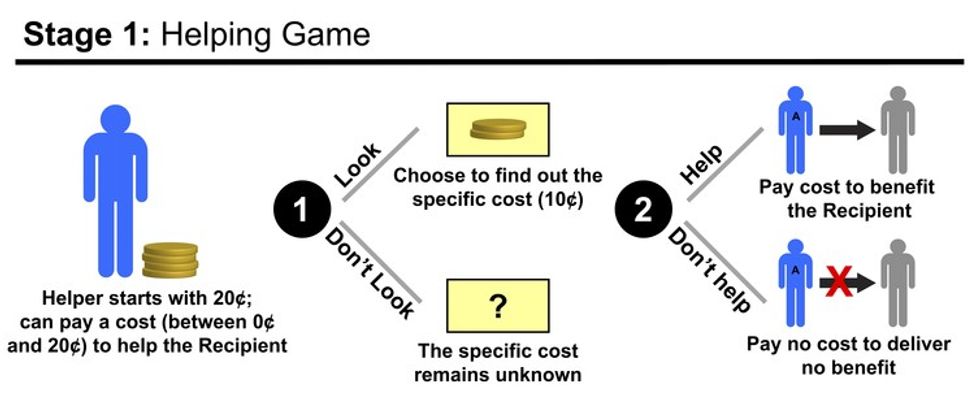
Helping Game.
In the Helping Game stage, “Helpers” are given some money and have the opportunity to give some of it away to benefit another participant.
The second participant is a total stranger who is assigned to the “Recipient” role, and not given any money.
Helpers know that helping the Recipient out will come at a cost – sacrificing a predetermined, but undisclosed, amount of money.
We then give Helpers a choice. They can decide whether to help the Recipient without “looking” at the cost (i.e., without knowing how much money they’ll be giving away). Or, they can choose to find out how much money they’ll be giving away and only then decide whether to help.
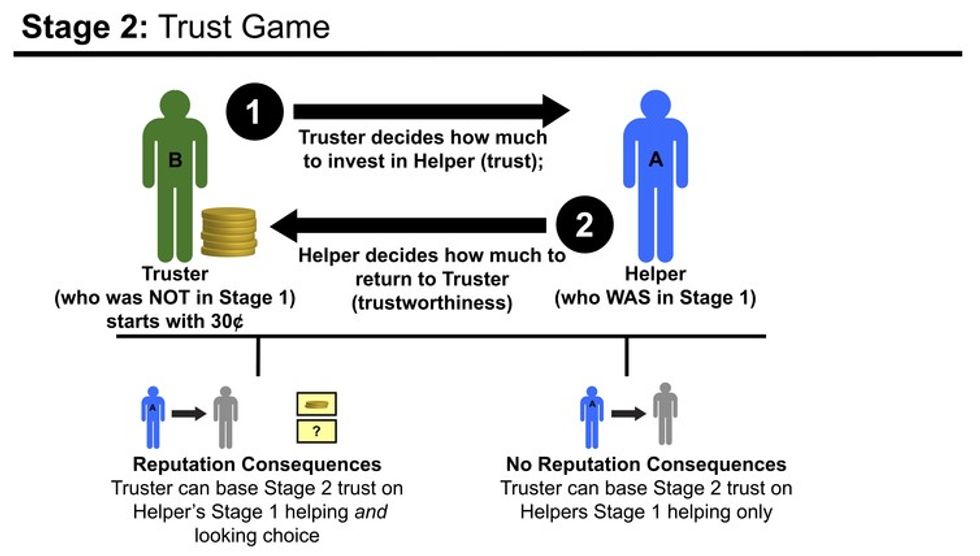
Trust Game.
Next, in the Trust Game stage, Helpers engage in a new interaction with a third participant. This person is called the “Truster.” The Truster learns about how the Helper behaved in the first interaction, and then uses it to decide how much the Helper can be trusted.
To measure trust, we give the Truster 30 cents. He then chooses how much to keep and how much to “invest” in the Helper.
Any money he invests gets tripled and given to the Helper. The Helper then chooses how to divide the proceeds of the investment.
Under these rules, investing is productive, because it makes the pot grow larger. But investing pays off for the Truster only if the Helper is trustworthy, and returns enough money to make the Truster a profit.
For example, if the Truster invests all 30 cents, that amount is tripled and the Helper gets 90 cents. If the Helper is trustworthy and returns half, they both end up with 45 cents: more than the Truster started with.
However, the Helper may decide to keep all 90 cents and return nothing. In this case, the Truster ends up with zero and is worse off than when he started.
So the Truster bases his decision of how much to invest in the Helper on how trustworthy he thinks the she will be in the face of a temptation to be selfish – that is, how much he trusts her.
We found that Helpers who agree to help the Recipient without “looking” at the cost are trusted more by Trusters. Moreover, they really are more trustworthy. These “uncalculating Helpers” actually return more money to Trusters in the face of the temptation to keep it all for themselves.
Somebody is watching you
We also found that Helpers are motivated by concerns about their reputation.
For half of participants, there were reputational consequences of calculating: The Truster was told whether the Helper looked at the cost before deciding whether to help – and thus Helpers could lose “trust points” by calculating. For the other half of participants, Trusters found out only whether Helpers helped, but not whether they looked at the cost. Our results showed that Helpers were less likely to look at the cost when they knew it would have reputational consequences.
This result suggests that people do not make uncalculating decisions only because they cannot be bothered to put in the effort to calculate. Whether this strategy is conscious or not, uncalculating decisions can also be a way to signal to others that you can be trusted.
Uncalculating cooperation in daily life
Our studies demonstrate that there are reputation benefits to seeming principled and uncalculating.
This conclusion likely applies broadly to social relationships with friends, colleagues, neighbors and lovers. For example, it may shed light on why a good friend is someone who helps you out, no questions asked – and not someone who carefully tracks favors and remembers exactly how much you owe.
It may also reveal an unexpected reason for the popularity of rigid ethical guidelines in philosophical and religious traditions. Committing to standards like the golden rule can make you more popular.
To trust Trump or Clinton?
Our studies may also help to shed light on Trump’s appeal. One of his greatest advantages appears to be the authenticity that he conveys with his emotionally charged behavior.
But it’s important to understand uncalculated decisions will benefit your reputation only if the actions you end up taking are perceived positively. In our experiments, Helpers who decided not to help without calculating the costs seemed especially untrustworthy – presumably because they seemed committed to be selfish no matter what. Similarly, Trump’s impulsiveness may be a plus for those people who support his values, but a huge turnoff to those who do not.
In contrast, Clinton’s persona is often unattractive even to those who support her values – because it suggests that she may not stand by those values when the cost is too high. This may shed light on why she does not inspire more enthusiasm among some liberals, despite her experience and progressive record.
However, there’s an important nuance to what it means to be “calculating.” One sense of “calculating” is self-interested: Before you agree to adhere to your ethical principles, or to sacrifice for others, you consider the costs and benefits to yourself – and you follow through with doing the “right” thing only if you conclude that it will be best for you.
Another way to be “calculating” is to carefully consider what’s right for others. Instead of acting on her gut, a policymaker could conduct a complex analysis to figure out the best way to implement a policy to maximize its benefit to the population.
Our theory and experiments apply only to the first sense of “calculating”: They suggest that engaging in self-interested calculations is what undermines trust.
But in what sense is Trump uncalculating – and in what sense is Clinton calculating?
Of course, there’s room for debate, but a common argument in support of Clinton is that her calculations reflect her ability to effectively play the game to deliver the most progressive policies possible, given the constraints of our two-party system.
To win, Clinton needs to convince voters that her calculations have their best interests at heart – a major goal of this week’s Democratic National Convention.
Tim LaHaye, evangelical leader and best-selling author of the Left Behind series died earlier today, July 25, 2016 after suffering a stroke. He was 90. LaHaye had made a career out of preaching a version of Christianity that saw gay people as monsters and Catholics as pagans among other views. Here is a list of reasons that Raw Story suspects he may be "left behind" should the Rapture turn out to be anything more than a fictional event.
1. LaHaye was prompted to write his best-selling book series after judging others' behavior. At LaHaye's bio page, he explained that he was prompted to write the first book in the series of Left Behind novels, which tell the story of a post-apocalyptic world where Christ has selected deserving Christians in the Rapture and left behind those who sinned, after observing a couple flirting.
"Dr. LaHaye said the idea for the apocalyptic series came during a flight when he noticed a married pilot flirting with an attendant. The incident prompted the minister to wonder what would happen to the pilot if the pre-tribulation rapture came at that moment."
For the record, LaHaye doesn't actually approve of the word "gay." Or at least he didn't in 1978. The third chapter of The Unhappy Gays is titled, seriously, "Gay It Isn't!" LaHaye explains: "Not many years ago 'gay' meant 'fun' and was a word utilized by all kinds of people....It costs the taxpayers of California approximately $20 million a year to treat homosexuals for VD. Taking massive doses of penicillin to cure VD certainly is not gay!" Uh, I guess not. LaHaye goes on to list "sixteen reasons why 'gay' isn't gay." These include loneliness, guilt, selfishness, depression, and my personal favorite, "vulnerability to sadism-masochism." LaHaye's image of gays seems to have been wholly informed by those horrible '70s melodramas about the evil dark side of the gay world. Think Al Pacino's Cruising -- which, in fairness, was released after LaHaye's book was published.
3. He was one of the founding members of the Moral Majority. The right-wing Christian political organization was founded by Jerry Falwell, Tim LaHaye, and Greg Dixon. Among the campaigns that the Moral Majority was associated with included supporting Anita Bryant's campaign to discriminate against gay people in Florida, and running evangelist Pat Robertson for president.
4. LaHaye dismissed Catholicism as a "false religion." He was removed as chair of the Jack Kemp presidential campaign in 1988 after just four days when his anti-Catholic views came to light. LaHaye had founded a mission to Catholics that was virulently anti-Catholic and sought to convert them to evangelical Christianity.
Writing about Pope John Paul II, LaHaye and his co-writer for the Left Behind books were described as believing:
The present pope," the pair assert, "is on record as believing in the Trinity and may indeed pray in the name of Jesus Christ. However, his infatuation with the vision of Fatima and his reverence for Mary (whom he credits with saving his life from an assassin's bullet) concerns some who fear he could be setting up his church and the religions of the world for the fulfillment of Revelation 17, where the 'Mystery Babylon, the mother of harlots,' unifies all the religions of the world during the first half of the Tribulation."
5. He believed that the "Illuminati" controlled worldly events. According to an article published by the organization "Americans United for the Separation of Church and State," LaHaye wrote in one of his books:
In Rapture Under Attack, LaHaye writes, "I myself have been a forty-five year student of the satanically-inspired, centuries-old conspiracy to use government, education, and media to destroy every vestige of Christianity within our society and establish a new world order. Having read at least fifty books on the Illuminati, I am convinced that it exists and can be blamed for many of man's inhumane actions against his fellow man during the past two hundred years."
The State Senate of Michigan is currently considering legislation that would scale back “zero tolerance” discipline policies in the state’s public schools.
Zero tolerance discipline laws require automatic and generally severe punishment for specified offenses that could range from possessing weapons to physical assault. They leave little leeway for consideration of the circumstances of the offense.
The bill, already approved by the State House, proposes to add provisions that would consider the contextual factors around an incident, such as the student’s disciplinary history, and would ask whether lesser forms of punishment would suffice.
In other words, suspension and expulsion would no longer be as “mandatory” and there would be a little more “tolerance” in these state discipline laws.
As a researcher of education policy and school discipline, I would highlight that these revisions, some of which have been passed in other states, represent a significant change of course for state school discipline law.
In fact, my recent work and that of others suggests that the shift away from zero tolerance approaches is for the better.
Why zero tolerance policies were introduced
Throughout the 1990s, the number of states with zero tolerance laws, those requiring suspension or expulsion for specified offenses, increased significantly.
The rapid adoption of such laws was spurred in part by the passage of the 1994 Gun-Free Schools Act, federal legislation that required states to adopt mandatory expulsion laws for possessing a firearm in school.
These safety concerns were further heightened by the shooting that took place at Columbine High School, a public high school in Littleton, Colorado.
Clearly, such zero tolerance laws were meant to improve the safety and order of the school environment. However, in recent years, they have been seen as being overly prescriptive and as contributing to racial disparities in school discipline.
Additionally, federal data show that black students are suspended at rates two to three times higher than their white peers.
As a result, in 2014, the U.S. Department of Justice and Department of Education issued a joint “Dear Colleague” letter directed to public school districts. The letter was a call for reductions in the use of suspensions and expulsions and, instead, for a focus on ensuring the fair use of school discipline for students of all backgrounds.
Here’s what new research shows
In a newly published study, I explored the implications of state zero tolerance laws – laws that require school districts to adopt zero tolerance policies.
In particular, I sought to find out if they contributed to increased use of suspensions and if they led to racial disparities. Given claims by proponents of such laws that they increase the safety and order of the school overall, I also wanted to see if these laws contributed to decreases in perceptions of problem behaviors in the school as a whole.
I used national data collected by the U.S. Department of Education as part of the Civil Rights Data Collection and the Schools and Staffing Survey. The sample included thousands of school districts and principals spanning the late 1980s to the mid-2000s.
The study revealed three important findings.
First, the study showed that state laws requiring schools to have zero tolerance policies increased suspension rates for all students. Second, suspension rates increased at a higher rate for African-American students, potentially contributing to racial disparities in discipline. Finally, principals reported few decreases in problem behaviors in schools, suggesting that the laws did not improve the safety and order of schools.
The findings, in context
The findings show that the adoption of state zero tolerance laws result in increases in district suspension rates. For the average-sized district, such laws resulted in approximately 35 more suspensions per year.
Though this number may seem small, the potential impact is quite large.
A recent study by researchers at UCLA, for example, suggests that a one percentage point reduction in the suspension rate nationally would result in societal gains of over US$2 billion through reduced dropout and increased economic productivity. In short, state zero tolerance laws may be imposing significant financial costs on society.
Furthermore, the burden of these costs are not equally shared across all groups.
The results of my study suggest that the increase in suspension rates for black students as a result of these laws is approximately three times the size of that for white students.
Coupled with other research that finds links between zero tolerance policies and racial disparities, this finding demonstrates that these laws, though supposedly neutral with regard to race, are disproportionately impacting students of color.
Recent data released by the U.S. Department of Education’s Office for Civil Rights also point to persistent disparities by race in the use of school discipline.
No reduction in misbehavior
Proponents of zero tolerance discipline have argued that the use of suspensions and expulsions increases the safety and order of the learning environment as a whole. My study found evidence to refute the claim.
In my data set, principals rated the degree to which various behavior problems (i.e., fighting, disrespect, use of drugs, weapons) were problems in their schools.
I found that, in the view of principals, the presence of a state zero tolerance law did not decrease their rating of the degree to which these various behaviors are problems. In other words, state zero tolerance laws did not appear to be contributing to improved levels of safety and order overall.
What the results mean for policy and practice
Students, parents and other stakeholders have an expectation that schools should be safe and orderly environments that treat all students equitably. While it is imperative that schools take active steps to achieve these goals, the findings of my work call into question whether state zero tolerance discipline laws are the most effective way to do so.
While suspension and expulsion may still be appropriate tools in some circumstances, it is important for schools to consider context, and states to allow such discretion, in the administration of school discipline. Furthermore, it is important to have safeguards in place to ensure that such discretion is utilized equitably for students of color, who too often experience disproportionate disciplinary exclusion.
The revised disciplinary laws under consideration in Michigan and similar revisions to school disciplinary policies in other states represent more promising steps to ensuring effective and fair school discipline.
At the start of the 2016 Republican National Convention the GOP ratified their official platform which turned out to essentially be a grab bag of policy suggestions and other items designed to roll back progress based, in many cases, in faith.
While party planks are not binding and have no more force other than being a statements of principles which lawmakers adhere to when convenient, they reveal a mindset of the party in question from which one can glean a feel for the direction they wish to take the country.
In the case of the GOP, when it comes to science, backwards into a less enlightened time seems to be the plan.
With this in mind, the editors at LiveScience took a look at the latest GOP platform and found it lacking in both facts and acknowledgement of the latest discoveries in research.
As might be expected of a party that has set its sights on overturning Roe v. Wade, Republicans have a plan for a multi-prong attack on a woman's right to choose -- while ignoring the woman.
In the case of "fetal pain" the platform states: "Current medical research shows that unborn babies can feel excruciating pain," while pressing for a federal "Pain-Capable Unborn Child Protection Act."
Yet, according to the American College of Obstetricians and Gynecologists, a fetus lacks the neural development to feel pain until the third trimester when few abortion occur. In fact, researcher's findings on the subject were published in 2005 during former President George W. Bush's first term -- and have yet to be contradicted.
On the subject of abortion, the GOP platform also condemned a recent Supreme Court decision (Whole Woman's Health v. Hellerstedt) that would force women's clinics to meet the same infrastructure standards of surgical centers for the sake of "women's health."
However, as Live Science notes, the ACOG also addressed this issue, stating, "abortion is one of the safest medical procedures performed in the United States," while noting studies show that "less than 1 percent of U.S. women who have an abortion will experience a major complication that requires admission to a hospital."
Conservatives also call for rolling back or eliminating fetal tissue and embryonic stem cell research while opposing the 'harvesting of embryos."
As Live Science points out, eliminating research in those areas could have a devastating impact on the search for cures for diabetes, cancer and Parkinson’s disease. It would also be a set-back after President Obama reversed a ban on federal funding for embryonic stem cell research in 2009.
Of greater global concern, and emblematic of the Republicans denial of science, is global warming, with the GOP platform stating, "Climate change is far from this nation’s most pressing national security issue. This is the triumph of extremism over common sense, and Congress must stop it."
In fact, 97 percent of scientists link global warming and climate change to human activity.
According to the Intergovernmental Panel on Climate Change, "Human influence has been detected in warming of the atmosphere and the ocean, in changes in the global water cycle, in reductions in snow and ice, in global mean sea level rise, and in changes in some climate extremes."
According to NASA, each month in 2016 has been the warmest respective month globally and 2016 is expected to pass 2015 as the warmest year on record.
The GOP platform also touches on pornography, advocating for male/female marriages only and abstinence-only education for children which has proven to be a compete bust.
You can read the entire blow-by-blow refutations of the GOP platform here.
Last month was the hottest June in modern history, marking the 14th consecutive month that global heat records have been broken, the US National Oceanic and Atmospheric Administration said Tuesday.
"The globally averaged temperature over land and ocean surfaces for June 2016 was the highest for the month of June in the NOAA global temperature dataset record, which dates back to 1880," the agency said in a statement.
"This marks the 14th consecutive month the monthly global temperature record has been broken, the longest such streak in the 137-year record."
The report, issued each month by NOAA, also said the global temperature for the first six months of 2016 was the hottest on record.
The combined average temperature over global land and ocean surfaces for June was 1.62 degrees Fahrenheit (0.9 degrees Celsius) above the 20th century average of 59.9 degrees Fahrenheit (15.5 Celsius).
"June 2016 marks the 40th consecutive June with temperatures at least nominally above the 20th century average," NOAA said.
NOAA also spoke about what it calls the "monthly temperature departure" or record spikes in heat. It said 14 of 15 of these spikes have occurred since February 2015, signalling that global warming is accelerating.
Experts say global warming is at least partially to blame for a number of environmental disasters around the world, from the bleaching of the Great Barrier Reef off Australia to wildfires raging across Canada.
Last year marked the hottest on record, beating 2014, which previously held the title.
With 14 months in a row now setting records for heat, 2016 -- now half over -- is on track to be another scorching year.
"Happy Monday, America! The voice of your vag, here, reminding you to let those fingers do the walking! Today we are encouraging women (all women, no matter your current uterine condition) to call both Trump HQ at 646-736-1779 AND the Republican National Convention at 216-263-2016. Do your civic duty! Does your vagina feel anxious? Depressed? Did it have a good weekend? Or maybe you are crampy, bloated, or just craving the hell out of a Kit kat. THEY NEED TO KNOW IT ALL! Report back and let us know how it goes. Happy calling!"
The original protest began in response to Pence's signing of Indiana House Enrolled Act 1337, a piece of omnibus antiabortion legislation that is vague enough that women could be jailed for having difficulties with their pregnancies. The law also forbids parents from choosing abortion if a fetus is revealed to have Down's Syndrome.
The woman who began #periods4pence felt that women had no input into the law, and that Governor Pence had set the government of Indiana up as the medical authority on women's bodies. The governor's signing of the law evinced his interest in the working of women's reproductive cycles, and thus the idea was born that women should "check in" with Governor Pence with their medical questions about reproductive health and also to let him know the general state of a woman's vagina or uterus on a daily basis.
Since Trump's naming of Pence to the ticket, organizers feel that it's important that Trump know what's up with women's bodies as well. On the Periods4Pence Facebook page, several women expressed concern that the Trump campaign staff was illegally dispensing medical advice after one woman called to ask what her obligation to her unused eggs was now that she no longer had a uterus:
Stacey Robertson Ray wrote: "I called Trump's office Friday and said 'I had a hysterectomy 5 years ago - should I get a pap smear?' The woman on the phone actually said 'Yes! You never know what will hit you next' and then hung up on me - sounds like illegally dispensed medical advice to me!"
Jill Lewis replied: "Maybe you should ask them if it's necessary to turn yourself in to the police because you're no longer producing eggs which could've turned into humans. It's passive murder! At least that's probably how some of them look at it."
Holly Robinson wrote: "I'm through menopause but actual, real doctor seems to think I should still be getting exams. Maybe I should double check with the RNC. ;)"
Char Sheets added: "I am right there with you! I just came into full menopause in May. Am I even allowed to do the deed anymore, I mean my husband is wasting that precious sperm!"
Other posters had contacted the Trump campaign to ask whether they were guilty of "imprisoning" their eggs by using a silicon menstrual cup, whether it was more environmentally friendly to use pads or tampons, how best to deal with cramps, and those with gynecological exams scheduled for the coming week promised that they would phone the campaign's general number with the results of their Pap smears and mammograms.
On Twitter:
Although at the Twitter page, Periods for Pence requested that women NOT send the Trump campaign physical evidence of menstruation:
There is no word yet from the Trump-Pence campaign about whether they will hire medical staff to answer women's questions at the 646-736-1779 HQ number.
“Why does synthetic marijuana make people act like zombies?” asked an actualCBS News headline Thursday, seeming to take the idea that this occurs as established fact.
This article was originally published by The Influence, a news site that covers the full spectrum of human relationships with drugs. Follow The Influence on Facebook or Twitter.
“Synthetic marijuana”—a misnomer—is a catch-all phrase that may describe any of myriad so-called “synthetic” drugs, including K2, Spice and more, that are marketed as alternatives to marijuana. Chemical formulations are often tweaked in attempts to circumvent the law.
The zombie myth has been spawned by police misinformation and media hysteria. Last summer, for example, the NYPD released expand=1] two videos purporting to show nude individuals freaking out on K2. Trouble is, the videos were BS. One of them was shot years earlier, and featured a man with many issues who was very unlikely to have been using K2; the other was of a man suspected of using PCP from a 2003 episode of Cops.
“Synthetic” drugs, better termed Novel Psychoactive Substances (NPS), canbe dangerous—apart from anything else, you never know exactly what you’re getting. And one of the biggest tragedies around K2 and the rest is that the substance they’re intended to replace—regular ol’ marijuana—is much safer. It’s another bad consequence of prohibition.
In direct contradiction of all the sensationalized headlines, here are just five of the ways in which using K2 definitely does not make you act like a zombie.
1. People who use K2 do not have an insatiable lust for human flesh and/or brains; zombies do.
There is no evidence that using K2 is likely to make people behave violently.
2. People who use K2 have the option of turning to a less risky alternative; zombies are screwed.
Precisely zero marijuana overdose deaths occur each year—even according to the DEA. Much K2 use results from the criminalization of marijuana, whether it’s to avoid the consequences of a failed drug test or to avoid arrest.
3. People who use K2 do not have superhuman strength; zombies might.
NPYD Commissioner Bill Bratton has stooped low enough to ascribe “superhuman strength” to people who use K2, but that doesn’t mean we have to be stupid enough to listen to him.
4. Social workers and others are developing ways to help people who use K2; they are still stumped on zombies.
To take one example, Therese Sonesson, a Swedish social worker who works in New York, has developed a guide to help talk down K2 users experiencing adverse psychological effects. Many other services either are or should be available.
5. People who use K2 have feelings; zombies do not.
Sure, any zombie worth its salt can cheerfully survive having limbs hacked off, for example, or being demonized by the press. We would advocate treating actual human beings rather better.
A chunk of amber found along the Baltic Sea in Russia provides evidence roughly 50 million years old of an extremely fortunate bug.
An Oregon State University scientist on Thursday described a remarkable piece of amber -fossilized tree sap - containing a mushroom, a strand of mammalian hair and the recently shed exoskeleton of an insect that got away from the oozing sticky stuff in the nick of time, escaping eternal entombment.
The tiny bug looks similar to insects alive today known as walking sticks, whose stick-like appearance provides camouflage
that helps keep them safe from hungry birds and other predators.
The amber memorialized a little scene that unfolded in an ancient subtropical forest of evergreen trees roughly 15 million years after the dinosaurs went extinct and mammals began to assume their new position as Earth's dominant land animals.
"The mushroom was growing at the base of a tree," Oregon State entomologist and amber expert George Poinar said. "The insect was exploring the mushroom and getting ready to feed on it. A rodent came along, bit off the stem of the mushroom at the same time some resin from the tree was flowing down toward the mushroom."
"The resin caught the feet of the insect that was probably ready to molt and decided that this was a good time to leave its skin and flee. So now we have the rodent hair and the skin of the insect together with the prize mushroom in amber," he added. "Gourmet chefs should not get too excited about this find since the mushroom is way to small for an omelet."
Numerous creatures been found entombed in amber including insects, lizards, amphibians, mammals and birds, as well as plants including flowers. They are sometimes beautifully preserved and offer unique insight into ancient animals and plants.
"Finding insects and plants together creates a mini-event and shows interactions of the past that we couldn't determine by finding them separately," Poinar said.
The insect was the type that would have shed its exoskeleton over and over before becoming an adult and likely lived just a couple months. It is clear that the exoskeleton trapped in the amber had been recently shed because it contains fine strands that would not longer be present if it had molted a significant amount of time before being overtaken by the sap.
The research was published in the journal Fungal Biology.
(Reporting by Will Dunham; Editing by Sandra Maler)
Given her background in researching some of the deadliest pathogens on Earth, including Ebola, colleagues of newly arrived astronaut Kate Rubins had expected her to want to do "crazy science fiction" on the International Space Station.
Instead, Rubins pushed for carefully controlled experiments with a mix of a bacteria, a common virus and mouse cells, all already repeatedly sequenced and safe for testing in the space station's closed-loop environment.
Rubins, a trained microbiologist who arrived at the space station on Saturday, will be using the samples to put Oxford Nanopore's MinION sequencer - a pocket-sized DNA sequencer - through its paces.
The tests are intended to prove whether the technology can be used to understand microbes in the space station, to scan fellow astronauts for genetic changes that could diagnose illness, and in future missions, potentially to test samples from Mars and elsewhere for signs of DNA-based life.
One of the first things the scientists need to prove is just how well the machine operates in microgravity. "Technology behaves differently up here. Fluids behave differently up here,” Rubins said in an interview with Reuters on Thursday from the International Space Station.
The MinION sequencer, which is about half the size of a smartphone, operates fundamentally differently from current DNA sequencers, said Sarah Wallace, a microbiologist at the National Aeronautics and Space Administration's Johnson Space Center in Houston.
With most sequencers, scientists put in a sample and it runs for 24 to 48 hours, then stops. The station's sequencer displays its analysis as it works.
"Within minutes of loading your sample, you're starting to get the sequence data back ... so how long it runs is based on the scientific question you’re asking," Wallace said.
The MinION DNA sequencer is among the nearly 4,900 pounds (2,223 kg) of cargo scheduled to be launched to the station on Monday aboard a SpaceX Dragon capsule.
It will be the first use of the machine in space, Wallace said in a news briefing on Wednesday.
Currently, samples from space must be frozen and flown back to Earth for analysis.
"We don't get to analyze everything that is happening to human beings and to cells in real time," Rubins said.
In the future, Rubins would like to use the DNA sequencer to learn more about potential colonies of microbes that have taken up residence in the station's water system and elsewhere aboard the orbiting laboratory.
“We've got wonderful clean water, but we've got a water system that’s been up here for 15 years. Do we have any microbes living in the system?" Rubins said.
If all checks out, the DNA sequencer could be used to help diagnose illness in astronauts on the space station and understand whether any disease-causing microbes are susceptible to antibiotics, helping to conserve valuable medications that cannot be readily restocked.
The device joins a suite of other diagnostic instruments aboard the station, including a polymerase chain reaction, or PCR, device that can test single genes.
"These kinds of small, portable genomic technologies are going to let us look, in real time, at what's actually happening to bone degradation, for example. What's happening to your immune system, what's happening to a population of microbes that you bring up in a culture flask?" Rubins said.
Testing the DNA sequencer in space also could pave the way for its use in remote or resource-poor areas on Earth.
"This kind of device is something you would use in the developing world, you could use this in an outbreak situation, you could use this in a clinic where you don't have a lot of resources to buy a full-scale sequencer but you can enable some kinds of diagnostic tests in really resource-poor settings," Rubins said.
Rubins said the space station is an "amazing place" to test device performance when power and data processing capabilities are limited.
"We have to engineer devices that are going to work in space stations. Those same things are going to work in the most remote regions on Earth,” Rubins said.
(Reporting by Julie Steenhuysen; Editing by Jonathan Oatis)
A newly discovered meat-eating dinosaur that prowled Argentina 90 million years ago would have had a hard time using strong-arm tactics against its prey. That's because the beast, though a fearsome hunter, possessed a pitifully puny pair of arms.
Scientists said on Wednesday they have unearthed fossils in northern Patagonia of a two-legged, up to 26-foot-long (8-meters-long) predator called Gualicho shinyae with arms only about 2 feet (60 cm) long, akin to a human child's.
The fossils of Gualicho, named after an evil spirit feared by Patagonia's indigenous Tehuelche people, were discovered in Argentina's Rio Negro Province.
Gualicho and other carnivorous dinosaurs like Tyrannosaurus rex are part of a group called theropods that included Earth's largest-ever land predators. But a curious thing happened during their many millions of years of evolution. For some, as they acquired huge body size and massive skulls, their arms and their number of fingers shrank.
Gualicho had feeble forelimbs and only two fingers, just like T. rex, which lived in North America almost 25 million years later. The earliest dinosaurs had five fingers.
Paleontologist Peter Makovicky, curator of dinosaurs at the Field Museum in Chicago, said Gualicho's short, two-fingered forelimbs strongly resembled those of some members of a theropod group called tyrannosaurs including T. rex, even though Gualicho was only distantly related to them.
"Gualicho did not inherit this forelimb anatomy from an ancestor it shared with tyrannosaurs. Rather, it evolved independently in the two groups," Makovicky said.
Gualicho lived during the Cretaceous Period, the final chapter in the dinosaurs' reign. Many big Cretaceous meat-eaters had evolved immense skulls studded with formidable teeth, relying on these for hunting, rather than arms.
"Arms were irrelevant for many of them since their heads were massive and in balance with the tail," said paleontologist Sebastián Apesteguía of the Felix de Azara Foundation and the National Scientific and Technical Research Council in Argentina.
Gualicho lived in a forested flood plain environment alongside some of the biggest dinosaurs ever, including long-necked, four-legged plant-eater Argentinosaurus, about 115 feet (35 meters) long, and T. rex-sized predator Mapusaurus, about 41 feet (12.6 meters) long.
"Gualicho would likely not have been something you'd want to meet on a lonely, dark Cretaceous night," said Makovicky, whose research was published in the journal PLOS ONE.
"With Mapusaurus probably preying on large sauropods (the group that included Argentinosaurus), Gualicho likely focused on smaller prey: a category a human lost in the Cretaceous would fit into."
(Reporting by Will Dunham; Editing by Sandra Maler)
The rise in food allergies could be linked to an additive by the name of tert-butylhydroquinone, or tBHQ, widely used as a food industry preservative in goods such as cooking oil, nuts, crackers, waffles and bread products, according to a researcher at Michigan State University, USA.
Cheryl Rockwell, an assistant professor of pharmacology and toxicology in the College of Human Medicine, has been investigating tBHQ (tert-butylhydroquinone,) and its effects for nine years. This synthetic additive derived from benzene is often found in industrially prepared products like cooking oil or chicken nuggets.
After seeing a marked rise in food allergies, Rockwell set out to investigate whether this substance could cause abnormal reactions in the immune system, triggering food allergies. The scientist's work even won her an award from the National Institute of Environmental Health Sciences.
Approved by the US Food and Drug Administration (FDA) in 1972 for use in foods at a maximum level of 0.02%, this preservative is hard for consumers to spot since it isn't listed on food labels.
Previous studies have found tBHQ to be carcinogenic at high doses, mainly causing tumors in the stomach and also damaging human DNA.
The scientist studied the effects of tBHQ on T cells, which produce proteins called cytokines that help the body fight pathogens. In the presence of tBHQ in lab tests, T cells released a different set of cytokines known to trigger allergies to eggs, milk, nuts and shellfish.
"The T cells stopped acting as soldiers in the defense against pathogens and started causing allergies," explains Rockwell. "What we're trying to find out now is why the T cells are behaving this way."
The scientist suggests that other chemical agents, such as lead and cadmium, could trigger similar effects.
NASA’s Juno mission to Jupiter has sent back its first picture of the planet since going into orbit around it last week. The image shows a section of the gas giant, along with three of its 67 moons: Io, Europa and Ganymede. The snapshot has relieved scientists who worried that Jupiter’s radioactive environment may have damaged…