Aspiring supervillains take heart: astrophysicist Neil deGrasse Tyson says blowing a planet up is relatively easy.
"Ask yourself: how much energy is keeping it together?" deGrasse Tyson told co-host Eugene Mirman on his Star Talk radio show. "Then you put more than that amount of energy into the object. It will explode."
The scenario, which deGrasse Tyson described as a "physics 102"-level discussion, came about in response to a listener's question.
"In the movie Star Wars, we see the Death Star blow up the planet Alderaan," Mirman said, reading the question. "Setting aside the question of how [such] a thing would be possible, what would happen to our solar system if the Empire blew up, say, Mars?"
First, deGrasse Tyson said, any Imperial sympathizer looking to make that happen would have to calculate the planet's binding energy, in order to determine how much energy it would take to overcome the gravitational forces binding the planet together.
"Now you have a device that can pump that energy into your planet and have that planet absorb the energy, rather than have the energy come out the other side, it will completely destroy the planet to smithereens, entirely," he explained. "So, that's how one would go about it."
At the same time, deGrasse Tyson argued against the idea, since NASA's Curiosity rover is currently gathering data on Mars' surface.
"But it wouldn't affect us that much," Mirman said. "Our physical well-being, not our mental and emotional well-being."
"We will continue to orbit the Sun," deGrasse Tyson confirmed. "Mars will have essentially no effect on us."
The discussion begins around the 34-minute mark of deGrasse Tyson's "Season 5 time capsule," and can be heard below.
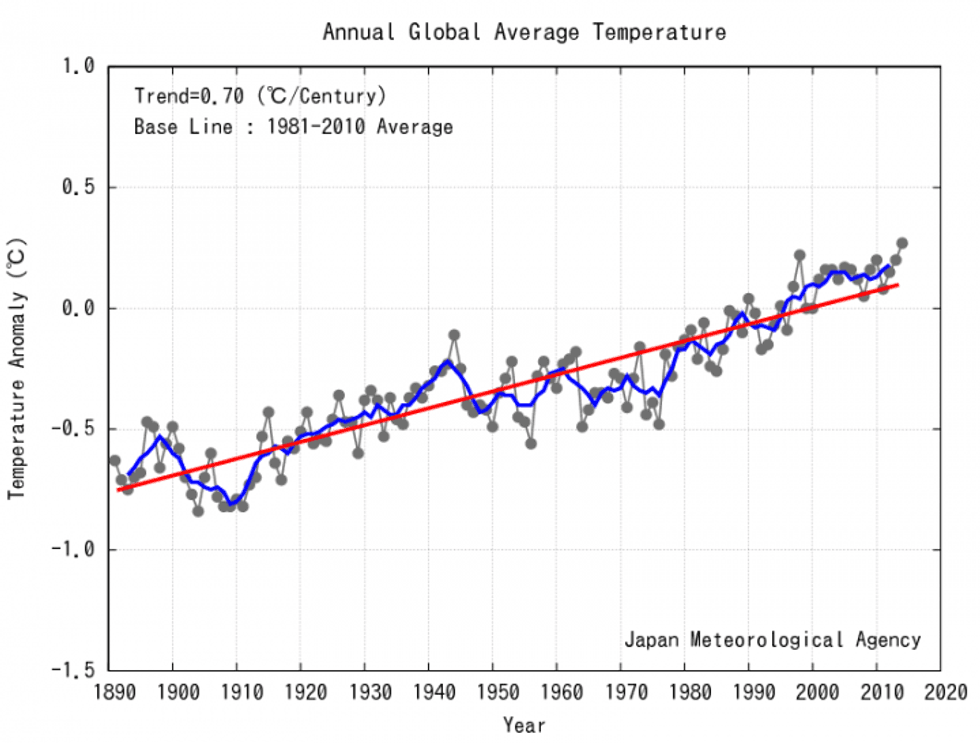
It’s official: 2014 has taken the title of hottest year on record. That ranking comes courtesy of data released Monday by the Japan Meteorological Agency (JMA), the first of four major global temperature recordkeepers to release their data for last year.
The global average temperature record from 1891-2014.
The average temperature was 1.1°F above the 20th century average according to JMA’s data. That edges 1998, the previous warmest year, by about 0.1°F.
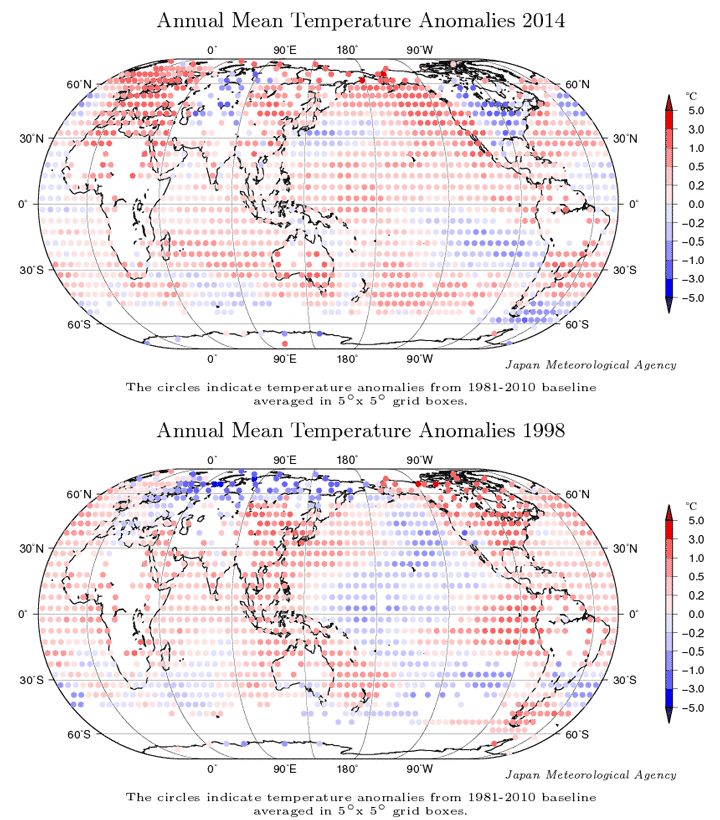
One big difference between 2014 and 1998 is that the latter was on the tail end of a super El Niño, which has the tendency to spike temperatures. In comparison, 2014 was the year of the almost El Niño.
Instead, record warmth in other parts of the Pacific as well as the hottest year on record in Europe were some of the main drivers in fueling the heat. Joe Romm of Climate Progress also notes that heat in Australia early in the year and California’s hottest year further contributed to the heat.
A comparison of 2014, the hottest year on record, and 1998, the previous record holder.
Credit: JMA
Seasonal temperatures also paint a picture of a planet that didn’t get a break. Spring, summer and fall were all record-setting hot. Last winter was the only season not to set a record, and even that was still the sixth-warmest winter.
JMA is one of the four major groups that use both ground measurements and satellites to compute the planet’s average temperature. The other three include NASA and the National Oceanic and Atmospheric Administration in the U.S. and the Hadley Center in the U.K. There are subtle differences in how they analyze temperature data, but there’s generally broad agreement, particularly the upward trend in temperatures over the past century.
The other groups are expected to release their data in the coming weeks and confirm that 2014 was indeed the hottest year on record. And some scientists think it could get even hotter sooner. Strong trade winds in the Pacific have likely had a dampening effect on the global average temperature by essentially allowing the ocean to store more heat, but those winds are expected to weaken in the near future as part of a natural fluctuation.
A member of the West Virginia Board of Education won a victory for climate-change deniers, as he convinced the board to alter the language of its K-12 science education standards to teach climate change as a controversy, The Charleston Gazettereports.
Wade Linger -- at whose behest the changes were made -- said that they are meant to encourage debate as to whether humans are the driving force behind climate change, and that the original standards attempted to forestall that debate by asking leading questions.
"There was a question in there that said, 'Ask questions to clarify evidence of the factors that have caused the rise in global temperatures over the past century,'" Linger said. "If you have that as a standard, then that presupposes that global temperatures have risen over the past century, and, of course, there’s debate about that."
Linger's Facebook page, however, indicates that he does not believe there is a debate:
In the comments below that post, Linger wrote that "[t]he world isn't warming. Scientists measuring surface temperatures and atmospheric temperatures using satellites -- including scientists who believe in the global warming theory -- say the Earth hasn't warmed since the Clinton administration."
"Global warming believers change their predictions," he continued. "As their temperature predictions have not come true, activists have desperately started blaming global warming for hurricanes, tornadoes and even cold weather. But climate has natural variations, hurricanes and tornadoes have not increased, and snow and colder winters don't prove global warming."
The new curriculum standards reflect Linger's belief that climate change is caused by such "natural variations," as the new version asks students to "[d]bate climate changes as it relates to natural forces such as Milankovitch cycles, greenhouse gases, human changes in atmospheric concentrations of greenhouse gases, and relevant laws and treaties."
Citing Milankovitch cycles as a possible cause for recent global temperature trends is a favorite tactic of climate-change deniers, but there are many problems with applying that theory to variation on the geologically brief time-scale of human history.
The real issue for Linger and his supporters, including fellow board member Tom Campbell, is that climate change is an "unproven theory" that is particularly detrimental to a West Virginia interest -- the coal industry.
When asked why he and Linger were focused on climate change as an "unproven theory" -- instead of similarly "unproven" theories that are almost universally accepted in the scientific community, such as gravitation or plate tectonics -- Campbell replied that "West Virginia coal in particular has been taking on unfair negativity from certain group," and "I would prefer the outlook [to] be, 'How do we mine it more safely and burn it more cleanly."
"But I think some people want to do away with it completely."
Let's jump forward in time a little. At some imagined point in the not too distant world, advances in robotics and artificial intelligence have seen massive growth. In almost every home, humans rely on robots to carry out everyday tasks. You have your favorite robot. Of course you…
An attorney and animal rights activist has failed in an attempt to have a chimp released from captivity using human rights laws. Steven Wise tried to employ habeas corpus to have a chimp held in private captivity moved to a sanctuary. Habeas corpus is designed to allow prisoners…
Children who have access to tablets or smartphones in their bedrooms get less sleep than children who do not have the devices with them at night, a US study said Monday.
The findings in the January 5 edition of the journal Pediatrics show that having a so-called "small screen" within reach was slightly worse than a television set when it came to sleep deprivation in a group of 2,000 middle school kids.
Overall, those with access to smartphones and tablets got nearly 21 fewer minutes of sleep per night than children whose rooms were free of such technology, and they were more likely to say they felt sleep deprived.
Those with a TV in the bedroom got 18 minutes fewer of slumber than kids without televisions in their rooms.
"Presence of a small screen, but not a TV, in the sleep environment, and screen time were associated with perceived insufficient rest or sleep," said the study led by Jennifer Falbe of the University of California, Berkeley School of Public Health.
"These findings caution against unrestricted screen access in children's bedrooms."
Participants in the study included 2,048 fourth- and seventh-graders enrolled in the Massachusetts Childhood Obesity Research Demonstration Study from 2012 to 2013.
Chemicals are all around us. They are crucial in all manner of industries, from agriculture to food to cosmetics. Most people give little thought to how these chemicals are made – and certainly very few would consider the chemical industry as a contributor to our society’s dependence on oil. But it is.
Historically petroleum has been used to develop the chemicals needed for products such as pesticides, food supplements and make-up. Although many of the building blocks required to make these chemicals occur naturally, trying to take those natural materials and use them in large-scale industrial processes has proved difficult and costly. So petroleum is used instead.
Until recently, oil was seen as a cheap commodity which was available in abundance, so petroleum was perfect for use in the chemical industry. However, the world has changed. We now recognise the need to reduce our reliance on oil in order to protect the environment and maintain our national security. There are also health concerns over the use of petroleum in products we eat and apply to our bodies.
This is why new advanced methods for industrial biotechnology are so important; they are enabling the use of engineered bacterial cells, rather than petroleum, in developing chemicals to be used in these products. Importantly, the bacteria can be grown on a range of cheap and renewable resources, even various kinds of farmland waste.
However, in order to use bacteria effectively – and in a manner which can be scaled up by industry – we need to know a lot more about bacterial cell biology. Only by investigating the machinery and processes at the heart of cells can we learn how to use them to develop organic chemicals in a manner that was previously unfeasible for industry.
Friendly bacteria
At Newcastle University’s Centre for Bacterial Cell Biology we’ve spent years studying Bacillus subtilis, a bacterium that lives peacefully in soil or even in the human gut. This organism and its relatives are very good at making and secreting enzymes which are catalysts for all sorts of useful processes. It means Bacilli are already used widely by industry, for example in producing the enzymes that are used in biological washing powders such as proteases (which break down blood, egg and other protein stains) or amylases (which dissolve starch).
However, the range of enzymes they can secrete efficiently is much more limited than we would like. Studies on fundamental structures and processes of the bacterium are now beginning to give us the ability to engineer the cells to secrete a wider range of proteins from a diverse range of sources.
This means that before long Bacillus will be used to make all kinds of enzymes, including those needed in the chemical industry to replace processes presently dependent on petroleum.
This is a huge opportunity. The European industrial biotechnology industry has an estimated annual turnover of more than €60 billion, and the global industrial enzyme market is predicted to be worth US$7.1 billion by 2018. Detergent enzymes alone make up a billion dollar business.
However, continued reliance on oil-based solutions will hamper growth and could have significant societal and environmental consequences. Replacing petroleum with bacteria will have a real impact on people’s lives.
Algae vs sunburn
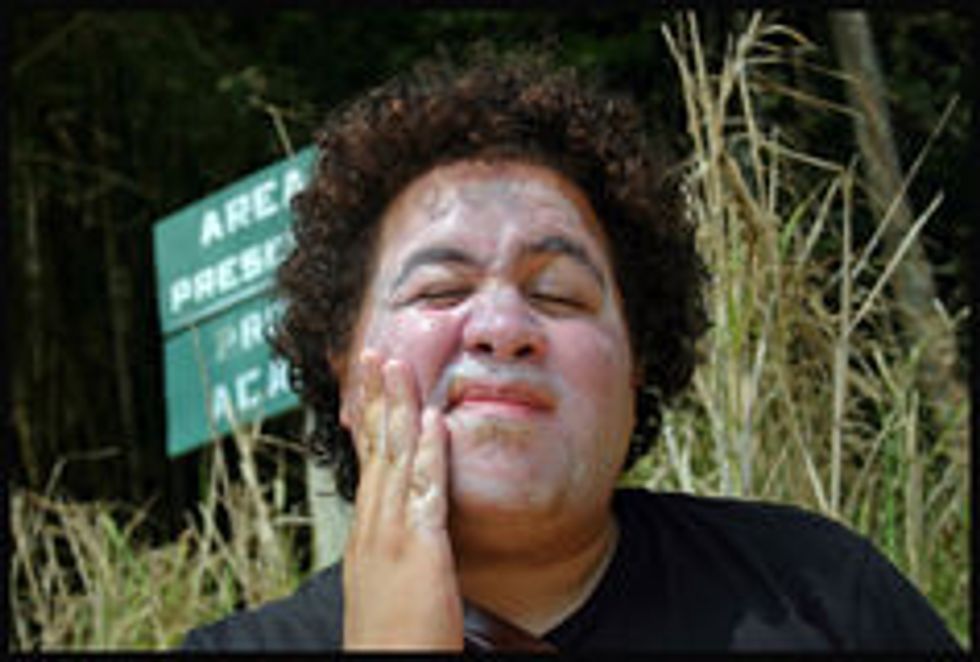
Suncream is a good example. One of the projects we are working on at Newcastle is to develop organic UV-absorber compounds from renewable materials to be used in sunscreens.
Damage from exposure to UV radiation is a major worry, and there is increasing demand for cosmetics that block UV rays. The industry relies on oil-based technology and inorganic metal oxide particles to create materials that block UV rays for use in sunscreen.
However, we know that photosynthetic bacteria called cyanobacteria that grow in the sea make their own organic sunscreen molecules. By taking the relevant genes from cyanobacteria and transplanting them into a bacterium that is already widely used in chemical production, we hope to be able to change this. If we are successful, the process could easily be scaled up so the cosmetics industry will be able to develop cheap organic sunscreen.
This is just one example of the way in which bacteria could support a future without oil. Work is already in progress to explore the potential of using waste to grow bacteria or other micro-organisms that could make chemicals such as ethanol for use as “biofuel” for cars and aeroplanes, further reducing the use of oil.
There is a lot of work still to be done to make this vision a reality, but by continuing to investigate how bacterial cells work and how they could be used in chemical production we can see a future in which waste becomes energy and we can live without oil.
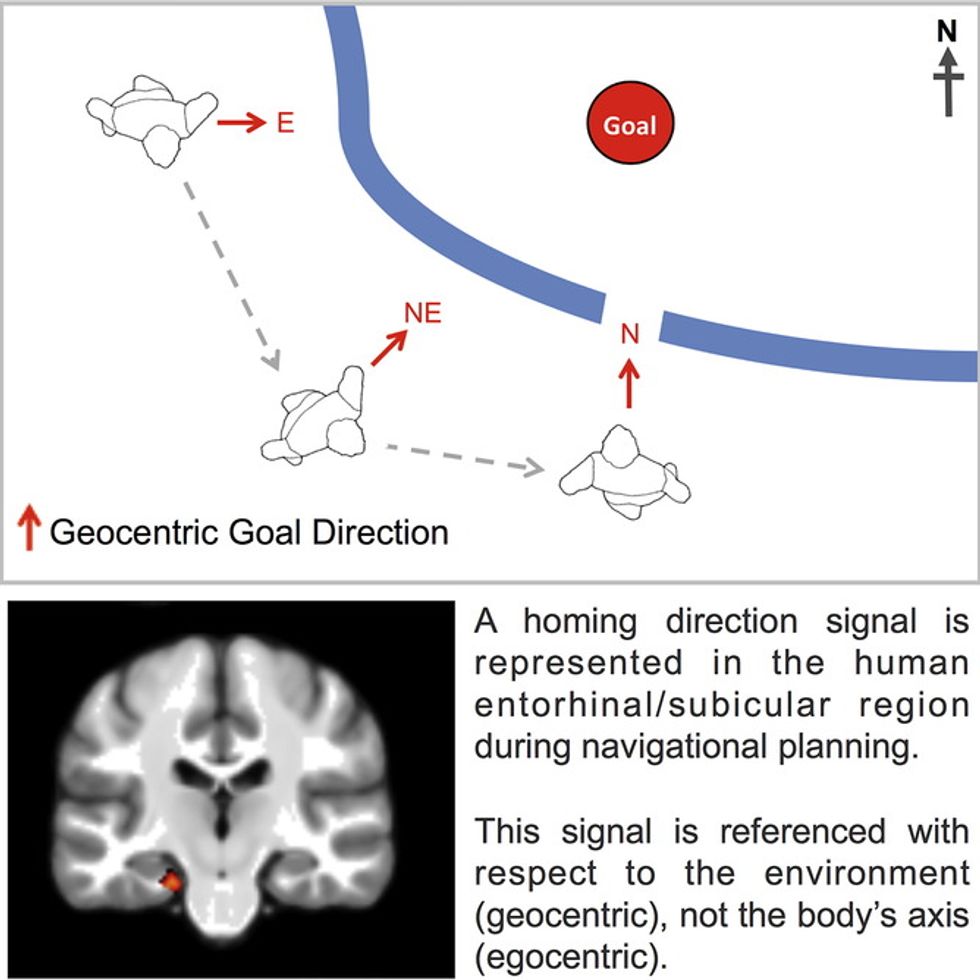
If you have taken a walk and would like to return home you need to have an idea of where you are in relation to your destination. To do this, you need to know which way you are facing and also in which direction home lies. This all seems fairly instinctive to humans and other animals, so how do we manage it?
Our understanding of this surprisingly difficult question has just taken a step forward in a new paper written by Michael Chadwick and colleagues and published in the journal Current Biology, which pinpoints where in the brain our instinctive sense of the direction towards our destination lies.
One way to successfully navigate from any point to a destination is to learn and remember information about your surroundings and use this information to orient yourself. But the process of learning this spatial information suggests there must be some sort of representation of that information stored somewhere in the brain. This could be thought of as a sort of neuronal map – a way of encoding space that maps information about your surroundings onto your brain cells.
A useful sense of direction has to update as you change direction.
Such a map would allow you to find your way around – a vital ability for any animal’s survival. Working out how the brain stores information about space and how this enables us to find our way around efficiently has been the focus of a concerted effort over the past few decades.
Looking for maps in the brain
In the late 1970s, the so-called “seat of the cognitive map” was discovered in rats in an area of the brain called the hippocampus. Particular neurons were shown to fire when a rat travelled in a specific area of an experimental arena. Subsequent work showed that these neurons were tightly coupled to space – they were named place cells.
The question then turned to the nature of precisely what information is learned and remembered. Through a clever set of experiments the rats were found to encode and store information that related to both distance and direction. Information about distance is stored within part of the hippocampus called the entorhinal cortex, the so-called grid cells.
These grid cells fire in a tessellating pattern when an animal travels and seem to operate a bit like graph paper, providing an animal with a sense of the distance travelled. Information about direction is stored in head direction cells, which fire when an animal is facing a particular direction (north, for example).
All these pieces of information are fed into the place cells, which bring it all together – hence why we really can consider the hippocampus to contain our own internal, spatial map. This was so significant to our understanding of how the brain operates that the 2014 Nobel Prize in Physiology was awarded to John O’Keefe, who was the first to identify place cells, and Edvard and May-Britt Moser, who discovered grid cells.
So we have an idea of how animals encode a mental map, and how they know which direction they are facing. But, to make use of this and follow its sense of direction, an animal also needs to know in which direction home lies. The paper’s authors have established where this information is stored in the brain, and how it might be used to orient a human or animal.
An internal compass
In their experiment, human subjects were given a virtual reality environment to explore and learn, and then asked to make judgements about in which direction a destination lay working entirely from memory. At the same time the subjects' brains were scanned using fMRI, which measures brain activity by monitoring changes in blood flow.
By looking at the patterns of which neurons fired in response to the task of navigating their way around, the researchers found the activity was centred on the entorhinal cortex, indicating this was the brain’s “internal compass” and the source of this sense of direction.
Interestingly, the pattern of neuronal firing is remarkably similar when someone is facing in the goal direction to when they simply imagine the direction of the goal. The researchers suggest that the brain can use this property of the neurones to simulate the intended direction in the brain without actually moving. They assume that head direction cells switch from one role to another, so that they are initially involved in representing the current heading direction, before switching to simulating the goal direction. In this way, the neurones can aid in planning the route home.
The strength of the activity in this region of the brain is linked to a person’s navigational skills: less activity means a less accurate sense of direction. It’s also the area of the brain that is one of the first damaged by diseases such as Alzheimer’s, which may explain why becoming lost and confused is a common early problem in sufferers.
There are at least four reasons people are trying to cut down on meat: their health, the environment and the treatment of animals and workers. Not everyone gets a pang in their heart when they see how today's factory farms treat "animal units," but no one today actually thinks meat is good for you. The best that cancer and heart groups will say about meat is it is not too harmful if you seriously limit portions.
Yet, to produce a less-than-healthful food product, an industry is tolerated that contributes to global warming, water pollution and fish kills, appalling and often under-reported worker abuse and animal abuse and even harm to the economy. It is no secret the U.S. government enables low meat prices to help the meat sector while telling us to abstain from meat and dumping meat on the poor. During the recession of 2009, the National Association of State Departments of Agriculture rolled out a "Meat the Need" plan to dump what it called the "oversupply" of meat on SNAP recipients. Nice. The government also helps private ranchers with our tax dollars by killing birds, foxes, coyotes and other wildlife that "threaten" the cattle industry.
Now, a new community group is hoping to unite all the people who for economic, ethical, health and environmental reasons want to cut down on meat under the umbrella term "reducetarian." Reducetarianism is "an identity, community, and movement. It is composed of individuals who are committed to eating less meat--red meat, poultry, seafood, and the flesh of any other animal," says the website. "The concept is appealing because not everyone is able or willing to completely eliminate meat from their diet.
"In a thought-provoking TED lecture 25-year-old reducetarian movement co-founder Brian Kateman addresses the gulf that happens when two people meet for lunch and one is vegan--it "changes their perception of each other forever," he notes. Even if the non-vegan luncher is "semi-vegetarian," "mostly vegetarian" or "flexitarian," there is often a "pulse of discomfort" says Kateman and the terms become a "boxing match for moral superiority." Yet, by the new movement's definitions, both lunchers are reducetarians.
"Identifiers such as semi-vegetarian and flexitarian sound weak and inconsistent and describe individuals who primarily eat fruits and vegetables with the occasional inclusion of meat," Kateman told me in an email. Reducetarians, on the other hand, view each meal as a choice and the movement "encourages people to gradually eat less meat with respect to their own diet."
Since its launch, Reducetarianism has received support from Steven Pinker, Peter Singer, Dan Gilbert, Michael Pollan, Maria Elia, the celebrity chef and author and many other well-known figures.
"I love meat. I love big juicy steaks, crispy fried chicken, and soft tender pork. But you know what else I love? Rich creamy eggplant, crunchy sweet snap peas, and buttery, salty potatoes. Also seitan. Have you had it? It totally crushes tofu," says Dan Pashman, host of The Sporkful food podcast and author of Eat More Better: How To Make Every Bite More Delicious on the Reducetarianism website.
In a phone interview I asked Kateman why the sad and gory factory farming Web photos make some people renounce meat but leave others unmoved. The photos can be persuasive, he told me, but meat eating is very entrenched in our culture. People can also find cutting down on meat "impractical" because they lack access to healthy foods or they lack knowledge about better eating. Also, he said in his TED lecture, the commitment to cutting down on meat can waver as people have "carnivore" moments or smell bacon frying.
The reducetarian campaign is unique in addressing the value of eating less meat from an ethical, environment and human health perspective, rather than focusing on a single issue, summarizes Kateman. Every person trying to reduce meat consumption and mindful about their next meal is part of the reducetarian movement he says. They can take a pledge to eat less meat for 30 days and share photos of their meatless meals using the hashtag #lessmeat and tag @reducetarian.
If this is the year you are looking for an online love connection, start today. Why? Because the first Sunday after New Year's Day is annually the busiest day of the year for online dating. Meaning: Tonight's the night! Using data gathered from traffic in previous years, the…
Men who find themselves in the company of fertile women are more likely to make creative attempts at sentence structure to signify their mating fitness, a study has found.
Researchers discovered that when young men talk with a woman who is in the fertile period of her menstrual cycle, they react to small changes in her facial skin tone, vocal pitch and scent. The changes activate their mating goals and cause them to shift the way they speak.
Conversational partners often align their linguistic choices to demonstrate affiliation, but when men talk to fertile women they are less likely to copy their sentence structure - and more likely to try to stand out, the researchers found.
Their study, led by Michael Kaschak, an associate professor of psychology at Florida State University in Tallahassee, is published in the journal PLoS ONE.
In one experiment, they studied 123 male college students as they took turns interacting with five female college students at different times in their menstrual cycles.
After getting to know each other, the men and women had to give one-line descriptions of a group of drawings.
When the women were at the low point of their menstrual cycle, the men mimicked their sentence constructions 62% of the time. When they were at their peak, the men did so 49.7% of the time.
The results reflected the idea that men may use “non-conforming behaviour” to stand out to potential mates, the researchers said, but was “at odds with a wide range of data suggesting that attraction to a conversational partner should lead to an increase in matching behavior”.
Dr Kaschak said that “being creative is a way of showing one’s mental acumen. Within the context of our experiment, non-aligning sentence structures may be used as a way of showing creativity or non-conformity so that you can stand out a bit.
“We’ll need to do more research to pin down the motivations more precisely - for example, is it creativity, non-conformity, or some combination of both, that is motivating the behaviour?”
Although he did not ask the men in the study if they knew what they were doing, Dr Kaschak said that “structural repetition effects are virtually always unconscious; participants have no idea that they are repeating the syntactic structures of their conversation partner. I’d bet that the same is true for the men in our studies.”
Nenagh Kemp, a lecturer in the School of Psychology at the University of Tasmania, said there was ample evidence that under normal circumstances, someone else’s choice of sentence construction can influence our own.
“If we hear someone else describe a scene as “The teacher is reading a book to the children”, we’ll be more likely to describe a subsequent scene with the same grammatical pattern, for example, saying “The farmer is giving some hay to the horses”, rather than “The farmer is giving the horses some hay”.”
The research extended current thinking about the attractiveness of non-conforming behaviour by showing how men would switch between different grammatical constructions when engaging with women.
“It seems that men can show off their potential as a partner by structuring their sentences a little bit differently, and that this propensity varies according to how receptive the woman appears.”
Czech archaeologists have unearthed the tomb of a previously unknown queen believed to have been the wife of Pharaoh Neferefre who ruled 4,500 years ago, officials in Egypt said Sunday.
The tomb was discovered in Abu Sir, an Old Kingdom necropolis southwest of Cairo where there are several pyramids dedicated to pharaohs of the Fifth Dynasty, including Neferefre.
The name of his wife had not been known before the find, Antiquities Minister Mamdouh al-Damaty said in a statement.
He identified her as Khentakawess, saying that for the "first time we have discovered the name of this queen who had been unknown before the discovery of her tomb".
That would make her Khentakawess III, as two previous queens with the same name have already been identified.
Her name and rank had been inscribed on the inner walls of the tomb, probably by the builders, Damaty said.
"This discovery will help us shed light on certain unknown aspects of the Fifth Dynasty, which along with the Fourth Dynasty, witnessed the construction of the first pyramids," he added.
Miroslav Barta, who heads the Czech Institute of Egyptology mission who made the discovery, said the tomb was found in Neferefre's funeral complex.
"This makes us believe that the queen was his wife," Barta said, according to the statement.
An official at the antiquities ministry said the tomb dated from the middle of the Fifth Dynasty (2994-2345 BC).
Archaeologists also found around 30 utensils, 24 made of limestone and four of copper, the statement added.
The first 2015 comet visible to the naked eye can be seen streaking across the sky for most of January, Slate's Phil Plait reports.
The comet, C/2014 Q2 (Lovejoy) will reach its peak visibility on January 7, when it passes about 44 million miles from Earth. It will also be easy to locate, as it will begin its journey across the sky near the foot of the constellation Orion and continue through Taurus and Aries.
The optimal viewing time, Plait wrote, is after 9 p.m. local time, when the comet will be high above the horizon. But as the month progresses and the moon wanes, it should be visible even earlier -- and be bright enough even to be seen with the naked eye even in cities with low- to moderate levels of light pollution.
As its name indicates, the comet was first spotted by amateur astronomer extraordinaire Terry Lovejoy, whose modifications of early digital cameras for use in astrophotography created a generation of amateur comet-hunters. In 2011, he discovered C/2011 W3, becoming the first ground-based astronomer to discover a Kreutz Sungrazing comet in over 40 years.
He disocovered C/2014 Q2 -- the comet currently bearing his name -- near the constellation Puppis on August 17, 2014. The comet itself has a long-period orbit -- passing around the Sun every 14,000 years, so this will be the only opportunity to see it in pass the Earth in so spectacular a fashion.
Watch time-lapse footage of the comet in the night's sky via Phil Hart below.




 By
By