




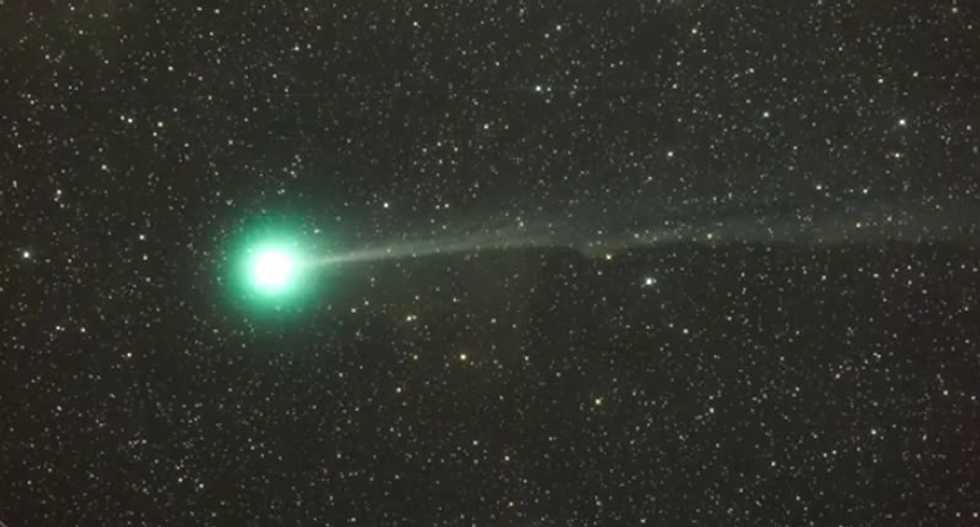
The first 2015 comet visible to the naked eye can be seen streaking across the sky for most of January, Slate's Phil Plait reports.
The comet, C/2014 Q2 (Lovejoy) will reach its peak visibility on January 7, when it passes about 44 million miles from Earth. It will also be easy to locate, as it will begin its journey across the sky near the foot of the constellation Orion and continue through Taurus and Aries.
The optimal viewing time, Plait wrote, is after 9 p.m. local time, when the comet will be high above the horizon. But as the month progresses and the moon wanes, it should be visible even earlier -- and be bright enough even to be seen with the naked eye even in cities with low- to moderate levels of light pollution.
As its name indicates, the comet was first spotted by amateur astronomer extraordinaire Terry Lovejoy, whose modifications of early digital cameras for use in astrophotography created a generation of amateur comet-hunters. In 2011, he discovered C/2011 W3, becoming the first ground-based astronomer to discover a Kreutz Sungrazing comet in over 40 years.
He disocovered C/2014 Q2 -- the comet currently bearing his name -- near the constellation Puppis on August 17, 2014. The comet itself has a long-period orbit -- passing around the Sun every 14,000 years, so this will be the only opportunity to see it in pass the Earth in so spectacular a fashion.
Watch time-lapse footage of the comet in the night's sky via Phil Hart below.
