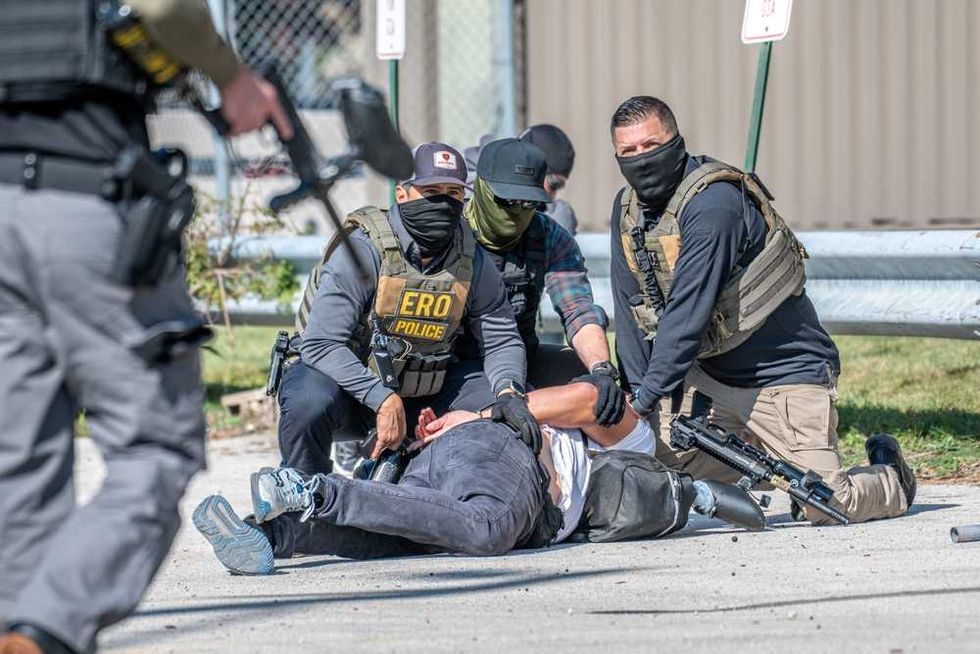
Broadview, Illinois, USA - 09-26-2025 Protest at the ICE processing center where many immigrants are kept and transported to the airport terminal to be flown to detention centers or deported. (Photo credit: Peter Serocki / Shutterstock)

On Nov. 4, the Oklahoma City-based Federal Transfer Center held 1,403 prisoners, nearly 31% above its documented design capacity. The population had jumped by 195 prisoners in 20 days between Oct. 15 and Nov. 4.
That strain comes as the U.S. Marshals Service tries to develop a second major prisoner airlift hub in Kansas City, an effort intended to improve the national prisoner transportation network by adding another operating site closer to Oklahoma City.
The Marshals Service had already warned that President Donald Trump’s immigration enforcement expansion was making it harder to secure detention beds for that effort while also increasing demand on the Marshals Service’s own prisoner housing and transportation system.
The overcrowding at Oklahoma City matters because the center anchors the national system for moving federal prisoners, and the Marshals Service’s plan to relieve it with a second hub in Kansas City has stalled. The agency says ICE’s enforcement expansion has made detention beds near that airport hard to secure, even as it has offered to restart a transportation partnership with ICE.
The Oklahoma City facility is integral to the nation’s federal prisoner airlift operation.
Run by the Federal Bureau of Prisons, the Federal Transfer Center temporarily houses prisoners awaiting transportation between courts, jails and prisons aboard aircraft operated by the Marshals Service’s Justice Prisoner Air Transportation System.
The Marshals Service also moves federal defendants awaiting trial or sentencing, people held for other federal agencies, and state, local and military prisoners on a reimbursable basis.
JPATS’ principal Air Fleet Operations Center is based at Will Rogers World Airport in Oklahoma City, alongside the detention and transportation infrastructure supporting the nearby FTC.
The strain matters because delayed prisoner movements can have consequences beyond crowded facilities and disrupted flight schedules.
A February 2024 Justice Department inspector general investigation documented a prisoner held for four months at the Oklahoma City FTC during pandemic-related transportation disruptions.
Staff told investigators that before the pandemic, prisoners awaiting transfers typically stayed two days to two weeks.
Investigators also found that prisoners confined there for extended periods had less access to programs, recreation, personal property and care than those in conventional federal prisons.
The same investigation found that five of seven prisoners who died by suicide at the Oklahoma City center during fiscal 2014-2021 had been housed alone. The report did not establish that prolonged confinement caused those deaths.
An independent April 2024 audit found that the FTC’s average daily population during the preceding 12 months was 1,269, approximately 18% above its 1,072-person design capacity. On March 5, 2024, the first day of the audit, 1,387 prisoners were at the facility.
The Marshals Service acknowledged in a fiscal 2027 budget justification that Immigration and Customs Enforcement’s expanding enforcement mission is straining detention capacity by making beds harder to secure near Kansas City, where JPATS has been trying to establish another major transportation hub since 2023.
“Due to the current ICE [Enforcement and Removal Operations] mission expansion, paid bedspace near MCI has been difficult to obtain,” the Marshals Service said, referring to Kansas City International Airport.
A separate Marshals Service fiscal 2027 budget justification shows the pressure extends beyond Kansas City. According to the agency, the then-acting homeland security secretary expanded the Marshals Service’s authority in January 2025 to support immigration enforcement.
The Marshals Service said “immigration-related arrests create immense pressure” and that “without additional funding, the [Marshals Service] could turn into a ‘bottleneck’ in the federal criminal justice process.”
The agency requested $152 million and 533 additional positions to support increased immigration enforcement.
For prisoner operations, the agency said increased immigration enforcement is expected to increase the number of people entering Marshals Service custody, creating additional demands for detention beds, medical care and both ground and air transportation.
JPATS has already provided some transportation support connected to immigration enforcement, including court-ordered removals and cross-border coordination with the Department of Homeland Security and ICE.
The Marshals Service said it expects that work to continue for detained noncitizens and people facing federal immigration charges.
Oklahoma City’s prisoner transportation infrastructure extends beyond the federal transfer center.
A 2013 Marshals Service detention agreement with the Grady County Jail in Chickasha provides for housing federal prisoners and transporting them to JPATS. It also identifies ICE and the Bureau of Prisons as authorized users.
The agreement listed an estimated 330 federal beds at Grady County, including 300 for men and 30 for women.
A July 2025 analysis of federal detention records by the Prison Policy Initiative found that Grady County held an average of 355 Marshals Service prisoners daily in January 2025 and 369.5 in April, both above the number of federal beds contemplated in the published agreement.
The arrangement illustrates how Oklahoma City’s airlift depends on federal and county detention facilities working together.
That combination is precisely what the Marshals Service has struggled to recreate in Kansas City.
In September 2023, the agency moved an aircraft and 13 positions from Las Vegas to Kansas City, expecting to house prisoners awaiting transportation at the federal prison in Leavenworth, Kansas.
But the Bureau of Prisons capped the number of Marshals Service prisoners it would accept and restricted airlift transfers to once a week, according to the agency’s fiscal 2024 annual report, released in January 2025.
The Marshals Service turned to the Greene County Jail in Springfield, Missouri, for temporary housing.
In February 2025, the jail began accepting ICE detainees under an amended federal detention agreement.
ICE’s fiscal 2026 detention data show an average daily ICE population of approximately 254 at Greene County, according to an analysis of the agency’s published detention data. By August 2026, the ICE population had reached 413, according to KSMU public radio.
The Marshals Service said the federal prison-and-airport partnership it envisioned around Kansas City International Airport still had not materialized and warned that another operating location might eventually be necessary.
The predicament is compounded by the Marshals Service’s own plans. Even as ICE’s growing detention demands complicate development of the Kansas City hub, JPATS has offered to renew a formal transportation partnership with ICE.
ICE stopped participating in JPATS as a regular paying customer in 2011, although other detention, transportation, and custody arrangements between the agencies continued.
In its April 2026 budget document, the Marshals Service disclosed consultations with ICE leadership about supplementing ICE’s existing contractor-operated aviation services.
“JPATS shared a draft reimbursable agreement with ICE to restart the partnership,” the document states.
The Marshals Service said JPATS had capacity to accommodate ICE detainees on a recurring or surge basis and would consider expanding that capacity if necessary.
The public records do not establish that ICE subsequently signed the proposed agreement or how many detainees, if any, have been transported under it.
It also anticipated incorporating additional detainee movements without fundamentally increasing the airlift system’s reimbursable budget authority.
The Marshals Service did not respond to Oklahoma Watch’s requests for comment about how ICE’s expansion affects detention space.
This article first appeared on Oklahoma Watch and is republished here under a Creative Commons Attribution-NoDerivatives 4.0 International License. 
Report typos and corrections to corrections@rawstory.com.
For customer support contact support@rawstory.com.