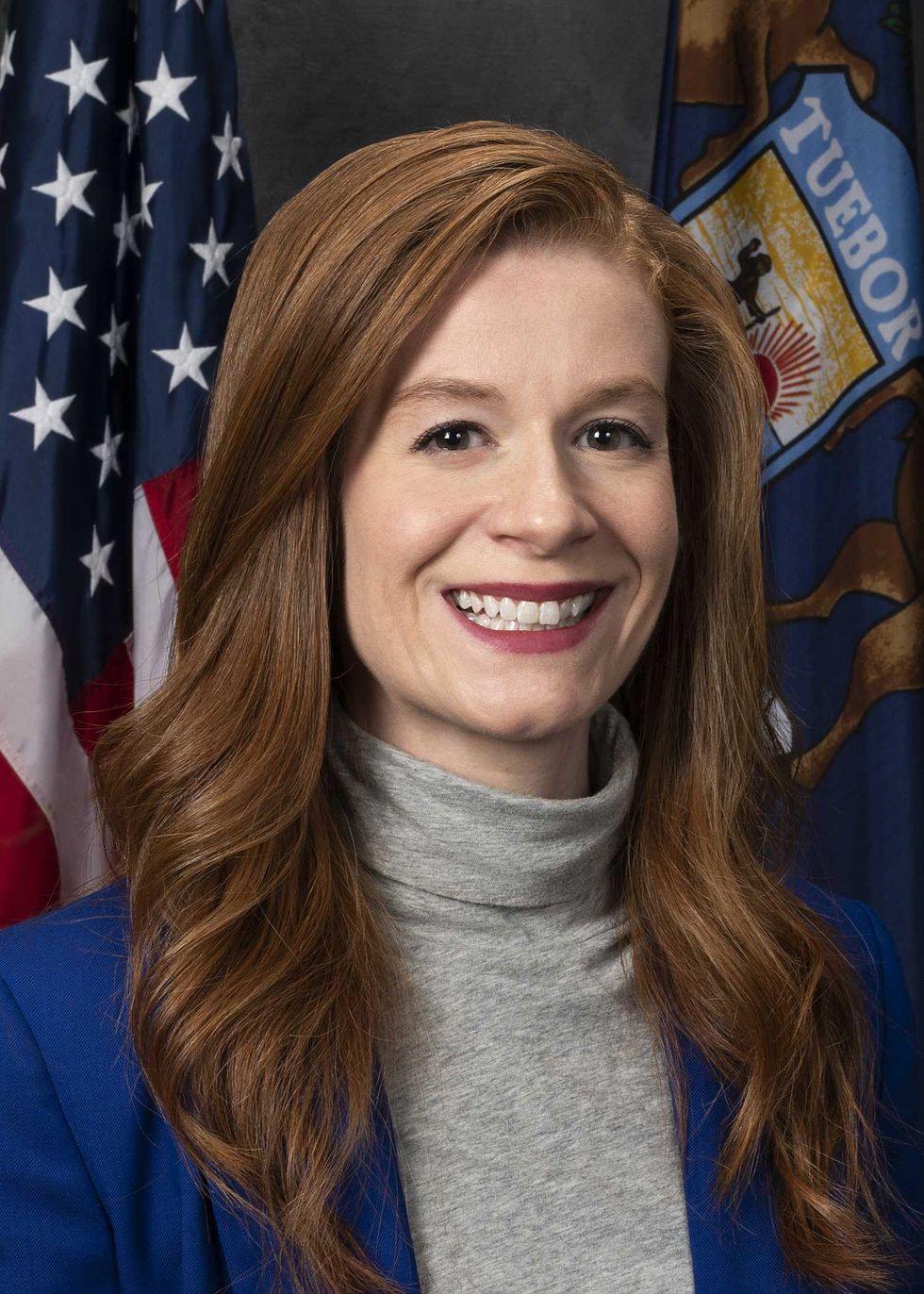
Democratic State Sen. Mallory McMorrow (official photo)

Wedgewood Polls was among several firms that released data during the 2026 Democratic primary race for the U.S. Senate showing state Sen. Mallory McMorrow trailing her opponents by a wide margin and Abdul El-Sayed — the eventual nominee — well ahead of his chief rival, U.S. Rep. Haley Stevens of Birmingham. But Wedgewood now says the poll’s data was fake and was an “experiment” designed to be a “wake-up call” to voters about the vulnerabilities of modern polling.
Wedgewood made the admission after election analysis website FiftyPlusOne said Tuesday that it had launched an investigation into how the firm had conducted its survey research.
A poll released by Wedgewood Polls on June 24 showed El-Sayed ahead of the pack by 46%, Stevens at 39% and McMorrow with a low 9% potential vote share. That same poll showed McMorrow as the only candidate unable to beat Republican nominee Mike Rogers in the fall.
McMorrow, who eventually bowed out of the primary race July 5, addressed the controversy on X Tuesday, saying that the Wedgewood “experiment” had a real impact on her campaign and its endgame decision to leave the race.
“Donations dried up. Volunteers were devastated and pleading for guidance on what to do,” McMorrow wrote. “Reporters hounded me with calls to drop out. Sure, a point was proven. Polling is broken. But tens of thousands of people poured their hearts, time, energy, hard-earned money into something they believed in — for a year-and-a-half, and it was treated like a game. Our volunteers gave their all. And then some. I felt like I had let so many of them down.”
As one of the candidates featured in these polls – the infamous one in late June that showed me plummeting into single digits (which was at odds with our internals) – here’s the impact of this “experiment”
– Donations dried up
– Volunteers were devastated and pleading for guidance on what to do
– Reporters hounded me with calls to drop out
Sure, a point was proven. Polling is broken. But tens of thousands of people poured their hearts, time, energy, hard-earned money into something they believed in – for a year-and-a-half, and it was treated like a game. Our volunteers gave their all. And then some. I felt like I had let so many of them down.
To be extremely clear, Michigan Democrats are locked in to beat Mike Rogers. We WILL send @AbdulElSayed to the US Senate.
But between crap like this, endless fundraising texts that drive supporters away with spammy fake deadlines and trash “match” claims, scam PACs run rampant for firms to grift without actually supporting candidates, undisclosed content creators pushing content out either misrepresenting themselves as residents of states they don’t live in or hiding whether they were paid and by who so they could make a buck, and the tidal wave of dark money ads — I hope Democrats are ready to blow up the system with campaign finance and transparency reforms.
Trust is already at an all-time low. We don’t get out of this mess without rebuilding trust.
And media – who loves to ride the drama of a pollercoaster – needs to take a hard look at what’s legitimate and what’s not.
If this teaches us anything – DON’T GET COMPLACENT AND DON’T TRUST THE POLLS.
LOCK IN. SIGN UP FOR A CANVASSING SHIFT. LEAVE NOTHING TO CHANCE OVER THE NEXT TWO WEEKS.
— Mallory McMorrow (@MalloryMcMorrow) October 21, 2026
For its part, Wedgewood Polls said its fake polling was “to test whether media outlets, aggregators, and commentators would report on data without verifying the source, methodology, or underlying firm legitimacy.”
“Despite having no history, formal credentials, or real data behind the vast majority of our releases, Wedgewood Polls was added to major polling aggregators, including The New York Times, FiftyPlusOne and VoteHub, and repeatedly treated as a legitimate data source,” the firm said in a news release.
FiftyPlusOne wrote that Wedgewood did not respond to a request for information, and followed up with its public statement instead, adding that any assertion that the aggregator hadn’t vetted the polling firm before was false.
“We reached out to them to ask who they were and confirm the methodology statement on their website. We were given two names, Jack Sims and Andrew Prater,” the blog post said. “We were able to independently confirm that Sims had previous experience in the polling industry and reviewed their methodology statement in detail. It is not atypical for a pollster to leave an existing firm, form their own, and self-fund some surveys to build reputation; we had no reason at the time to believe this case was any different. Wedgewood operated as if it were a legitimate polling firm, including collecting money from donors to conduct crowd-funded polls, and sharing raw survey data (which we now have confirmed was fraudulent) with FiftyPlusOne on Oct. 15, 2026.”
In making her statement Tuesday, McMorrow said she wanted to be clear that commenting on the controversy was in no way meant to detract from her support of El-Sayed and that “Michigan Democrats are locked in to beat Mike Rogers. We WILL send @AbdulElSayed to the US Senate.”
“But between crap like this, endless fundraising texts that drive supporters away with spammy fake deadlines and trash ‘match’ claims, scam PACs run rampant for firms to grift without actually supporting candidates, undisclosed content creators pushing content out either misrepresenting themselves as residents of states they don’t live in or hiding whether they were paid and by who so they could make a buck, and the tidal wave of dark money ads – I hope Democrats are ready to blow up the system with campaign finance and transparency reforms,” McMorrow wrote.
She added that “trust is already at an all-time low.”
“We don’t get out of this mess without rebuilding trust,” McMorrow wrote. “And media — who loves to ride the drama of a pollercoaster — needs to take a hard look at what’s legitimate and what’s not. If this teaches us anything — don’t get complacent and don’t trust the polls.
McMorrow also touched on the fact that another polling firm, Mitchell Research and Communications Inc., also had her in single districts during the primary.
The senator from Royal Oak said, “That poll was bull**it — and our team proved it.”
“It was an open SurveyMonkey link that people were able to send around to friends and take multiple times. We expended a lot of capital (and took a serious risk) – calling it out as bull**it. MIRS ultimately declined to publish it because of shoddy methodology,” McMorrow wrote. “But then this one hit immediately after. It was a one-two punch. Then all of the sudden it was a pattern –- and people believed it had to be true. It killed us.”
Michigan Advance is part of States Newsroom, a nonprofit news network supported by grants and a coalition of donors as a 501c(3) public charity. Michigan Advance maintains editorial independence. Contact Editor Jon King for questions: info@michiganadvance.com.
Report typos and corrections to corrections@rawstory.com.
For customer support contact support@rawstory.com.