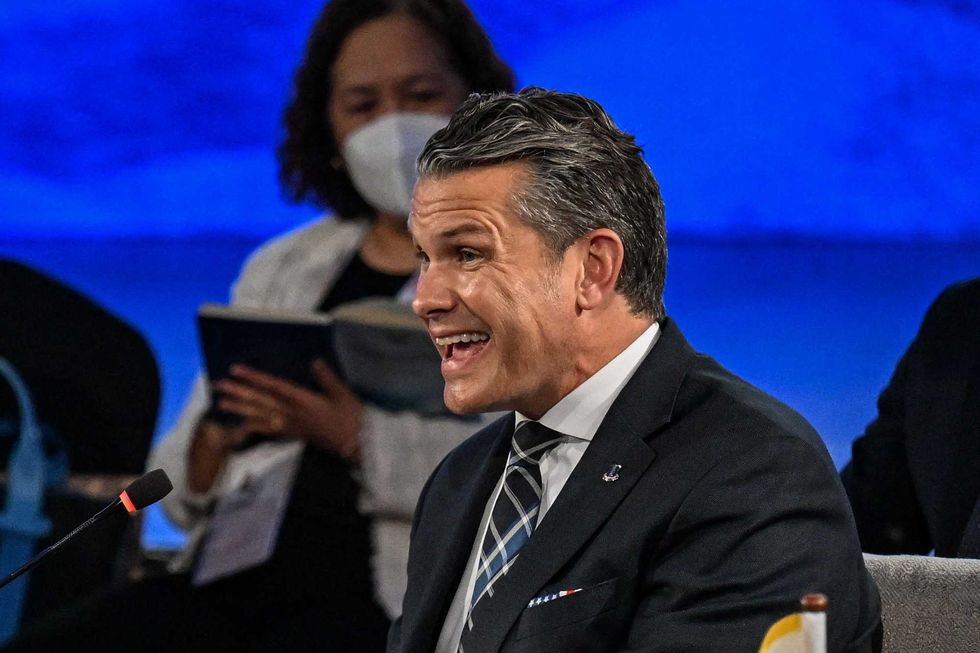
US Secretary of Defence Pete Hegseth delivers his opening statement at the Association of Southeast Asian Nations (ASEAN) Defence Ministers' Informal Meeting in Cebu on October 28, 2026. JAM STA ROSA/Pool via REUTERS

Defense Secretary Pete Hegseth seemed in rare form as he delivered a speech at the Naval War College, according to one military expert.
Tom Nichols, a staff writer at The Atlantic and a former professor at the war college, argued in a new article that Hegseth seemed "unburdened" by facts and logic during his speech. While several points made Nichols wonder what Hegseth was talking about, the speech also offered a useful illustration of what the Trump administration is really after.
"What he delivered was more like an early Festivus 'Airing of Grievances,' in which the secretary of defense unburdened himself about academics, academic credentials, term papers, and education in America in general," Nichols wrote.
Nichols argued that "much of the speech amounted to Hegseth’s usual culture-war performance art." Even so, some revealing moments still mystified him and others in attendance.
"Specifically, he was very angry that the Naval War College refused to study 'failure.' This mystified me and some of the people who still teach there, because the college studies both historical failures (such as Napoleon in Russia) as well as modern American disasters, including Vietnam, the Iraq War, and the global War on Terror," Nichols wrote."They do this as Hegseth claims he wants them to do: dispassionately, much like pathologists talking about what killed a patient, what might have worked as alternatives, and lessons for the future."
"What, then, could Hegseth have been talking about? Trump’s political enemies," he added.
Hegseth took aim at some of Trump's favorite boogeymen during the speech, such as the Covid-19 mandates for the military and the Biden administration's withdrawal from Afghanistan. That made it clear that he was only interested in exacting "revenge on the previous administration," Nichols argued.
"Insofar as Hegseth said anything of substance, it was to insist that the faculty ditch what he sees as an artificial distinction between 'education' and 'training,'" Nichols wrote. "This is odd because the remit of the war colleges has long been the opposite: to wrench students out of the comfort zones of their previous jobs, acclimating them to uncertainty and ambiguity. Their time flying helicopters or driving ships is over. They’re in a classroom to learn how to become officers capable of advising civilians, able to see the links between national goals and military strategy and navigate the policy world."
"Understandably, a man whose Army career topped out at major does not like that idea. Very few majors do, until they’ve spent a year studying at a war college," he added.
Report typos and corrections to corrections@rawstory.com.
For customer support contact support@rawstory.com.