WASHINGTON — Senate Majority Leader Chuck Schumer seems to have overcome a major roadblock in his own party who’s holding up legislation designed to protect children from online harm.
“The majority leader and I have exchanged new text that looks like an improvement to me,” Sen. Ron Wyden (D-OR) exclusively told Raw Story at the U.S. Capitol. “I need to make sure that it protects LGBTQ teens, and, at this point, it looks like we're moving in the right direction.”
While some GOP dissension remains, Wyden’s support is seen as a huge step forward, because he’s had a hold on the broadly bipartisan measure for months now.
Since February, the Kids Online Safety Act (KOSA) has enjoyed the support of a rare, filibuster-proof majority in the U.S. Senate, yet it’s gone nowhere, in part, because of opposition from progressives such as Wyden.
The Oregon Democrat — who chairs the Senate Finance Committee — has been the leading voice in the Senate pushing a more law enforcement-centric response to online harms facing children, which is the centerpiece of the Invest in Child Safety Act that allocates $5 billion to help law enforcement officials combat online threats facing the nation’s children.
KOSA, on the other hand, attempts to put the burden for protecting children on tech companies by limiting things like infinite scrolling, auto play and other subliminal features that keep young and old alike glued to our screens.
What’s changed?
People are regularly talking about online harms lurking in the digital shadows, for one.
Surgeon General Dr. Vivek Murthy, for another, turned heads all week after penning an op-ed for the New York Times calling on Congress to slap warning labels on the social media apps America’s children love most — from TikTok to YouTube.
Long road to protecting kids online
An earlier draft of KOSA was panned widely for erecting a new duty of care — a legal obligation — on state attorneys general that many outside groups feared would allow Republican AGs to target vulnerable communities, such as LGBTQ teens.
In KOSA, that duty of care now rests with the Federal Trade Commission, not partisan state AGs.
But Wyden wants to go further. And Schumer seems to agree.
“After weeks of work, we have made real progress in removing objections to this bill,” Leader Schumer said on the Senate floor Thursday afternoon.
Back in 1996, Wyden was a lead author of the Communications Decency Act, which is now infamous for its Section 230 that acts as the shield protecting social media companies from being sued for content people post on their sites.
While the new KOSA bill text is still a work in progress, it makes “changes to better protect users’ speech as opposed to harmful platform design,” according to Wyden and his team.
In other words, Wyden doesn’t want KOSA to trump Section 230 and its digital speech protections.
“Part of what I've tried to do in tech policy is to be fair to everybody. There are serious issues here,” Wyden said. “My wife and I are older parents. We have twins that are 16. We have a little one that's 11. And it's my job to be fair to everyone. And it’s certainly important to be fair to minorities, you know, LGBTQ teens is an example.”
It’s still unclear if these new tweaks go far enough to win over groups such as the American Civil Liberties Union (ACLU), Electronic Frontier Foundation and Fight for the Future, which have opposed KOSA.
Those groups have remained opposed to the measure even after its lead authors — Sen. Richard Bluemnthal (D-CT) and Marsha Blackburn (R-TN) — unveiled an updated version at the start of this year that attempted to address their censorship concerns.
“After pushing and cajoling, we are much closer to ultimate success,” Blumenthal told Schumer in a colloquy on the Senate floor Thursday. “This bill, which has nearly 70 cosponsors, is a set of safeguards and accountability measures to protect kids from the clear and horrific harms created by social media and other online platforms.”
While Schumer won over Wyden from his progressive left flank, there’s still opposition from his conservative right flank on the other side of the proverbial aisle.
“Sadly, objectors remain. I hope that progress can continue over the coming days,” Schumer said. “If the objectors refuse to come to a resolution, we must pursue a different legislative path to get this done.”
‘Let people sue’
The surgeon general’s calls for new social media warning labels is being embraced by lawmakers across the political spectrum.
But critics say the warning label proposal and Wyden’s tweaks to KOSA still fall short.
Republican senator Josh Hawley. (Andrew Caballero-Reynolds/AFP)
“Good,” Sen. Josh Hawley (R-MO) told Raw Story just off the Senate floor Thursday. “Yeah, good. You know what would be even better though? I mean, the warning label’s fine, but let people sue. You want to change the behavior of these companies, let parents sue them. That would drive change.”
The rank-and-file in both parties are itching to deliver online protections for the nation’s children during the current congressional session.
“Watching governors act in California, New York and Utah, it's clear that this is a priority issue for parents, and I just don't think we're doing our job if we don't act on online safety bills by the end of the year,” Sen. Chris Murphy (D-CT) told Raw Story.
While red and blue states alike have acted to protect children online, the broadly bipartisan measures have all withered on the vine in the U.S. Capitol in recent years.
Senate Majority Whip Dick Durbin (D-IL) says he hopes Congress can piggyback on the surgeon general’s new social media warning for the nation’s kids.
“It's a good vehicle for us to take up this issue. The announcement of the surgeon general makes it timely,” Durbin told Raw Story.
“Do you think because there’s so much broad, bipartisan support we might see this before the election?” Raw Story asked of the filibuster-proof support in the Senate for KOSA.
“I certainly hope so,” Durbin replied. “I'd move on this topic as quickly as possible. American families really care.”
Still, Republicans like Hawley are dubious that Democratic leaders like Durbin and Schumer care.
“The corporations don't want it — tech companies don't want it,” Hawley told Raw Story just feet away from the Senate floor. “So as I've said before, you know, just post the ‘owned by big tech’ sign right there on the Senate doors, because that's the truth. They don't want us to move.”
“Listen, we voted out — unanimously — out of this Judiciary Committee a bill to stop child pornography. And Durbin and I are the co-sponsors — it’s ‘Durbin-Hawley,’ you know. Unanimous support,” Hawley complained of his bipartisan measure to end Section 230 protections specifically for child pornography — a measure that’s never the Senate floor.
For now, even as generative artificial intelligence (AI) continues remaking the internet as we knew it, the Senate continues to work at Senate speed.
“We've exchanged new text,” Wyden told Raw Story. “And I believe we're making some progress.”
Marine Corps veteran and avowed neo-Nazi Jordan Duncan plans to plead guilty to a charge of conspiracy to manufacture firearms, Raw Story has learned.
Raymond Tarlton, Duncan’s lawyer, told Raw Story his client anticipates entering a guilty plea during a hearing scheduled in federal court in Wilmington, N.C., on June 24.
Federal prosecutors filed a superseding charge of conspiracy to illegally manufacture firearms — specifically, a rifle with a barrel less than 16 inches long — against Duncan earlier this month. The charge overrode an earlier indictment with more extensive charges, including one related to an alleged scheme to sabotage electrical substations as part of an alleged plot to launch a race war.
LinkedIn photo of Jordan Duncan, a Marine Corps veteran whom the government alleges had classified military materials on his hard drive.
Duncan had been the last remaining holdout among five co-defendants, the rest of whom had already reached plea deals with the government.
Liam Montgomery Collins, the alleged ringleader of the neo-Nazi terror cell known as “BSN,” entered a guilty plea of conspiracy to illegally manufacture a firearm last October. Co-defendants Justin Hermanson and Joseph Maurino earlier pleaded guilty to the same charge.
Only one of the co-defendants, a former porn actor named Paul Kryscuk, pleaded guilty to conspiracy to damage an energy facility.
The government alleges that Collins wrote on Iron March — an online forum for Nazis that was active from 2011 to 2017 — that he was recruiting for “a modern-day SS,” alluding to the paramilitary organization responsible for security surveillance and state terrorism in Nazi Germany.
Collins recruited Duncan, who trained as a Russian linguist and specialized in intelligence and communications during his Marine Corps service, to join BSN while the two were stationed at Camp Lejeune, according to Naval Criminal Investigative Service Special Agent John Christopher Little. The Naval Criminal Investigative Service is the law enforcement arm for the Navy and Marine Corps.
Collins wrote on Iron March that he was “looking for an intelligence/comm guy for his group,” Little testified during Duncan’s detention hearing.
While Collins completed his military service obligation at Camp Lejeune in late 2020, Duncan joined Kryscuk in Idaho, where the group had held a paramilitary training and hoped to establish a base of operations. While staying with Kryscuk, Duncan worked for a Navy contractor outside of Boise.
When the FBI arrested Duncan in October 2020, they found classified Defense Department materials on his external hard drive, as reported by Raw Story.
A federal magistrate also noted during Duncan’s detention hearing that authorities found a fake ID and a Defense Department passport in Duncan’s possession at the time of his arrest.
Court filings by the government disclosed that the FBI investigated Duncan for potentially mishandling classified materials, but the probe did not result in additional criminal charges. Prosecutors had agreed to exclude any mention of Duncan’s possession of classified documents were his case to go to trial.
Raw Story is suing the Department of Defense and the Navy for access to records about the classified materials investigation.
Tarlton declined to comment on what sentence Duncan, his client, might face. But a court filing indicates that Collins, who pleaded guilty to the same conspiracy to manufacture firearms charge, faces a statutory maximum of 10 years in prison.
Collins, Kryscuk and Hermanson are scheduled to be sentenced on July 23. It remains unclear when Maurino is scheduled for sentencing, and his lawyer, Damon Cheston, declined comment when reached by Raw Story.
Last summer, Judge Richard E. Myers II issued an order that tightly controls how Duncan, Collins and their lawyers may share the classified materials — identified by the marking “FOUO,” or “For Official Use Only” — that were found on Duncan’s hard drive at the time of his arrest.
Look at her 2020 congressional campaign ad where she fires a semi-automatic rifle into targets symbolizing Democratic policy concerns such as climate change and gun control.
“She comes across sometimes like a girl version of Yosemite Sam, just kind of ‘pew, pew, pew, pew,’” said Wendy Davis, a former city commissioner for Rome, Ga., who ran and lost in the 2022 Democratic primary for the 14th District seat. “Not just because of her seemed love of guns, but just that firing off at the slightest thing.”
But the MTG that Americans see on the national stage isn’t always the same fiery character in person. Sometimes she is, but other times she’s “very nice” and asks “politely worded questions,” her constituents tell Raw Story.
MTG in the wild
Raw Story traveled to Greene’s 14th Congressional District to speak with some of her constituents, both Republicans and Democrats, who’ve had an opportunity to see her in-person.
Together, they paint a picture of what the headline-grabbing congresswoman is really like off camera when engaging with her community.
Mary Bramblett, a member of the Floyd County Republican Women, recalled once seeing Greene while Christmas shopping at a local Hobby Lobby with her cousin. Bramblett’s cousin wanted a photo, so they followed Greene around the store, which “she didn’t seem to mind at all,” Bramblett said.
Bramblett also heard Greene speak in-person at a meeting for the Floyd County Republican Women.
“Her speeches, you know how she can become so, well, like Trump? She’s so down to earth … she was great,” Bramblett said. “Very passionate, even the day she spoke to us, she was just so passionate about everything wanting to be more perfect, which is what she said.”
Maggie Combs, another member of the Floyd County Republican Women, said of meeting Greene at the party event, “She's a very nice person. Very, very out front, and that's what matters.”
Nedra Manners, the owner of Yellow Door Antiques and Art and a member of the Floyd County Democratic Party, said she met Greene at a fundraiser in September 2020. Manners described Greene as “fine in person” and “real nice.”
But Greene did question the decision to move the fundraiser from its usual spot on a popular pedestrian bridge to a hotel courtyard where more social distancing was possible during the height of the COVID-19 pandemic, Manners said.
“It was smaller, but tables were spread around, and everybody felt real comfortable out there,” Manners said. “So, I was introduced to her, and we had this magazine that showed the event on the bridge, and her question was, ‘why didn't y'all have it out there this year?’ Because she didn't get it.”
Davis was in the same room as Greene when they both were supervising vote recounts for their respective parties in 2020.
“She has this capacity to be this flame throwing ‘la, la, la,’ loud, loud, loud, angry, mad, ‘everybody else is bad’ energy when she's trying to be in front of a camera,” Davis said. “When she's in smaller spaces, she's smaller. She's more like a regular person.”
Davis said Greene would make comments on camera about how “this election was probably stolen,” but then “she comes inside, and she's just asking legitimate, nicely, politely worded questions, and just watching, right, not making a spectacle of herself.”
Added Davis: “Why do you have to be two different things? Just be who you are.”
Kelly Thurman, an employee with the Murray County Sheriff’s Office, and his wife, Michelle Thurman, a dental assistant and office manager, said Greene frequently visits Murray County in Greene’s sprawling district.
“She believes in values that a lot of small town people have, I guess, and so that's one reason everybody likes her,” Michlle Thurman said. “She likes to stand behind the people themselves. A lot of people don't want to stand behind the people, just the politics. But she's definitely for the people.”
One of the values that Greene best represents in the community is her belief in “gun laws and the right for us to carry,” Michelle Thurman said.
Lamar Wadsworth, chair of the Polk County Democratic Party, said he saw Greene from a distance in the parking lot of a local grocery during her first campaign. He said she spoke from the back of a pickup truck to about 10 people.
“I don't know what attracts people to her except Trumpianity is the dominant religion here, and she’s wholeheartedly in the Trump cult. I don't really remember anything standing out. There’s simply nothing about her that qualifies her,” Wadsworth said. “A lot of people who are just decent people are fed up with her antics. You know, her behavior would get her suspended in middle school.”
Numerous other constituents in Greene’s district previously told Raw Story they’ve never had a chance to meet her and find her presence in the district to be lacking, particularly as her district office is not publicly listed and only available to visit by appointment.
Greene’s spokesperson, Nick Dyer, did not respond to Raw Story’s interview request.
The scene is straight from a discount bin spy novel.
A black SUV arrived at Seattle-Tacoma International Airport to collect Sabrina Keliikoa, a QAnon adherent and supervisor at the facility’s FedEx air freight terminal.
Keliikoa was scared out of her wits.
She did not want to go.
But late on this Friday night in early December 2020, Keliikoa felt as if she had no choice: A retired Michigan State Police officer nicknamed “Yoda” had just warned that her life was in danger.
Keliikoa called in another employee to finish her shift. She entered the vehicle driven by a Marine Corps veteran who had provided security for American diplomats in Iraq. They arrived at a hotel where the driver checked her in. There, Keliikoa stayed for the next two days. A rotating set of “guards” occupied the adjacent room in shifts.
What was possibly happening here?
As Keliikoa would later testify in legal deposition, a video of whichRaw Story recently reviewed, a man entered her hotel room and asked her to write an affidavit about election ballots she’d seen — and considered suspicious — at the FedEx facility shortly after the 2020 election.
The man was part of a secretive team of Donald Trump supporters, operating without legal authority but under the leadership of former Trump national security adviser and retired Lt. Gen. Michael Flynn, that aimed to obtain information they believed could be used in lawsuits to change the outcome of the election in Trump’s favor.
More generally, they hoped to undermine public confidence that Joe Biden had won the 2020 election.
Keliikoa described the experience as being “detained” and complained she became a “pawn” of people determined to use her.
“So, I got a phone call that said somebody is coming in from another state with illegal ballots, and they were going to be looking for me, and they were going to try to kill me,” Keliikoa testified. “And I started crying because this turned into the biggest s---show when it shouldn’t have been.”
The escapade showcases the absurd lengths Flynn and his team went to concoct evidence that Trump had the 2020 presidential election “stolen” from him.
These and other baseless allegations of election fraud would instill fury in Trump’s supporters, who by the thousands attacked the U.S. Capitol on Jan. 6, 2021, while attempting to prevent Congress from certifying the election.
These new revelations about Keliikoa’s ordeal also come at a time when Trump, who is expected to again be the Republican nominee for president, relentlessly claims that the multiple criminal prosecutions against him constitute an effort “to rig the presidential election of 2024.”
Trump’s script is familiar and predictable: He similarly made repeated claims well in advance of the 2020 election that the vote would be rigged. It’s an all-but-foregone conclusion that if Trump loses the 2024 election, he will exclaim, as he did then, that he actually won, and that Democrats, communists, the “deep state” and other perceived bogeymen stole it from him.
And if history is a guide, high-profile Trump surrogates can again be expected to again chase phantom evidence and spin wild tales in service of Trump’s I-can’t-lose approach to campaigning.
‘A plane full of ballots’
Until now, Keliikoa — the woman who held the information so feverishly sought by Trump’s supporters following the 2020 election — was known only as “the Seattle whistleblower.”
Keliikoa’s deposition, taken in March, fills in details about the “stop the steal” escapade and are being reported for the first time by Raw Story.
The seeds of Keliikoa's ordeal began germinating in November 2020. An array of high-profile Trump supporters had initiated a frenzied effort to collect affidavits that they hoped would bolster claims of election fraud, which pro-Trump attorney Sidney Powell detailed in a series of lawsuits.
The goal: overturn the presidential election results in tightly contested states such as Arizona, Georgia and Michigan, and more generally, to undermine confidence in the election.
With his charisma and the respect he commanded as a retired lieutenant general, Michael Flynn, who had briefly served as Trump's national security advisor, quickly emerged as a de facto leader among the group of “stop the steal” operatives surrounding Powell.
The 2020 election was “the greatest fraud that our country has ever experienced in our history,” Flynn told far-right broadcaster Brannon Howse during an interview aired on Nov. 28, 2020. “I’m right in the middle of it right now, and I will tell you that, first of all, the president has clear paths to victory.”
Flynn had reason to feel emboldened. Three days earlier, then-President Trump granted Flynn a full pardon, wiping away his guilty plea to charges of lying to the FBI about his contacts with Russian ambassador Sergey Kislyak.
Flynn began to speak at rallies and make media appearances on Trump’s behalf.
Flynn’s interview with Howse was his first interview of any sort since receiving Trump’s pardon. The key to exposing the election fraud, Flynn told the podcaster, was channeling the perceived power of hundreds of Trump supporters who believed they witnessed voting fraud or election irregularities.
“I mean hundreds and hundreds of Americans around the country, not just the swing states, but many, many other states that are coming forward with their stories and putting them down in affidavits,” he said at the time.
Four days later, Powell addressed a “Stop the Steal” rally in the Atlanta suburb of Alpharetta. There, she angrily told the crowd that there had been “flagrant election fraud,” and said her team had “evidence” of all manner of ballot fraud, including “a plane full of ballots that came in.”
Burk was a former school board member and law school student in Arizona who suffers from a medical condition known as pulmonary arterial hypertension.
A man in Burk’s lung condition support group told her about a woman in Seattle who allegedly had information about illegal ballots. That woman was Keliikoa, and Burk’s lung condition buddy arranged to put the two women in touch.
But Burk first attempted to report Keliikoa's information to the FBI and then relayed it to Arizona state Rep. Kelly Townsend, a leading figure in the pro-Trump stop-the-steal effort. The supposed intel eventually filtered up to Sidney Powell’s legal team.
Burk and Keliikoa kept in touch by phone for the next month, but Keliikoa would later say she wouldn’t characterize their relationship as a friendship. Keliikoa didn’t want to give up her anonymity. Burk felt caught in a bind; she didn’t want to associate her own name with information she didn’t know firsthand, but she was feeling pressure from Townsend and others to persuade Keliikoa to come forward.
“I’ve been working on her coming forward for over a month,” Burk told Carissa Keshel, Powell’s assistant, in a Dec. 1, 2020, text message reviewed by Raw Story. “I almost facilitated a call with you, but she just got to work. She will likely let me do a conference call with anyone. But she’s still afraid to come forward.”
“What can we do to make her feel more comfortable?” Keshel asked Burk. “We can facilitate security.”
Attempting to find a way to obtain the information while preserving Keliikoa’s desired anonymity, Keshel suggested that Keliikoa forward her ballot intel to Burk, who, in turn, could include it in her own legal declaration. (Burk never fulfilled the request to provide such a statement.)
“Ok I just spoke with General Flynn,” Keshel told Burk. “He says if nothing else, if she can get us as much evidence as possible: pictures, facts. If she can send that to us (or you) and if she can even just write an email. Then you can do another declaration to cover for that. I hope that makes sense.”
What happened next demonstrates the effort by Flynn, Powell and a gaggle of pro-Trump activists to obtain affidavits supporting claims of election fraud was carefully orchestrated. It stands in stark contrast to the picture painted by Flynn — one of ordinary citizens organically and voluntarily coming forward to tell their stories out of a sense of patriotic duty.
Like Keliikoa, Burk found herself in the middle of conspiratorial talk surrounding supposed illegal ballots transported on planes and various security concerns.
Also — not insignificantly — if Powell's team was going to get access to Keliikoa, they would have to go through Burk, who was the only one who knew Keliikoa’s name or how to get in touch with her.
Flynn’s security team finds the ‘Seattle whistleblower’
On the morning of Dec. 4, 2020, Keshel texted Burk to tell her that she thought they had Burk’s “security issue all ironed out.”
Keshel then texted a photo of a man she identified as “Yoda” and a link to the website for 1st Amendment Praetorian, a volunteer security group linked to Flynn.
“Yoda” was Geoffrey Flohr, the retired Michigan State Police officer.
“Gen Flynn and his brother arranged the security for you, so I trust them,” Keshel told Burk in a text message.
“Yoda” arrived at Burk’s home in Florence, Ariz., later that day.
As previously reported by Raw Story, Burk has said that “Yoda” woke her up in the middle of the night. He told her that he had reliable information that the “Seattle whistleblower” was about to be kidnapped and taken to South Korea. “Yoda” even claimed that Burk’s friend in Seattle could potentially be killed if they didn’t send a security team to protect her, Burk recalled.
Burk called Keliikoa and put her on speaker phone so “Yoda” could speak to her.
Keliikoa would later testify that she was terrified by “Yoda” telling her about threats to her safety because bad actors were supposedly attempting to prevent her from exposing massive election fraud.
Indeed, she was so terrified that she called in another employee to cover for her and complete her work for the shift.
“And then what ended up happening is continuous phone calls back and forth,” Keliikoa testified. “‘Okay, well, somebody’s gonna send somebody to pick you up and take you to a safe place.’ But my name should have never been out there, and that makes me mad.”
At Burk’s insistence, late on that Friday night in early December 2020, “Yoda” provided Burk with a resume and photo of the driver who would pick up Keliikoa at the FedEx facility at the Seattle airport.
At 11:50 p.m., Burk texted the resume to Keliikoa.
Roland Hurrington — described on his resume as a Seattle-area Marine Corps veteran “responsible for the protection of classified material, equipment and U.S. mission personnel” — arrived at the FedEx facility in the black SUV to transport Keliikoa.
Keliikoa testified that Hurrington passed through a security checkpoint at the facility. How he was able to do that remains unclear, but Keliikoa speculated that the security personnel may have let him through based on the assumption that he was a chauffeur.
The pickup took place late at night — roughly 30 minutes after “Yoda” first spoke to her, according to Burk’s account.
“And then I get detained, taken,” Keliikoa recalled in her deposition. “And I don’t know who this person is. I don’t know where I was going. I can’t believe I actually agreed to go with this person, because they could have killed me and threw me on the side of the road, and nobody would have known.”
As it turned out, there never was a plot to kill Keliikoa.
In fact, while the pro-Trump stop-the-stealers involved didn’t know or admit it at the time, their entire ballot fraud enterprise was little more than a house of cards perched on pillars of sand.
And the ground beneath them was about to start quaking.
‘He fabricated everything’
Jim Penrose, a cyber-security expert who had previously worked at the National Security Agency under President Barack Obama, would later acknowledge to Burk that he was the man who showed up at Keliikoa’s hotel room and urged her to write an affidavit. After “Yoda” tracked Keliikoa down, Penrose went to her hotel room to meet her.
Penrose has been identified by the New York Times as being one of three men who joined Flynn and Powell at the South Carolina estate of defamation attorney Lin Wood to “gather and organize election information.” One of the others was Seth Keshel, a former Army military intelligence captain who was married to Carissa Keshel.
“We had a security team dispatched in Seattle,” Penrose told Burk in a phone call that she recorded on Christmas Day of 2020.
“My worst fear was that the people were moving, you know, like a team of people that might want to, you know, even kidnap your friend in Seattle,” he said. “I didn’t want to let that happen, right, because I thought it was a situation that was dangerous. And we didn’t have enough info at the time to make a better decision.”
The reason why it was necessary for Flohr to wake up Burk involved grave concerns about an Arizona-based security company called Mayhem Solutions Group.
Why would Flohr care so much about this security firm?
Penrose had told Flohr a wild story about two Mayhem Solutions Group employees he believed were planning to fly an airplane to Phoenix to Seattle and potentially “kidnap” Keliikoa and take her to South Korea because of information she might have about election fraud.
The idea that Mayhem Solutions Group would be involved in a plot to harm Sabrina Keliikoa for the purpose of preventing her from exposing anti-Trump election fraud was not only bizarre. It was based on an utter fabrication.
Owner Shawn Wilson and his employee, Kenneth Scott Koch — both far-right operatives — were prone to conspiracy theories. Koch was a member of the far-right group the Oath Keepers and an anti-COVID lockdown crusader. Koch had presented himself to Burk as a shadowy agent for a rogue government operation involved in illegal ballot trafficking.
More than two weeks before the Flynn security team was dispatched to Seattle, Koch had come to Burk’s house in Arizona to advise her on home security. During a discussion about a similar theory concerning illegal ballots being unloaded from a plane at Phoenix Sky Harbor, Koch told Burk that a group of men shown in a photo standing next to the plane were “my guys.”
Koch, who had organized an anti-lockdown group in Arizona in response to COVID-19 measures, went on to suggest to Burk that pro-Trump amateur sleuths attempting to uncover election fraud might learn about more than they bargained.
“A lot of these people want to be the center,” he said. “They wanna have the information. The problem is the information they don’t want.” For reasons that remain unclear, Penrose would hire an investigative team that included two former FBI agents to interview Koch about his claims, but not until after the madcap mission in Seattle to obtain the affidavit from Keliikoa.
“We interviewed Koch at length, and he said he fabricated everything,” Penrose told Burk during the Christmas Day phone call.
A one-time ‘hostile actor’ in Flynn’s camp
Patently ridiculous is the notion that a lie told by an anti-COVID lockdown advocate in Arizona, about illegal ballots on a plane, would trigger a weeks-long wild-goose that reached the highest levels of then-President Donald Trump’s inner sanctum, up to and including his former national security adviser.
In the end, the lead that sent Flynn’s associates to the Seattle airport under the pretext of a manufactured election crisis in December 2020 turned out to be little more than a photo of ballots and unexplained beeping from a package scanner that raised the suspicions of Keliikoa, a woman whose imagination was set alight by QAnon conspiracy theories.
One would not be faulted for thinking that nothing about this fake ballot-hunting story seems real.
Except for the fact that it is real.
It’s unclear whether Koch and his boss, Shawn Wilson, knew Flynn prior to the 2020 election. Regardless, Koch’s admitted deception hasn’t prevented Wilson from associating with the Flynn camp since that time.
The America Project, a nonprofit co-founded by Flynn, published a video in late 2023 that presented Wilson as someone who “knows more about what is going on at the border than probably anybody in America.” (Not mentioned in the interview was the fact that Wilson’s company had subcontracted with the state of Texas to operate buses transporting migrants to Democratic-run cities.)
As Election Day 2024 draws nearer, Wilson has only become more public and overt about his support for Trump.
The messaging in Wilson’s interview for Flynn’s nonprofit was a classic appeal to authoritarianism by invoking fear — part of Trump’s playbook since he launched his first presidential campaign in 2015. Wilson claimed that a military assault similar to the one launched against Israel by Hamas is imminent at the U.S southern border.
The remedy, Wilson suggested, is to ensure that Trump wins the 2024 election, adding, “I’ll be leading the charge with him right behind him.”
‘There was no goldmine’
Keliikoa confirmed her QAnon association, which inspired her ballot skepticism, during her deposition earlier this year.
She allowed that she sent Burk a link to a three-hour documentary video series Fall of the Cabal, which is described by the Anti-Defamation League as “a popular recruitment tool for QAnon followers.”
Keliikoa testified that following the November 2020 presidential election, she became suspicious because “we were moving ballots after places were called.” (That wouldn’t have been unusual, considering that the U.S. Postal Service was under a federal court order to locate and deliver mail-in ballots that hadn’t been received by Election Day.) One package that caused a scanner to triple beep — meaning “that it’s not recognized” — also concerned her.
“I believe that something looked wrong,” Keliikoa testified when asked under oath by Burk whether still believes that she witnessed election fraud at the FedEx facility in November 2020.
But Keliikoa admitted that she had nothing of value to share with the ad-hoc security team that sequestered her in a hotel in December 2020.
“They wanted to know if I knew about a plane coming in with these illegal ballots,” Keliikoa recalled. “I told them, ‘I don’t know what you’re talking about.’ That didn’t come from me. I don’t know what you’re saying.’ They were asking me if I knew about stuff that was going on outside of my workplace. I don’t. I was working. I don’t go out to other places.”
This didn’t stop Powell, who included a “Jane Doe” witness — Keliikoa presumably — on a witness list filed as part of an Arizona ballot lawsuit in support of Trump’s stop-the-steal effort. “Jane Doe,” Powell said at the time, would “testify about illegal ballots being shipped around the United States including to Arizona on or about before Nov. 3, 2020.”
No one was more disappointed by Keliikoa’s statement than Penrose.
“I thought when we exfil-ed her and we got her to write her affidavit, I thought we were going to have a goldmine of information,” he later told Burk, using the spy-craft term “exfiltrate” that means to furtively remove someone from a hostile area.
“There was no goldmine,” Penrose continued. “She had a picture of two ballot bags, and I asked her: ‘Would you know if ballots came across the tarmac from that Korea Air flight?’ And the answer was, ‘I just know what comes in this bay door from the USPS and what goes out these bay doors to get loaded on FedEx planes.’ So, the answer was there was no smoking gun per se with respect to that.”
The band breaks up
These days, few of the people involved want to discuss the Seattle ballot brouhaha, now revealed as a tangle of conspiracy theories, creative fantasies and outright lies — all in service to Trump’s goal of retaining presidential power that he was about to lose.
Reached by Raw Story earlier this month, Penrose’s lawyer John S. Irving said, “We don’t have anything to add.”
Keliikoa declined to comment to Raw Story for this story.
In an email to Raw Story last week, FedEx Media Relations said, “We do not have any comment at this time.”
Hurrington, the Marine Corps veteran who drove Keliikoa in the SUV, could not be reached for comment. Flohr also could not be reached for comment.
Some of the key players involved have also split up.
Keliikoa said in her deposition that one of the men who met her at the hotel told her it would “be in my best interest not to keep in contact” with Burk because she was a “troublemaker.”
Burk told Raw Story this month that Keliikoa had previously told her that it was Penrose who called her a “troublemaker,” but during her deposition, she claimed that she didn’t remember the names of anyone at the hotel.
“That was clearly projection since he was overseeing and directing a group of heavily armed former law enforcement holding my family and me hostage using fear and deception, who then spent months continuing to use that group to manipulate and malign my character to cover for their bad behavior,” Burk told Raw Story.
Flynn and Powell are both defendants in Burk’s lawsuit, along with former Arizona state Rep. Kelly Townsend. Burk accuses the defendants of civil rights violations, false imprisonment, assault, infliction of emotional distress and civil conspiracy.
In a filing seeking to dismiss the lawsuit, Flynn’s lawyers wrote that Burk’s claims are “baseless” and “frivolous,” while denying that their client sent the security team to her house or that he intended that they hold her “hostage.”
But Flynn’s efforts to distance himself from Burk are belied by the fact that Flohr — aka “Yoda,” the ex-law enforcement volunteer dispatched to her home in Arizona — flanked Flynn as part of his security detail when he spoke at a pro-Trump rally in front of the Supreme Court in Washington, D.C., less than a week after he was at Burk’s house in December 2020.
Flynn is currently promoting a documentary movie that portrays him as a victim of political persecution, and Trump has hinted that he may bring his former national security adviser back to public service — and the taxpayer-funded payroll — should he win election to a second term.
Flynn did not respond to repeated requests for comment made by Raw Story through his lawyers.
Last year, Powell pleaded guilty to conspiracy to commit intentional interference with performance of election duties in Georgia.
Burk is suing Koch for fraudulent misrepresentation, invasion of privacy and infliction of emotional distress in the Arizona state courts, separate from her federal claim against Flynn, Powell and Townsend. Representing herself, Burk deposed Keliikoa for her lawsuit against Koch. Last week, Burk filed a motion to consolidate her case against Koch with her federal lawsuit against Powell and Flynn.
Under cross-examination by Koch’s lawyer in March, Keliikoa downplayed her role in giving life to the “ballots on planes” theory.
“The only relevance I have is a lot of people got involved and it turned into, like I said before, a big s---show where a lot of people were involved that should have never even been there, that should have never been involved,” she said. “And I got thrown into the mix like everybody else. I was used as a pawn. That’s what makes me mad.”
Knowing what she knows now, Keliikoa said, she would have never agreed to write the affidavit.
“I thought people really wanted to help,” she said in her deposition. “And now I know otherwise.”
“Nobody really cares,” she added, “because everybody has their own objective.”
* * * * *
Key players
Staci Burk is a former school board member from Arizona who found herself in the middle of a conspiracy theory concerning illegal ballots and airplanes after the 2020 election.
Roland Hurrington is a Marine Corps veteran enlisted to pick up Sabrina Keliikoa at the Seattle-Tacoma International Airport FedEx air freight terminal in December 2020.
Geoffrey Flohr, also known as “Yoda,” is a retired Michigan State Police officer who volunteered for the 1st Amendment Praetorian security group in late 2020 and early 2021. He used Staci Burk to track down Sabrina Keliikoa.
Michael Flynn is a retired lieutenant general who served as national security advisor for President Donald Trump before pleading guilty to lying to the FBI. Trump pardoned Flynn in November 2020, and Flynn emerged alongside Sidney Powell as a key player in the effort to overturn the 2020 election.
Sabrina Keliikoa is a former FedEx supervisor and QAnon adherent who claims to have been detained by a security team linked to Michael Flynn that obtained an affidavit about election ballots observed at her facility shortly around the time of the 2020 election.
Carissa Keshel was a volunteer who served as attorney Sidney Powell’s assistant in late 2020, as Flynn worked with Powell to overturn the 2020 election.
Kenneth Scott Koch is a security contractor formerly employed by Mayhem Solutions Group (now MSG Risk Management & Intelligence) who “fabricated” a story about his involvement in illegal ballot trafficking. Koch organized anti-lockdown protests in Arizona and was a member of the far-right group the Oath Keepers.
Jim Penrose is a cyber-security expert who worked for the National Security Agency under President Barack Obama. He traveled to Washington state to obtain an affidavit from Sabrina Keliikoa.
Sidney Powell is a former federal prosecutor who filed lawsuits in Arizona and other states seeking to overturn the 2020 election based on outlandish claims of voting fraud.
Kelly Townsend is a former Arizona state House member who told Staci Burk it was imperative that the “Seattle whistleblower” (now revealed to be Sabrina Keliikoa) come forward and report her suspicions about illegal ballot trafficking after the 2020 election.
Donald Trump is the former president of the United States who is again running for the presidency in 2024. Many of the actions described in this story were done in Trump’s name.
Shawn Wilson is the president of MSG Risk Management & Intelligence (formerly Mayhem Solutions Group). Jim Penrose told Staci Burk that he was initially concerned that Wilson, along with Kenneth Scott Koch, were “hostile actors” intent on harming Sabrina Keliikoa.
A Republican congressman was as much as five years late reporting his spouse’s stock trades, violating a federal financial disclosure law, according to a Raw Story review of congressional financial records.
Each stock trade was in the $1,001 to $15,000 range involving a variety of companies such as tech conglomerate Alphabet, artificial intelligence company NVIDIA, pharmaceutical giant Eli Lilly and Company and media and entertainment conglomerate Walt Disney and Company.
Members of Congress are required to publicly report — within 45 days — most purchases, sales and exchanges of stocks, bonds, commodity futures, securities and cryptocurrencies as outlined by the Stop Trading on Congressional Knowledge (STOCK) Act, a law passed by Congress in 2012 to defend against conflicts of interest, curb insider trading and enhance public transparency.
Lawmakers only need to disclose the values of their transactions in broad ranges per the financial disclosure law.
Williams’ congressional office did not respond to Raw Story’s request for comment.
This isn’t the first time that Williams has apparently violated that STOCK Act.
Nonpartisan ethics group, the Campaign Legal Center, filed a complaint against Williams and six other members of Congress for failing to properly disclose their stock transactions in 2021, NPR reported. Williams’ 2021 violations involved three undisclosed 2019 stock trades for wife, Patty Williams, totaling up to $45,000.
“In the situation when we filed the complaint, it seems as though the member knew the rule, and therefore, could not say that he didn't understand the rule, and that's why we thought that there needs to be an investigation to see if this was intentional,” Kedric Payne, vice president, general counsel and senior director of ethics for the Campaign Legal Center, told Raw Story in a phone interview.
“If you fast forward now, to a few years after we filed the complaint, it seems to raise questions again, why would you not comply if you know the rule? It’s either you’re trying to hide something, or you just don't care.”
The House Committee on Ethics previously scolded, but decided not to reprimand Williams over concerns about how his auto dealership would financially benefit from an amendment he introduced in 2015, the Center for Public Integrity reported.
'Common error'
Another Republican member of Congress, Rep. Daniel Webster (R-FL), was more than a year late disclosing the purchase of a U.S. Treasury I bond valued up to $15,000.
“We understand this is a common error given that U.S. Treasury Bonds are government securities and wholly distinct from private stock purchase,” Adam Pakledinaz, a spokesperson for Webster, told Raw Story via email. “As soon as the requirement was brought to Rep. Webster’s attention, we worked with the Ethics Committee to immediately file the necessary paperwork. He is in full compliance and has been told no further action is required.”
The standard fine for violating the STOCK Act is $200. Often, the fee is waived by the House Committee on Ethics and Senate Select Committee on Ethics. As for consequences for both Williams and Webster, “there’s no reason to think that there'll be anything other than a $200 late penalty at most,” Payne said.
“The rules are clear that Treasury bonds need to be reported, and it’s because voters need to know whether there are any potential conflicts of interest with the information that members of Congress are getting and the trades they’re making,” Payne said. “Treasury bonds are directly tied to … how the health of the U.S. market is seen. So if members of Congress know something about what to anticipate about the health of the US economy that’s impacting those trades, the public needs to know.”
Williams and Webster join a growing list of legislators — Republicans and Democrats alike — who have violated the STOCK Act.
Raw Story has now identified at least 48 members of the 118th Congress, including Williams and Webster, who have violated the law.
Numerous bills have been introduced over the past two congressional sessions that would at least in part ban stock trading by members of Congress and their spouses or require stricter punishments for violators.
Such bills include the Ban Conflicted Trading Act, the Ban Stock Trading for Government Officials Act, the Bipartisan Restoring Faith in Government Act, the TRUST in Congress Act and the Preventing Elected Leaders from Owning Securities and Investments Act.
None of these bills have yet been voted upon by either the U.S. House or Senate.
Julie Farnam, who supervised intelligence gathering for the U.S. Capitol Police at the time of the Jan. 6, 2021, attack, has received a subpoena to appear for a deposition by a Republican-controlled House subcommittee investigating security failures that day.
“We are investigating the alleged failures within USCP IICD leading up to January 6 to assess what legislative reforms, if any, are needed,” Rep. Barry Loudermilk (R-GA), chair of the House Administration Oversight Subcommittee, told Farnam in a letter that she received late Friday.
The subpoena sets up a confrontation between two pivotal — if somewhat under-the-radar — figures in the Jan. 6 attack saga, which three-and-a-half years on remains an unresolved matter for many Americans.
Loudermilk personally led a tour of the U.S. House buildings complex on Jan. 5, 2021 — the day before the attack on the Capitol — involving people who traveled to Washington, D.C., to support then-President Donald Trump’s effort to overturn the results of the 2020 presidential election.
Farnam served as assistant director of the Intelligence and Interagency Coordination Division at the Capitol Police at the time of the Jan. 6, 2021, attack.
Farnam previously told Raw Story last that she believes Loudermilk is dragging her before the subcommittee as a way to deflect from his own role in the events of Jan. 6.
“I think he does have some involvement in January 6th,” she said, “and these hearings are designed to distract from the truth.”
A prescient warning
Farnam wrote an intelligence assessment on Jan. 3 that provided a prescient warning about the threat of violence by Trump supporters who were becoming increasingly unhinged due to the looming certification of the election.
“This sense of desperation and disappointment may lead to more of an incentive to become violent,” Farnam’s assessment warned. “Unlike previous post-election protests, the targets of the pro-Trump supporters are not necessarily counter-protestors, as they were previously, but, rather, Congress itself is the target on the 6th.”
Farnam gave a briefing to commanders, including then-Assistant Chief Yogananda Pittman, on Jan. 4, telling them, according to her recollection: “Stop the Steal has the propensity for attracting white supremacists, militia groups, groups like the Proud Boys. There are multiple social media posts saying that people are going to be coming armed, and it’s potentially a very dangerous situation.”
Farnam and others who have previously spoken to the now-disbanded House Select January 6 Committee said there were no questions after her presentation.
Sean Gallagher, now assistant chief of police for uniformed operations, told the House Select January 6 Committee that it was fair to say that Farnam’s warning did not prompt the Capitol Police to make any operational changes.
By the time thousands of pro-Trump protesters began breaching a U.S. Capitol security perimeter on Jan. 6, 2021, U.S. Capitol Police were overwhelmed and unable to stop throngs of people who illegally entered the Capitol complex, and in many cases, injured law enforcement officials, terrorized members of Congress, stole government property and trashed the premises.
Despite Farnam’s efforts to warn commanders of the threat of violence on Jan. 6, the Republican-led subcommittee chaired by Loudermilk has faulted her for the security breakdown at the Capitol that day.
Capitol rioters
Capitol rioters on Jan. 6, 2021, in Washington, D.C. (Photo by Saul Loeb for AFP)
An “initial findings” report released by Loudermilk’s subcommittee in March complained that the most alarming content was “buried” near the end of Farnam’s intelligence assessment, while blaming the intelligence division for leaving the Capitol Police leadership “uninformed and unable to properly plan.”
Meanwhile, the Republican majority has given former Capitol Police Chief Steven Sund, who was aware of the Jan. 4 conference call but did not attend, a sympathetic hearing.
Sund testified before the subcommittee last September that “no intel agencies or units sounded the alarm.”
“We were blindsided,” he said. “Intelligence failed operations.”
Shifting blame away from Trump
The Republican majority’s favorable treatment of Sund compared to Farnam falls under a larger effort to shift blame from Trump, who summoned supporters to Washington, D.C., on Jan. 6 with the promise that it would be “wild.”
Republicans — some of whom have downplayed the violence at the U.S. Capitol altogether — have attempted to shift blame to then-House Speaker Nancy Pelosi, who fled the Capitol alongside other members of Congress as violent Trump supporters disrupted and delayed Congress’ certification of 2020 presidential electoral votes.
The topline of the subcommittee’s interim report accuses the House Select January 6 Committee, which Pelosi appointed, of pursuing a “pre-determined narrative that President Trump was responsible for the breach.”
Instead, the report by the Loudermilk subcommittee blames the attack on the “politicization” of the U.S. Capitol security apparatus. They accuse Pelosi of exerting political pressure on Capitol security operations through the House sergeant at arms, whose duties as chief law enforcement and protocol officer for the House include maintaining order and assessing threats.
The report also includes a section complaining that the House Select January 6 Committee “made unfounded allegations against members of Congress” and “specifically targeted Subcommittee Chairman Barry Loudermilk.”
In a public letter to Loudermilk, Rep. Bennie Thompson (D-MS) noted that video of Loudermilk’s Jan. 5, 2021, tour of the Capitol showed individuals filming hallways, staircases and security checkpoints.
Thompson noted that some of the individuals attended Trump’s stop-the-steal rally at the Ellipse the next day, including one who was captured on video noting that the Capitol was “surrounded” and that the rioters were “coming” for Pelosi and other Democratic members.
The subpoena calls for Farnam to appear for a deposition before the subcommittee at the O’Neill House Office Building on June 21.
Under the subcommittee rules, only Farnam, her lawyer, subcommittee members and their staff, and an official reporter may attend the deposition.
"Aw, such a big man @RepLoudermilk!" Farnam wrote Friday evening in a post on X. "You feel so big and strong? Remember when you were asked to speak to Congress about #J6 and were too cowardly to do so? I do. I'll show for your deposition. One of us has some balls."
Aw, such a big man @RepLoudermilk! You feel so big and strong? Remember when you were asked to speak to Congress about #J6 and were too cowardly to do so? I do. I'll show for your deposition. One of us has some balls. #january6th#insurrection#revisionisthistory — Julie Farnam (@JulieFarnam) June 14, 2024
Farnam — today a candidate in the Democratic primary for an open seat on the Arlington County Board in northern Virginia, which will be decided on June 18 — previously told Raw Story that she is concerned that by deposing her behind closed doors, the Republican majority will be able to cherry-pick her words “and construe it however they want.”
Under the subcommittee rules, the Democratic minority members may object to the selective release of testimony, transcripts or recordings. But such concerns would be resolved by a vote of the subcommittee, where Republicans hold the majority.
The rules provide members of the Republican majority and Democratic minority equal time to question Farnam.
WASHINGTON — In the territory Kevin McCarthy once ruled with a wooden, if limp, gavel, Republicans in the House of Representatives spent the week laughing off the former House speaker for meddling in GOP primaries — then getting walloped.
McCarthy and his allies were dealt a stunning defeat in the Palmetto State when Rep. Nancy Mace (R-SC) turned heads for destroying her Republican primary opponent by some 27 points.
McCarthy’s rarely at the Capitol, but this week, he found his name transformed into a punchline (again).
“Anybody that maintains that level of bitterness for that long, I feel sorry for ya,” Rep. Matt Rosendale (R-MT) — one of the eight who last year helped end McCarthy’s speakership — told Raw Story at the Capitol this week.
McCarthy and his allies dropped more than $2 million on Mace’s race. But from day one, Mace told Raw Story, she wasn’t afraid of Team McCathy’s effort to get behind her opponent, Catherine Templeton, who served in former South Carolina Gov. Nikki Haley’s cabinet.
“She's a puppet to Kevin McCarthy,” Mace told Raw Story this spring. “Like, that doesn't sell in my district. My district wants someone who's going to be conservative but an independent voice.”
Even with millions of dollars in outside spending flooding her opponent from McCarthy-allied super PAC American Prosperity Alliance, Mace still demolished Templeton on Tuesday.
Even Republicans who like McCarthy weren’t impressed with his poor primary showing.
“I don't think it’s personal — well, with McCarthy, it probably was personal,” Rep. Ralph Norman (R-SC) — a friend of Mace — told Raw Story. “She stuck in there and had a message.”
Other members of the so-called “Gaetz Eight” say McCarthy miscalculated when crossing Mace at home.
“Not surprising. She's a great candidate,” Rep. Tim Burchett (R-TN) told Raw Story.
Her win was never guaranteed. Mace has had a complicated history with GOP leaders, namely, former President Donald Trump, who called her “crazy” and “a terrible person” during the 2022 midterms.
This time around, Mace netted Trump’s endorsement. Burchett says Mace’s independent streak makes her formidable.
“She's fiery, and everybody alway says things like, ‘Oh, I can't believe that person did this or did that’ — I mean, from their perspective, but she represents her people and her people apparently like her,” Burchett said.
McCarthy may net a win in Virginia this week
The saga’s far from over. McCarthy and his allies are still gunning to oust members of the gang of eight who ended his speakership. Next on the list: Freedom Caucus Chairman Bob Good (R-VA).
On June 18, Republicans in Virginia’s 5th District will decide Good’s fate when they cast their primary ballots either for him or state Sen. John McGuire.
After Good backed Gov. Ron DeSantis (R-FL) in this year’s Republican presidential primary — before declaring his allegiance to Trump once DeSantis threw in the proverbial towel — McGuire netted Trump’s endorsement.
The race has attracted a staggering $20 million in outside spending, with McGuire slightly edging out Good in fundraising — $1.2 million to $1.1 million as of the end of May. Pundits are closely watching the race to see if McCarthy and company can knock out one of the Republicans who ingloriously retired him.
“I don't think the people of the 5th District are gonna let their seat be bought by D.C.-California swamp interests, but that's clearly who's funding my opponent’s campaign,” Good told Raw Story earlier this year.
In Florida, the former speaker’s aides vetted Aaron Dimmock before the Navy veteran announced a late challenge to McCarthy’s forever foe, Rep. Matt Gaetz (R-FL).
Florida’s primary for its congressional delegation is Aug. 20. While Gaetz now has to beat back a challenge, he was this week laughing McCarthy off after the former speaker and his allies got “smoked in the low country of South Carolina.”
Still, Gaetz feels the challenge in his own backyard, though he says he’s undeterred.
“We’ve been outspent four, five, nine-to-one,” Gaetz said. “The people are coming. My movement is coming. We’re hot on their heels.”
Donald Trump’s Republican National Committee is touting the role of union labor in building out Fiserv Forum and other venues for the party’s national convention next month in Milwaukee.
But the feelings of affection aren’t exactly mutual.
In an email Thursday, the RNC boasted that the majority of workers involved in the convention buildout will be union members. Republicans name-dropped stagehands represented by the International Alliance of Theatrical Stage Employees, or IATSE; drivers represented by the Teamsters; and electricians represented by the International Brotherhood of Electrical Workers.
IATSE, which has endorsed Democratic incumbent President Joe Biden for reelection, has previously called outTrump, the presumptive Republican nominee, for crossing its picket line when New York City workers on “The Apprentice” — the NBC show Trump hosted — called for better pay. In the runup to the 2020 election, the union called Trump “the most anti-worker, anti-union president in U.S. history.”
Stagehands represented by IATSE Local 18 ratified a collective bargaining agreement with Fiserv Forum in 2019, at a time when the basketball arena was expected to host the 2020 Democratic National Committee. Because of the COVID-19 pandemic, the convention wound up getting downsized to the smaller Wisconsin Center, and Democrats conducted a large part of those convention activities remotely.
Reached by phone by Raw Story, IATSE spokesperson Jonas N. Loeb declined to comment on the RNC’s use of the union’s name.
Unlike IATSE, the Teamsters have not yet endorsed Biden — or Trump, for that matter. The Teamsters met with both candidates earlier this year, and President Sean O’Brien has reportedly defended a $45,000 donation to the Republican National Committee saying it “gets us a seat at the table.” O’Brien has said the union would poll its members before making a decision on an endorsement.
The Hill reported this week that O’Brien has asked to speak at both the Democratic and Republican national conventions this summer.
As to the convention, the union is clearly putting its members’ jobs ahead of political considerations.
“If you’re asking do we support good union jobs in the convention industry, of course we do,” Teamsters spokesperson Kara Deniz told Raw Story. “Teamsters work on the RNC and the DNC, and we will again this election year.”
Deniz added that the Teamsters union traditionally issues endorsements after the two parties’ respective conventions.
The International Brotherhood of Electrical Workers did not respond to emails and phone calls seeking comment for this story.
Biden, for his part, declared in 2021: "I intend to be the most pro-union president leading the most pro-union administration in American history."
WASHINGTON — Former President Donald Trump visited Capitol Hill on Thursday for a "unity" meeting with Republican lawmakers, some of whom did not support him in the primary election.
Speaking to Raw Story outside of the meeting, several lawmakers including Sen. Ted Cruz (R-TX) and Florida Republican Reps. Byron Donalds and Matt Gaetz called the president "energetic" or described the event as filled with "energy."
Rep. Mark Amodei (R-NV) told Raw Story the event was "mandatory fun for everybody" in the Republican Party. If it was, that message didn't make it to Sens. Susan Collins (R-ME) and Lisa Murkowski (R-AK), both of whom told CNN they had a scheduling conflict.
Meanwhile, Rep. Paul Gosar (R-AZ) exited the event, telling Raw Story that Trump tried to bury the hatchet with some of his close allies who went on the attack against Speaker Mike Johnson (R-LA).
"I was very disappointed in Mike because I expected more," Gosar said. "And then — but I also wanted to be part of the solution. And I don't think [Rep. Marjorie Taylor Greene (R-GA)] gave him enough time before she took his legs out from under him."
Trump is dedicated to taking back the House and the Senate, he said, and he thinks it could happen.
"I can tell you, there is somethin' brewing big time," Gosar told Raw Story. "I think it is more about getting back to our founding principles and equal obligation of the law. A return to that. And a return to God."
He went on to say that he thinks Trump "raising $400 million" after being found guilty "tells you" all that is necessary on the topic.
Trump also attacked Milwaukee, Wisconsin, where the Republican convention is being held. This attack prompted an uproar of support for the city, sometimes referred to as the "The Good Land," "Motorcycle Mecca," and even the "Culinary Capitol of the Midwest."
WASHINGTON — House Republicans’ impeachment inquiry into President Joe Biden all but unraveled, but you wouldn’t know that from talking to House Republicans this week.
They’re out for Biden family blood more than ever.
The GOP’s cheering of a damning verdict for presidential son Hunter Biden — found guilty of lying on a federal firearm form and illegally owning a gun — have proven short-lived.
On Capitol Hill, the mood amongst Republicans is mostly anger as the party overflows with complaints about “a two-tiered” system of justice — even after the president’s son was successfully prosecuted by the same Department of Justice they decry for its pursuit of former President Donald Trump.
On Wednesday, three powerful Republican committee chairs sent the Department of Justice criminal referrals for Hunter and James Biden, the president’s brother.
The two Bidens made false statements to their committees that "implicate Joe Biden’s knowledge and role in his family’s influence peddling schemes and appear to be a calculated effort to shield Joe Biden from the impeachment inquiry," wrote Oversight Committee Chair James Comer (R-KY), Judiciary Chair Jim Jordan (R-OH) and Ways and Means Chair Jason Smith (R-MO).
Those criminal referrals were sent to Special Counsel David Weiss and Attorney General Merrick Garland on the same day House Republicans voted to hold Garland in contempt for turning over a transcript of President Biden’s interview with the special prosecutor while withholding audio of it.
In the wake of the Hunter Biden guilty verdict, Republicans now say Department of Justice lawyers are complicit in a cover up.
“I think it's just an attempt to try to say, ‘Oh, we're not a two-tier justice system,’” Greene said. “And they [don’t] want to prosecute BLM rioters, Antifa and all these other people that caused $2 billion in damage.”
It’s more than just a different system of justice: the “deep state” is now in the driver’s seat at the DOJ, according to many in the GOP.
“The Hunter Biden trial was a veneer. There wasn't a sincere prosecution,” Rep. Matt Gaetz (R-FL) told Raw Story.
While House Republicans voted along party lines to launch a formal impeachment inquiry into President Biden at the end of last year, the effort has gone nowhere in the GOP-controlled House.
That’s in part because their star witness, retired Russian figure skater Alexander Smirnov, went from being an FBI informant to being charged with lying and creating false documents about President Joe Biden and his son Hunter.
Even though his committee has failed to make the case that Biden corruption is a family affair leading all the way to the White House, Gaetz dismisses the Hunter Biden gun case as “dumb.” He says DOJ lawyers need to do more — and broaden their investigation.
“I identify strongly with the statement from the Trump campaign that it was a distraction from the real Biden crimes. These guys are moving around millions of dollars in Chinese bribe money, and what we got him on was lying on a gun form? It’d be like getting Jeffrey Dahmer for littering,” Gaetz said, referencing the convicted serial killer.
Dumb or not, many Republicans are now watching to see whether Hunter Biden gets any jail time for his first time, non-violent felony conviction.
“Well, I think they considered the facts and found him guilty. It’ll be interesting to see what his consequences are,” Rep. Ralph Norman (R-SC) told Raw Story. “If you’re on drugs, should you really have a gun? It’s either a law or it’s not a law. If they don’t believe in it, it’s like anything else, you gotta change it.”
While Norman’s closely watching the case against the first son, he, too, accuses the Department of Justice of playing politics even after the special prosecutor won a conviction this week.
“I do think it's a smokescreen,” Norman said. “I mean, look at what Hunter Biden’s gotten by with. $8 million in art sales. I don’t think he’s an artist.”
President Biden has said he will not pardon Hunter Biden.
“I will accept the outcome of this case and will continue to respect the judicial process as Hunter considers an appeal," President Biden said. "Jill and I love our son, and we are so proud of the man he is today. So many families who have had loved ones battle addiction understand the feeling of pride seeing someone you love come out the other side and be so strong and resilient in recovery."
President Biden also reaffirmed his loyalty to his family.
"Jill and I will always be there for Hunter and the rest of our family with our love and support,” Biden said. “Nothing will ever change that."
Seismologists report that the chunks of granite falling from the Mount Rushmore National Memorial come from the laughter of Abraham Lincoln, George Washington, Thomas Jefferson and Theodore Roosevelt after they read a recent email blast from the National Republican Senatorial Committee.
Donald Trump is “the greatest president in American history,” the NRSC’s fundraising missive declared.
The group, whose purpose is electing Republicans to the Senate, isn’t known for having a staff of eminent historians. But that didn’t stop the NRSC from making the claim about Trump in an email urging people to sign an online birthday card for the former president and current putative Republican president nominee. Trump turns 78 on Friday.
The idea of Trump’s presidential preeminence runs counter to historians’ verdicts.
Rachel Dumke, press secretary for Daines, demurred: “This is the senator’s official office, and since this is an unofficial matter, you’ll need to reach out to the NRSC.”
Raw Story asked the NRSC to explain its reasoning for ranking Trump ahead of all other presidents, including Republicans such as Ronald Reagan, Dwight D. Eisenhower, Teddy Roosevelt and Lincoln. The NRSC did not respond.
Even Trump himself — during the dawn of MAGA, at least — indicated Lincoln stands above all other presidents.
“You can’t out-top Abraham Lincoln,” Trump told the Washington Post in 2016.
“With the exception of the late, great Abraham Lincoln, I can be more presidential than any president that’s ever held this office,” Trump said in 2017.
C-SPAN’s presidential ranking survey has used the same criteria since 2000 for assessing presidencies: public persuasion, crisis leadership, economic management, moral authority, international relations, administrative skills, relations with Congress, vision and setting an agenda, pursued equal justice for all and performance within the context of times.
Said Don Levy, director of the Siena College Research Institute, when its rankings were announced: “The scholars that participate in this study have changed over 40 years but the top five — FDR, Abe, Washington, Teddy and Jefferson — remain carved in granite year after year.”
The Presidential Greatness Project, which had Trump last, put Biden at No. 14, which project directors Justin Vaughn of Coastal Carolina University and Brandon Rottinghaus of the University of Houston attribute in part to the dim view academics take on Trump.
“Trump’s radical departure from political, institutional and legal norms has affected knowledgeable assessments not just of him but also of Biden and several other presidents,” Vaughn and Rottinghaus wrote.
Rottinghaus declined to tell Raw Story whether any plausible argument exists to place Trump at No. 1, as the NRSC did.
But he and Vaughn did note that Trump even ranked below presidents James Buchanan and Andrew Johnson, the mid-19th century flameouts who bookended Lincoln’s presidency.
Their assessment of Buchanan and Johnson: “Historically calamitous.”
ROME, Ga. — When a man threatened in November to use a sniper rifle to assassinate Rep. Marjorie Taylor Greene, the Georgia Republican’s team responded by swiftly shutting down her congressional district office in Dalton, Ga.
And it wasn’t the first time that Greene shut down an official district office — her Rome, Ga. office quietly closed a year prior and remains closed.
Greene’s one remaining district office is publicly unlisted and unadvertised, her congressional spokesman confirmed. In order to visit, constituents must fill out a meeting request form on Greene’s website or set up an appointment by phone, where only then they will be given the physical address of her office, said Nick Dyer, who requested the office address not be publicized citing security concerns.
Short of someone divining the existence of Greene’s all-but-secret district redoubt, or being told about it by a staffer in Washington, D.C., it publicly appears Greene has no official, fixed district office at all.
Greene’s congressional website directs constituents in Georgia’s 14th District to literally talk to a wall — they’re pointed to Box 829 inside Dalton’s U.S. Post Office. The same goes for her campaign office, which sends people not to a bustling hive of re-election activity, but to a gold, postcard-sized mailbox in a UPS store in a strip mall in Rome.
Security concerns for Greene certainly seem serious — she said she receives death threats “on an almost daily basis,” and she’s taken expensive measures to enhance her security protection, including a $65,000 fence around her home in Rome.
But some constituents perceive a lack of Greene’s presence in her sprawling district in Northwest Georgia, leaving them frustrated and wondering if she cares more about burnishing her national image than helping locals. Some of Greene’s constituents are turning to other legislators — including Georgia’s two Democratic U.S. senators — when they need assistance.
In his experience, Garry Baldwin, a military veteran and former mayor of Aragon, Ga., said Greene doesn’t do enough to bring “living wage” jobs to the district or to address the “frustrating” experiences with understaffed local Veterans Affairs offices.
“Everybody’s fed up with Marjorie Taylor Greene. She doesn't represent us. We're not getting anything, any benefit of her being our representative. Period,” said Baldwin, a Democrat. “She doesn't have a physical office in the district. She’s got a P.O. box. She’s got a telephone number and all you get is a voicemail.”
Calls placed to Greene congressional staff members at the phone numbers for the congresswoman’s D.C. and Dalton, Ga., offices went to voicemail — and remained unreturned at the time of publication.
Greene’s campaign committee did not respond to Raw Story’s request for comment.
Dyer did not respond to Raw Story’s request for comment prior to publication but spoke with Raw Story by phone after publication. This story has been updated accordingly.
From a federal office building to a P.O. box
Greene used to have a district office in the federal building that houses a courthouse in Rome, Ga., recalled Wendy Davis, a former city commissioner for Rome, Ga., who ran in the Democratic primary for the 14th District seat in 2022. Davis lost in the primary to Marcus Flowers, who in turn lost to Greene by more than 30 percentage points despite raising more than $15.6 million.
“A lot of people were unhappy that she closed the Rome office, but more people heard that there was a Rome office when she closed it, if that makes sense,” Davis said.
At the time of publication, Greene’s office did not confirm why her Rome office closed in 2022, and for months, she failed to answer questions from local reporters about the impending closure. Local media reported on major changes within the federal building that included relocations of a post office and an FBI office along with rearrangement of courtrooms.
“The federal building is extremely difficult for people to access,” Dyer later told Raw Story on Tuesday. “The traffic was virtually zero, and to save taxpayers money, to put things into hiring more staff for the Dalton office, that office was closed.”
Davis said the federal building is “very secure,” requiring visitors to go through metal detectors, so she theorized that the closure of the office had less to do with “security worries” and more to do with resource allocation with a lack of visitors.
“I’ve always been somebody when I was working with people who were elected officials, I want you to have a lot of offices. If you don't have a lot of offices, have a lot of pop-up offices,” Davis said. “I know it's more complicated in today's more volatile world, but to me, that's one of the things that I can't imagine she holds up and says, ‘this is a great thing I did, closing my office.’”
Greene’s congressional website lists her district office as P.O. Box 829 in Dalton, with no physical address to visit. Her campaign "office" is located at 3 Central Plaza, No. 142, in Rome, which is a mailbox located inside a UPS store in a strip mall that Raw Story recently visited.
Clarence Blalock, a candidate in the June 18 Democratic runoff election, with the winner to take on Greene in November, said he — in contrast with Greene — would not sequester himself from constituents.
“Commercial rent’s cheap here,” Blalock said, predicting he’d have at least two or three district offices if he won the election. Blalock said he envisions one office in Paulding County to the South of the 14th District’s boundaries, one in Rome in the central part of the district and one in the northern part of the district, perhaps in Catoosa County, near the Tennessee line.
“I want to make sure people know that I'm here. I want to spend more time in the district than her,” Blalock said.
Office politics
Members of Congress aren’t required to have a minimum number of district offices — it’s up to the member how many offices they have and often depends on the “size and makeup of the district,” said Kristin Nicholson, director of the Government Affairs Institute at Georgetown University.
Nicholson, who declined to comment on any specific member, said she previously worked with a legislator who had seven district offices in southern Illinois and another who had just one district office in a much smaller state.
Greene’s 14th Congressional District has a population of more than 765,000 people, according to the 2020 census, which is comparable to most districts in the state, according to figures from the Georgia General Assembly.
All Georgia congressional representatives have at least one physical district congressional office.
Rep. Sanford Bishop, Jr. (D-GA), who represents the state’s 2nd Congressional District, and Rep. Rick Allen (R-GA), who represents the 12th District, each have three district offices. Allen has an additional satellite office, too.
Rep. Rich McCormick (R-GA) announced in November that he’d temporarily shutter his 6th Congressional District office in Cummings, Ga. due to threats of violence. He reopened the office just over two weeks later.
“What drives most members in making those decisions is there's generally a big priority placed on being visible and accessible to your constituents,” Nicholson said. “It's sort of up to each member to decide what kind of operation they would set up in their district that would best achieve that goal.”
No matter the size of their district, all House members can have up to 18 full-time staff and four part-time staff, which are often divided among a D.C. office and their district offices, Nicholson said. In reality, because of budget cuts, most members have eight to 10 full-time staff, she said.
The legislators themselves often work out of a main office in their district when they’re not in D.C. in order to meet with constituents or state advocates, as well as engage with their staff, Nicholson said.
“When they're in the district, they certainly aren't tied to an office the same way they are like when they're in D.C. because a lot of that district work is about being out in the communities and attending events and visiting various organizations, sites, schools, businesses, et cetera,” Nicholson said. “But, that district office does tend to at least be sort of like the base of operations where they would come for meetings and that kind of thing.”
Dyer later told Raw Story, ”Congresswoman Greene doesn't work out of that office very often because she's in D.C..”
“Obviously, she does do travel, and obviously, we're stuck in D.C. a lot lately, but she's happy to meet with her constituents and do her job as a member of Congress,” Dyer said.
Dyer said at least one staff member is always in the district office, with as many as six employees and interns there at once.
Phone calls and meeting request forms are monitored daily, and “we get back with every constituent that leaves a voicemail,” Dyer said. Dyer said the congresswoman’s offices get hundreds of calls daily, and “we do our best to get back with every single constituent in a week or less.”
Dyer added: “It may take a few days because we get calls from everywhere, all over the place, that flood our voicemail, and that's part of the reason why we can't answer every single phone call is because we get calls every single day from all over the country, with people either praising Marjorie Taylor Greene, attacking Marjorie Taylor Greene, prank phone calls, people calling because their reps aren't answering, that sort of thing.”
District offices are the “hub for their casework and constituent service,” Nicholson said. Constituents might come to a district office for help accessing federal resources and programs or assistance with issues involving Social Security, Veterans Affairs or immigration, she said.
Dyer estimated that “98 out of 100 times there's no need to be in person for these issues” where constituents might contact a district office, which can be handled remotely, he said.
“We get rave reviews for our constituent services,” Dyer said.
Security threats against legislators have increased in the last four to five years, so members need to strike a balance between their accessibility to constituents and their safety, Nicholson said. In 2023, the U.S. Capitol Police’s Threat Assessment Section investigated 8,008 cases, compared to 7,501 in 2022, noting that threats typically surge in an election year.
The House and Federal Election Commission have expanded allowable expenses on the administrative and campaign sides to include security measures, such as allowing $10,000 from a member’s annual office budget to go toward security needs, Nicholson said.
Particularly in a district where members often don't have access to Capitol Police, those security expenses might include bulletproof glass, security staff and security and locking systems, Nicholson said.
Constituents complain about lack of access to Greene
Some Democrats and Republicans told Raw Story that Greene’s lack of presence is felt throughout the district, and they can’t even access her through public forums like town halls.
“I can't talk to her. You tell me where she is. MIA MTG,” Blalock said. “Where is she? Where's her office?”
Her last known district town hall in April was held in Whitfield County, where advance RSVPs were required and government IDs needed for entry. The address of the event was not released publicly prior.
“Due to her popularity, we have people RSVP so we can get constituents in the door. That is critical for the town halls. They are meant specifically for constituents,” Dyer said. “We have people that would travel from hours away to attend a town hall. We do that explicitly to ensure that only constituents are in the location. Due to the security concerns, we only give verified constituents the address to those town halls.”
Given that hundreds of people attend these events, Greene’s team asks for questions to be submitted on their way into the meeting, Dyer said.
“She goes through personally all of them unless they're offensive,” Dyer said.
A 2022 report by the Center for Effective Lawmaking, a project of the University of Virginia and Vanderbilt University, concluded that the generally “unscripted and often raucous gatherings provide the public with a direct line of communication to their representatives,” and that “legislators with few legislative accomplishments also chose to hold fewer town hall meetings.”
“It's a one-sided messaging platform,” said Rob Nolen, chair of the Catoosa County Democratic Party, who chose not to go to Greene’s most recent meeting but watched the video recording. “I would imagine that the bulk of people there were Republicans and pretty diehard conservatives. There were a lot of people sort of yelling out and speaking out against things she was saying, and she really systematically shut them down. It's just obvious that she wants to be able to say what she wants to say and have that be the soundbite, and there's no substantive discussion.”
Members of Congress might limit their town halls to a “known audience” for legitimate security reasons, Nicholson said. They have the ability to host these events as they please, such as hosting online town halls instead of in-person, she said.
“Vetting the questions in advance, sometimes members do that just to make sure that they can give full, thoughtful responses to questions, and other times, obviously, members are just trying to control what they have to respond to,” Nicholson said.
Greene isn’t a stranger to everyone.
Kelly Thurman, an employee with the Murray County Sheriff’s Office, said he has met Greene and says she “comes pretty regular here to the sheriff’s office. We met her several times. She’s had some town halls here.”
When Greene is in town, it’s usually for “a big Republican meeting or rally,” and she meets with people at restaurants “occasionally,” Davis said.
“I don't feel like she's done the kind of work that a lot of people do of coming and sitting down and meeting with people and just listening to what's going on,” Davis said.
Deric Houston, who captured 14.5 percent of the vote in last month’s 14th Congressional District Democratic primary, said he’s never met Greene because she’s rarely out publicly in the 14th congressional district.
“She’s never in the district. Never in the district,” Houston said. “When she's in the district, she does a town hall. I've seen her do, I think, two town halls in the last six months.”
By comparison, Sen. Jon Ossoff (D-GA), who represents the entire state of Georgia, has visited the 14th Congressional District at least twice since he was elected in 2021, Davis said.
“One time he came and met with a lot of local elected officials, and I've been in politics a long time, I've never seen a U.S. senator sit at a table,” Davis said. “It wasn't about his speechifying. He literally made everyone who had been invited to the table say what was on their mind and what the senator could do or what our community needed and went around the table and his staff actually did follow up from that conversation.”
Shawn Harris, the other Democratic candidate in the runoff election on June 18, said Greene “drives right through” Polk County, where he lives, each week if she’s heading to her home in Rome.
“You can't get to Rome without coming through here when you’re coming from the airport in Atlanta. She never stops. Never stops,” Harris said. “You can ride all over this place, you can't find anybody that says, ‘I talked to Marjorie Taylor Greene right here in Polk County.’ This is a place you just drives through,”
Don Westlake, a Republican and beef producer in Polk County, said one of the reasons he is voting for Harris is because he meets with people in the community unlike Greene.
“I've never met her … what I understand, she lives in Rome, so she has to come through here,” Westlake said. “I've never, never seen her or met her, talked to her. I've never seen her go out and talk.”
Most members find it “pretty vital” to be “present, visible, attending events” and having a robust staff to do casework in the district and be accessible to constituents, Nicholson said.
“Particularly, these days when it's so extremely difficult for most rank and file members to make a big impact legislatively, that constituent service and casework piece of the operation has become even more important than ever because it's a place where they really do have total control,” Nicholson said. “Any member who wants to do good constituent service has that ability, whereas they may not have the ability to get a hundred bills passed into law.”
This week, Greene spoke at a rally for Trump in Las Vegas, where she compared the former president, who was convicted on all 34 felony counts in his New York hush money trial, to Jesus Christ.
Greene has rallied on Trump’s behalf throughout the country from Iowa to South Carolina this year.
Greene was in her district Monday for an academy send-off dinner in Dalton for “five young people from the district that are now going to military academies,” Dyer told Raw Story.
This story was updated on June 11 at 1:26 p.m. ET to reflect post-publication comments from Greene spokesperson Nick Dyer.
WASHINGTON — Many Republicans on Capitol Hill are all but daring New York Judge Juan Merchan to lock Donald Trump up ahead of November.
After former President Donald Trump and Republican campaign committees saw a windfall of donations after the guilty verdict came down, the GOP base is enlivened and that’s only emboldening rank-and-file Republicans who are feeling bullish.
“I think it’s bulls—,” Sen. Lindsey Graham (R-SC) told Raw Story of the guilty verdict. “It’d be seen as election interference on steroids.”
Others are predicting political retribution to come for Democrats if Trump’s locked up, as one rumored GOP vice presidential contender told Raw Story.
“I think it would blow up the country,” Sen. J.D. Vance (R-OH) told Raw Story at the Capitol this week.
In these unprecedented, post-verdict times — mere days after the former president was found guilty on 34 felony counts by a jury of his New York neighbors — some on the formerly fringe-right are calling for the GOP to officially coronate Trump the Republican presidential nominee prior to the party’s scheduled national convention in mid-July, before the earliest time Trump could be sentenced to time in the slammer or otherwise placed in detention.
But of the 10 Republican lawmakers Raw Story exclusively interviewed this week, most are practically giddy about Trump’s post-conviction prospects regardless of whether the would-be leader of the free world himself remains a free man.
That’s a lot of money
Much of this enthusiasm revolves around money: The Trump campaign and Republican National Committee said they raised a combined $141 million in May — a figure that must formally be reported to the Federal Election Commission later this month.
It’s a staggering figure that nearly doubles Team Trump’s previous high fundraising mark this cycle. While some Republicans are nervous about the prospects of what’s just over the horizon, most Republicans are confident publicly and say Trump would be an effective GOP standard bearer whether behind bars or, say, on house arrest.
To Republicans, the entire trial was tainted from its inception, thus any sentence handed down is also necessarily tainted.
“Just further confirms the level of corruption,” Rep. Joe Wilson (R-SC) told Raw Story of the trial.
“But do you think he'd be effective as the GOP nominee?” Raw Story asked.
“Yes,” Wilson said. “It shouldn't occur. And people really need to focus: If it can happen to a former president, every American citizen — regardless of party — is at risk.”
Talking points aside, even as Trump’s lawyers appeal the verdict, the reality TV star-turned-politician is scheduled to be sentenced on July 11. If the judge decides to lock Trump up, Graham thinks Trump’s base will erupt, again.
“I don't know how much more of a boon they can get. I talked to ‘em this morning,” Graham told Raw Story at the Capitol. “They can't count the money fast enough. The reaction in terms of financial support has been beyond anybody's imagination. I think if they continue to trend in the eyes of millions of Americans using the New York case to interfere with the election, you know, it only gets more support for Donald Trump.”
The head of the National Republican Senatorial Committee, Sen. Steve Daines (R-MT), has seen a massive spike in donations since the verdict. He predicts a similar response if Trump’s jailed in New York, because he says it would turn Trump into a martyr for the MAGA cause.
“His fundraising will explode, even more so. And I think they'll see this as a political prisoner,” Sen. Steve Daines (R-MT) told Raw Story. “It's awful. Trump probably had a better chance getting a fair trial in Honduras.”
Shortly after the guilty verdict reverberated across the globe last Thursday, the MAGA wing of Trump’s base started calling — some say, conspiratorially so — for the GOP to move the party’s scheduled convention up. The convention is scheduled for July 15 to July 18 in Milwaukee, Wis.,, afterall, and the sentencing is scheduled for July 11.
Republicans in Congress were quick to follow their followers, even if altering the convention’s timing would be a logistical nightmare.
“Consider moving the convention. Don't let that get messed up by virtue of that,” Rep. Chip Roy (R-TX) told Raw Story. “Like, move it up. And whether that's in Milwaukee or whether you do a sort of an informal — or a different kind of convention — to get the nomination knocked out before that occurs.”
“It sends a signal that the party’s resolved,” Roy said. “Look, I've been very public in my differences with the [former] president on different things. This is a republic. This is where we are. He's the nominee of the Republican Party for president of the United States. He's been targeted in a ridiculous politically motivated personal prosecution.”
The Republican drumbeat is deafening. Nobody knows what Merchan will do. In fact, because Trump’s never been convicted before and because he’s not charged with a violent crime, some prominent legal minds don’t expect any jail time — perhaps probation, a fine, community service, even nothing at all. Trump has also vowed to appeal his conviction, and the appeals process could take months.
You wouldn’t know that from talking to rank-and-file Republicans, though.
“They are gonna do it, and he will get the biggest, have another big fundraising haul,” Rep. Ralph Norman (R-SC) told Raw Story. “American people sense what's going on, and they're furious. And it'll just incite them more to take up for Trump, and you're seeing it already.”
One of Senate Minority Leader Mitch McConnell’s top lieutenants, Sen. John Cornyn (R-TX), agrees.
“I think people are awake,” Cornyn — who’s running to replace McConnell as GOP leader —- told Raw Story. “There's been so many abuses — that would just be the icing on the cake.”
Those GOP talking points have now, seemingly, become a part of the party’s DNA.
Republican retribution on horizon?
Republicans aren’t going to forget that Trump was convicted in a blue state, regardless of whether it’s the former president’s home state — a state Trump recently said he could win in 2024. If the GOP standard-bearer is jailed, then we should all brace for a new low in today’s gutter politics.
“It would be next level, man,” Vance of Ohio told Raw Story. “This is going to come back around, right? Eventually Republicans are going to have power, and I guarantee there are going to be really strong pressures to use this new precedent in a way that's going to harm Democrats.”
Republican rhetoric leaves no wiggle room: If Trump is jailed, the conservative messaging machine is going to unleash an unrelenting barrage of accusations that the prosecutions are all politics — jurors and their independent verdicts be damned.
“If there were, of course, a house arrest, it would be very transparently taken as a way to keep former President Trump off the campaign trail and a way to try to get Biden reelected through election interference as opposed to through our legitimate processes,” Sen. Cynthia Lummis (R-WY) told Raw Story. “The same would be true with a jail sentence. Most people can't even figure out what crime former President Trump was convicted of. So it just looks like such a sham.”
‘Let's not be distracted’
While Sen. Thom Tillis (R-NC) agrees that a Trump imprisonment would mean the former president would “raise more money and more likely win the election,” he’s also cautioning his fellow party members against focusing on the trials, tribulations and tumults of Trump.
“We should not take the bait and shift their focus away from the failure of [the Biden administration] on the economy, on the border, on global leadership,” Tillis told Raw Story at the Capitol this week. “Let's not be distracted and say, ‘poor me.’”
July 11 is just about a month away, but Tillis says it should be just another day to the GOP.
“I don't think he will be sentenced anytime — because that would, I just think, it's already mind blowing what he's going through — but if he is, let’s keep focusing on the thing that's gonna win November,” Tillis said.
Still other Republicans — even those who usually have an answer for everything — are mum.
“I don't want to answer hypotheticals,” Sen. Ron Johnson (R-WI) told Raw Story. “I mean, this whole thing is just a travesty.”





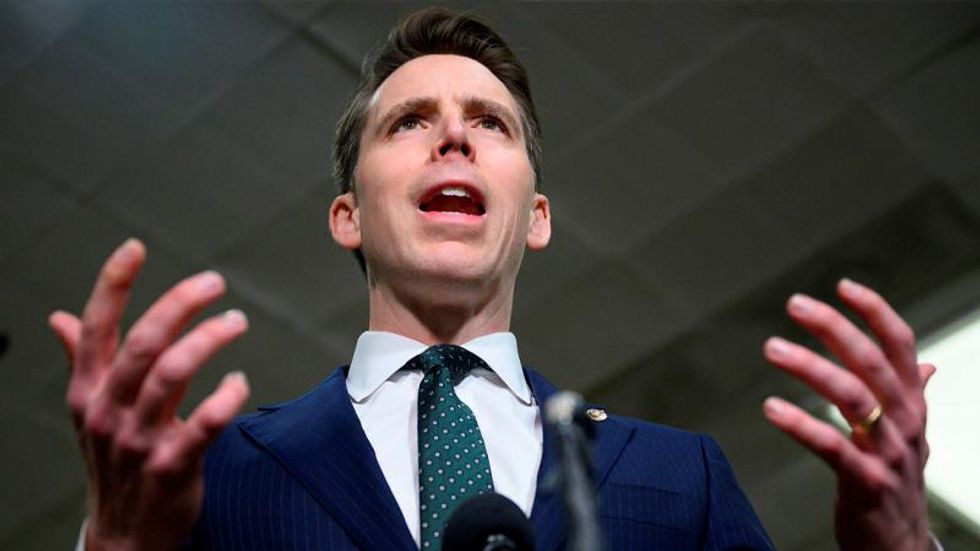 Republican senator Josh Hawley. (Andrew Caballero-Reynolds/AFP)
 LinkedIn photo of Jordan Duncan, a Marine Corps veteran whom the government alleges had classified military materials on his hard drive.
 Capitol rioters
 on Jan. 6, 2021, in Washington, D.C. (Photo by Saul Loeb for AFP)
Capitol rioters
Capitol rioters on Jan. 6, 2021, in Washington, D.C. (Photo by Saul Loeb for AFP)