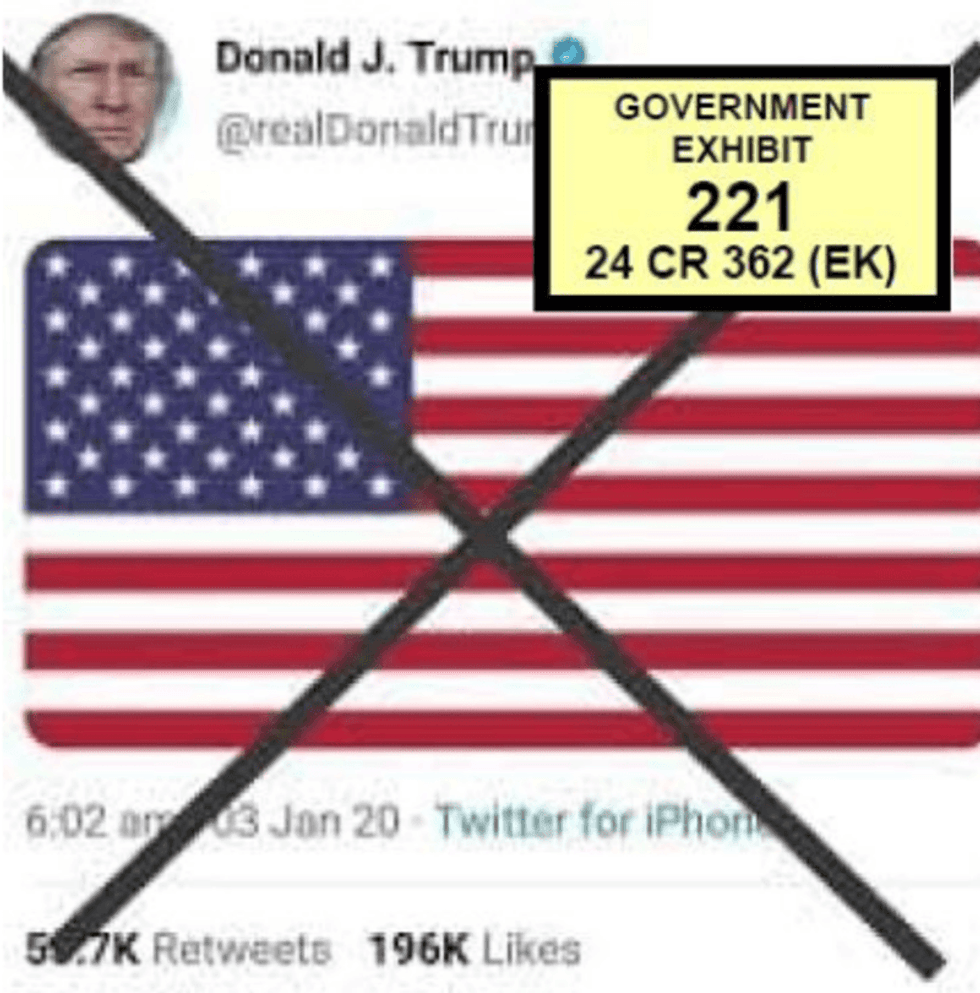
An image Asif Merchant shared on Facebook, showing an “X” through a screenshot of a Jan. 2020 Trump post of the American flag, was entered as evidence by prosecutors. (U.S. Attorney’s Office, Eastern District of New York court filing)

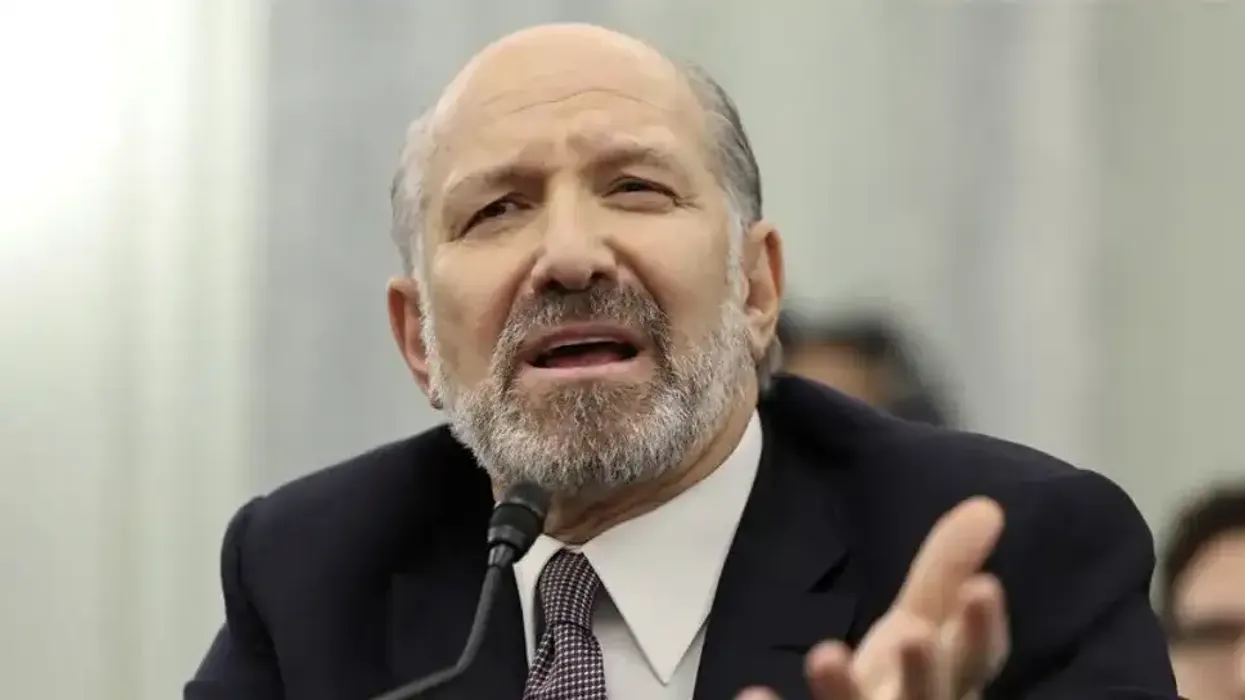
Federal prosecutors want an operative for Iran’s Revolutionary Guard who plotted a political assassination on U.S. soil to spend the rest of his life behind bars — and their sentencing memo lays out spy-thriller details of the plot.
Asif Merchant, a Pakistani citizen, was convicted in March of attempting an act of terrorism transcending national boundaries and murder for hire. Prosecutors are asking for life in prison plus a consecutive 10 years when U.S. District Judge Eric Komitee sentences him Tuesday in Brooklyn federal court.
Prosecutors said Merchant believed he would recruit hitmen whose ultimate target would be Donald Trump, then a presidential candidate, though he said the target could also have been then-President Joe Biden or Nikki Haley.
The memo also revisits a moment first revealed at trial. Merchant was arrested July 12, 2024, the day before a gunman opened fire on Trump at a rally in Butler, Pennsylvania. When agents told him about the shooting, Merchant said it was “the same thing he was sent here to do,” according to the memo. The memo does not connect Merchant to the Butler gunman, whom officials said appeared to have acted alone.
His Islamic Revolutionary Guard Corps handler called him by the code name “Amer,” after his brother, whom the filing described as martyred. Before each of roughly 15 meetings with his handler at an IRGC safehouse in Tehran, Merchant was told to pull the battery from his phone and seal it in a secure bag. He said his work with the hitmen he recruited would be long term.
He is also fighting the government over about $1,048 seized at his arrest, saying he needs the money, according to the memo. Prosecutors say the cash traces to $10,000 his handler gave him to fund the plot.
Seven details from the 15-page memo show how the plot came together.
1. A whiteboard lesson in killing a politician
In the Tehran safehouse, Merchant’s handler drew a political rally on a whiteboard and showed him which angles the hitmen should shoot from to kill the politician at the podium, prosecutors wrote. The plan called for a staged protest at the rally as a distraction.
2. Hire “criminals or mafia members”
Merchant was told the hitmen he recruited should be criminals or mafia members and that the killing should happen at a political rally in America, according to the memo, as The Bureau reported. His handler also said the hitmen might be used to steal documents, without saying what kind.
3. The target would be named after he fled
Merchant was supposed to put all the pieces in place in the United States, then return to Iran, where the IRGC would name the target once he was “safely outside America.” He moved up his flight because his work was completed, prosecutors said. Agents arrested him as he was about to head to the airport.
4. A secret report in a gift bag, and his daughter as a go-between
To avoid communicating electronically, Merchant hid a status report in a gift bag and had an acquaintance carry it on a flight to Pakistan and deliver it to his daughter, according to the memo. He also had his daughter text his handler from a phone he had hidden in his home in Pakistan.
5. A Texas airport insider
On an earlier assignment, the IRGC told Merchant to travel to the United States and return with a list of people who could be useful. He gave the IRGC the name of an acquaintance who worked at a Texas airport, admitting he thought the man could be “useful to us” because of his access.
6. Repeated searches for “Trump upcoming events”
Merchant searched “trump upcoming events” at least 14 times between May 1 and May 10, 2024, according to a search log included in the filing. He also found the location of a Trump rally in New Jersey and looked up its address on Google Maps.
7. Thirty years or life
The Probation Department recommended a 30-year sentence while calling Merchant’s plot among the “most heinous crimes brought before the Court.” Prosecutors say 30 years isn’t enough, arguing that under federal prison guidelines he would likely serve less than the full term and could one day be released.
Merchant’s lawyers argue the scheme was so poorly conceived and executed that neither he nor the IRGC intended it to succeed, and they compared it to an Inspector Clouseau movie. Merchant also testified that he went along only because he feared for his family in Iran.
Prosecutors said that comparison was exactly the response the IRGC hoped for and argued the group recruits many operatives in hopes that one succeeds, counting on failed attempts to be minimized. They also noted Merchant testified that he believed the hitmen were real and that pulling off the plot “could be possible,” and that he never mentioned fear for his family in multiple interviews with the government after his arrest. Jurors rejected his duress defense.
Iran has denied plotting to kill U.S. officials.
The case went to trial days before Trump ordered strikes on Iran that grew into a war whose toll on U.S. forces came under new scrutiny this week.
Report typos and corrections to corrections@rawstory.com.
For customer support contact support@rawstory.com.