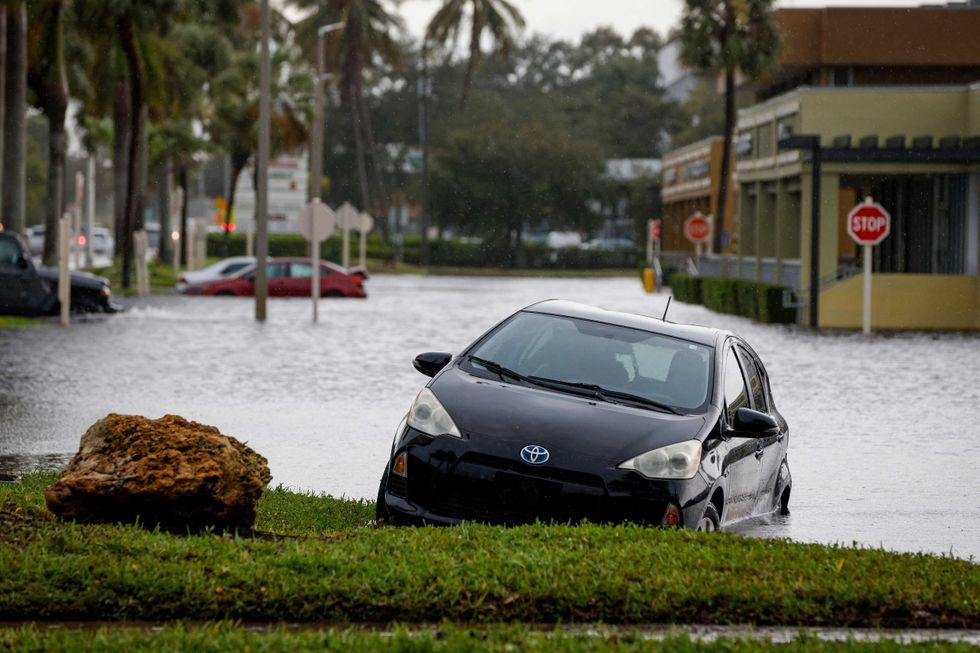
Cars are partially submerged in floodwaters in a parking lot following heavy rainfall in Hollywood, Florida, US, November 18, 2026. REUTERS/Eva Marie Uzcategui

Did you see what happened last week in Delray Beach? It was a hoot!
The city council reviewed the anti-diversity measure that Gov. Ron DeSantis signed into law and concluded it could no longer use public funds to support the city’s popular St. Patrick’s Day Parade. If you can’t spend public money promoting any ethnic group, then that must include the Irish.
Faith and begorrah, me lads and lassies, it kicked off quite a kerfuffle!
Angry citizens bombarded the council with complaints. Of course, they should have focused their Eire — er, I mean ire — on the legislators who passed this law thinking it would only affect people who looked different from them, and the governor who apparently signed it with both eyes closed.
DeSantis reacted to this perfectly logical legal conclusion with what my Cracker grandmother used to call “a conniption fit.” He accused Delray Beach of committing the horrible crime of “malicious compliance.”
Isn’t that hilarious? It’s like a state trooper pulling you over and yelling at you for driving the speed limit. How dare you obey the letter of the law! I bet you’re such a sicko you renewed your license and registration in a timely manner!
When I stopped giggling, though, it dawned on me that “malicious compliance” could be the best way to deal with the biggest legacy of our lame-duck governor. I am speaking, of course, of climate cha — oh wait, he doesn’t want us to talk about that.
But we sure have been talking about the effects lately. Take that combination of record rainfall and king tides that’s led to massive flooding along the Atlantic coast.
“King tides and strong northeast winds are causing significant flooding concerns across Northeast Florida, with impacts that a National Weather Service forecaster says resemble those of a tropical storm,” WJXT-TV in Jacksonville reported. One resident captured footage “showing neighbors using kayaks to reach their homes.”
“Between 15 and 20 inches of rain have fallen in parts of Florida, turning roads into rivers, submerging cars and coming close to the state’s single-day rainfall record,” ABC News reported, focusing on Brevard County.
“Treasure Coast citrus growers are wading through what they described as the worst flooding event the local industry has ever seen,” the Treasure Coast newspaper chain reported.
“King tides are sweeping into South Florida more often, supercharged by sea level rise and other weather factors that are sending more saltwater into streets and buildings from Fort Lauderdale to Miami,” the Miami Herald reported last week.
And we’re not done. “Severe storms dumped as much as 8 to 10 inches of rain overnight in parts of Broward County, leaving neighborhoods underwater, flooding major roadways and forcing Memorial Regional Hospital in Hollywood to temporarily suspend visitation,” WPLG-TV reported Wednesday.
Bear in mind that this all-liquid blue wave happened without a hurricane hitting the state. It was influenced by a super-strong El Nino that was clearly a product of, well, you know.
Since we’re not supposed to mention that c-word, my Delray-inspired recommendation is that from now on we call it something equally descriptive: The DeSantis Effect.
Dirty emissions from the fossil fuels we burn in our power plants, factories, and cars began baking our world during the Industrial Revolution and continue to do so today. They’re why we’re warming up like we’re living in a frying pan.
As a semi-tropical, mostly flat state surrounded by water, Florida has long been on the front lines of that … uh … phenomenon the governor wants us to ignore.
We’re seeing lots of impacts. The list includes increased temperatures even at night, storm surges that go further inland because of sea level rise, hurricanes that became more intense more rapidly, a boost in the number of mosquito-borne diseases, and lots of toxic algae blooms, as well as a heightened acidity in the seas on both sides of us.
How bad is it? Last year, a Florida plant, the Key Largo tree cactus, became the first species in the world to be completely wiped out by that thing we’re not allowed to talk about. The cacti, known for their height (up to 20 feet), were washed away by rising seas.
We’re no longer the Sunshine State. We’re the Soggy State.
When DeSantis has mentioned the folks who would rather see Florida take action to counter this stuff than pretend it doesn’t exist, he’s complained that they’re members of “the church of the global warming leftists.”
Yet not too long ago, Florida had a Republican governor and Legislature that tried to fight back. No leftists in that congregation!
In his first State of the State Speech in 2007, then-Gov. Charlie Crist called the c-word “one of the most important issues that we will face this century,” After all, Florida ranked among the top 25 producers of greenhouse gases in the world.
Crist signed a series of executive orders imposing far-reaching changes for the state’s energy policies. Then he persuaded the Legislature to pass a bill calling for the state to set up a cap-and-trade system to limit emissions.
Unfortunately, wealthy healthcare executive Rick “I Wear My Navy Cap Because My Yachting Cap Looks Too Fancy” Scott replaced Crist and junked all that stuff. When scientists tried to talk to him about it, he refused to even discuss it.
DeSantis and Scott don’t like each other, but they’ve taken a similar approach to this issue: Silence is golden.
Now here we sit, 16 years later, needing kayaks to navigate our streets. If this place gets much wetter, Walt Disney World will have to cut a deal with Kevin Costner to change its name to “Water World.”
Unlike Scott, DeSantis acknowledged that the cli — oops, sorry! — that thing we don’t discuss was changing. But he insisted that cutting our emissions would be bad for the economy, and instead we should burn MORE fossil fuels.
Hey Guv, you know what’s really bad for our economy? Repeatedly flooded streets, homes, offices, factories, and stores.
Not one person in state government should be surprised about this flooding. The website for the Florida Climate Center, at Florida State University, warns, “Extreme precipitation events are expected to become more frequent and intense as average temperatures rise.”
The only way FSU could have been clearer about that is if the ’Noles had set up speakers all around the Capitol to repeatedly play Bob Dylan’s “A Hard Rain’s Gonna Fall.”
Yet DeSantis didn’t just block the discussion about this. He vetoed a bill that would have spurred the state to buy more electric vehicles. He signed into law one that bars state and local governments from adopting net-zero greenhouse gas emissions policies. He even turned down $377 million in federal funding for energy efficiency initiatives.
Now can you see why I say we should call it the DeSantis Effect? He’s earned it!
When I have questions about that thing that starts with a C, one of the first people I call is John Morales, a TV meteorologist in South Florida since 1991. He’s now chief scientist for a company he founded called ClimaData.
When I asked him about the flooding along the East Coast, he reminded me that this was far from the first time it’s happened. Storms that hit Fort Lauderdale in 2023 dropped 26 inches in 24 hours, an amount so excessive it would make Noah start rounding up all the animals.
A warmer atmosphere tends to hold more moisture, he explained. That’s why Florida is being hit repeatedly by precipitation so destructive that people are calling it a “rain-bomb.”
Meanwhile, the rising sea level pushes king tides further inland, blocking the seaward flow of rain-swollen canals and other waterways, he said. It intrudes into the underground aquifer just as the rain is starting to soak into the ground and fill the aquifer.
The result: Flooding that keeps getting worse as well as more expensive.
Is it any wonder insurance costs are going through what’s left of the roof?
“It is increasingly hard to live in Florida,” Morales said.
Two years ago, in the wake of another rain-bomb flooding Hollywood, DeSantis angrily rejected any attempt at drawing a connection between the watery disaster and his hostility to … um, you know.
“Our energy bill that we did, it wasn’t about saying or not saying ‘climate change,’” DeSantis insisted, according to Politico. “It was a substantive piece of legislation to say that in the state of Florida our energy policy is going to be driven by affordability for Floridians and reliability.”
Ah yes, “affordability,” the big political catchphrase of the past election.
But Florida’s property insurance bills show that repeated weather-related disasters are making Florida less and less affordable. Just cleaning up after the flooding is hurting affordability.
Repairing your swamped car, peeling wet baseboard out of your house, cleaning the septic waste out of your bedroom — those all hurt homeowners’ ability to afford life in Florida.
These are all signs of the DeSantis Effect — increasingly destructive and expensive weather-related disasters.
Isn’t that the perfect term for it? Now that I think about it, calling it that really isn’t malicious compliance. I think it’s more accurate than that c-word thing. This is the effect that DeSantis has ensured we have to deal with.
Why is he so allergic to even discussing it? My theory is that he hopes to get financing from the oil companies for his next presidential run. That’s assuming he can make donors forget two years ago, when DeSantis campaigned in all 99 counties in Iowa and lost every one of them.
The good news is, in a couple of months, he’ll pack up his go-go boots and scoot out the door.
Dawn Shirreffs, director of the Environmental Defense Fund’s Florida office, said she hopes his successor, Byron Donalds, and the new leadership of the Legislature will take up the challenge of making changes. They’ll ignore it at their political peril, she contended.
“This election showed what happens when the voters don’t feel heard,” she explained.
In 2023, when he was in Congress, Donalds told a committee that when it comes to climate change, “I don’t think that the science is settled.”
I hope the Florida scientists who tried to talk to Scott will tell Donalds that the c-word science actually IS settled, and it’s past time to do something about it.
After all, Donalds’ big promise is to make Florida more affordable. Stepping up to deal with all that expensive flooding would go a loooong way toward achieving that goal.
However, there’s one more aspect to the DeSantis Effect likely to cause problems.
While he was shutting down discussions of the double-C, DeSantis did spend a lot of the taxpayers’ money on “resiliency.”
That’s a bureaucratic buzzword that means “blowing big bucks on an infrastructure stopgap.” He handed out money for lots of pumps, pipes, and seawalls.
That’s a legitimate pursuit. A lot of stormwater facilities that were built in the 20th century can’t handle the ginormous quantities of runoff we’re seeing now. Unfortunately, whatever we add now probably won’t be able to handle the even larger quantities that will hit us in the next decade or so.
One person I called about this month’s rain-bombs was Jennifer Jurado, chief resilience officer for Broward County. She told me her county had scrambled to prepare for the deluge before it hit, managing water levels in canals, figuring out what storage was available and worrying about how much room is left in the aquifer.
The county has created a $20 million grant program to help municipal governments add infrastructure to deal with flooding caused by rising sea levels, she said.
“We are on the cusp of being able to get a suite of projects in the ground,” Jurado said.
Just one little problem: Amendment 3, the property tax “reform” measure DeSantis pushed to tie the hands of local governments and make them turn to Tallahassee for help.
Now that that measure passed, she said, “our ability to move forward with all of these projects is … substantially questionable. There is a question whether we will get any of it done.”
That’s another disaster we can chalk up to the DeSantis Effect!
Florida Phoenix is part of States Newsroom, a nonprofit news network supported by grants and a coalition of donors as a 501c(3) public charity. Florida Phoenix maintains editorial independence. Contact Editor Michael Moline for questions: info@floridaphoenix.com.
Report typos and corrections to corrections@rawstory.com.
For customer support contact support@rawstory.com.