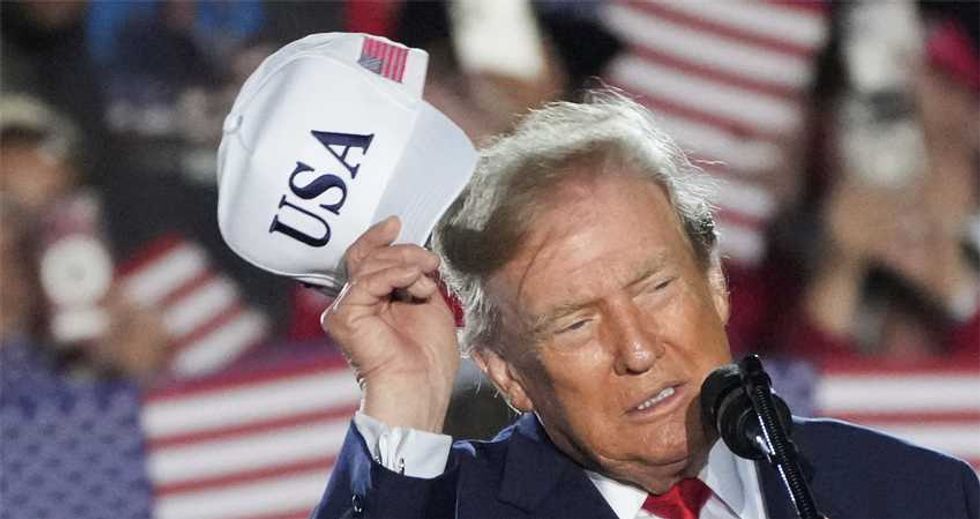
US President Donald Trump adjusts his cap as he speaks during a midterm campaign rally at Salina Regional Airport in Salina, Kansas, US, November 1, 2026. REUTERS/Nathan Howard

Leaked Russian defense industry documents show Moscow agreed to supply Iran with 90 launchers for helicopter-fired guided missiles, a revelation that sits uneasily with President Donald Trump’s insistence that Russia is doing little to help Tehran.
The Guardian reported Thursday on the files, which Ukrainian private intelligence firm Dallas Analytics obtained and passed to the paper. The Financial Times separately reported on the same order.
The launchers are built for the LMUR, a precision missile Russian attack helicopters have fired heavily at Ukrainian targets since the 2022 invasion.
A May 2024 production schedule from Russian missile maker Vympel lists 90 launchers for a foreign buyer coded “K-10,” with deliveries planned from late 2024 through December 2025. Other internal records name K-10 as Iran, and the FT reported that Russia’s state arms exporter uses the code for Tehran.
It’s unclear whether the launchers ever arrived. But another schedule in the files, covering six Yak-130 trainer jets for Iran in 2023, lines up with reported deliveries of those planes.
The order predates the current war, but it shows how closely the two countries have worked together on weapons.
Trump has repeatedly downplayed Russia’s support for Iran. Last month he wrote that Moscow was doing “very little, if anything” to help Tehran, saying he didn’t want to drive Russia away from talks to end the war in Ukraine.
European intelligence agencies see it differently, according to The Guardian. They have found that Russia gave Iran key data and satellite imagery that could help it target U.S. forces in the Middle East, and they have warned that Moscow was preparing to send Tehran explosive-laden drones for use against the U.S. and Israel.
Moscow has denied supplying military equipment to Iran for the current conflict and has kept its cooperation with Tehran quiet, wary of damaging Vladimir Putin’s relationship with Trump, the paper reported. Still, senior officials from the two countries met three times in October alone.
Russia has also profited from the war, according to The Guardian. Attacks on Gulf energy sites and disruptions to shipping through the Strait of Hormuz have pushed up oil prices, putting more money in the Kremlin’s coffers for its war in Ukraine, while the conflict has drawn Western attention and scarce Patriot interceptors away from Kyiv.
The Wall Street Journal reported this week that Trump made a deal with Russia to try to bring down fuel prices during the war. More than 20 U.S. service members have been killed in the conflict, according to the Journal.
Report typos and corrections to corrections@rawstory.com.
For customer support contact support@rawstory.com.