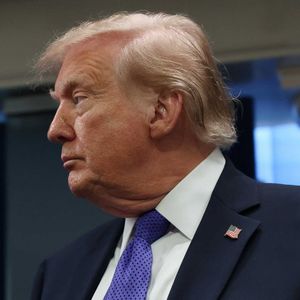
U.S. President Donald Trump speaks with the media before boarding Marine One for travel to Florida from the South Lawn of the White House in Washington, D.C., U.S., February 6, 2026. REUTERS/Leah Millis

President Donald Trump promised on the campaign trail that college accreditation would be his "secret weapon" against higher education. Now that weapon is about to go live, and the people who have to wield it say they don't know how it works.
New Education Department rules taking effect in July will change how accreditors evaluate colleges and universities, The Hill reported Sunday. Accreditation is the status schools must hold to access federal funding, including student aid. The change could cost institutions millions of dollars.
The most controversial piece is a new standard on so-called intellectual diversity. Under the final rules, accreditors must "evaluate policies at institutions that prioritize intellectual diversity and the free exchange of ideas at colleges and universities, ensuring that students are exposed to a range of viewpoints," according to the department.
What that means in practice is anyone's guess, including for the accreditors who will have to enforce it.
"I think in a lot of cases, because these concepts are so broad, and there is a lack of clarity of what the Department of Education is looking for on a lot of these concepts, they're kind of guessing in the dark," Antoinette Flores, vice president of federal policy and government affairs at the Council for Higher Education Accreditation, told The Hill.
Flores warned that "there is a risk that accreditation becomes a mechanism for federal influence over institutional decisions, institutional policies that have traditionally been within the purview of colleges and universities."
Trump made his intentions clear in 2023. "The time has come to reclaim our once great educational institutions from the radical left," he said. "Our secret weapon will be the college accreditation system."
The administration has already tried to use accreditation as leverage. Last year, it declared Columbia University in violation of federal antidiscrimination laws and recommended that its accreditor revoke the school's status. The accreditor declined.
"Essentially, the administration can force institutions into doing a host of things through the accreditor," said Jeremy Bauer-Wolf, investigations manager on the higher education program at the left-leaning think tank New America. He called the regulation "overly expansive," saying it "goes into areas that just simply do not have anything to do with accreditation."
The Education Department defended the rules as "a commonsense step toward restoring intellectual diversity." It cited a 2025 Northwestern University study that found 88% of students pretended to hold more progressive views to succeed academically.
"The regulations do not mandate any specific policies, nor do they give the Department any authority to police speech," said Ellen Keast, a department spokesperson.
Critics could still challenge the rules in court or in Congress, where Democrats take control in January. Courts have already halted other administration efforts to pressure colleges, including attempts to block their funding and their access to international students.
Accreditors are running short on time either way.
"There's a very short timeline to get to July, and for accrediting agencies, they have to go through their processes for changing their standards," Flores said.
Report typos and corrections to corrections@rawstory.com.
For customer support contact support@rawstory.com.