A former Commerce Department official says President Donald Trump's administration wants companies to give back to the government "in cash," as a lawsuit accuses it of extorting chipmaker Intel.
The former official spoke to Wired, which reported this week on internal Intel records unsealed in the case.
"Are you going to give back to the government in cash?" the former official said, describing the test that has replaced goals "like creating jobs."
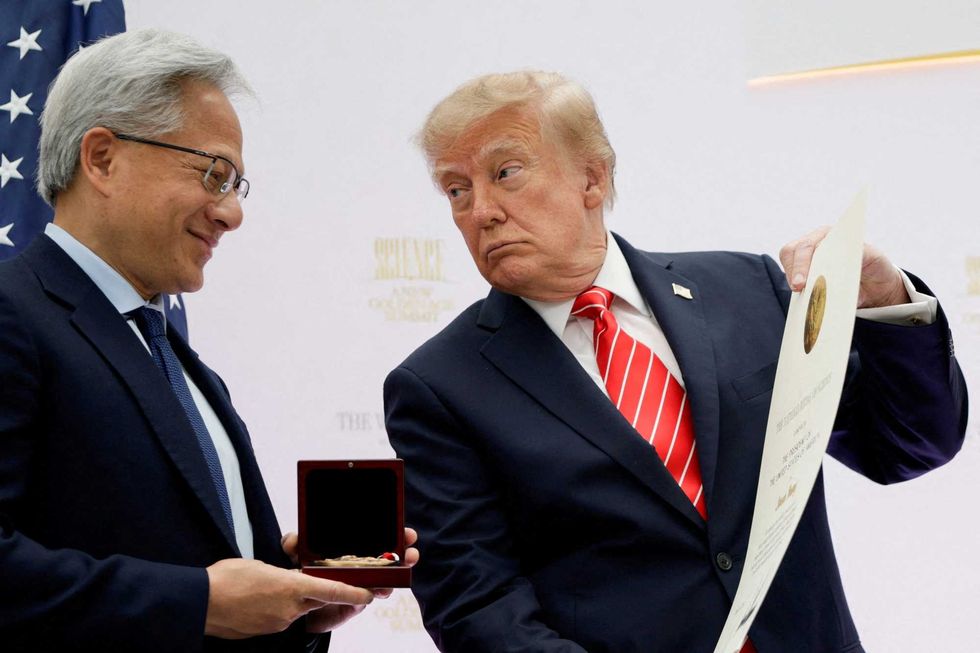
Under Trump, Nvidia agreed to pay the government 15% of its H20 chip sales to China, and later 25% of its sales of the more advanced H200, Wired reported. Intel handed over about a tenth of its stock in exchange for $8.9 billion in grants it had already won.
In both deals, the government charged for something it already controlled: Nvidia's permission to sell in China and Intel's access to money the government had promised.
"The Board, operating under the shadow of the President's threats," the lawsuit by Intel shareholder Richard Paisner alleges, "caved to the government's extortion."
The lawsuit lays out 15 days of pressure, from Trump's Aug. 7, 2025, demand that Intel CEO Lip-Bu Tan resign over his China ties to the board's approval of the stock deal on Aug. 22.
"I said, 'Give the country 10% ownership for free in Intel,'" Trump told Fortune in May, recalling an Aug. 11 Oval Office meeting with Tan. "He said, 'You have a deal.' I said, 'S—, I should have asked for more.'"
"The President is expecting to announce a deal on these terms on Friday," David Shapiro, then the top lawyer in the Commerce Department's CHIPS office, told Intel's finance chief on Aug. 20, according to Intel's notes of the call, cited in the lawsuit. He warned Intel not to make the "mistake of thinking that this is a negotiation."
"[R]ejection will have consequences that [Shapiro] cannot predict," Intel's summary of the call said, even as it noted he acknowledged the board "could choose not to accept the offer."
"The economic terms that had been proposed [by] the Administration were not, in their current form, attractive to the company," the board's minutes from that day said. The board approved the deal two days later.
"The United States paid nothing for these Shares, and the Shares are now valued at approximately $11 Billion Dollars," Trump posted that day.
Intel's lawyers argue in a motion to dismiss that the board bargained for better terms and that the deal freed up the grants right away, according to Wired. Intel declined to comment, and the White House and Commerce Department did not respond to Wired.
"There's nothing in it for me other than I want companies to do well," Trump said in the same Fortune interview, speaking of his corporate deal-making.
He made that claim about two months after accounts in his own name began buying Intel stock, according to ethics filings.
"There are no conflicts of interest," White House spokesman Davis Ingle told CNBC in May, adding that Trump's assets are held in a trust managed by his children.
Much of Trump's wealth sits in a revocable trust bearing his own name, an arrangement that gives him more control than the blind trusts other recent presidents used, CNBC reported in August.
Commerce used the same CHIPS program in January to take a 10% stake in USA Rare Earth, which hired Cantor Fitzgerald, now run by Commerce Secretary Howard Lutnick's sons, to lead a $1.5 billion stock sale tied to the deal.
"Cantor acted as a compensated broker for a company whose financial position was bolstered by as much as $1.6 billion in public funds from your Department," three Senate Democrats wrote to Lutnick in February. Lawmakers say Lutnick has refused to answer their questions, and Commerce did not respond to Reuters about the deal.
U.S. District Judge Richard G. Andrews has set a Dec. 10 hearing on motions by Intel's board and the Commerce Department to dismiss the lawsuit.