Specifically, Draper says that court documents still under seal show that "Meadows did in fact receive an immunity order, signed on March 20, 2023, by Chief Judge James E. Boasberg of the District Court in Washington, to testify before a federal grand jury" that had been investigating Trump's efforts to illegally remain in power after losing the 2020 presidential election.
Draper believes that this testimony gives Trump "reason for Trump to be fretful about Meadows" because "Meadows did not simply honor a subpoena request with a single obligatory interview with federal prosecutors; rather, he spoke expansively to them and then, the next day, testified before the grand jury for approximately six hours."
Added to this, writes Draper, Meadows was not named as an unindicted coconspirator in special counsel Jack Smith's election subversion indictment against Trump, which means there's a good chance he gave Smith and his team very useful information against the former president.
While it's not known exactly what Meadows told prosecutors, Draper argues that "a firsthand verification from Trump’s former top aide that the president knew that he lost the election but proceeded with efforts to overturn the results anyway might by itself sway the jury to find Trump guilty and send him to prison."
Now, there’s a legitimate chance Donald Trump could be running for president, or even serving as commander in chief, from behind bars.
Two overriding factors contribute to this bizarre reality.
Firstly, there’s very little — legally speaking — preventing Trump from doing so.
Secondly, Trump himself has offered no indication he’ll step away. To the contrary, he’s as emboldened as ever to run for and win the presidency he lost in 2020.
Thus far, juries have found Trump civilly liable for the sexual abuse and defamation of writer E. Jean Carroll. He’s been ordered to pay more than $88 million combined in damages.
New York Judge Arthur Engoron also found Trump and associates of his business empire liable for fraudulently inflating the value of the Trump Organization’s assets. Determination of damages in the civil fraud trial are expected this month — and could be well into the hundreds of millions of dollars.
And then there's the felony charges: 91 in total across four cases. If convicted, Trump could face significant prison time — totaling more than 700 years combined.
His trials are scheduled in the midst of the Republican presidential primary.
The indictments:
For the first time in U.S. history, a grand jury on June 8, 2023, federally indicted a former president — Trump — on 37 felony counts related to the alleged willful retention of classified documents and conspiracy to conceal them. District Judge Aileen Cannon set trial to begin May 20, but in February, special counsel questioned whether the FBI missed searching some rooms at Trump’s Mar-a-Lago residence, ABC reported.
Then it happened again on Aug. 1 when Trump was indicted on four separate federal counts related to his alleged efforts to overturn the 2020 election. He was set to be tried starting March 4, but U.S. District Judge Tanya Chutkan delayed the trial's start as Trump — unsuccessfully, so far — petitioned a federal appeals court to rule that he enjoys presidential immunity from such prosecution.
Trump also faces a criminal trial in Georgia related to election interference in the state, with trial requested for Aug. 5. Fulton County District Attorney Fani Willis admitted in February to having a romantic relationship with a special prosecutor overseeing the case but denied any tainting of the case, Raw Story reported.
Separately, Trump is charged in New York with 34 felony counts of falsifying business records in relation to payments the Trump Organization made to adult film actress Stormy Daniels. His trial is slated for March 25.
Such a laundry list of legal woes would seemingly sabotage any politician’s campaign efforts. But the cases haven’t slowed Trump down in his pursuit of a second term as president or slashed his chances — now as good as ever — of winning the 2024 Republican nomination.
Trump, who has handily won in the Republican primaries thus far, is almost certain to become the Republican nominee — and has made it clear he has no intention of dropping out of the race no matter how severe his legal battles become.
“I see no case in which I would do that,” Trump said in June during an appearance on a radio show hosted by political strategist Roger Stone, a longtime confidant. “I just wouldn't do it. I wouldn't do it. I had opportunities in 2016 to do it, and I didn't do it.”
But Allan Lichtman, a professor of history at American University, said campaigning for president and defending himself against criminal charges are two very different endeavors.
“He thinks he can win this case in the court of public opinion, but the truth is, Trump can huff, and Trump can puff, but he can't blow the courthouse down,” Lichtman said. “It’s a very, very different game once you enter a federal courthouse or a state courthouse. You can't just bluster. Anything that you present has to be proven, and you're subject to perjury.”
Still, Trump can continue to run his campaign while facing these charges — and he could even do so from prison in the event he were to be tried, convicted and sentenced before the 2024 election.
“Trump’s legal problems shouldn’t affect his campaign. Many of his supporters believe that he is being treated unfairly, and there is no prohibition against a defendant under indictment or even a convicted felon from serving as president,” said Neama Rahmani, a former assistant U.S. attorney and president of West Coast Trial Lawyers. “Theoretically, Trump could even be president while in prison.”
Indeed, the U.S. Constitution stipulates only that a presidential candidate be a natural-born citizen of the United States, be at least 35 years old and a U.S. resident for 14 years. Trump easily checks all those boxes. And congressional Democrats’ strongest efforts to potentially disqualify Trump from ever again seeking the presidency — convicting him following impeachment trials — failed.
So, what would it take for Trump to run a presidential campaign — or govern the nation — from prison?
Raw Story interviewed historians, legal experts, political operatives and former government leaders who pieced together a playbook for how he could do it — and the peril that he’d face along the way as he stands to secure the GOP nomination ahead of a general election rematch with President Joe Biden in November.
Campaigning from a cell
Each of the charges Trump faces in the classified documents federal indictment carries maximum prison sentences between five and 20 years. Across all four indictments, potential prison time could span hundreds of years.
Being behind bars would, of course, prevent Trump from campaigning in his signature fashion: at big, rowdy MAGA rallies.
But Amani Wells-Onyioha, operations director at Democratic political firm Sole Strategies, envisions Trump still figuring out ways to communicate with potential voters.
“There's no doubt in my mind that he would have some recorded press from the little prison phone. There's no doubt in my mind that he would set up press opportunities whenever he's out on the yard getting his recreational use in, that there would be cameras there,” Wells-Onyioha said. “He would be using every opportunity to campaign. I don't see him stopping at all, and I only see him using this as fuel to make him go harder.”
Keeping up his Truth Social posts from prison might not be such a challenge for Trump, Wells-Onyioha said, as some jails and prisons might allow internet access.
“I do see him using the internet because that's all that he has, and he's great at that already,” Wells-Onyioha said. “He's a huge internet, TV personality type of guy, so it really would just force him to be in a position to do something that he's the best at, which is unfortunate for the country, but as far as he's concerned, I think he thinks that this is political gold for himself.”
Plus, Trump isn’t building a campaign from scratch. His 2024 presidential campaign is flush with staffers. He enjoys the support of super PACs, which may raise and spend unlimited amounts of money on his behalf to promote the former president and attack his opponents.
He also has a roster of high-profile MAGA acolytes — from Reps. Marjorie Taylor Greene (R-GA) and Elise Stefanik (R-NY) to Sen. J.D. Vance (R-OH) and South Dakota Gov. Kristi Noem — who gladly serve as Trump surrogates.
And save for former South Carolina Gov. Nikki Haley, who remains in the race despite losses in the Iowa caucuses and New Hampshire primary, with dim prospects going forward, Trump has already vanquished his other main GOP challengers, including Florida Gov. Ron DeSantis, Sen. Tim Scott (R-SC), former New Jersey Gov. Chris Christie, former Vice President Mike Pence and businessman Vivek Ramaswamy.
Meanwhile, few politicians are as good as Trump at presenting himself as a victim — he’s single-handedly vaulted the terms “witch hunt,” “deep state,” “hoax” and “fake news” into the contemporary political lexicon. As an inmate, Trump could become a martyr to the MAGA cause.
“You’re obviously handicapped to campaign, but in this electronic age, you can certainly campaign virtually, plus Trump's pretty well known. It’s not like he has to introduce himself to the American people,” Lichtman said.
If not prison, maybe jail
Former President Donald Trump arrives for his arraignment at Manhattan Criminal Court on April 04 in New York City. Michael M. Santiago/Getty Images
Although it seems unlikely Trump will be serving an active prison sentence before the November election, it’s conceivable he could wind up in pretrial confinement of some sort while campaigning.
This, several legal experts said, will depend on Trump himself.
“He has to behave himself during a trial, and that's not beyond the realm of possibility that he'll act up, thinking that somehow he can win over the jury, but that would be a mistake,” said Kevin O’Brien, a former assistant U.S. attorney and partner at Ford O’Brien Landy LLP who specializes in white-collar criminal defense.
His social media antics stand to put him in potential violation of pretrial instructions and release terms, raising the question of whether a judge would dare throw the former president in jail. So far, he’s been fined thousands for violating gag orders.
Brazenly defying a judge’s order or attempting to intimidate witnesses are among the more common ways a defendant can get himself thrown in jail or home confinement before or during his trial.
This isn’t merely conceptual, said Mike Lawlor, a criminal justice professor at the University of New Haven and former member of the Connecticut House of Representatives, who helped lead impeachment hearings against then-Gov. John Rowland, who ultimately pleaded guilty in federal court to political corruption.
Knowing Trump’s penchant for cutting outbursts, Lawlor can envision a judge sanctioning Trump for defying directives. Trump not only has one judge with whom to contend, but several, given the multiple legal actions against him.
“The opportunity to engage in contempt of court or witness tampering or obstruction of justice is fraught at this point. I’m not sure he has the self-control to keep himself from doing something that would get him confined pre-trial,” Lawlor said.
The U.S. House Jan. 6 select committee accused Trump of potential witness tampering, and Lawlor says he’s monitoring similar allegations here, especially because so many of the witnesses are GOP staffers of the former president.
“It’s so easy to imagine a situation where someone could be contacted and intimidated,” Lawlor said. “I think the temptation to do that for a guy like Trump is probably irresistible. I’m not sure his attorneys or the advisors he listens to can stop him from doing so. I don’t rule it out. As I said, it’s unlikely, but I can definitely see it happening.”
Using legal danger to fuel fundraising
The Trump campaign wasted no time in exploiting the indictments to raise money, leaning into a familiar claim that the candidate is a victim of a Democratic witch hunt.
Only one day after news broke about Trump’s first federal indictment, a fundraising appeal built around the charges appeared on the campaign website prominently displayed in a column on the left-hand side of the page, suggesting contribution amounts ranging from $24 to $3,300. The message lays out a bill of particulars with the former president at the center of the persecution narrative, beginning with the apocalyptic opener: “We are watching our Republic DIE before our very eyes.”
Trump Save America, the beneficiary, is a joint fundraising committee for Donald J. Trump for President 2024 and the Save America PAC, which supports Trump.
The fundraising appeal contends that a “witch hunt began when the FBI RAIDED my home and then staged it to look like a made-for-TV crime scene with police sirens and flashing red and blue lights.”
Alluding to his previous indictment in New York state, the appeals continued: “So, after a state prosecutor failed to break us, the Deep State sharpened their attacks and unleashed a FEDERAL prosecutor to TRY and take us down.”
Notwithstanding Trump’s claim, the charges in New York state remain pending, and Jack Smith, the special prosecutor appointed by U.S. Attorney General Merrick Garland, was investigating Trump for allegedly mishandling classified documents four months before a grand jury in New Manhattan returned an indictment on the state charges related to the Stormy Daniels affair.
Minutes after the Aug. 1 indictment dropped, Trump started fundraising again, selling "I Stand With Trump" T-shirts featuring the indictment date, and Trump's mugshot from his booking at the Fulton County Jail helped him bring in more than $7 million after the Georgia indictment as he quickly took to selling mugs, shirts and other merchandise with the photo.
At least one prominent surrogate helped retail the fundraising push.
Kari Lake, a fellow election denier who lost her race for governor of Arizona in 2022, joined a Twitter Spaces co-hosted by Dustin Stockton and Jennifer Lynn Lawrence on the night news broke about Trump’s indictment on charges of mishandling classified documents.
Stockton and Lawrence helped organize the rally that provided the springboard for the Jan. 6 insurrection. During her appearance on Stockton and Lawrence’s Twitter Space, Lake, who is now running for U.S. Senate, told more than 1,300 listeners she had just gotten off the phone with Trump shortly after news broke about the indictment on June 8. Lake said it wasn’t enough for Republican voters to just say they stand with Trump or condemn the indictment.
“And if we really stand with him, we need to go to DonaldTrump.com and make a donation tonight,” said Lake, who is herselfpreparing a 2024 U.S. Senate run in Arizona. “Everybody, whether it’s $5, $10, $500 — whatever you can afford. Because if we’re gonna stand with him, we need to put our money where our mouth is tonight.”
The political monetization of Trump’s legal woes grows deeper by the month. Go to Trump’s campaign website and you’ll find several items on sale — a black-and-white ceramic coffee mug is $24 — featuring a fake mugshot of Trump above the words “NOT GUILTY”. Of late, Trump hassuggested that he would “end” his campaign in a deceptive bid to squeeze money from supporters.
The Federal Election Commission, which enforces federal campaign finance laws, would have no grounds to intervene in Trump’s fundraising efforts while facing criminal charges or even time in jail or prison, said Ann Ravel, who served as an FEC commissioner from 2013 to 2017, including one year as the commission’s chairwoman.
Trump's campaign is selling these black-and-white ceramic coffee mugs for $24. (Screen grab)
Trump’s campaign could easily continue sending supporters incessant fundraising emails and text messages in Trump’s name.
“The only problems for him would be if there's failure to disclose, or if people are giving more than the limits, all of the things that are traditional FEC issues, but they don't have the authority to do anything with regard to a person who's been indicted and is still fundraising,” Ravel said. “That in and of itself is not sufficient for the FEC to take any action.”
Lessons of Eugene Debs, incarcerated presidential candidate
Trump wouldn’t be the first candidate to run for president from prison if he were convicted.
In the weeks before the 1920 election, Eugene V. Debs, the Socialist Party candidate for president of the United States and an inmate in federal prison, touched on the significance of the moment.
“Has there ever been anything like it in American history before?” Debs said, as reported by the socialist newspaper Appeal to Reason. “Will there ever be anything like it in American history again? We must impress it upon the people that this scene is symbolic of what has befallen this country.”
There has been one other. Lyndon LaRouche, whom The New Republiccalled “The Godfather of Political Paranoia,” ran from prison in 1992 after being convicted of tax evasion and mail fraud.
His vice presidential running mate, the Rev. James Bevel, did most of the campaigning. This suggests that a jailed Trump could lean heavily on the presence of a charismatic vice presidential candidate — be it someone such as Lake of Arizona, Rep. Marjorie Taylor Greene of Georgia or even banished Fox News host Tucker Carlson.
LaRouche received .02% of the popular vote — 26,334.
Debs, who was serving a 10-year sentence for decrying the United States’ involvement in World War I, received 3.4% of the popular vote — 919,799.
He received 6% of the vote as a candidate eight years earlier, in 1912.
While emphasizing that she’s speaking as an individual, Allison Duerk, director of the Eugene V. Debs Museum, located in Debs’ home in Terre Haute, Ind., said she cringes at comparisons between Debs and Trump. In material ways, the two men are polar opposites.
“I bristle at recent casual references to the 1920 campaign — not because they are inaccurate on the surface, but because these two men and their respective projects are diametrically opposed,” she told Raw Story.
Duerk does believe Debs predicted the emergence of American political leaders such as Trump.
Illustration of Eugene Debs while running for president in prison. Indiana State University archives
“Take this quote from the speech that got him locked up,” she said, quoting Debs: “‘In every age it has been the tyrant, the oppressor and the exploiter who has wrapped himself in the cloak of patriotism, or religion, or both to deceive and overawe the people.’"
In an Appeal to Reason article, Debs said he believed in change “but by perfectly peaceful and orderly means.” He added, “Never in my life have I broken a law or advised others to do so.”
Unlike Trump, who nurses grievances daily, the article said of Debs, “Nothing embitters him. Injustice, oppression, persecution, savagery do not embitter him. It is a stirring, an uplifting thing to find a man who has suffered so much and remains so ardent and so pure.”
The U.S. government and the prison warden made small accommodations to Debs’ candidacy. He was, for one, allowed a single written message per week to voters.
“Where Debs had once stormed the country in a verbal torrent,” wrote Ernest Freeberg, author of Democracy’s Prisoner, “he would now have five hundred words a week.”
Debs still had some of the trappings of a political campaign, including a button that had his photo from prison with the words, “For President - Convict No. 9653.” He had printed material that said, “From Atlanta to the White House, 1920,” a reference to his residency inside the Atlanta Federal Penitentiary.
On election night, Debs received the results in the warden’s office and soon conceded the election to President-elect Warren Harding.
In his book Walls and Bars, Debs wrote that the question came up in the room about his potential ability to pardon himself as president — an action over which Trump has reportedly mused.
“We all found some mirth in debating it,” Debs wrote.
Serving as president from prison
If Trump ran a successful campaign from jail or prison, is there anything stopping him from assuming the Oval Office if he were elected president?
“There is nothing in our traditions or the Constitution that prevents someone who is indicted or convicted or, in fact, serving in jail, from also serving as the president,” said Harold Krent, law professor at the Chicago-Kent College of Law, who formerly worked for the Department of Justice. “Does it make any sense? No. But there is no Constitutional disablement from that happening. So, you could think of a scenario in which the case goes to trial, maybe after the primary and results in a prison time with President Trump and then he is inaugurated, and he gets to serve as president from some prison farm somewhere.”
Lichtman said “of course” Trump would just pardon himself of any federal crimes were he reelected president. There’s also the possibility of Trump attempting to preemptively pardon himself, with then-President Gerald Ford’s pardoning of Richard Nixon serving as an imperfect template.
But if Trump is convicted on any state-level charges, where federal pardons do not apply, that’s a different story.
“That's unprecedented, but the pardon power is pretty absolute,” Lichtman. “He can’t pardon himself for the New York case because that’s a state case. If he's convicted in New York, he's stuck. If ... he's convicted in Georgia, he can’t pardon himself from that either, because that's also a state case.”
Trump’s ability to pardon himself is widely debated in the academic community, Krent said.Federal document listing indictment counts against former President Donald Trump. U.S. District Court, Southern District of Florida
“There's no law on the books that says you can't. You just have to reason from the idea of separation of powers and the Constitution or to think that it doesn't make any sense to have one person aggregate or accumulate so much power,” Krent said. “As a constitutional matter, I think that that would be too much of a conflict of interest to be able to pardon yourself.”
Interestingly, the classified documents federal indictment didn’t include counts related to 18 U.S.Code 2071, which deals with the concealment, removal or destruction of government documents. This would disqualify anyone found in violation of the code from running for office, Rahmani said.
“That particular provision was passed after Nixon as a disqualification provision that prevents anyone convicted of it from holding public office,” Rahmani said. “Trump's lawyers would have said that it's unconstitutional because only the Constitution can place limits on who could be president. You can be a felon. You can be in prison and still theoretically be president of the United States.”
The Constitution could be interpreted — ostensibly by the U.S. Supreme Court — that an imprisoned president wouldn’t qualify as capable of carrying out his duties, preventing him from taking the office, Ravel said.
“There's nothing to stop him from becoming president either because the provisions in the Constitution about the presidency and the requirements for presidency don't reflect any concern if a president has been indicted or is in jail,” Ravel said. “Although if he goes to jail, it would create a problem for him because the Constitution does have concerns about the inability to carry out the obligations of the office, which he certainly wouldn't be able to do in jail.”
Specifically, Section 4 of the Constitution’s 25th Amendment potentially empowers Congress to determine — via a two-thirds vote of both chambers — that a president is “unable to discharge the powers and duties of his office” and thereby transfer presidential powers to the vice president.
But if Trump is elected in November, and trials end up taking place after the general election, some of his legal peril could subside — at least at the federal level.
“There's clear Department of Justice memos and policies. It's pretty clear that a sitting president cannot be prosecuted,” Rahmani said.
If Trump won and was convicted but on appeal, he would “probably” still be able to get inaugurated, Krent said.
“The question is whether they would stop the appeal and let him serve out the presidency before it would continue,” Krent said. “Uncharted waters in terms of how this would go. It's gonna affect the primary. It would affect the general election, and it certainly would affect his ability to conduct a presidency.”
Editor’s note: A version of this article was originally published on June 13, 2023, and has been updated to reflect numerous legal and political developments involving Trump.
Judge Cannon appears to be intentionally helping Donald Trump in his criminal case over confidential documents, and it might warrant an appeals court forcing her out, a legal expert said on Wednesday.
Former federal prosecutor Joyce Vance once again raised the issue of Cannon's behavior in the Trump documents case, calling the pattern of delay "disturbing."
"Perhaps we’d view any one of them, on their own, as a judicial aberration. But the pattern of ruling upon ruling that is out of the legal mainstream and results in delay well past the point where this case should have been ready for trial is something that shouldn’t be ignored," Vance wrote on Substack. "Judges should not put their fingers on the scales of justice either for or against a defendant or any other party. Here, it’s impossible to avoid the conclusion that the scales are being tipped."
Vance goes on to say that Judge Cannon has "entered an order in the case that is worth paying attention to" on Tuesday.
"Trump and his Florida co-defendants filed a consolidated motion on January 16, 2024, asking the court to order the government to turn over more discovery to them than it had provided... The Special Counsel filed a response, opposing making information public if it revealed the identity or any personal identifying information of any potential witness for the government, or any transcripts or other documentation of statements or testimony they may have given," Vance wrote. "Most Judges would give serious consideration to protecting this type of information, at least at this stage of the proceedings. Judge Cannon decided to protect some, but not all of it."
Finally, Vance raises the potential solution.
"When Judge Cannon was first assigned this case, we discussed the standards used in the 11th Circuit for determining whether a judge should be recused based on their prior conduct in a case. The argument is not one of personal bias, or even that she should be recused because Trump appointed her. But in rare, extraordinary cases where a judge has made multiple rulings that were without a valid basis in the record, the 11th Circuit has ordered recusal, finding that 'the original judge would have difficulty putting his previous views and findings aside,'" Vance wrote. "Whether they would apply that rule to Cannon remains to be seen. Forced recusals are rare. But at this late date, even if the 11th Circuit were to move quickly, as it has in the past, and force Cannon to step aside, it would take a new judge some time to get up to speed. There are no quick fixes for the damage Judge Cannon has done."
After getting cut down to size as "citizen Trump" by the three-judge appeals panel denying him absolute immunity from committing crimes — former President Donald Trump is pushing false narratives that the ruling weakens the presidency.
During an appearance on MSNBC's "The Last Word" with Lawrence O'Donnell, former federal prosecutor Barbara McQuade explained that nothing that came out to the D.C. Court of Appeals was a "surprise" because they were "simply restating a law, as we have always known it."
Earlier today, Trump beat the innocence drum on Truth Social that the decision (which he has vowed to appeal) does indelible harm to the office.
"If a President does not have Immunity, the Opposing Party, during his/her term in Office, can extort and blackmail the President by saying that, 'if you don’t give us everything we want, we will Indict you for things you did while in Office,' even if everything done was totally Legal and Appropriate," Trump said. "That would be the end of the Presidency, and our Country, as we know it, and is just one of the many Traps there would be for a President without Presidential Immunity."
He then plays judge and jury to decide former presidents Obama, Bush, and "Crooked Joe Biden" are all guilty of something and "would all be in PRISON."
McQuade calls this out as another con by the Don.
"What Donald Trump is doing is engaging in disinformation," she said. "He is suggesting to the public that what the court has done is something very radical, that is now eroding a power that existed before yesterday, and that now, presidents have lost the power to be able to govern in this country without the fear and the chilling effect that it would have to now face some sort of accountability that they did not face before."
Last month, Trump declared on social media that even presidential acts that “CROSS THE LINE” must be given “TOTAL IMMUNITY” from prosecution.
In fact, McQuade points out the obvious that only one person appears to be unable to grasp: that a "president was not above the law, and that they could be charged with crimes."
"Donald Trump is the only one suggesting that this was different, and that this is something new; but for people who don't know better. they will read that, and they will fall for that con."
A tense exchange occurred between CNN's Anderson Cooper and Rep. Dan Crenshaw (R-TX) over Congressional inaction to solve the Southern Border crisis, and it had the lawmaker turning on anybody who doesn't want a bill to be voted through to score political points.
"People on both sides of the aisle applaud you for that," Cooper told the Texas Republican who served the country as a Navy SEAL. "[Trump] has put his thumb on scale on this. I understand activist groups make money off this. He is making money off this. He is running an election. This is perhaps a winning issue for him. He does not want improvement despite all the talk of fentanyl, despite all the talk of national security issues. he doesn't want a deal —"
Cooper then tried again. "Lots of people in the House have said that," he said. "There's Republicans in the House who supported HR.2 who are now saying, 'We don't need any border deal at all, and the only reason is because —"
H.R. 2 is the Republican bill that markedly aimed to change the way the Department of Homeland Security (DHS) would deal with undocumented immigrants and also negotiate with countries critical countries such as El Salvador, Guatemala, Honduras, and Mexico when it comes to asylum.
Crenshaw told Cooper those who aren't trying to solve the problem are missing a critical window to hash out a deal.
"They are wrong," he said bluntly. "I disagree with them."
"I disagree with them in conversations today on the floor. I said, 'Look if we didn't need new Border laws, why did we pass HR.2," he said."
He then started to praise Trump's actions during his first term before he was voted out in 2020, such as changing the laws and forging agreements with Mexico and Northern Triangle countries.
"That's what he ended up having to do," said Crenshaw.
He then accused Cooper of baiting him into a verbal beef with the 45th president who remains in the lead to become the GOP candidate to challenge to become the 47th president.
"I know you want me to get into a fight with Trump... I'm not going to do it... We need a Border deal."
Rep. Ronny Jackson (R-TX) did not take kindly to reports that his fellow right-wing Texas lawmaker, Rep. Chip Roy, could make a move to oust House Speaker Mike Johnson (R-LA) from the gavel, KSDK's Mark Maxwell reported on Wednesday.
“I love Chip Roy, but Chip Roy is a major pain in the ass for all of us a few times,” Jackson told the crowd at a GOP panel held at an American Legion post.
According to Maxwell, Jackson then "Suggest[ed] Roy could use a 'code red' beat down from ‘A Few Good Men.’"
Jackson, who represents the Texas Panhandle and the Wichita Falls area, previously served in a White House physician role under multiple presidents, and was accused of having been frequently intoxicated while in that job, as well as sexually harassing staff, mishandling drugs, and crashing a government vehicle while drunk.
He recently made headlines after he was briefly detained by police for getting into a foul-mouthed screaming match with officers while trying to administer medical aid at a rodeo in Amarillo.
Johnson himself was elected speaker after weeks of chaos following a renegade group of Republicans successfully forcing a vote to remove former Rep. Kevin McCarthy (R-CA) from that role.
Rep. Lauren Boebert (R-CO), faced with a difficult election after only winning by hundreds of votes in the previous race, decided to jump ship to a more conservative district on the other side of the state — and according to straw polling, she is unlikely to even get the nomination there.
But whether she finds a new seat to stay in Congress or not, one thing appears to be true: Many of her constituents in Western Colorado are happy to see her go, reported The Independent.
“There are people I know that are Trump supporters that don’t support her, and they started out, like, ‘Yeah, ra, ra, ra,’ and now, they’re just embarrassed – because she just makes a fool out of herself,” said a 40-year-old independent voter in New Castle. “When she comes to public places around here, it’s just not professional.” Another elderly grandmother told the paper, “She’s always in drama here in Rifle and Silt."
"She’s not the most popular person anymore,” that voter reportedly added.
"It’s a common refrain from constituents represented by the 37-year-old new grandmother, who has endured a spectacular rise and fall between her home turf and DC," reported Sheila Flynn. "A Democrat briefly until 2008, she first came to power in a shock 2020 upset, riding a MAGA wave of rural Colorado libertarianism and covid restriction backlash to victory over five-term incumbent Republican Scott Tipton. Boebert tapped into the fringe elements of the right, weaving Christian nationalism and conspiracy theory bait into her unique brand of Trump-tinted braggadocio, and it played well for a time … before she seems to have taken it too far."
Boebert has found herself at the center of multiple dramas in recent years, from a highly public and personal feud with fellow far-right Rep. Marjorie Taylor Greene (R-GA), to an incident in which she was kicked out of a local performance of "Beetlejuice" for publicly groping her date and causing a scene.
The woman former President Donald Trump was talking about in his infamous "Access Hollywood" tape is suing "Days of Our Lives," claiming she was sexually harassed by a producer, reported Rolling Stone on Wednesday.
"Arianne Zucker alleges in her new complaint filed in Los Angeles County Superior Court that former Days executive producer Albert Alarr repeatedly subjected her to unwanted sexual advances and physical touching during production – and that she was written off the show and eventually fired for reporting his alleged abuse," reported Nancy Dillon. "'Alarr would frequently grab and tightly hug plaintiff, purposely pushing her breasts onto his chest, while moaning, ‘Oh Ari!’' her complaint, obtained by Rolling Stone, reads. 'Alarr would put his hand on plaintiff’s waist, with his thumbs placed just above her vagina, and move her around, all the while smirking and grinning in a sexual manner, making plaintiff extremely uncomfortable.'"
According to the complaint, higher-ups at the show, including boss Ken Cordray, who is also named in the suit, failed to act when she took her complaints about the situation to them.
Zucker is also known for being the woman that Trump discussed when he infamously told Billy Bush on "Access Hollywood" in 2005 that he can assault women whenever he likes because he's a star.
“I better use some Tic Tacs, just in case I start kissing her,” Trump said, after Bush pointed her out in an image as the person who would escort him to the set. “You know, I’m automatically attracted to beautiful — I just start kissing them. It’s like a magnet. Just kiss. I don’t even wait. And when you’re a star, they let you do it. You can do anything… Grab ‘em by the pussy. You can do anything.”
Trump recently came out of a defamation suit by writer E. Jean Carroll, who alleges he raped her, owing $83.3 million in damages.
Rudy Giuliani accused his most famous client's campaign of stiffing him for a $2 million tab.
Giuliani appeared in U.S. Bankruptcy Court on Wednesday after filing for Chapter 11 protection in December when a Georgia jury ordered him to pay $148 million for defaming a mother and her daughter who sued him for defaming them when they served as election workers back in 2020.
In meeting with creditors, Giuliani says Donald Trump’s 2020 election campaign and the Republican National Committee are in arrears of $2 million for legal fees, according to Bloomberg Law.
“I got paid expenses but I never got a salary,” he said when being questioned about his finances by U.S. Trustee attorney Andrea Schwartz.
He stressed that the bill isn't directly related to the 45th president himself.
After several hours of questioning, Giuliani, who credited Trump as his private client for years and earned a reputation as a respected federal prosecutor before that, opened up about his financial status which includes $10.6 million in assets but shows he is also on the hook for $153 million in liabilities, the outlet reported.
The beleaguered figure, revered as "America's Mayor" said that his income has dwindled since he started repping Trump, but the defamation judgment forced his hand to file for protection.
His adviser, Ted Goodman said that Giuliani was forced into Chapter 11 by the “the abhorrent weaponization of our justice system for partisan political gain,” according to the outlet.
“The only reason we’re here today is because Mayor Rudy Giuliani has the courage to speak up and take on the permanent Washington political class, and he refuses to be unfairly censored or bullied into silence,” he added, according to Bloomberg.
Former Gov. Marc Racicot (R-MT), a conservative and a signatory to an amicus brief urging the Supreme Court to disqualify former President Donald Trump from the ballot, was aghast at Sen. J.D. Vance (R-OH) for his recent statement that he would have blocked certification of the 2020 presidential election if he were in the place of former Vice President Mike Pence.
Vance, a former critic of Trump turned MAGA loyalist, made the comments during an interview with George Stephanopoulos on "ABC This Week."
"If I had been vice president, I would have told the states, like Pennsylvania, Georgia, and so many others, that we needed to have multiple slates of electors and I think the U.S. Congress should have fought over it from there," said Vance. "That is the legitimate way to deal with an election that a lot of folks, including me, think had a lot of problems in 2020. I think that's what we should have done."
"He's basically saying he would have done the coup," said anchor Chris Hayes. "Kicked it to the House. And allowed Republican majorities, maybe, to make Donald Trump president despite losing by 7 million votes. What's your reaction to hearing a sitting U.S. Republican senator say that?"
"Well, I think it's stunningly uninformed and mistaken," said Racicot. "And frankly, it's preposterous. In the first place, the selection of electors is a matter within the exclusive province of the individual states. So, he's terribly wrong. He doesn't understand the constitutional history, nor the requirements of the law. Or of the Constitution."
"To suggest that you would do something that would once again incite more chaos and disruption is beyond the pale," he added. "And frankly I think it's an unbelievable demonstration of a lack of information and knowledge about what's appropriate under the Constitution."
When the nine justices making up the Supreme Court convene on Thursday, they will try to decide whether the Civil War-era Section 3 of the 14th Amendment — barring anyone from seeking office who once took an oath to uphold the Constitution but then "engaged” in “insurrection or rebellion” against it — applies to the presidency and Trump.
Former federal prosecutor Elie Honig is especially interested in how the court's three liberal-leaning justices will engage when they hear oral arguments in the case.
The case is based on voters in the Rocky Mountain State accusing Trump of violating the Constitution when he attempted to reverse his 2020 election defeat and fomented an attack on the Capitol Building to stop Congress from certifying the vote back on Jan. 6, 2021.
The ex-president remains the frontrunner to nab the GOP presidential nomination and is contesting a move by some Colorado voters to disqualify him from appearing on the primary ballot.
He's also interested in seeing how Chief Justice John Roberts works to protect his legacy and that of the court.
"The last thing Chief Justice Roberts wants is for his tenure to be the one where the court split apart," he said.
As far as what could transpire, Honig said they could uphold Colorado's disqualification of Trump and then he's off the ballot and can't run for a second term there. But doing so opens the "door for other states" to file challenges, who are waiting and seeing what happens with Colorado decision.
If they strike down Colorado but "do it in a certain way, either say the president does not count under the 14th Amendment, or if they say Congress must act first, then they put an end to it."
Another panelist, a senior Supreme Court analyst, also said to look to the liberal judges. As for who could compromise with the conservatives on the court, she cited Kagan.
After a humiliating day in which Republicans failed to get the votes to pass multiple items of their own agenda in the House, many lawmakers were left openly wishing they had leadership as competent as former House Speaker Nancy Pelosi (D-CA) had been, CNNreported on Wednesday.
Republicans teed up a vote to impeach Homeland Security Secretary Alejandro Mayorkas, as well as one that as meant to pass a standalone $17.6 foreign aid package to Israel — and failed on both of these votes.
"In the House, the pair of stunning floor defeats was so painful that it even had many Republicans heaping rare praise on former Speaker Nancy Pelosi and House Democrats for their vote counting skills, and pining after disgraced former GOP Rep. George Santos, who was expelled, but at least cushioned their majority," reported Melanie Zanona, Annie Grayer, and Manu Raju.
One Freedom Caucus member, Rep. Ralph Norman (R-SC), said, “As bad as Pelosi was, she knew her votes before they took place.”
"The meltdown – just the latest in a long string of chaotic moments under this GOP majority – is raising fresh concerns over how Republicans will navigate the fast approaching government funding deadline, and their ability to maintain control of the House after November," the report continued.
This comes after Rep. Matt Gaetz (R-FL), who spearheaded the move last year to force former Rep. Kevin McCarthy (R-CA) out of the speakership, reflected that he wished McCarthy had stayed in Congress to at least give his vote on these issues.
The business community is purportedly wise to Trump and if there's a sequel they likely will "act when they see autocratic power abuses and assaults upon the national character."
Time columnist and Yale University professor Jeffrey Sonnenfeld reflects back on his two decades of ties to the 45th president and how the thinking that C-suite executives are going to pay fealty to the former president isn't so.
"The hunches that CEOs are enthusiastic for Trump’s return are not based upon any stated first-hand endorsements from CEOs," he writes, adding that among the top corporation leaders that he's rubbed elbows with "they largely want nothing to do with him now."
The reason is many of these powerful individuals don't square with his general paradigm, and so "there is no incentive for them to condemn him in the absence of any current abuse of power, but they did not hesitate to do so before and, I feel sure, will not hesitate to speak out again should he act up."
What's more, he claims Trump's burned many of them before.
"The stark lack of enthusiasm from CEOs for Trump is also because the business community has already learned its lesson..." according to Sonnenfeld.
That was most clear back in 2017 after the Charlottesville protest led by Far Right nationalists raising tiki torches in support of protecting a monument of Confederate Gen. Robert E. Lee. The event led to the untimely death of 32-year-old Heather Heyer.
Trump opined then that there were “some very bad people” involved in pro-statue protests. “But you also had people that were very fine people, on both sides."
For his time that he's known Trump, Sonnenfeld writes that the reception to many major business owners has been icy because "few saw him as a genuine peer — since he had not ever run a global public company."
And his moral compass was apparently too much way back in 2006.
The professor brought Trump to a CEO gathering at New York’s Waldorf Astoria and as he puts it, he might as well have been delivering rotten fish because "many of the biggest names on the guest list walked out in protest."
He believes that the business community leaders may not come forward to back or condemn him, but if he should return to power they will act should Trump "create another catastrophic moment which tears at the fabric of American society."




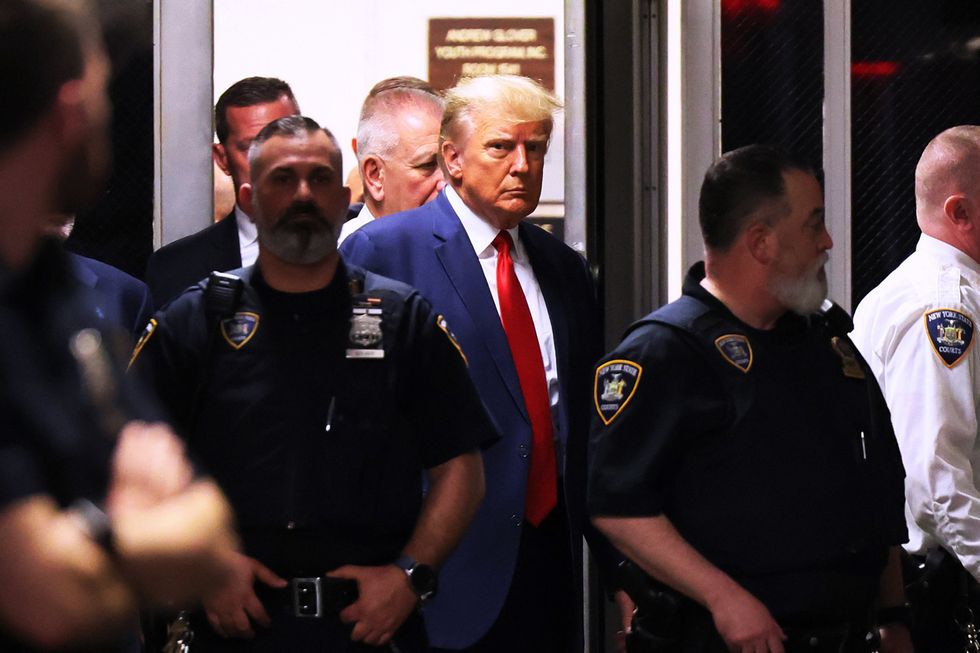 Former President Donald Trump arrives for his arraignment at Manhattan Criminal Court on April 04 in New York City. Michael M. Santiago/Getty Images
 Trump's campaign is selling these black-and-white ceramic coffee mugs for $24. (Screen grab)
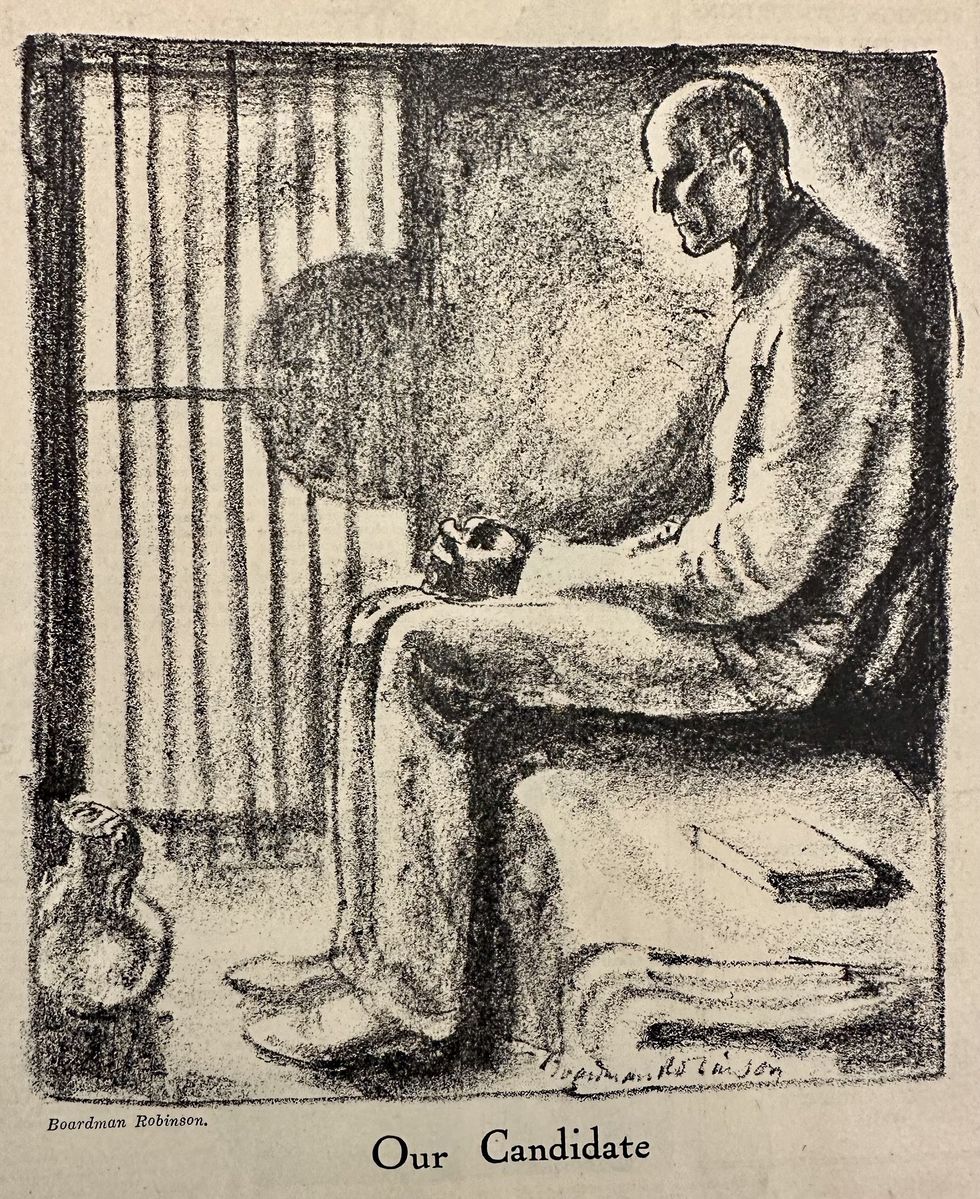 Illustration of Eugene Debs while running for president in prison. Indiana State University archives
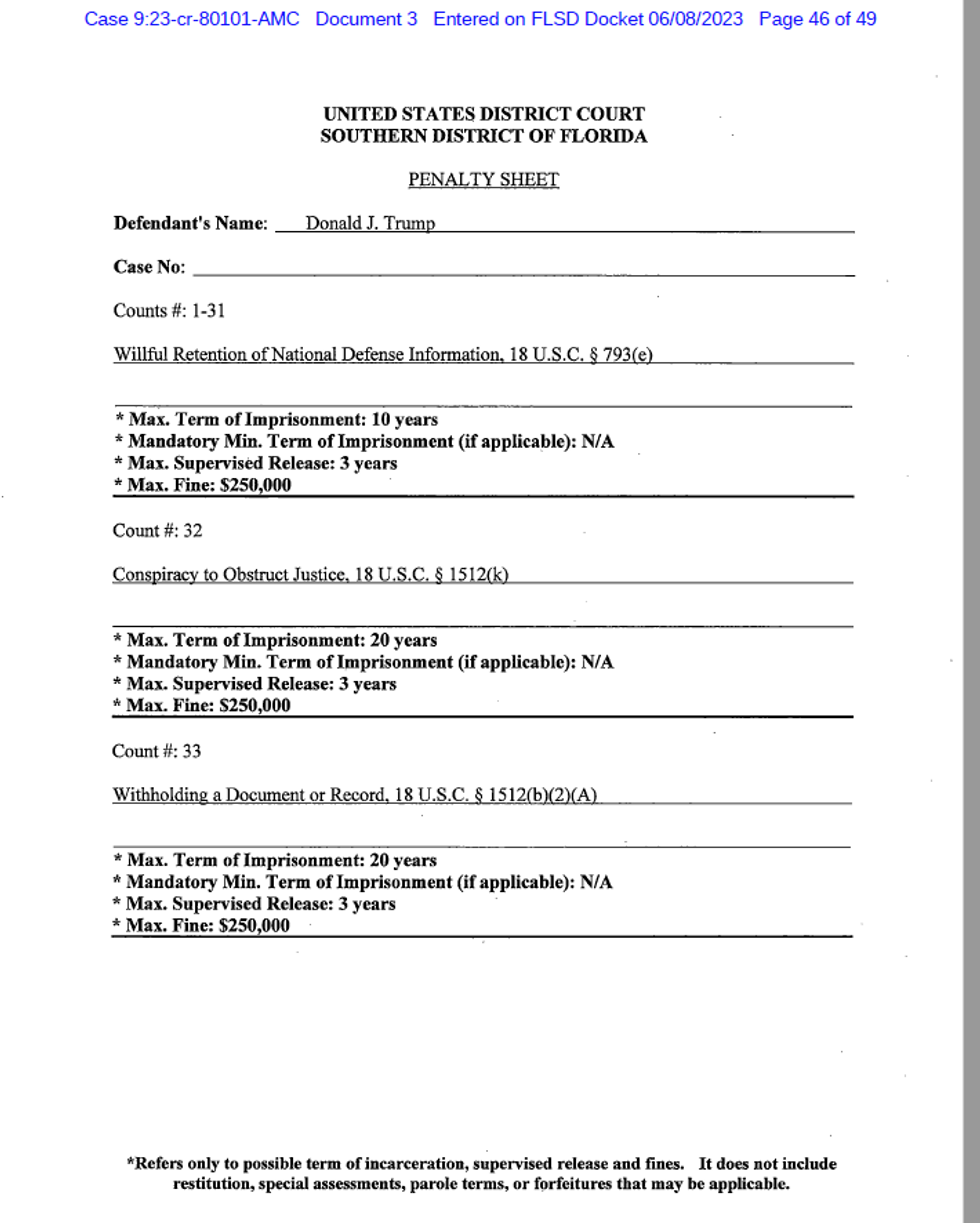 Federal document listing indictment counts against former President Donald Trump. U.S. District Court, Southern District of Florida