Top Stories Daily Listen Now
RawStory

World

Simone Biles wins bronze medal on balance beam at Olympic return

Simone Biles stuck the landing. The American gymnastics superstar won bronze during the balance beam final on Tuesday, a week after she took herself out of several competitions to focus on her mental health.

Biles earned her seventh career Olympic medal - tied with Shannon Miller for the most by an American in gymnastics - by drilling a slightly watered-down version of her usual routine in front of a crowd that included IOC President Thomas Bach.

Keep reading... Show less

Brazil court to investigate Bolsonaro for baseless warnings of voter fraud

Brazil's Supreme Electoral Court (TSE) decided on Monday to open an investigation into far-right President Jair Bolsonaro for his statements claiming there will be fraud in next year's elections.

Bolsonaro, who is expected to seek a second term in 2022, has repeatedly said Brazil's electronic voting system is vulnerable to fraud.

Keep reading... Show less

Boeing attempts uncrewed test flight to ISS a second time

Boeing will be aiming to get its spaceflight program back on track Tuesday with an uncrewed flight of its Starliner capsule to the International Space Station (ISS), after its last such test in 2019 ended in failure.

The spaceship is due to launch on an Atlas V rocket built by the United Launch Alliance from Cape Canaveral Space Force Station in Florida at 1:20 pm Eastern time (1720 GMT).

Keep reading... Show less

Olympics-Biles to compete in balance beam, Belarus athlete enters Polish embassy

By Gabrielle Tétrault-Farber, Karolos Grohmann and Amy Tennery

TOKYO (Reuters) -Simon Biles will compete in the balance beam competition, officials said on Monday, in what would be the U.S. superstar gymnast's last chance for gold in Tokyo after pulling out of other events citing mental health issues.

Keep reading... Show less

Simone Biles on start list for Olympics beam final

Simone Biles is set to return to competition at the Olympic Games for the closing women's gymnastics beam final on Tuesday.

The US superstar's name was included on the list of eight finalists for the beam released on Monday.

Keep reading... Show less

Canada shocks USA to reach Olympic women's football final

Jessie Fleming scored a second-half penalty as Canada upset four-time Olympic women's football champions the United States 1-0 in Kashima on Monday to reach the final for the first time.

Fleming's 74th-minute spot-kick earned Canada a first win over their neighbours since 2001 and set up a clash with Sweden or Australia for the gold medal.

Keep reading... Show less

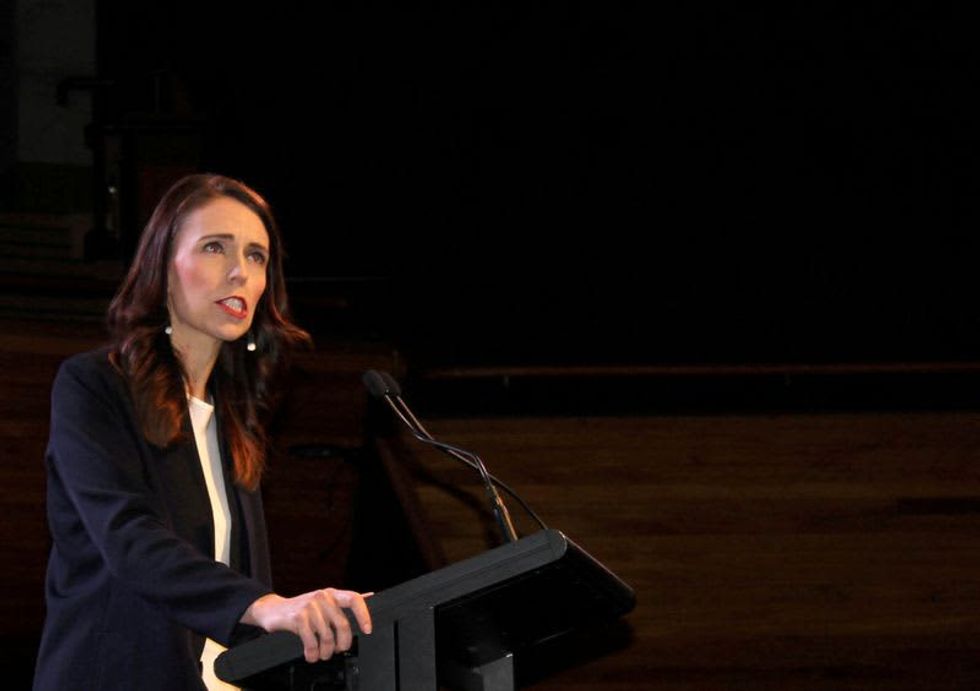
New Zealand's PM Ardern apologises for 1970s immigration raids on Pacific community

MELBOURNE (Reuters) - New Zealand's Prime Minister Jacinda Ardern issued a sombre state apology on Sunday to the Pacific community for racially targeted immigration raids in the 1970s that resulted in deportations and prosecutions.

The "Dawn Raids", which often occurred early in the morning, took place from 1974 to 1976 when New Zealand's economy was in a downturn and the government clamped down on immigrant workers from the Pacific who overstayed their work visas.

Keep reading... Show less

Australia's News Corp walks a delicate line on COVID politics

Elements within News Corporation are now fighting among themselves over how its platforms should position themselves in response to the worsening COVID crisis in New South Wales.This has become clear with the decision by the editor of News Corp's Daily Telegraph, Ben English, to ditch Alan Jones as a columnist.

Over the past few weeks, as the coronavirus outbreak got inexorably worse, the Telegraph ran a series of characteristically shrill columns by Jones attacking mask-wearing, lockdowns and NSW Premier Gladys Berejiklian.

Yet Jones also promotes these opinions on News Corp's Sky News, where his Sky-at-Night slot is undisturbed. Indeed, Jones makes a virtue of this, telling The Sydney Morning Herald:

Keep reading... Show less

Dead, shrivelled frogs are unexpectedly turning up across eastern Australia

Over the past few weeks, we've received a flurry of emails from concerned people who've seen sick and dead frogs across eastern Victoria, New South Wales and Queensland.

One person wrote:

About a month ago, I noticed the Green Tree Frogs living around our home showing signs of lethargy & ill health. I was devastated to find about 7 of them dead.

Another wrote:

We previously had a very healthy population of green tree frogs and a couple of months ago I noticed a frog that had turned brown. I then noticed more of them and have found numerous dead frogs around our property.

And another said she'd seen so many dead frogs on her daily runs she had to “seriously wonder how many more are there".

So what's going on? The short answer is: we don't really know. How many frogs have died and why is a mystery, and we're relying on people across Australia to help us solve it.

Why are frogs important?

Frogs are an integral part of healthy Australian ecosystems. While they are usually small and unseen, they're an important thread in the food web, and a kind of environmental glue that keeps ecosystems functioning. Healthy frog populations are usually a good indication of a healthy environment.

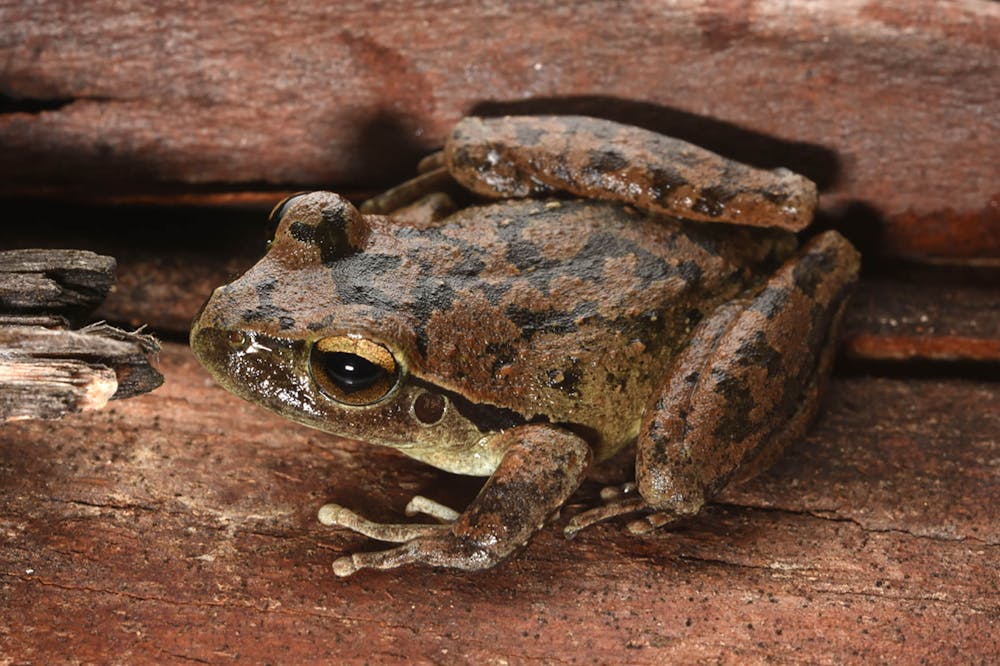
The stony creek frog is one of the species hit by this mysterious outbreak.

Jodi Rowley, Author provided

They eat vast amounts of invertebrates, including pest species, and they're a fundamental food source for a wide variety of other wildlife, including birds, mammals and reptiles. Tadpoles fill our creeks and dams, helping keep algae and mosquito larvae under control while they too become food for fish and other wildlife.

But many of Australia's frog populations are imperilled from multiple, compounding threats, such as habitat loss and modification, climate change, invasive plants, animals and diseases.

Although we're fortunate to have at least 242 native frog species in Australia, 35 are considered threatened with extinction. At least four are considered extinct: the southern and northern gastric-brooding frogs (Rheobatrachus silus and Rheobatrachus vitellinus), the sharp-snouted day frog (Taudactylus acutirostris) and the southern day frog (Taudactylus diurnus).

A truly unusual outbreak

In most circumstances, it's rare to see a dead frog. Most frogs are secretive in nature and, when they die, they decompose rapidly. So the growing reports of dead and dying frogs from across eastern Australia over the last few months are surprising, to say the least.

While the first cold snap of each year can be accompanied by a few localised frog deaths, this outbreak has affected more animals over a greater range than previously encountered.

This is truly an unusual amphibian mass mortality event.

In this outbreak, frogs appear to be either darker or lighter than normal, slow, out in the daytime (they're usually nocturnal), and are thin. Some frogs have red bellies, red feet, and excessive sloughed skin.

A browned, shrivelled green tree frog

A browned, shrivelled green tree frog (Litoria caerulea)

Suzanne Mcgovern, Author provided

The iconic green tree frog (Litoria caeulea) seems hardest hit in this event, with the often apple-green and plump frogs turning brown and shrivelled.

This frog is widespread and generally rather common. In fact, it's the ninth most commonly recorded frog in the national citizen science project, FrogID. But it has disappeared from parts of its former range.

Other species reported as being among the sick and dying include Peron's tree frog (Litoria peronii), the Stony Creek frog (Litoria lesueuri), and green stream frog (Litoria phyllochroa). These are all relatively common and widespread species, which is likely why they have been found in and around our gardens.

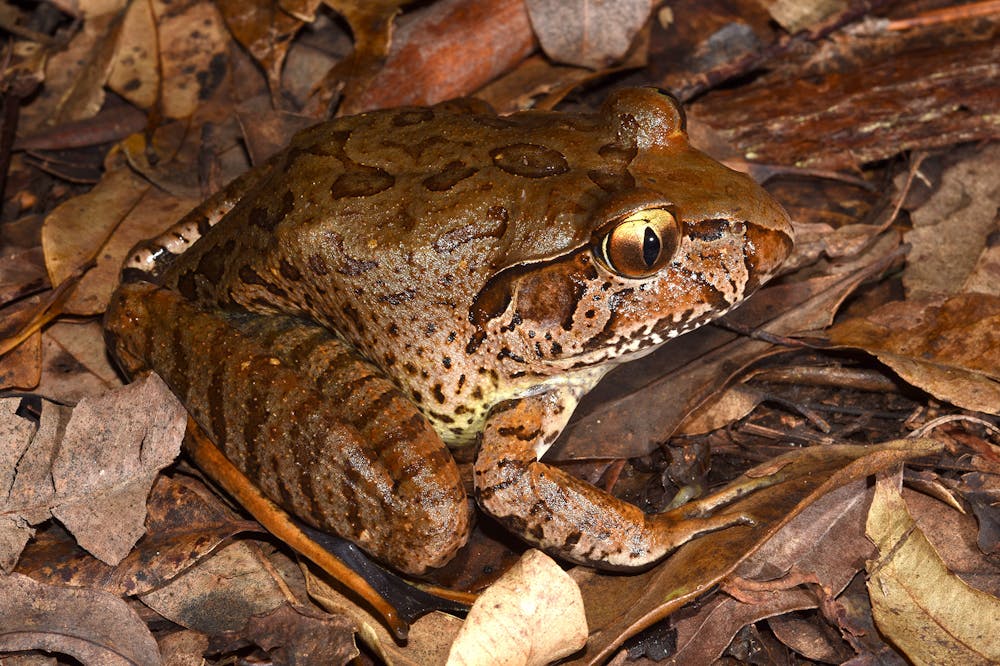
We simply don't know the true impacts of this event on Australia's frog species, particularly those that are rare, cryptic or living in remote places. Well over 100 species of frog live within the geographic range of this outbreak. Dozens of these are considered threatened, including the booroolong Frog (Litoria booroolongensis) and the giant barred frog (Mixophyes iteratus).

The giant barred frog is a threatened species that lives in the geographic range of this outbreak.

Jodi Rowley, Author provided

So what might be going on?

Amphibians are susceptible to environmental toxins and a wide range of parasitic, bacterial, viral and fungal pathogens. Frogs globally have been battling it out with a pandemic of their own for decades — a potentially deadly fungus often called amphibian chytrid fungus.

This fungus attacks the skin, which frogs use to breathe, drink, and control electrolytes important for the heart to function. It's also responsible for causing population declines in more than 500 amphibian species around the world, and 50 extinctions.

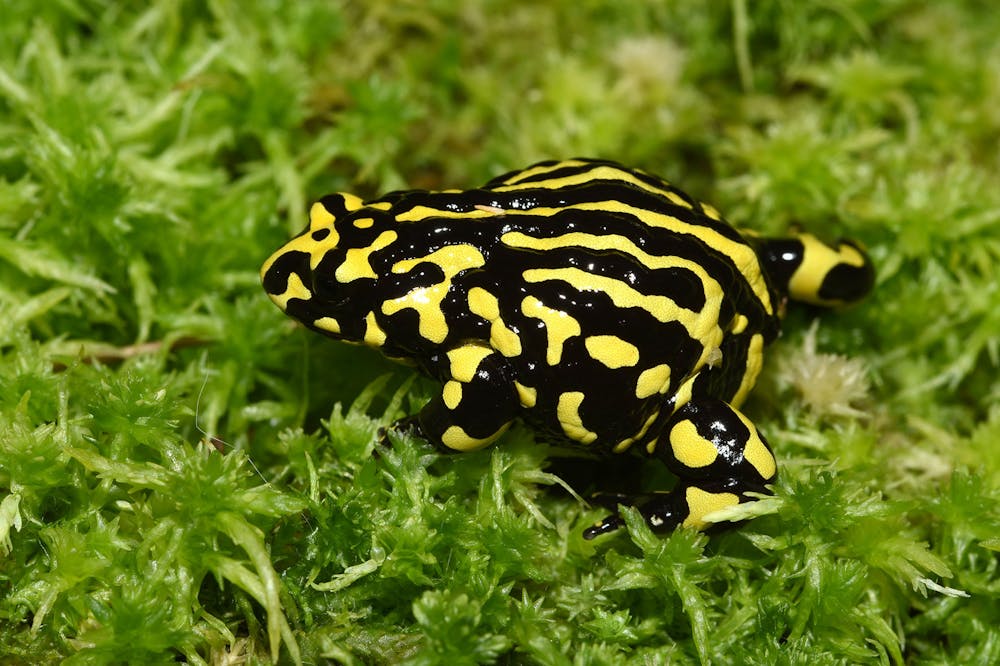
For example, in Australia the bright yellow and black southern corroboree frog (Pseudophryne corroboree) is just hanging on in the wild, thanks only to intensive management and captive breeding.

The teeny tiny southern corroborree frogs have been hit hard by the chytrid fungus.

Jodi Rowley, Author provided

Curiously, some other frog species appear more tolerant to the amphibian chytrid fungus than others. Many now common frogs seem able to live with the fungus, such as the near-ubiquitous Australian common eastern froglet (Crinia signifera).

But if frogs have had this fungus affecting them for decades, why are we seeing so many dead frogs now?

Keep reading... Show less

Taliban rockets hit Kandahar airport in Afghanistan, flights suspended

KABUL (Reuters) - Taliban fighters struck Kandahar airport in southern Afghanistan with at least three rockets overnight, the insurgent group's spokesman said on Sunday, adding that the aim was to thwart air strikes conducted by Afghan government forces.

"Kandahar airport was targeted by us because the enemy were using it as a centre to conduct air strikes against us," Zabiullah Mujahid, a Taliban spokesperson, told Reuters.

Keep reading... Show less

Your bed probably isn’t as clean as you think – a microbiologist explains

There's nothing quite like crawling into bed, wrapping up in your blankets, and nestling your head into your pillow. But before you get too comfortable, you might want to know that your bed isn't all that dissimilar to a petri dish. The combination of sweat, saliva, dandruff, dead skin cells and even food particles make it the optimal environment for a whole host of germs such as bacteria, fungi, viruses and even tiny bugs to grow.


Here are just a few of the things that lurk beneath our covers.

Keep reading... Show less

How summer of 2021 has changed our understanding of extreme weather

A succession of record-breaking natural disasters have swept the globe in recent weeks. There have been serious floods in China and western Europe, heatwaves and drought in North America and wildfires in the sub-Arctic.
An annual report on the UK's weather indicates extreme events are becoming commonplace in the country's once mild climate. August 2020 saw temperatures hit 34°C on six consecutive days across southern England, including five sticky nights where the mercury stayed above 20°C. In the future, British summers are likely to see temperatures greater than 40°C regularly, even if global warming is limited to 1.5°C.

The Canadian national temperature record was shattered in June 2021 meanwhile, with 49.6°C recorded in Lytton, British Columbia – a town that was all but destroyed by wildfires a few days later.

Many of these events have shocked climate scientists. The Lytton temperature record, for example, was head-and-shoulders above those set during previous heatwaves in the region. Some scientists are beginning to worry they might have underestimated how quickly the climate will change. Or have we just misunderstood extreme weather events and how our warming climate will influence them?

Keep reading... Show less

Thousands protest against COVID-19 health pass in France

By Lea Guedj and Yiming Woo

PARIS (Reuters) - Thousands of people protested in Paris and other French cities on Saturday against a mandatory coronavirus health pass for entry to a wide array of public venues, introduced by the government as it battles a fourth wave of infections.

Keep reading... Show less