New York (AFP) - Pandemic confinement has electronic dance music titan David Guetta looking inward, and he said he's emerging "extremely inspired" ahead of a New York benefit set for this weekend.A key EDM architect who's heavily influenced the pop of recent decades, the 52-year-old Grammy-winning French DJ will perform a livestreamed set from New York for COVID-19 relief, starting Saturday after the nightly clap for health workers.The exact location remains secret.But Guetta told AFP he's remixing a version of the famed "Empire State of Mind" hit, from rapper Jay-Z and Alicia Keys, for the sh...
The publication of a new J.K. Rowling story has often been accompanied by lines of robed children, parents, and wizard wannabes waiting outside bookshops to pluck the first volumes from the piles at the stroke of midnight.That won’t be happening, or not at least until late fall, for “The Ickabog,” a children’s story that the “Harry Potter” author began releasing free online Tuesday to entertain kids in lockdown. Her plan is to continue to publish “a chapter (or two, or three) every weekday” until July 10.“I think ‘The Ickabog’ lends itself well to serialisation because it was written as a read...
Washington (AFP) - The United States will take action to prevent alleged espionage by Chinese students, Secretary of State Mike Pompeo said Thursday, ahead of an expected announcement by President Donald Trump.Trump earlier said that he will hold a press conference Friday about China amid soaring tensions between the two powers, including over the status of Hong Kong and the novel coronavirus pandemic.Asked about a report in The New York Times that Trump was considering throwing out thousands of graduate students, Pompeo said that Chinese students "shouldn't be here in our schools spying.""We ...
Hong Kong (AFP) - False alerts about a man shot dead at a coronavirus checkpoint, old footage of a supermarket stampede in reports of panic buying, and a 2015 video of a police raid on a brothel recirculated with a misleading claim.A deluge of online misinformation and hoaxes during the coronavirus crisis is stoking fear and confusion across Asia, where violators of lockdown rules can face jail and hefty fines in some countries.AFP has produced more than 150 lockdown-related misinformation reports across the region since February, when governments beyond China began introducing restrictions to...
In the late 1990s, cosmologists made a prediction about how much ordinary matter there should be in the universe. About 5%, they estimated, should be regular stuff with the rest a mixture of dark matter and dark energy. But when cosmologists counted up everything they could see or measure at the time, they came up short. By a lot.
The sum of all the ordinary matter that cosmologists measured only added up to about half of the 5% what was supposed to be in the universe.
This is known as the “missing baryon problem” and for over 20 years, cosmologistslike us looked hard for this matter without success.
It took the discovery of a new celestial phenomenon and entirely new telescope technology, but earlier this year, our team finally found the missing matter.
Origin of the problem
Baryon is a classification for types of particles – sort of an umbrella term – that encompasses protons and neutrons, the building blocks of all the ordinary matter in the universe. Everything on the periodic table and pretty much anything that you think of as “stuff” is made of baryons.
Since the late 1970s, cosmologists have suspected that dark matter – an as of yet unknown type of matter that must exist to explain the gravitational patterns in space – makes up most of the matter of the universe with the rest being baryonic matter, but they didn’t know the exact ratios. In 1997, three scientists from the University of California, San Diego, used the ratio of heavy hydrogen nuclei – hydrogen with an extra neutron – to normal hydrogen to estimate that baryons should make up about 5% of the mass-energy budget of the universe.
Yet while the ink was still drying on the publication, another trio of cosmologists raised a bright red flag. They reported that a direct measure of baryons in our present universe – determined through a census of stars, galaxies, and the gas within and around them – added up to only half of the predicted 5%.
This sparked the missing baryon problem. Provided the law of nature held that matter can be neither created nor destroyed, there were two possible explanations: Either the matter didn’t exist and the math was wrong, or, the matter was out there hiding somewhere.
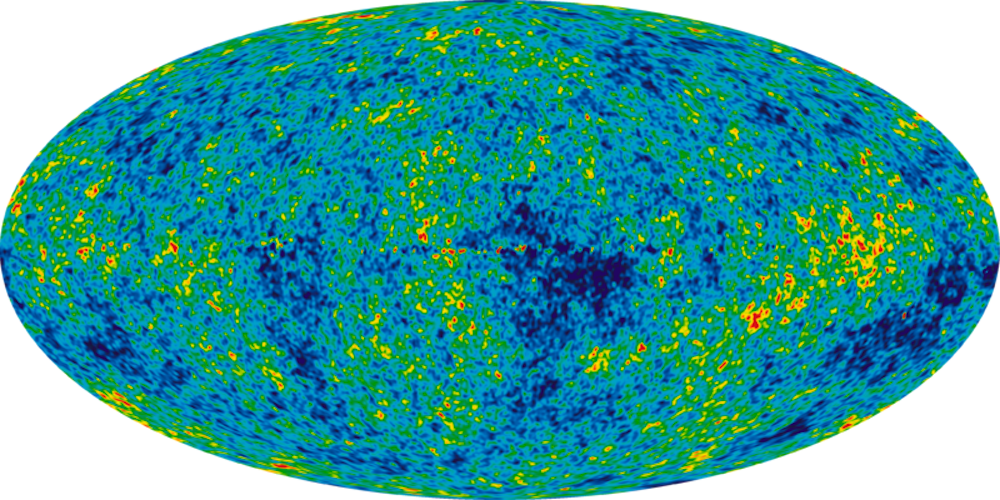
Remnants of the conditions in the early universe, like cosmic microwave background radiation, gave scientists a precise measure of the unverse’s mass in baryons. NASA
Unsuccessful search
Astronomers across the globe took up the search and the first clue came a year later from theoretical cosmologists. Their computer simulations predicted that the majority of the missing matter was hiding in a low-density, million-degree hot plasma that permeated the universe. This was termed the “warm-hot intergalactic medium” and nicknamed “the WHIM.” The WHIM, if it existed, would solve the missing baryon problem but at the time there was no way to confirm its existence.
In 2001, another piece of evidence in favor of the WHIM emerged. A second team confirmed the initial prediction of baryons making up 5% of the universe by looking at tiny temperature fluctuations in the universe’s cosmic microwave background – essentially the leftover radiation from the Big Bang. With two separate confirmations of this number, the math had to be right and the WHIM seemed to be the answer. Now cosmologists just had to find this invisible plasma.
Over the past 20 years, we and many other teams of cosmologists and astronomers have brought nearly all of the Earth’s greatest observatories to the hunt. There were some false alarms and tentative detections of warm-hot gas, but one of our teams eventually linked those to gas around galaxies. If the WHIM existed, it was too faint and diffuse to detect.
The red circle marks the exact spot that produced a fast radio burst in a galaxy billions of light-years away.
J. Xavier Prochaska (UC Santa Cruz), Jay Chittidi (Maria Mitchell Observatory) and Alexandra Mannings (UC Santa Cruz), CC BY-ND
An unexpected solution in fast radio bursts
In 2007, an entirely unanticipated opportunity appeared. Duncan Lorimer, an astronomer at the University of West Virginia, reported the serendipitous discovery of a cosmological phenomenon known as a fast radio burst (FRB). FRBs are extremely brief, highly energetic pulses of radio emissions. Cosmologists and astronomers still don’t know what creates them, but they seem to come from galaxies far, far away.
As these bursts of radiation traverse the universe and pass through gasses and the theorized WHIM, they undergo something called dispersion.
The initial mysterious cause of these FRBs lasts for less a thousandth of a second and all the wavelengths start out in a tight clump. If someone was lucky enough – or unlucky enough – to be near the spot where an FRB was produced, all the wavelengths would hit them simultaneously.
But when radio waves pass through matter, they are briefly slowed down. The longer the wavelength, the more a radio wave “feels” the matter. Think of it like wind resistance. A bigger car feels more wind resistance than a smaller car.
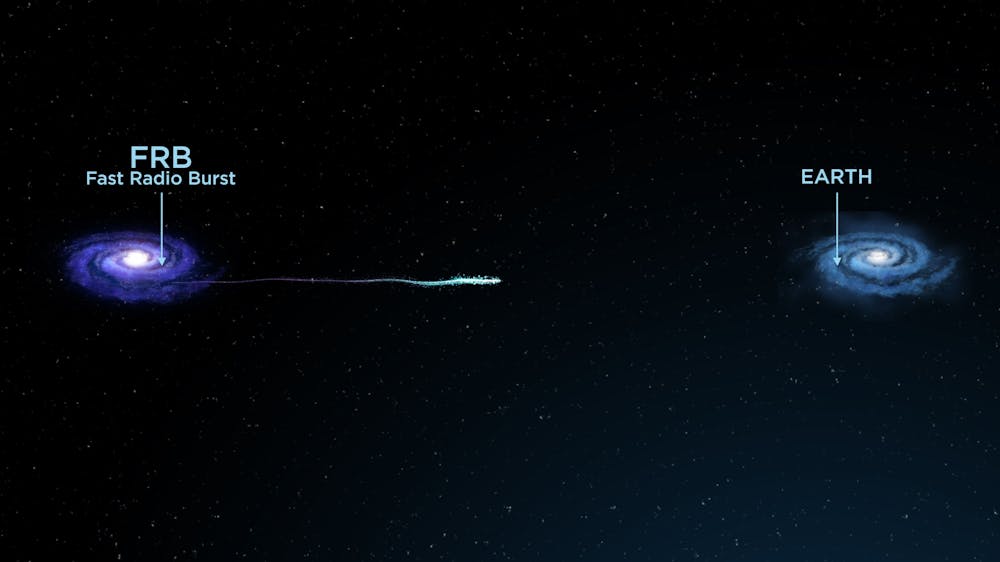
The “wind resistance” effect on radio waves is incredibly small, but space is big. By the time an FRB has traveled millions or billions of light-years to reach Earth, dispersion has slowed the longer wavelengths so much that they arrive nearly a second later than the shorter wavelengths.
Fast radio bursts originate from galaxies millions and billions of light-years away and that distance is one of the reasons we can use them to find the missing baryons. ICRAR, CC BY-SA
Therein lay the potential of FRBs to weigh the universe’s baryons, an opportunity we recognized on the spot. By measuring the spread of different wavelengths within one FRB, we could calculate exactly how much matter – how many baryons – the radio waves passed through on their way to Earth.
At this point we were so close, but there was one final piece of information we needed. To precisely measure the baryon density, we needed to know where in the sky an FRB came from. If we knew the source galaxy, we would know how far the radio waves traveled. With that and the amount of dispersion they experienced, perhaps we could calculate how much matter they passed through on the way to Earth?
Unfortunately, the telescopes in 2007 weren’t good enough to pinpoint exactly which galaxy – and therefore how far away – an FRB came from.
We knew what information would allow us to solve the problem, now we just had to wait for technology to develop enough to give us that data.
Technical innovation
It was 11 years until we were able to place – or localize – our first FRB. In August 2018, our collaborative project called CRAFT began using the Australian Square Kilometer Array Pathfinder (ASKAP) radio telescope in the outback of Western Australia to look for FRBs. This new telescope can watch huge portions of the sky, about 60 times the size of a full Moon, and it can simultaneously detect FRBs and pinpoint where in the sky they come from.
The technology and technique worked. We had measured the dispersion from an FRB and knew where it came from. But we needed to catch a few more of them in order to attain a statistically significant count of the baryons. So we waited and hoped space would send us some more FRBs.
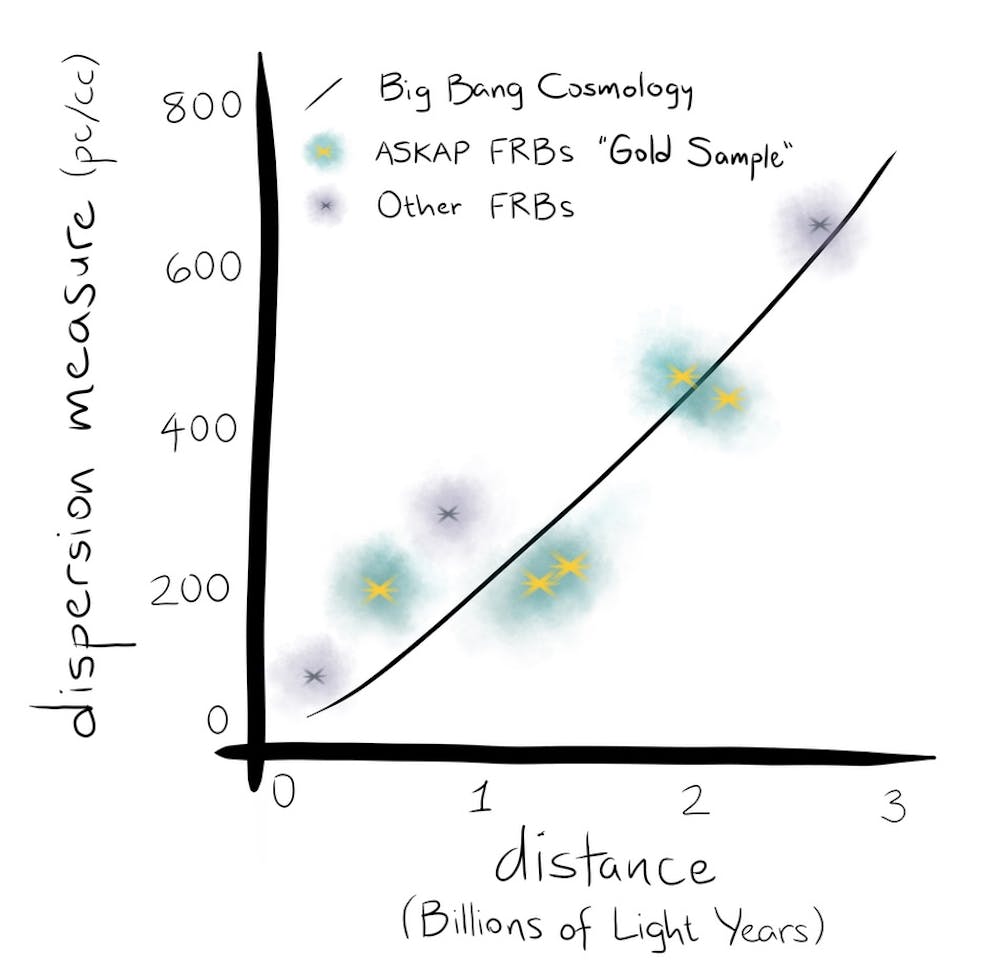
By mid-July 2019, we had detected five more events – enough to perform the first search for the missing matter. Using the dispersion measures of these six FRBs, we were able to make a rough calculation of how much matter the radio waves passed through before reaching earth.
We were overcome by both amazement and reassurance the moment we saw the data fall right on the curve predicted by the 5% estimate. We had detected the missing baryons in full, solving this cosmological riddle and putting to rest two decades of searching.
Sketch of the dispersion measure relation measured from FRBs (points) compared to the prediction from cosmology (black curve). The excellent correspondence confirms the detection of all the missing matter.
This result, however, is only the first step. We were able to estimate the amount of baryons, but with only six data points, we can’t yet build a comprehensive map of the missing baryons. We have proof the WHIM likely exists and have confirmed how much there is, but we don’t know exactly how it is distributed. It is believed to be part of a vast filamentary network of gas that connects galaxies termed “the cosmic web,” but with about 100 fast radio bursts cosmologists could start building an accurate map of this web.
Russia said on Thursday the United States was acting in a dangerous and unpredictable way, after Washington withdrew from a key military treaty and moved to ramp up pressure on Iran.
Foreign ministry spokeswoman Maria Zakharova made the comments after Washington announced it would end sanctions waivers for nations that remain in a nuclear accord signed with Iran. The remaining parties to the deal include Britain, China, France, Germany and Russia.
US officials also said they would walk away from the Open Skies Treaty, which allows each signatory's military to conduct surveillance flights over another member country each year on short notice.
"Washington's actions are becoming more and more dangerous and unpredictable," Zakharova told reporters.
"The nature of this behavior is clearly disruptive," Zakharova said, accusing Washington of undermining international security.
She also criticized the United States for exiting the INF missile treaty last year and failing to commit to renewing the New START arms control accord with Russia, which is due to expire in 2021.
President Donald Trump in 2018 withdrew the United States from a landmark agreement under which Iran had drastically curbed its nuclear activities and reimposed sanctions on Iran.
On Wednesday, Washington said it was ending sanctions waivers for the countries remaining in the Iran deal, bringing the agreement further to the verge of collapse.
Last week Trump also announced that he planned to withdraw the United States from the Open Skies Treaty, citing Russian violations.
People with cancer are more than twice as likely to die from COVID-19 than those without it, a large study published Thursday found.
The data on more than 900 patients in the US, Canada and Spain which appeared in a paper in The Lancet, found that mortality increased the further the cancer had progressed.
Cancer patients with decreased ability to carry out daily life tasks were more at risk than those with higher functionality.
The paper's authors looked at how many people died within 30 days of being diagnosed of COVID-19 of all causes.
"The 30-day all-cause mortality was 13 percent, more than twice the mortality reported as the global average by Johns Hopkins," Toni Choueiri, an oncologist at the Dana-Farber Cancer Institute who co-authored the paper told AFP.
In keeping with previous studies, the team also found that advanced age, male sex, the presence of two or more underlying conditions, and former smoking status were all also tied to increased risk of death.
But the receipt of chemotherapy or other anti-cancer therapies within four weeks of COVID-19 diagnosis did not affect mortality outcomes.
"Taken together, these results suggest that fit patients with cancer and few comorbidities can and should proceed with appropriate anti-cancer treatment," said Choueiri.
But those who have poor daily life functionality or a cancer which is progressing "need to have thoughtful conversations with their oncology providers about risk versus benefit of anti-cancer treatment," he added.
Bill Cance, chief medical and scientific officer for the American Cancer Society which provided funding for the study, said: "This is a very high impact paper that shows how cancer patients are at higher risk for Covid."
He added that the paper suggested that the drug combination of hydroxychloroquine and azithromycin may cause a three-fold greater risk of death -- an area that needed further exploration.
The authors of the paper themselves said they could not draw a conclusion on this trend because it may have arisen from other factors.
As the coronavirus pandemic swept across the globe, Latin America's slum dwellers waited defenseless in its path. Now, with the region becoming the new epicenter of the crisis, the virus is unleashing destruction on its most vulnerable populations.
With limited sanitation and little space, millions of people living cheek by jowl in slums cannot take even the most basic hand-washing and social distancing precautions recommended by health authorities.
"We are increasingly concerned about the poor and other vulnerable groups more at risk from disease and death from the virus," Pan American Health Organization chief Carissa Etienne said this week.
With infections continuing to climb in the pandemic's new epicenter Brazil, as well as Peru and Chile, experts warn the situation is rapidly worsening.
In a region where an estimated 54 percent are employed in the informal sector, slum residents are forced to choose between "starving or dying from the virus," according to Brazilian economist Dalia Maimon of the Federal University of Rio de Janeiro.
Maimon sums up the prevailing belief as: "if dying of hunger is a certainty, by not working -- then I will take the risk of trying not to become infected by going out to work."
An economic crisis exacerbated by the shutdown has left millions of Latin Americans without a livelihood. In Brazil alone, five million people lost their jobs since the pandemic began, the government said Thursday.
- 'Staying home means starving' -
"We are construction workers, people who sell things, people who go out every day. With confinement everything has changed for most of us. We find ourselves without any work," Oscar Gonzalez, 43, told AFP.
Gonzalez, a welder in the deprived Brisas del Sol area of Santiago, was employed in a workshop that closed down last month.
The neighborhood has seen an increase in social unrest this week as people took to the streets and erected barricades to demand state aid.
"We don't even get a little help from the government here. They believe that we can live without money. But how can we buy food?" Gonzalez asked.
It is a sentiment heard also in Santiago's sprawling La Pintana area, where locals lambast the state's slow reaction to the crisis.
"If we don't support each other, nobody helps us here," says Gloria Reyes, a 62-year-old seamstress who now runs a soup kitchen.
The virus "has stopped everything," said Claudia Gutierrez, 31, who runs a market stall selling second-hand clothes.
- Soup kitchens -
"I'm 55 years old, my family is from here and I have never seen so many soup kitchens in my life," said the La Pintana's mayor Claudia Pizarro, a member of the leftist opposition Democratic Party.
"Last week it was 20, and this week it's 40," she said.
La Pintana has more than 2,100 COVID-19 cases and "more than 50 percent of the PCR tests we are doing are positive," said the mayor, well above the 12-16 percent positives seen nationwide.
Fifteen people with COVID-19 died in the area, according to Pizarro.
In Sao Paulo, Brazil's sprawling megacity of 12.2 million, the coronavirus has killed more than 6,400 people of the 86,000 officially infected.
After the United States, Brazil is the country most affected by the pandemic in terms of numbers, with more than 25,000 deaths and 410,000 infections out of a population of 210 million.
"We must have our own public policies and create alternatives because of the absence of the government," said Gilson Rodrigues, an official in Paraisopolis, the second largest favela in Sao Paulo.
"We have to prepare for the worst-case scenario."
In Argentina, a spike in cases in a Buenos Aires slum last week forced the government to postpone plans to emerge from a 10-week lockdown.
On Monday another surge in the Villa Azul slum spread further alarm, and police enforced quarantine, as authorities fear the virus could spread to a much bigger slum nearby.
- Absent state -
Elsewhere, the absence of the state -- a vacuum that existed even before the pandemic -- has led to criminal organizations moving in to extend their control by helping stricken communities.
The ability of these groups to fill the void left by the authorities "is the most alarming trend" since the virus struck, security expert Douglas Farah told a recent forum in Washington hosted by the Organization of American States.
In Mexico, cartels are distributing food and medicine; in Honduras, gangs organize vehicle disinfection campaigns, to protect themselves from the virus in the areas they control.
According to the UN, nearly 89 million people in the region do not have even basic sanitation services, making impossible regular hand-washing, the most basic protection against the coronavirus.
In Peru almost a third of Lima's 10 million population are facing serious water supply problems.
"The water crisis in Lima is a silent threat. The most vulnerable populations are those most at risk of being exposed to the pandemic," Mariella Sanchez, head of the Aquafondo NGO, told AFP.
Shortages of electricity and gasoline have added to the lack of water in Venezuela.
In the town of San Cristobal on Colombian border, Reinaldo Vega's family collects water in buckets from a pipeline in the street and uses what he terms "boy scout" techniques to get through.
"This is how we survive," he told AFP, as he went off to forage for firewood to cook.
Pharmaceutical company executives said Thursday that one or several COVID-19 vaccines could begin rolling out before 2021, but warned the challenges would be "daunting" as it was estimated that 15 billion doses would be needed to halt the pandemic.
Well over 100 labs around the world are scrambling to come up with a vaccine against the novel coronavirus, including 10 that have made it to the clinical trial stage.
"The hope of many people is that we will have a vaccine, hopefully several, by the end of this year," Pascal Soriot, head of AstraZeneca, told a virtual briefing.
His company is partnering with the University of Oxford to develop and distribute a vaccine being trialled in Britain.
Albert Bourla, head of Pfizer, meanwhile said that his company, which is conducting clinical trials with German firm Biontech on several possible vaccines in Europe and the United States, also believed one would be ready before the end of the year.
"If things go well, and the stars are aligned, we will have enough evidence of safety and efficacy so that we can... have a vaccine around the end of October," he said.
It can take years for a new vaccine to be licensed for general use, but in the face of the COVID-19 pandemic, experimental vaccines shown to be safe and effective against the novel coronavirus could likely win approval for emergency use.
The International Federation of Pharmaceutical Manufacturers and Associations (IFPMA), which organised Thursday's briefing, highlighted the "daunting" challenges facing the industry in the push for a vaccine.
- 'Running against time' -
One challenge, which may seem counterintuitive, is that transmission rates are rapidly declining in Europe where some of the trials are taking place.
Soon they will be too low to properly conduct clinical vaccine trials in a natural setting, Soriot said, adding that so-called "human challenge" studies in which people are intentionally exposed to the virus to test efficacy, were not considered ethically acceptable with COVID-19.
"We are running against time," he said.
The novel coronavirus has killed more than 355,000 people and infected at least 5.7 million worldwide in a matter of months.
IFPMA director Thomas Cueni pointed to estimates that the world will need some 15 billion doses to stop the virus, posing massive logistical challenges.
He stressed that the industry was committed to ensuring equitable access to a future vaccine, but acknowledged that "we will not have sufficient quantities as from day one, even with the best efforts."
Once a working vaccine is developed, one of the biggest obstacles to putting out the amount needed could surprisingly be that there are not enough glass vials to store the doses in.
"There are not enough vials in the world," Soriot said, adding that AstraZeneca, like a number of other firms, was looking into the possibility of putting multiple doses in each vial.
- IP 'fundamental' -
Paul Stoffels, vice chairman and chief scientific officer at Johnson and Johnson, meanwhile said that if 15 billion doses were needed, a number of different vaccines would be necessary to satisfy the initial demand.
"Not all vaccine candidates could go all over the world depending on features, so somewhere between five and 10 will definitely be needed to serve the whole world," he said.
One challenge could be that some of the vaccines being worked on require storage at very low temperatures, which could be difficult in places lacking the proper infrastructure.
While stressing the need for solidarity and for ensuring fair and equitable distribution of a COVID-19 vaccine, the pharmaceutical chiefs flatly rejected any suggestion that intellectual property rights should be waived on vaccine research.
"IP is absolutely fundamental to our industry," GSK chief Emma Walmsley said.
Soriot meanwhile pointed out that pharmaceutical companies are currently investing billions of dollars with little chance of recuperating the costs.
"If you don't protect IP, then essentially there is no incentive for anybody to innovate," he said.
British Prime Minister Boris Johnson’s adviser likely broke the government’s coronavirus regulations by traveling during lockdown, but will not face further action, police said Thursday.
The adviser, Dominic Cummings, has acknowledged driving 250 miles (400 km) to his parents’ house in Durham, northeast England, at the end of March and later taking another drive to a scenic town 30 miles (50 km) away.
Durham Constabulary said the drive to Durham did not breach the rules but the second trip, to the town of Barnard Castle, might have been “a minor breach” of lockdown rules “that would have warranted police intervention.”
The force said that had Cummings been stopped by an officer at the time he would likely have been ordered to turn around, but “there is no intention to take retrospective action.”
More than 14,000 people in Britain have been fined by police for violating a ban on all but essential travel that was imposed March 23 to help slow the spread of the virus.
Johnson has resisted calls to fire Cummings, his most senior aide and the architect of the Conservative Party’s December election victory, for apparently flouting restrictions that the government imposed on the rest of the country.
Cummings has defended his actions, saying he traveled to ensure that his 4-year-old son could be looked after if he and his wife, who both had coronavirus symptoms, became sick. He says he drove to Barnard Castle to test whether his eyesight, which had been affected by illness, was good enough for the long trip back to London.
Cummings’ explanation failed to assuage the anger among many Britons who have endured two months of isolation from loved ones during the pandemic and see a double standard at work.
More than 30 lawmakers in Johnson’s Conservative Party have called on Cummings to resign, citing an outpouring of fury from their constituents.
Johnson has stood by his aide. His office said, “The police have made clear they are taking no action against Mr. Cummings over his self-isolation and that going to Durham did not breach the regulations.”
It said the prime minister “regards this issue as closed.”
The United States said Thursday it would offer up to $3 million for the arrest of a senior leader of the Islamic State movement who has overseen the extremists' grisly execution videos.
The State Department said it would provide the reward in return for information on the location or further identification of Jordanian-born Muhammad Khadir Musa Ramadan, also known as Abu Bakr al-Gharib.
"He has overseen the planning, coordination and production of numerous propaganda videos, publications and online platforms that included brutal and cruel scenes of torture and mass execution of innocent civilians," it said in a statement.
US special forces in October killed the group's leader Abu Bakr al-Baghdadi inside Syria, where the extremists once ran a self-styled caliphate that stretched into Iraq.
The extremists carried out summary beheadings and enslaved non-Muslims, with videos of their deeds used to recruit fighters from around the world.
A Western-backed military campaign decimated the group's former stronghold but attacks linked to Islamic State extremists have been rising farther afield, including in Afghanistan and sub-Saharan Africa.
Dutch authorities on Thursday announced a nationwide ban on the transport of mink after mink farm workers were believed to have contracted coronavirus from the small mammals.
The infections in the south of the Netherlands could be the "first known cases of animal-to-human transmission", the World Health Organization had said on Tuesday.
The Dutch government had previously made COVID-19 testing mandatory on all mink farms in the country, where the animals are bred for their fur.
"Until the results of this screening are known," the transport of mink and mink manure will be banned to combat the spread of the new coronavirus, Public Health Minister Hugo de Jonge and Agriculture Minister Carola Schouten said in a letter to parliament.
There have been no mink exports to countries outside of the European Union this year, the ministers added.
However, it is not possible to know whether mink was traded from the Netherlands to other EU member states in 2020 because this trade is not subject to a European certificate, they said.
According to the ministers, health authorities consider the risk of contamination "negligible" outside the four Dutch farms where infected mink have been reported.
The initial infection of a mink farm worker was reported last week on one of two farms near the southern city of Eindhoven, where the disease was discovered in April among mink.
The infection happened before it was known that the mink were carrying the virus, meaning that workers did not wear protective clothing at the time.
The health ministry said on Tuesday that three people on the farm tested positive for the virus, but said that it remained unclear if more than one of the cases had come directly from a mink.
There have been more than 5,900 coronavirus deaths and 45,950 infections in the Netherlands, according to the latest official figures.
The exact source of the virus, which first appeared in China late last year, remains unknown, and there is growing pressure for an international probe to determine its origin.
Most scientists believe the virus jumped from animals to humans, possibly in a market that sells exotic animals for meat in the city of Wuhan.
Since the initial jump to humans, there have been no previous reports of animals being the source of infections.
Nathalie Szczepaniak caresses the hand of her husband Joseph, a care home resident, as the couple reunites after weeks without a visit because of France's coronavirus lockdown.
But this is no ordinary reunion.
The couple meets in an anti-virus "bubble" at Joseph's nursing home in Bourbourg, northern France, separated by a clear plastic sheet that allows them some physical contact, face-to-face, without the risk of infection.
Nathalie holds up the couple's dog, a white fluffy creature named Valco, so that Joseph, who has Parkinson's disease, can press his palm to its paw through the plastic.
"You are eager to see your dog? Well, look, here he is," she says, smiling tenderly as Joseph reaches out weakly, his eyes shining as Valco tries in vain to climb onto his master's lap on the other side of the sheet.
The new coronavirus has proved deadliest for older people, and France imposed a strict no-visit policy at retirement homes when the country was placed in lockdown in March in a bid to curb infections.
So far, the virus has killed 10,336 people at French care homes, authorities say, more than a third of the national toll of 28,596.
But the lack of contact has been hard to bear for nursing home residents, many of whom are battling dementia, and psychologists have warned that the trauma of perceived abandonment can be fatal for some.
- 'They stop eating' -
Confined to their rooms, "the residents suffer tremendously" and some "just let themselves die, they stop eating, they no longer find meaning in life," said Audrey Bernard, director of the Bourbourg nursing home.
The separation has been hard on loved ones too.
"We couldn't visit him for two months... This week I called for an appointment, and voila, the surprise!" Nathalie Szczepaniak said, pointing to the plastic reception tent she discovered upon arrival.
She had been expecting to see her husband only from a distance, but instead the igloo-like contraption allowed them to experience something as close as possible to real contact.
"We can touch each other, you can feel the body heat through the (plastic)... It is very, very, very nice," Szczepaniak said, a big smile on her face.
Erected just last week, the inflatable tent comprises a central bubble that acts as the reception area, connected to an entrance on either side that can be closed airtight.
- Renewed energy -
"You can see an improvement in the people who've already had visits... there is renewed energy, a newfound interest, you can see the smiles on the faces both of the families and the residents," Bernard told AFP of the innovation.
"The families really feel like they're with the resident, there's no feeling of separation, it allows them to touch each other safely... They are both inside, safe and secure, they can hear each other easily, as if they were in the same room."
Before the bubble, the home had tried to facilitate family access by placing residents in the on-site restaurant, with visitors waving and talking to them through the windows, from outside.
But they had trouble hearing each other, and many found the experience frustrating.
"Today, with this bubble... they can talk, see each other without masks and almost touch," said Bernard, who recounts seeing one couple kiss through the plastic.
- 'I saw him smile' -
"It is excellent. Excellent!" exclaims Nathalie. "He did not even notice the plastic. And I saw him smile, something that I haven't been seeing any more."
After she leaves, the bubble is disinfected before the next visitors to arrive: a woman coming to see her father, his granddaughter in tow.
The bubble tent receives between six and eight visits a day, each lasting 30 to 45 minutes, and there is already a long waiting list.
"We wanted to restore a humane dimension to a totally inhumane situation while guaranteeing safety, the non-transmission" of the virus, said Pierre-Stephane Dumas, of BubbleTree, the company that designed the tent.
A prototype was erected at the Bourbourg site without cost for a two-week trial period, with a view to making improvements before others are rolled out to more French care homes.
Several have already shown interest, Dumas said, but the wind and rain-resistant installation, complete with electricity, costs between 7,500 and 10,000 euros ($8,250-$11,000) to manufacture, meaning financing will have to be found to reduce overheads.