Russia has detained an investigative journalist for drugs offences, prompting protests on Friday as supporters condemned the charges as trumped-up and suggested they were punishment for his reporting.
Ivan Golunov, a reporter with Meduza, an independent Russian-language media outlet, was detained in central Moscow on Thursday and police have opened a probe into manufacturing and dealing drugs.
A police spokesman said a 36-year-old man he did not identify had been detained with five packages of mephedrone, a designer drug.
Supporters said the drugs had been planted on him.
Reporters Without Borders warned Golunov's arrest could mark "a significant escalation in the persecution" of independent journalists in Russia.
Police on Friday briefly arrested several prominent reporters as they protested with placards in the front of the headquarters of the Moscow police, including author Viktor Shenderovich and Pavel Kanygin of the opposition newspaper Novaya Gazeta.
"I am a journalist. Arrest me too," said one of the placards carried by the reporters, while another read: "A journalist is a drug kingpin. Who would believe this madness?".
"We have reasons to believe that Golunov is being persecuted for his journalistic work," Meduza general director Galina Timchenko and editor-in-chief Ivan Kolpakov said in a statement.
They described Golunov as "one of Russia's most famous investigative journalists" and said he had received threats in recent months.
- Paying the price -
The Meduza website is based in EU member Latvia to circumvent censorship from Moscow, but some of its journalists live in Russia.
"Everything indicates that the authorities are planting drugs on their targets to shut them up with a jail sentence," said Natalia Zvyagina, director of Amnesty International's branch in Russia.
In his investigations, Golunov zeroed in on everything from Russia's shady funeral industry to corruption in Moscow city hall.
The journalist's lawyer Dmitry Dzhulai said police claimed they found packages containing drugs in Golunov's backpack and apartment.
"There are a lot of facts signalling that the drugs have been planted," the lawyer told AFP.
He said the journalist had been beaten while in detention and pointed to numerous violations including a refusal by investigators to take swabs of Golunov's fingernails and backpack to check for handling of drugs.
"He was detained at 2.30 pm yesterday and I only got a call at 4.30 am," Dzhulai said.
- 'Ludicrous provocation' -
During his two decades in power Russian President Vladimir Putin has silenced most of his critics and muzzled independent media.
The few opposition and independent media that still operate in Russia are under huge pressure, Kremlin critics say.
Golunov's arrest sparked wide outrage.
Alexander Baunov of the Carnegie Moscow Center said Golunov was a close friend and did not take stimulants because he did not like an "altered state of mind."
Johann Bihr, the head of the Reporters Without Borders Eastern Europe and Central Asia desk, pointed to "the police's highly suspicious behaviour".
"If such methods were indeed used against such a prominent journalist...it would mark a significant escalation in the persecution of independent journalism in Russia," he said.
In an open letter, hundreds of Russian journalists demanded Golunov's immediate release.
"We believe that Ivan Golunov has become a target of a crude and ludicrous provocation," it said.
Seventy years after its publication, George Orwell's classic dystopian novel "1984" continues to fascinate readers, in particular youngsters growing up in a social media-dominated age of increasing angst.
"Some students are very shocked by it, and remain shocked by it," said Michael Callanan, an English teacher and director of the Orwell Youth Prize, which supports political expression amongst young people.
"It is part of the paradox of a book being 70-years-old," he added.
"I think they were taken aback by how fresh and how true to our lives today it strangely is."
Written in 1948, and published the following year, "1984" depicted a chilling future world in which a totalitarian state controls people's thoughts and actions, suppressing any dissent.
This rigidly-controlled society features a so-called "ministry of truth" that distorts reality, with the ever-watchful eyes of "Big Brother" keeping tabs on citizens' behaviour.
The novel introduced other terms that have endured in the lexicon, including "double-think", which means "the power of holding two contradictory beliefs in one's mind simultaneously, and accepting both of them", according to Orwell.
For Jean Seaton, director of the Orwell Foundation, which promotes the work of the writer who died in 1950 aged 46, and administers various awards, his masterpiece was "very prescient".
She noted the book's description of "two minutes hate" -- in which citizens watch a daily film inciting them to hate enemies of the state -- as comparable to online hate-mobs today.
- Sales spikes -
Over the seven decades since its publication, "1984" has remained omnipresent on the social landscape, and even seen periodic spikes in sales.
In 2017 it enjoyed a boom in popularity after one of US President Donald Trump's advisors used the term "alternative facts", a phrase used in the book.
In Britain, sales that year increased by an eye-popping 165 percent, publisher Penguin Books told AFP.
The novel also saw a marked increase in purchases in 2013, after the revelations of mass state spying by US whistleblower Edward Snowden.
Callanan, who has been teaching for 30 years, said today's teenagers are not "frightened of it in a way that maybe previous generations were".
"But in the past couple of years with the rise of Trump, there is now significant minorities of students that are very concerned about the way the world is going -- and of course truth is the big thing," he added.
- Thought police -
Even those who have not read "1984" can be hard pressed to avoid its influence on popular culture, from movies and music through to video games.
When students open the book for the first time, Callanan said they "immediately recognise things like 'double-think' and the 'thought police'.
"These kind of Orwell phrases are out there in the zeitgeist, and kids have heard of them," the teacher at a school northwest of London added.
The book appears particularly relevant amid wider public interest in dystopian fiction and drama on television and in cinemas, with television hits like "The Handmaid's Tale" and "Black Mirror" and film adaptations such as the "Hunger Games" series.
Callanan tells his pupils Orwell is "the granddaddy" of these contemporary works.
"People read it when they are young and then read it when they are older and come to a different understanding of what it is saying," Seaton added.
"People are reading it for signs of what they should be worried about now."
In a move critics warned could empower the Saudis to manufacture their own high-tech weaponry for use in their assault on Yemen, the Trump administration reportedly wants to allow the American arms giant Raytheon to work with the kingdom to construct bomb and missile parts inside Saudi Arabia.
As The New York Timesreported Friday, President Donald Trump's emergency declaration last month greenlighting billions of dollars in U.S. weapons sales to Saudi Arabia without congressional approval contained a provision that permits Raytheon to "team up with the Saudis to build high-tech bomb parts in Saudi Arabia."
The provision, according to the Times, immediately "raised concerns that the Saudis could gain access to technology that would let them produce their own versions of American precision-guided bombs—weapons they have used in strikes on civilians since they began fighting a war in Yemen four years ago."
"The move grants Raytheon and the Saudis sweeping permission to begin assembling the control systems, guidance electronics, and circuit cards that are essential to the company's Paveway smart bombs," the Times reported. "The United States has closely guarded such technology for national security reasons."
In a detailed investigation published last month, In These Times found that the Saudi kingdom has "ordered more than 27,000 missiles worth at least $1.8 billion from Raytheon alone."
"About $650 million of those Raytheon orders," In These Times reported, "came after the Saudi war in Yemen began."
William Hartung, director of the Arms and Security Project at the Center for International Policy, warned that handing the Saudis the capacity to develop high-tech bombs on the level of U.S. weaponry could have disastrous consequences for the people of Yemen, who are already suffering from the world's worst humanitarian crisis.
"If Saudi Arabia is able to develop an indigenous bomb-making capability as a result of this deal," Hartung said, "it will undermine U.S. leverage to prevent them from engaging in indiscriminate strikes of the kind it has carried out in Yemen."
According to the Times, the Trump administration's agreement with Raytheon "is part of a larger arms package, previously blocked by Congress, that includes 120,000 precision-guided bombs that Raytheon is prepared to ship to the coalition."
"These will add to the tens of thousands of bombs that Saudi Arabia and the United Arab Emirates have already stockpiled," the Times reported, "and some in Congress fear the surplus would let the countries continue fighting in Yemen long into the future."
As Common Dreamsreported in April, Trump vetoed a congressional effort—led by Sen. Bernie Sanders (I-Vt.) and Rep. Ro Khanna (D-Calif.)—to end U.S. complicity in the Saudi assault on Yemen by halting military assistance to the kingdom.
A bipartisan group of lawmakers is now planning a series of votes in an attempt to block Trump's emergency declaration on Saudi arms sales.
"We will not stand idly by and allow the president or the secretary of state to further erode congressional review and oversight of arm sales," said Sen. Bob Menendez (D-N.J.), the top Democrat on the Senate Foreign Relations Committee.
A same-sex couple traveling on a double-decker bus in London say they were beaten bloody by four men after they refused to kiss in front of them.
Melania Geymonat, who is 28, told BBC News she experiences "a lot of verbal violence all the time," but has never been physically attacked for being gay.
"There were at least four of them," Geymonat wrote about the May 30 hate crime on her Facebook page on Wednesday, calling it "CHAUVINIST, MISOGYNISTIC AND HOMOPHOBIC VIOLENCE."
"They started behaving like hooligans, demanding that we kissed so they could enjoy watching, calling us ‘lesbians’ and describing sexual positions," she says.
"It was only them and us there. In an attempt to calm things down, I started making jokes. I thought this might make them go away. Chris even pretended she was sick, but they kept on harassing us, throwing us coins and becoming more enthusiastic about it."
"The next thing I know is that Chris is in the middle of the bus fighting with them,: she continues. "On an impulse, I went over there only to find her face bleeding and three of them beating her up. The next thing I know is I'm being punched. I got dizzy at the sight of my blood and fell back. I don’t remember whether or not I lost consciousness. Suddenly the bus had stopped, the police were there and I was bleeding all over. Our stuff was stolen as well. I don’t know yet if my nose is broken, and I haven’t been able to go back to work, but what upsets me the most is that VIOLENCE HAS BECOME A COMMON THING."
BBC News reports Scotland Yard is investigating and examining CCTV footage.
"There were 2,308 homophobic hate crimes across London in 2018, compared with 2014 when 1,488 were recorded, according to the Met Police's crime dashboard," the BBC adds.
Mexico scrambled Thursday to slow the flow of Central American migrants to the United States as talks continued in Washington to head off President Donald Trump's threat of potentially catastrophic tariffs on Mexican goods.
Mexico City was deploying 6,000 National Guard troops to its southern border with Guatemala, blocked hundreds of migrants in a new caravan and froze the bank accounts of suspected human traffickers in hopes of appeasing Washington's demands.
But in the US capital, negotiators holding a second day of talks were still trying to find agreement on issues including asylum application procedures and financial aid to the Central American countries that are the source of most of the migrants.
"We have been working this afternoon, we still do not have an agreement," Mexican Foreign Minister Marcelo Ebrard said as talks wrapped for the day. "Tomorrow we have another session in the morning and we will continue forward."
With migrant apprehensions at the border with Mexico soaring to 144,000 in May, the highest number in 13 years, the Trump administration has threatened to hit all imports from Mexico with a five percent tariff starting Monday, a move that could savage the export-dependent Mexican economy.
Trump made the threat last week, saying that the tariffs would rise by five percentage points each month to a high of 25 percent if the southern US neighbor fails to halt the northward flow of migrants.
In an interview that aired late Thursday with Fox News from France where he is attending D-Day commemorations, Trump defended his tariff plan as "a beautiful thing" and complained about "this onslaught, this invasion" of undocumented migrants.
"That's really an invasion without guns," Trump told interviewer Laura Ingraham.
The president hesitated when Ingraham pointed out that Mexico was an important US trade ally.
"How do you define ally?" he asked, then talked about violence and drugs coming into the United States from Mexico.
"They shouldn’t be allowing people to come through their country from Central (America), from Honduras and Guatemala, (and) El Salvador," he said.
Trump was unconcerned that pushback in Congress over the tariffs could sink his new North America trade deal, the USMCA, which needs legislative approval. "I'm not worried about it because they need us, we don’t need them," he said.
- No deal yet -
Ebrard declined to comment on whether the talks at the State Department revisited the so-called "safe third-country" option proposed by the United States, which aims at having Central American migrants fleeing chronic poverty and violence apply for asylum from Mexico rather than in the United States.
Earlier in the week Ebrard rejected the idea, but the White House declared it one of its principal demands.
The Washington Post reported that a potential deal to avoid the tariffs would allow the United States to deport asylum seekers from Honduras and El Salvador to Guatemala, which they pass through to get to Mexico and then the United States.
Ebrard's spokesman Robert Velasco Alvarez said Thursday that there was no deal as the two sides were far apart, but that talks continue.
"The US position is focused on migrant control measures, ours is on development," he said, referring to Mexico's support of a broader effort to support the economies of Honduras, El Salvador and Guatemala.
At Mexico's southern border Thursday, there were visible efforts to slow the migrants and hinder their supporters.
In the southern state of Chiapas, AFP journalists reported an increased police and military presence on roads typically used by migrants heading north. Ebrard confirmed that 6,000 National Guardsmen would be deployed to the border.
Mexico City froze the bank accounts of 26 suspected human traffickers allegedly responsible for organizing US-bound migrant caravans.
Two activists from People Without Borders (Pueblo Sin Fronteras), which has helped organize migrant caravans, were arrested on allegations of offering migrants money to enter Mexico illegally.
Mexican authorities also blocked 420 migrants in a new caravan, although the group was initially about 1,200-strong, with many suspected of running away before immigration officials stepped in.
- Asylum not the problem -
Meanwhile Carla Provost, the head of the US Border Patrol, downplayed the issue of asylum, saying migrants simply understand that, due to US laws, if they arrive with children, they will likely be released into the United States.
She noted that since October, 230,000 children without legal travel documents have crossed the border into the United States, most with families but also tens of thousands unaccompanied by adults.
"The issue is they don't even have to claim asylum, they know that," Border Patrol chief Carla Provost told CNN.
"They are telling us they are told by smugglers, they are hearing announcements in their own country, that if they come right now and bring a child, they will be released," she said.
"That is a true statement, because we cannot hold them longer than 20 days if they have a child."
April 26, 1803 was an unusual day in the small town of L’Aigle in Normandy, France – it rained rocks.
Over 3,000 of them fell out of the sky. Fortunately no one was injured. The French Academy of Sciences investigated and proclaimed, based on many eyewitness stories and the unusual look of the rocks, that they had come from space.
The Earth is pummeled with rocks incessantly as it orbits the Sun, adding around 50 tons to our planet’s mass every day. Meteorites, as these rocks are called, are easy to find in deserts and on the ice plains of Antarctica, where they stick out like a sore thumb. They can even land in backyards, treasures hidden among ordinary terrestrial rocks. Amateurs and professionals collect meteorites, and the more interesting ones make it to museums and laboratories around the world for display and study. They are also bought and sold on eBay.
Despite decades of intense study by thousands of scientists, there is no general consensus on how most meteorites formed. As an astronomer and a geologist, we have recently developed a new theory of what happened during the formation of the solar system to create these valuable relics of our past. Since planets form out of collisions of these first rocks, this is an important part of the history of the Earth.
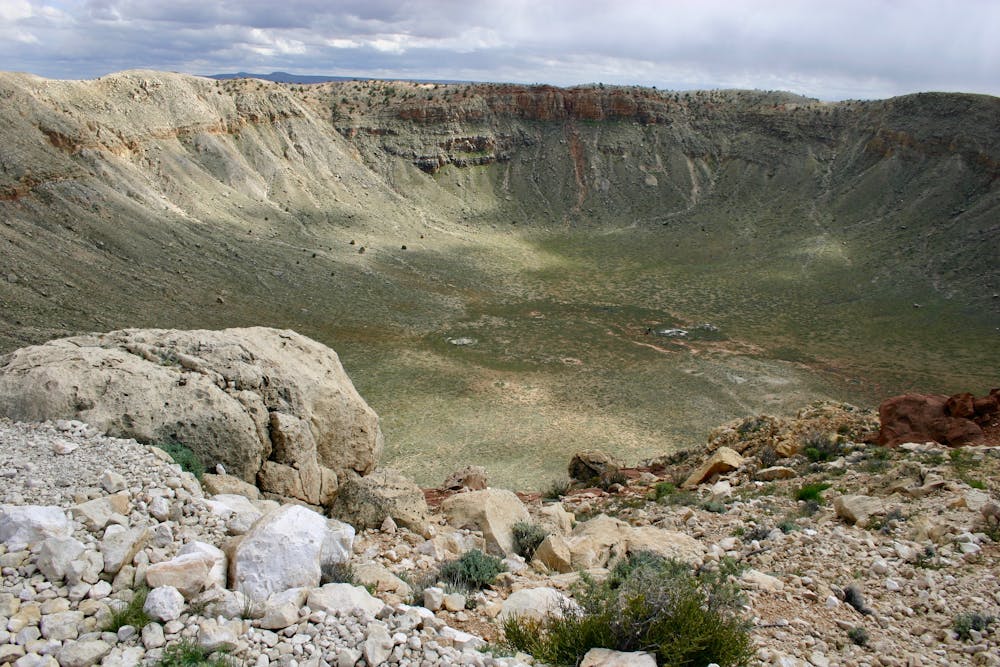
This meteor crater in Arizona was created 50,000 years ago when an iron meteorite struck the Earth. It is about one mile across.
Drew Barringer (left), owner of Arizona meteor crater, his wife, Clare Schneider, and author William Herbst in the Van Vleck Observatory Library of Wesleyan University, where an iron meteorite from the crater is on display.
W. Herbst
About 10% of meteorites are pure iron. These form through a multi-step process in which a large molten asteroid has enough gravity to cause iron to sink to its center. This builds an iron core just like the Earth’s. After this asteroid solidifies, it can be shattered into meteorites by collisions with other objects. Iron meteorites are as old as the solar system itself, proving that large asteroids formed quickly and fully molten ones were once abundant.
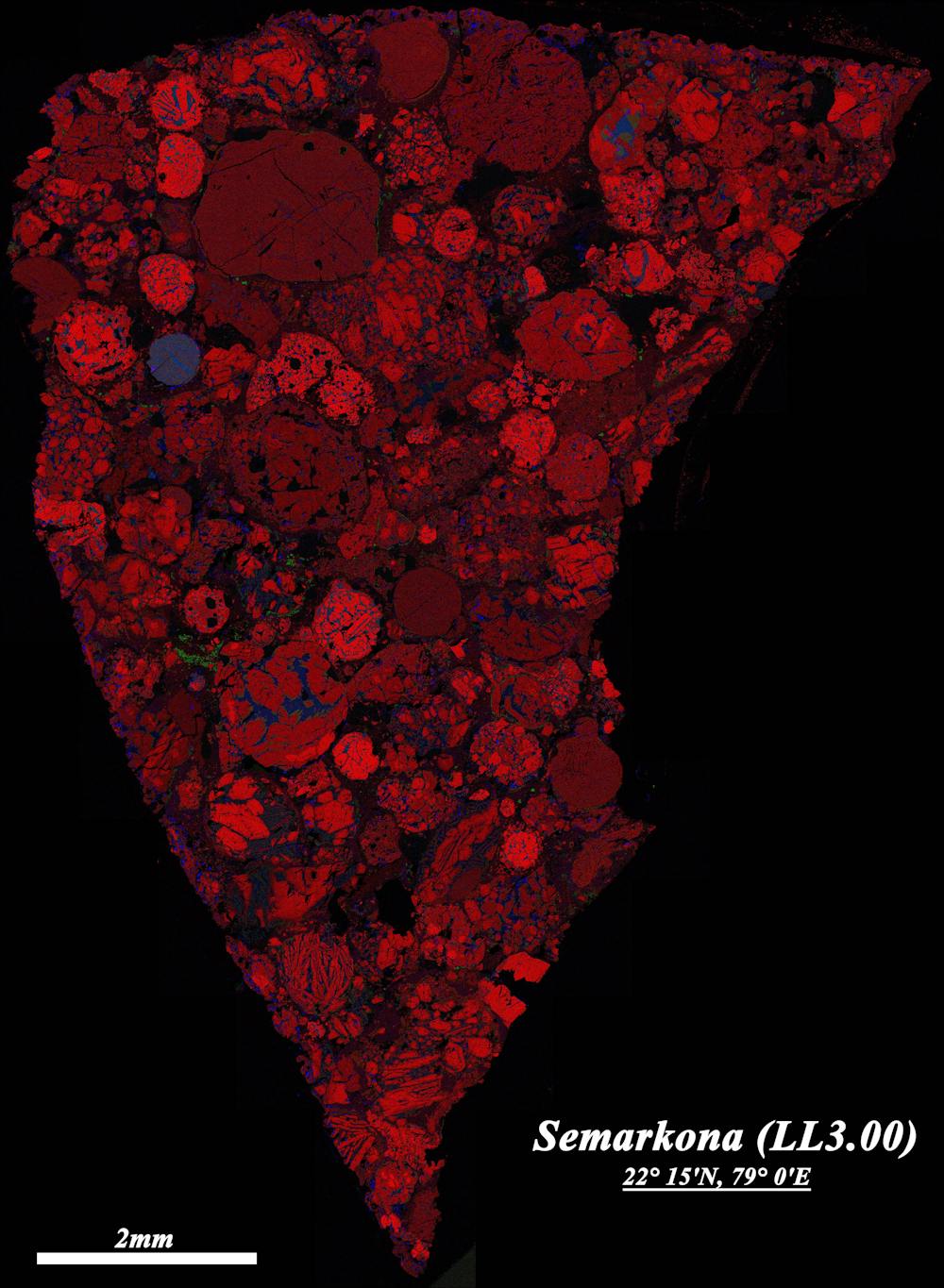
The other 90% of meteorites are called “chondrites” because they are full of mysterious, tiny spheres of rock known as “chondrules.” No terrestrial rock has anything like a chondrule inside it. It is clear that chondrules formed in space during a brief period of intense heating when temperatures reached the melting point of rock, around 3,000 degrees Fahrenheit, for less than an hour. What could possibly account for that?
A closeup of the Semarkona meteorite showing dozens of chondrules.
Kenichi Abe
Researchers have come up with many hypotheses through the last 40 years. But no consensus has been reached on how this brief flash of heating happened.
The chondrule problem is so famously difficult and contentious that when we announced to colleagues a few years ago that we were working on it, their reaction was to smile, shake their heads and offer their condolences. Now that we have proposed a solution we are preparing for a more critical response, which is fine, because that’s the way science advances.
The flyby model
Our idea is quite simple. Radioactive dating of hundreds of chondrules shows that they formed between 1.8 and 4 million years after the beginning of the solar system – some 4.6 billion years ago. During this time, fully molten asteroids, the parent bodies of the iron meteorites, were abundant. Volcanic eruptions on these asteroids released tremendous amounts of heat into the space around them. Any smaller objects passing by during an eruption would experience a short, intense blast of heat.
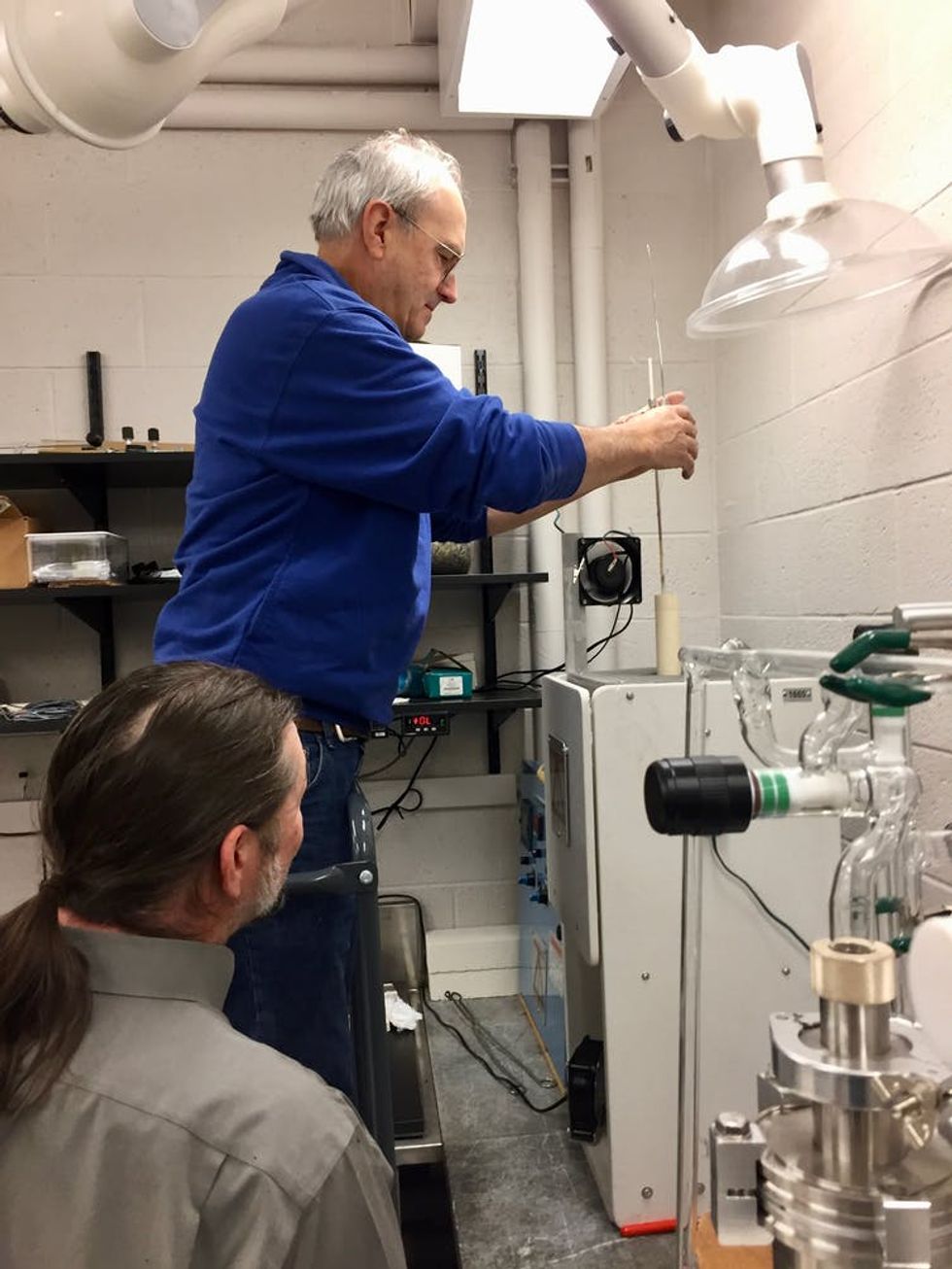
To test our hypothesis, we split up the challenge. The astronomer, Herbst, crunched the numbers to determine how much heating was necessary and for how long to create chondrules. Then the geologist, Greenwood, used a furnace in our lab at Wesleyan to recreate the predicted conditions and see if we could make our own chondrules.
Laboratory technician Jim Zareski (top) loads a programmable furnace as co-author Jim Greenwood looks on, in his laboratory at Wesleyan University. This is where the synthetic chondrules are made.
W. Herbst
The experiments turned out to be quite successful.
We put some fine dust from Earth rocks with compositions resembling space dust into a small capsule, placed it in our furnace and cycled the temperature through the predicted range. Out came a nice-looking synthetic chondrule. Case closed? Not so fast.
Two problems emerged with our model. In the first place, we had ignored the bigger issue of how chondrules came to be part of the whole meteorite. What is their relationship to the stuff between chondrules – called matrix? In addition, our model seemed a bit too chancy to us. Only a small fraction of primitive matter will be heated in the way we proposed. Would it be enough to account for all those chondrule-packed meteorites hitting the Earth?
A comparison of a synthetic chondrule (left) made in the Wesleyan lab with a heating curve from the flyby model, with an actual chondrule (right) from the Semarkona meteorite. The crystal structure is quite similar, as shown in the enlargements (bottom row).
J. Greenwood
Making whole meteorites
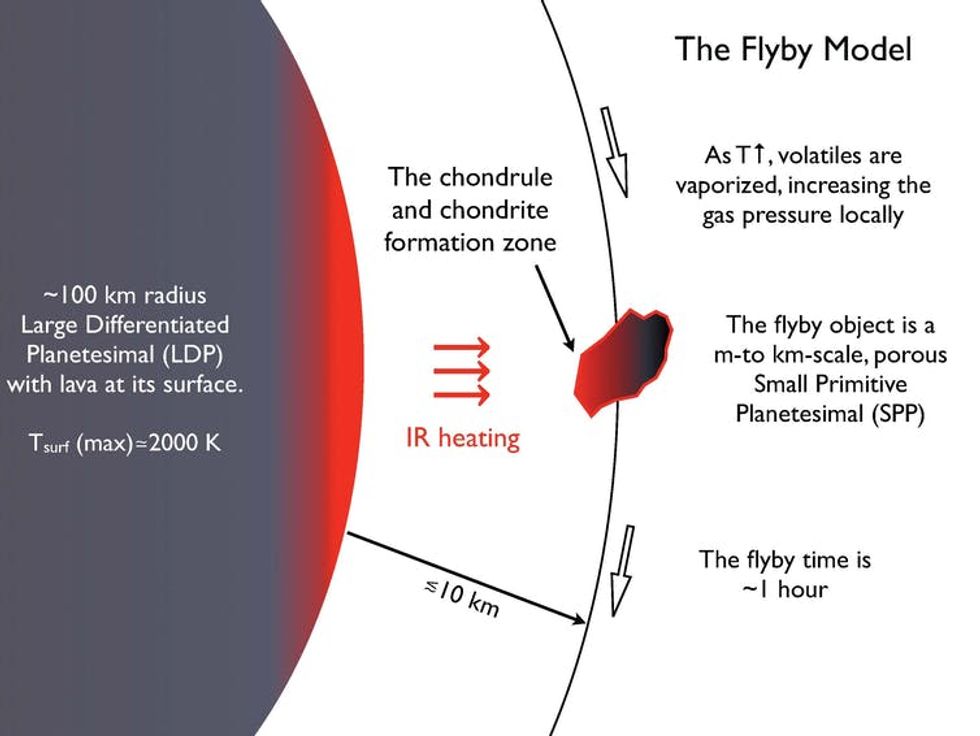
To address these issues, we extended our initial model to consider flyby heating of a larger object, up to a few miles across. As this material approaches a hot asteroid, parts of it will vaporize like a comet, resulting in an atmosphere rich in oxygen and other volatile elements. This turns out to be just the kind of atmosphere in which chondrules form, based on previous detailed chemical studies.
We also expect the heat and gas pressure to harden the flyby object into a whole meteorite through a process known as hot isostatic pressing, which is used commercially to make metal alloys. As the chondrules melt into little spheres, they will release gas to the matrix, which traps those elements as the meteorite hardens. If chondrules and chondrites form together in this manner, we expect the matrix to be enhanced in exactly the same elements that the chondrules are depleted. This phenomenon, known as complementarity, has, in fact, been observed for decades, and our model provides a plausible explanation for it.
The authors’ model for forming chondrules. A small piece of rock (right) — a few miles across or less — swings close to a large hot asteroid erupting lava at its surface. Infrared radiation from the hot lava briefly raises the temperature on the small piece of rock high enough to form chondrules and harden part of that object into a meteorite.
W. Herbst/Icarus
Perhaps the most novel feature of our model is that it links chondrule formation directly to the hardening of meteorites. Since only well-hardened objects from space can make it through the Earth’s atmosphere, we would expect the meteorites in our museums to be full of chondrules, as they are. But hardened meteorites full of chondrules would be the exception, not the rule, in space, since they form by a relatively chancy process – the hot flyby. We should know soon enough if this idea holds water, since it predicts that chondrules will be rare on asteroids. Both Japan and the United States have ongoing missions to nearby asteroids that will return samples over the next few years.
If those asteroids are full of chondrules, like the hardened meteorites that make it to the Earth’s surface, then our model can be discarded and the search for a solution to the famous chondrule problem can go on. If, on the other hand, chondrules are rare on asteroids, then the flyby model will have passed an important test.
China's central bank chief said Friday the country has plenty of policy tools left to handle the trade war with the United States.
There is "tremendous" room to counter the deepening trade war, People's Bank of China governor Yi Gang said in an interview with Bloomberg TV.
"We have plenty of room in interest rates, we have plenty of room in required reserve ratio rate, and also for the fiscal, monetary policy toolkit, I think the room for adjustment is tremendous," Yi said on Bloomberg TV.
Ties between China and the US have deteriorated sharply after trade negotiations stalled last month without a deal to lift bruising tariffs on goods worth $360 billion in two-way trade.
China said Thursday that it would soon release detailed information about a planned blacklist of "unreliable" foreign companies and individuals, that analysts expect will target firms cutting off supplies to Chinese tech giant Huawei.
Last month the US Commerce Department placed Huawei and dozens of its affiliates on an "entity list" on grounds of national security, curbing its access to crucial US-made components and software -- though a 90-day reprieve was later issued.
Yi has participated in several rounds of the trade negotiations with Washington and is scheduled to meet with US Treasury Secretary Steven Mnuchin this weekend during the G20 gathering of financial policymakers in Japan.
He said the meeting with Mnuchin would be "productive talk, as always," but trade war discussions would be "uncertain and difficult", according to Bloomberg News.
China's yuan, or renminbi, currency has also rapidly depreciated against the dollar as trade tensions have ramped up in recent weeks, nearing the critical seven to the dollar exchange rate.
The central bank has long prevented the yuan from falling below seven, but Yi hinted the bank may no longer defend the currency at that level.
"I don't think along this mathematical scale any number is more important (than) the other number," he said.
"The trade war would have a temporary depreciation pressure on renminbi, but you see, after the noise, (the) renminbi will continue to be very stable and relatively strong compared to emerging market currencies, even compared to convertible currencies," he told Bloomberg TV.
"I'm very confident (the) renminbi will continue to be stable at a more or less equilibrium level," Yi said.
Mexico scrambled Thursday to slow the flow of Central American migrants to the United States as talks continued in Washington to head off President Donald Trump's threat of potentially catastrophic tariffs on Mexican goods.
Mexico City was deploying 6,000 National Guard troops to its southern border with Guatemala, blocked hundreds of migrants in a new caravan and froze the bank accounts of suspected human traffickers in hopes of appeasing Washington's demands.
But in the US capital, negotiators holding a second day of talks were still trying to find agreement on issues including asylum application procedures and financial aid to the Central American countries that are the source of most of the migrants.
"We have been working this afternoon, we still do not have an agreement," Mexican Foreign Minister Marcelo Ebrard said as talks wrapped for the day. "Tomorrow we have another session in the morning and we will continue forward."
With migrant apprehensions at the border with Mexico soaring to 144,000 in May, the highest number in 13 years, the Trump administration has threatened to hit all imports from Mexico with a five percent tariff starting Monday, a move that could savage the export-dependent Mexican economy.
Trump made the threat last week, saying that the tariffs would rise by five percentage points each month to a high of 25 percent if the southern US neighbor fails to halt the northward flow of migrants.
"They have to step up to the plate, and perhaps they will," Trump told reporters in France where he was attending D-Day commemorations.
"We've told Mexico the tariffs go on, and I mean it too."
"Looks like we're moving toward the path of tariffs," White House communications chief Mercedes Schlapp said on Fox News.
"What we've seen so far, the Mexicans what they are proposing is simply not enough."
No deal yet
Ebrard declined to comment on whether the talks at the State Department revisited the so-called "safe third-country" option proposed by the United States, which aims at having Central American migrants fleeing chronic poverty and violence apply for asylum from Mexico rather than in the United States.
Earlier in the week Ebrard rejected the idea, but the White House declared it one of its principal demands.
The Washington Post reported that a potential deal to avoid the tariffs would allow the United States to deport asylum seekers from Honduras and El Salvador to Guatemala, which they pass through to get to Mexico and then the United States.
Ebrard's spokesman Robert Velasco Alvarez said Thursday that there was no deal as the two sides were far apart, but that talks continue.
"The US position is focused on migrant control measures, ours is on development," he said, referring to Mexico's support of a broader effort to support the economies of Honduras, El Salvador and Guatemala.
At Mexico's southern border Thursday, there were visible efforts to slow the migrants and hinder their supporters.
In the southern state of Chiapas, AFP journalists reported an increased police and military presence on roads typically used by migrants heading north. Ebrard confirmed that 6,000 National Guardsmen would be deployed to the border.
Mexico City froze the bank accounts of 26 suspected human traffickers allegedly responsible for organizing US-bound migrant caravans.
Two activists from People Without Borders (Pueblo Sin Fronteras), which has helped organize migrant caravans, were arrested on allegations of offering migrants money to enter Mexico illegally.
Mexican authorities also blocked 420 migrants in a new caravan, although the group was initially about 1,200-strong, with many suspected of running away before immigration officials stepped in.
Asylum not the problem
Meanwhile Carla Provost, the head of the US Border Patrol, downplayed the issue of asylum, saying migrants simply understand that, due to US laws, if they arrive with children, they will likely be released into the United States.
She noted that since October, 230,000 children without legal travel documents have crossed the border into the United States, most with families but also tens of thousands unaccompanied by adults.
"The issue is they don't even have to claim asylum, they know that," Border Patrol chief Carla Provost told CNN.
"They are telling us they are told by smugglers, they are hearing announcements in their own country, that if they come right now and bring a child, they will be released," she said.
"That is a true statement, because we cannot hold them longer than 20 days if they have a child."
Initial findings of an investigation led by the United Arab Emirates of May 12 attacks on oil tankers point to the likelihood that a state was behind the bombings, but there is no evidence yet that Iran was involved, the UAE said Thursday.
The UAE along with Saudi Arabia and Norway presented the preliminary findings during a briefing to the UN Security Council, which will also receive the final results of the probe to consider a possible response.
The United States has accused Iran of being behind the attacks on the four oil tankers off the Emirati coast, which came at a time of escalating tensions between Tehran and Washington.
The four vessels -- two Saudi-flagged, a Norwegian-flagged and an Emirati-flagged -- were damaged by explosions that took place within UAE territorial waters, off the port of Fujairah.
After assessing the damage and carrying out chemical analysis, the UAE told the council that the attacks were sophisticated and of the type most likely carried out by state services.
"While investigations are still ongoing, these facts are strong indications that the four attacks were part of a sophisticated and coordinated operation carried out by an actor with significant operational capacity, most likely a state actor," said a statement from the UAE, Saudi Arabia and Norway.
The initial findings showed that it was "highly likely" that four Limpet mines, which are magnetically attached to a ship's hull, were used in the attacks, placed by trained divers who were deployed from fast boats, according to the preliminary findings.
The UAE believes the attacks required intelligence capabilities to pick the four oil tankers as targets, one of which -- a Saudi ship -- was at the opposite end of the anchorage area at Fujairah from the three other tankers.
Saudis blame Iran
Iran has rejected accusations that it was behind the sabotage and diplomats said there was no mention of Iran's possible role during the briefing by the UAE.
Saudi Arabia, Iran's arch-rival, told reporters that Tehran was nevertheless the most likely culprit.
"We believe the responsibility for this attack lies on the shoulders of Iran," Saudi Arabia's UN Ambassador Abdallah al-Mouallimi told reporters after the briefing.
Saudi Arabia maintains the attacks affect the safety of international navigation and the security of world oil supplies, requiring a response from the Security Council.
Russia's Deputy Ambassador Vladimir Safronkov told reporters after the closed-door briefing that no evidence was presented linking Iran to the attacks.
"We shouldn't jump to conclusions," Safronkov said. "This investigation will be continued."
UN diplomats say that any attempt at the council to punish Iran for the attacks is likely to face opposition from Russia.
US National Security Advisor John Bolton said last week that Iranian mines were likely used in the attacks.
"There's no doubt in anybody's mind in Washington who's responsible for this," Bolton said last week during a visit to Abu Dhabi.
US Secretary of State Mike Pompeo has said that Iran was trying to raise the price of oil as Washington works to end Iran's exports of crude.
Regional tensions have spiked since President Donald Trump's administration reimposed sanctions against Iran after the United State pulled out of the Iran nuclear deal.
The United States has sent nuclear-capable bombers and an aircraft carrier strike group to the Gulf, but Trump has said he does not want war.
Anti-EU populist Nigel Farage's new Brexit Party failed to win its first seat in Britain's parliament as it lost out to the main opposition Labour Party in a crunch by-election, results on Friday showed.
The poll in the eastern English city of Peterborough was triggered after the sitting MP, Fiona Onasanya, was dumped by voters after being jailed for lying over a speeding offence.
The Brexit Party's candidate Mike Greene, a local entrepreneur, came in second with nearly 29 percent of the vote, behind Labour's Lisa Forbes, who won around 31 percent. The ruling Conservatives came third with 21 percent, while the Liberal Democrats won 12 percent.
Friday's result is a setback for the Brexit Party -- founded by eurosceptic figurehead Farage only a few months ago -- which came out on top in the European elections in May with 31.6 percent of votes cast.
It had been seeking to capitalise on that momentum as well as voter disillusionment with the main Conservative and Labour parties, who have historically shared the Peterborough seat.
Prime Minister Theresa May is stepping down after delaying Brexit twice as she tried and failed to get her EU divorce deal through parliament.
Farage, who has called for Britain to leave the bloc without a deal, said last weekend while campaigning he saw the by-election as "the opportunity for the next chapter in this great story".
Mexico scrambled Thursday to slow the flow of Central American migrants to the United States as talks continued in Washington to head off President Donald Trump's threat of potentially catastrophic tariffs on Mexican goods.
Mexico City was deploying 6,000 National Guard troops to its southern border with Guatemala, blocked hundreds of migrants in a new caravan and froze the bank accounts of suspected human traffickers in hopes of appeasing Washington's demands.
But in the US capital, negotiators holding a second day of talks were still trying to find agreement on issues including asylum application procedures and financial aid to the Central American countries that are the source of most of the migrants.
"We have been working this afternoon, we still do not have an agreement," Mexican Foreign Minister Marcelo Ebrard said as talks wrapped for the day. "Tomorrow we have another session in the morning and we will continue forward."
With migrant apprehensions at the border with Mexico soaring to 144,000 in May, the highest number in 13 years, the Trump administration has threatened to hit all imports from Mexico with a five percent tariff starting Monday, a move that could savage the export-dependent Mexican economy.
Trump made the threat last week, saying that the tariffs would rise by five percentage points each month to a high of 25 percent if the southern US neighbor fails to halt the northward flow of migrants.
"They have to step up to the plate, and perhaps they will," Trump told reporters in France where he was attending D-Day commemorations.
"We've told Mexico the tariffs go on, and I mean it too."
"Looks like we're moving toward the path of tariffs," White House communications chief Mercedes Schlapp said on Fox News.
"What we've seen so far, the Mexicans what they are proposing is simply not enough."
No deal yet
Ebrard declined to comment on whether the talks at the State Department revisited the so-called "safe third-country" option proposed by the United States, which aims at having Central American migrants fleeing chronic poverty and violence apply for asylum from Mexico rather than in the United States.
Earlier in the week Ebrard rejected the idea, but the White House declared it one of its principal demands.
The Washington Post reported that a potential deal to avoid the tariffs would allow the United States to deport asylum seekers from Honduras and El Salvador to Guatemala, which they pass through to get to Mexico and then the United States.
Ebrard's spokesman Robert Velasco Alvarez said Thursday that there was no deal as the two sides were far apart, but that talks continue.
"The US position is focused on migrant control measures, ours is on development," he said, referring to Mexico's support of a broader effort to support the economies of Honduras, El Salvador and Guatemala.
At Mexico's southern border Thursday, there were visible efforts to slow the migrants and hinder their supporters.
In the southern state of Chiapas, AFP journalists reported an increased police and military presence on roads typically used by migrants heading north. Ebrard confirmed that 6,000 National Guardsmen would be deployed to the border.
Mexico City froze the bank accounts of 26 suspected human traffickers allegedly responsible for organizing US-bound migrant caravans.
Two activists from People Without Borders (Pueblo Sin Fronteras), which has helped organize migrant caravans, were arrested on allegations of offering migrants money to enter Mexico illegally.
Mexican authorities also blocked 420 migrants in a new caravan, although the group was initially about 1,200-strong, with many suspected of running away before immigration officials stepped in.
Asylum not the problem
Meanwhile Carla Provost, the head of the US Border Patrol, downplayed the issue of asylum, saying migrants simply understand that, due to US laws, if they arrive with children, they will likely be released into the United States.
She noted that since October, 230,000 children without legal travel documents have crossed the border into the United States, most with families but also tens of thousands unaccompanied by adults.
"The issue is they don't even have to claim asylum, they know that," Border Patrol chief Carla Provost told CNN.
"They are telling us they are told by smugglers, they are hearing announcements in their own country, that if they come right now and bring a child, they will be released," she said.
"That is a true statement, because we cannot hold them longer than 20 days if they have a child."
British Prime Minister Theresa May steps down as leader of her Conservative Party on Friday, formally triggering the race for a successor who will try where she failed to deliver Brexit.
May will remain prime minister until a new leader is chosen, likely in late July, but has relinquished control over the direction of Britain's tortuous departure from the European Union.
Brexit is still scheduled for October 31 but while her rivals thrash it out, the project remains stuck, with the only divorce plan agreed with Brussels stuck in parliament.
May took office after the 2016 referendum vote to leave the EU and has spent the past three years working on the plan, delaying Brexit twice to try to get it through.
But she finally acknowledged defeat in a tearful resignation speech last month, the culmination of months of political turmoil that has slowly sapped all her authority.
Eleven Conservative MPs are currently vying to replace her, including former foreign minister Boris Johnson, but some are expected to drop out before Monday's deadline for nominations.
The winner will have only a few months to decide whether to try to salvage May's plan, delay Brexit again -- or sever ties with Britain's closest trading partner with no agreement at all.
They are under pressure from eurosceptic figurehead Nigel Farage, who has called for a "no deal" option and whose Brexit party topped European polls last month.
His party made a strong showing in by-election for the British parliament in the eastern city of Peterborough on Thursday, but failed in its goal of winning its first MP.
However, the pro-European Liberal Democrats, who want to reverse Brexit, also performed well in the European polls, highlighting how divided Britain remains over its future.
Power shift
May will formally relinquish her leadership in a private letter to her party on Friday, but no official events are planned to mark the day.
She put on a brave face this week when hosting US President Donald Trump for a state visit, before joining him and other world leaders to mark 75 years since the D-day landings.
But Trump used the trip to speak with Johnson and other candidates to replace her, emphasising where the political power in Britain now lies.
"She remains prime minister for a good few weeks yet," May's spokesman insisted, noting that any successor must meet Queen Elizabeth II and assure the monarch they have the support of enough lawmakers to take over.
He said May would focus on domestic issues, but "in relation to Brexit, the prime minister said it wouldn't be for her to take this process forward".
Trump has been highly critical of May's Brexit strategy and ahead of his visit to Britain, urged her successor to leave the bloc with no deal if necessary.
Johnson, a leading campaigner in the 2016 referendum who quit the government last year over May's plan, is among several would-be candidates who say they are willing to do this.
But Environment Secretary Michael Gove, another frontrunner, is open to other Brexit delay, while Foreign Secretary Jeremy Hunt has said leaving with no deal is "political suicide".
Trump had a phone call with Johnson this week and met both Hunt and Farage, although a planned meeting with Gove never materialised.
Nominations for the contest must be submitted on Monday, and the 313 Conservative MPs -- including May -- will hold the first of a series of secret ballots on June 13.
With the worst performers eliminated each time, the goal is to have two candidates left by June 20. They will then be put to a ballot of an estimated 100,000 party members.
The contest should be completed by the week commencing July 22.
Bloomberg reported that the U.S. is being forced to reconsider the deadline since the Mexican negotiators don't agree to Trump's terms. One U.S. official said they're still trying to negotiate a 5 percent tax.
"If the 5 percent tariff is triggered, but Mexico follows through on promises to crack down on migration, the duties could be short-lived," Bloomberg paraphrased the official said.
For two-and-a-half years, Beijing has watched Trump draw a red line, only to be willing to cross it, erase it, push it back, or pretend he never drew the line, to begin with.
"After negotiations fell apart last month, Trump hiked tariffs on $200 billion of Chinese goods to 25 percent from 10 percent and stepped up moves to kneecap Chinese companies like Huawei Technologies Co.," Bloomberg reported. China retaliated, and now those trade taxes are being pushed off onto Americans.
China's experience can provide a path for Mexico: to hold out as long as they can.
"China can retaliate with blanket tariffs in a way that Mexico cannot because it would be shooting itself in the foot. We would be putting taxes on our own exports," said Jorge Guajardo, Mexico's former ambassador to China. "Mexico will have to be much more strategic in how they impose retaliatory tariffs than China."
The two countries could also work out their own deal on the side, outside of the United States, and leave Trump standing alone at the negotiation table. Mexico could embark on a whole new industry of produce that could supply China the way the United States has as a more cost-effective solution.