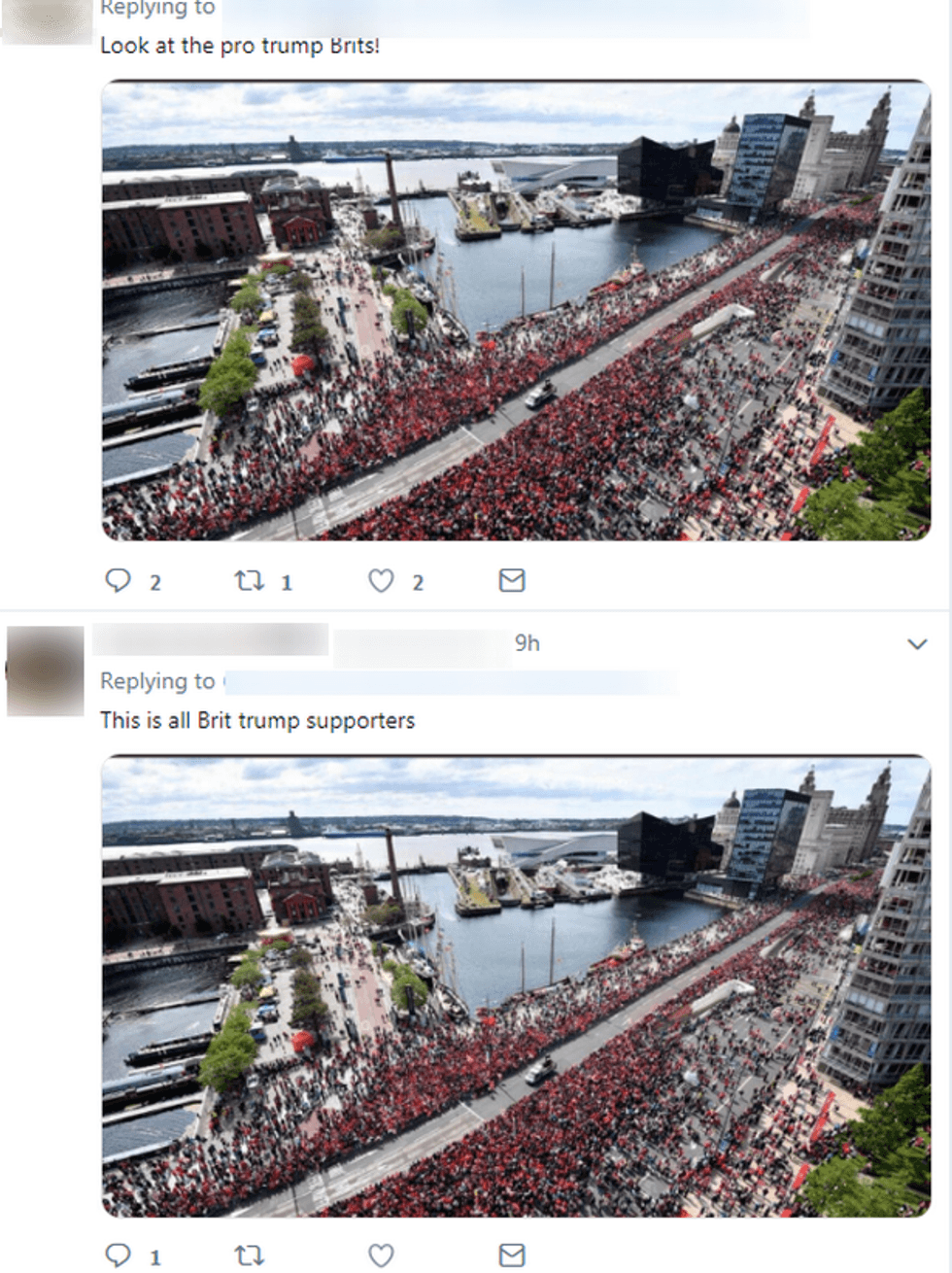
One British supporter of President Donald Trump tried to dispute media reports that there were very few supporters in the UK crowds this week. It didn't go very well, however.
The photos show a sea of people wearing red from an aerial perspective, saying "Look at the pro trump (sic) Brits!" Another person posted the same photo "This is all Brit trump supporters!"
[caption id="attachment_1509764" align="aligncenter" width="615"] Screen captures of disingenuous photos of Trump supporters (Captured by The Daily Star)[/caption]
The Star blurred the users, so it's unclear if they're actual Brits or real people at all. Regardless, the photos and tweets have been deleted and aren't searchable on Twitter anymore. They tweeted the photo to Trump's official account, but the president didn't retweet it.
The actual photos show 750,000 Reds fans welcoming the champions home. There may have been Trump supporters present but that wasn't why any of the people were wearing red.
Trump tweeted this week that he was told there were large protests but didn't see them, he only saw people coming out for him. That day Trump had driven past the giant Trump Baby Blimp that was floated over the city.
Another Twitter user posted his own version of the scene with British Trump supporters:
What would happen if the hands of time were turned back to an arbitrary point in our evolutionary history and we restarted the clock? American paleontologist Stephen Jay Gould proposed this famous thought experiment in the late 1980s – and it’s one that still grips the imagination of evolutionary biologists today.
Gould reckoned that if time was rewound, then evolution would drive life down a completely different path and humans would never re-evolve. In fact, he felt humanity’s evolution was so rare that we could replay the tape of life a million times and we wouldn’t see anything like Homo sapiens arise again.
Put simply, evolution is the product of random mutation. A rare few mutations can improve an organism’s chance of survival in certain environments over others. The split from one species into two starts from such rare mutations that become common over time. But further random processes can still interfere, potentially leading to a loss of beneficial mutations and increasing harmful mutations over time. This inbuilt randomness ought to suggest you’d get different life forms if you replayed the tape of life.
Of course, in reality, it’s impossible to turn back the clock in this way. We’ll never know for sure just how likely it was to have arrived at this moment – for us to have written this article, and for you to be reading it. Fortunately, however, experimental evolutionary biologists do have the means to test some of Gould’s theories on a microscale with bacteria.
Microorganisms divide and evolve very quickly. We can therefore freeze billions of identical cells in time and store them indefinitely. This allows us to take a sub-set of these cells, challenge them to grow in new environments and monitor their adaptive changes in real time. We can go from the “present” to the “future” and back again as many times as we like – essentially replaying the tape of life in a test tube.
Evidence of evolutionary fate
Many bacterial evolution studies have found, perhaps surprisingly, that evolution often follows very predictable paths over the short term, with the same traits and genetic solutions frequently realised. Consider, for example, a long-term experiment, in which 12 independent populations of Escherichia coli founded by a single clone, have been continuously evolving since 1988. That’s over 65,000 generations – there have only been 7,500-10,000 generations since modern Homo sapiens appeared. All the evolving populations in this experiment show higher fitness, faster growth and larger cells than their ancestor. This suggests that organisms have some constraints on how they can evolve.
There are evolutionary forces that keep evolving organisms on the straight-and-narrow. Natural selection is the “guiding hand” of evolution, reigning in the chaos of random mutations and abetting beneficial mutations. This means many genetic changes will fade from existence over time, with only the best enduring. This can also lead to the same solutions of survival being realised in completely unrelated species.
Pterosaur.
Warpaint/Shutterstock
We find evidence for this in evolutionary history where species that are not closely related, but share similar environments, develop a similar trait. For example, extinct pterosaurs and birds both evolved wings as well as a distinct beak, but not from a recent common ancestor. So essentially wings and beaks evolved twice, in parallel, because of evolutionary pressures.
But genetic architecture is also important. Not all genes are created equal: some have very important jobs compared to others. Genes are frequently organised into networks, that are comparable to circuits, complete with redundant switches and “master switches”. Mutations in “master switches” naturally result in much bigger changes, because of the knock-on effect felt by all genes under its control. This means that certain locations in the genome will contribute to evolution more frequently, or with a larger effect, than others – biasing evolutionary outcomes.
Physical laws
But what about the underlying physical laws – do they favour predictable evolution? At very large scales, it appears so. We know of many governing laws of our universe that are certain. Gravity, for example – for which we owe our oceans, thick atmosphere and the nuclear fusion in the sun that showers us with energy – is a predictable force. Isaac Newton’s theories, based on large scale deterministic forces, can also be used to describe many systems on large scales. These describe the universe as perfectly predictable.
If Newton’s view was to remain perfectly true, the evolution of humans was inevitable. However, this comforting predictability was shattered by the discovery of the contradictory but fantastical world of quantum mechanics in the 20th century. At the smallest scales of atoms and particles, true randomness is at play – meaning our world is unpredictable at the most fundamental level.
This means that the broad “rules” for evolution would remain the same no matter how many times we replayed the tape. There would always be an evolutionary advantage for organisms that harvest solar power. There would always be opportunity for those that make use of the abundant gases in the atmosphere. And from these adaptations, we may predictably see the emergence of familiar ecosystems. But ultimately, randomness, which is built into many evolutionary processes, will remove our ability to “see into the future” with complete certainty.
There’s a problem in astronomy that acts as a fitting analogy. In the 1700s, a mathematical institute offered a prize for solving the “three-body problem”, involving accurately describing the gravitational relationship and resultant orbits of the sun, Earth and moon.
Where will the moon be?
science photo/Shutterstock
The winner, Joseph-Louis Lagrange, essentially proved that the problem couldn’t be solved exactly. Much like the chaos introduced by random mutations, a little bit of starting error would inevitably grow, meaning that you couldn’t easily determine where the three bodies would end up in the future. But as the dominant partner, the sun dictates the orbits of all three to an extent – allowing us to narrow the possible positions of the bodies to within a range.
This is much like the guiding hands of evolution, which tether adapting organisms to familiar routes. We may not be entirely sure where we’d end up if we rewound time, but the paths available to evolving organisms are far from limitless. And so maybe humans would never appear again, but it’s likely that whatever alien world replaced ours would be a familiar place.
But as measles cases in the U.S. climb to an all-time high after the disease was declared eliminated in 2000, U.S. public health officials have been looking for ways to address the problem.
As a researcher on religious politics and health, I believe that Nigeria’s highly mobilized efforts to eliminate polio can teach America how to reverse the increase in measles cases and shore up its public health infrastructure. Working with international partners, Nigerians have combated misinformation, suspicion of vaccine science and religion-based boycotts to go from ground zero for polio on the African continent in 2003 to nearly polio-free in 2019.
Comparing Nigeria and the US
When the Global Polio Eradication Initiative (GPEI) was established in 1988 with the goal of complete eradication by 2000, several countries could not meet the target.
India needed another 14 years, while Nigeria, Pakistan and Afghanistan faced stiff internal opposition to immunization. GPEI’s big 2003 push came shortly after Nigeria’s northern states implemented Sharia (Islamic law). Some clerics and political leaders encouraged boycotting immunization, citing contaminants that could reduce the Muslim population and mistrust of the government.
The U.S. is facing similar resistance now. Under scrutiny are anti-vaxx Orthodox and Hasidic Jews in New York City and Rockland County, but The New York Times has also uncovered resistance among Muslims, Catholics, Waldorf school parents and other cultural dissenters.
Anti-vaxxers in Clark County, Washington, are not religious opponents but rather Russian-speaking immigrants who, according to a report, harbor “mistrust of government that built up after being exposed to years of propaganda and oppression in the Soviet Union.” A doctor in their community blames tribalism for suspicion of “people coming from outside.”
Tackling tribalism
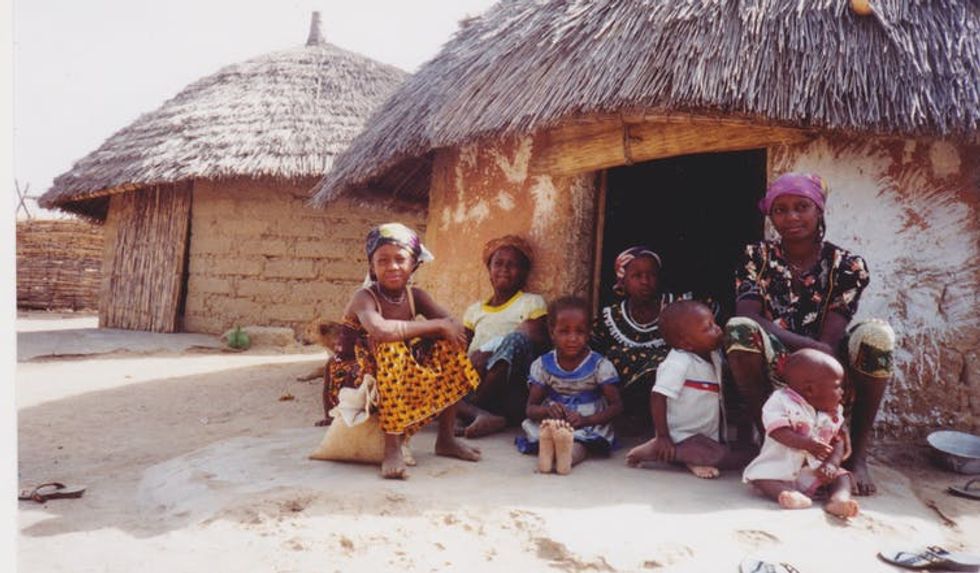
A mother and her children outside their home in rural Nigeria.
Nigerians understood that simply ostracizing religious communities would not work. Anti-vaxx politics tapped into mistrust of government and “others” that ran deep in a diverse but divided society, where religious, regional and ethnic loyalties took priority over national unity.
Nigerians know the ravages of tribalism better than most Americans. By conservative estimates, their nation is home to more than 250 ethnolinguistic groups. The civil war, lasting from 1966 to 1970 after anti-Igbo pogroms in the Hausa-majority north, was a terrifying manifestation of the hatred of difference and a total lack of faith in the government.
Using this logic to combat polio, Nigerian public health officials took themselves to anti-vaxxers, leaving behind their offices in the city to visit villages with reported polio cases. Their mobility built the “polio infrastructure” that “intensified political and managerial support from all levels of the Nigerian government,” according to a Gates Foundation white paper that analyzed global polio eradication. Traditional leaders like the Sultan of Sokoto also invested time and energy into immunization campaigns and social engagement.
Intensive socialization across class, education and other divisions were as important as traditional public health measures such as scale-up of local technical capabilities and independent monitoring.
Nigerian physicians in the field
I accompanied a team to a village outside Kano city in 2011, after years of public health interventions had reduced reported cases of polio to 20 in all of Nigeria for a 13-month period. The doctor leading the team leader had met four chiefs regularly; the eldest was the most supportive, the youngest the least.
The doctor asked the young man to roll up his left sleeve and pointed to a round scar on his upper arm, remarking, “Your parents had you vaccinated against smallpox. This campaign, though for a different disease, is the same. What’s the problem?” The young chief shrugged, ashamed at direct confrontation and unwilling to insult his parents. They bantered for a bit before we left in the Ministry of Health truck, having accomplished seemingly nothing but a social visit.
“Some may never vaccinate,” the doctor told me, “but I feel better equipped than you or another stranger to talk to them about this issue.”
Between mass immunization campaigns, he visited the villagers. “I know them now, their excuses, habits. Some men say the women are unreasonable. Others don’t care. I know their different personalities. And they know I know them.”
The polio infrastructure in Nigeria immerses experts and local communities in an ongoing relationship. It is an elaborate multilayered surveillance system, with many strategies and functions, from mundane visits to weekly record reviews at health centers in polio-affected areas.
Good strategies matter more than good stories
The media in the West tend to talk about anti-vaxxers as weird and foreign, because they “make a good story,” writes researcher Amanda Vanderslott. She describes common hidden problems like vaccine delays and equipment shortage that sometimes prevent full immunization coverage, but these reasons are less sexy than anti-vaxxers, who are themselves a tribe sharing false beliefs peddled online by discredited doctors like Andrew Wakefield.
Criticism of parents not vaccinating their children may now be commingling with broader mistrust of, say, Facebook. Propaganda and tribal isolation have always existed but now are proliferating with social media that is, paradoxically, fostering anti-social tendencies.
Fearing negative attention would isolate anti-vaxxers and drive them underground, Nigeria fostered greater social engagement in the public health system. The nation’s polio infrastructure was tested in 2017 by new cases in the Lake Chad basin where Boko Haram’s violence reigned. Although international political observers feared the public health effects of Islamist-inspired terrorism, a common element in the remaining polio-affected countries, Nigeria’s disease surveillance capabilities held strong and surpassed those of Pakistan and Afghanistan in its polio surveillance capabilities in 2018.
One clear lesson for the U.S. from Nigeria’s experience with expanding vaccinations is that we should work to depoliticize public health. Scapegoating religious communities evokes ugly histories of anti-Semitism and Islamophobia.
Tribalism and insularity affect many communities, even the educated and political classes. Nigerians have rarely held back criticism of the elites who blame the masses for their own poverty and illnesses. Ordinary Nigerians, in turn, blame elite corruption for destroying the public sector including public health. Nigeria’s postwar efforts to reduce social stigma and scapegoating are unfinished business, but the polio eradication campaign is continuing the good fight.
Few American college grads will spend years immersed in a social experiment, but public health officials can prioritize resocialization around measles. For America to strengthen its measles infrastructure, trust to discuss and debate vaccine science needs to develop.
GPEI had to rejigger its own understanding of the interactions between monovalent oral polio vaccine and wild polio behavior. Like it or not, American public health officials must answer American advocacy groups like Informed Choice that highlight “the messy conundrum” of exposure to wild measles versus the existing measles-mumps-rubella vaccination strain. A disease infrastructure built on human capacity can handle disagreement.
It can also adapt. Nigeria spent over US$8 million on surveillance alone and expanded polio capabilities to fight other diseases like measles and rubella. While the system puts a heavy workload on health officials, it points the way for how the American public health system can reshape existing structures for the current era. America led international health partnerships for decades, but the time has come to follow other countries’ lead.
As summer travel season begins, friends and relatives have asked me if it’s safe to travel outside the U.S.
I understand their fears. The news is filled with scary stories, like a tourist bus being bombed near Egypt’s pyramids, people being knifed at a bus stop in Japan and continuing coverage of the two Boeing 737 Max air crashes, both of which happened overseas.
As a macroeconomist I travel frequently to understand global trends. I crunched the numbers on U.S. fatalities abroad, and what I found might surprise you.
The average person leaving the U.S. by air spends slightly more than 17 nights outside the U.S., based on 2016 data. Multiplying trips by time means almost 3 million citizens are taking a trip abroad on any given day.
All this tourism is a vital part of many countries’ economies. U.S. travelers spent US$256 billion in 2018. If Americans or other international travelers stop hopping on a plane because they believe traveling to a specific country or region has become unsafe, this could have devastating effects on economies that depend on foreign tourism, such as Egypt and Sri Lanka.
Safety first
So is there reason to worry?
In October 2002, the State Department started tracking the number of U.S. citizens who die in a foreign country from non-natural causes, which excludes deaths from illness and things like heart attacks. The data include the date of death, where the death occurred and the cause.
I found the numbers shockingly low.
In 2018, just 724 Americans died from unnatural causes while abroad, the fewest since 2006 and down from a peak of 1,065 in 2010. I was expecting much larger numbers, more like the over 15,000 murders that happen in the U.S. every year.
And this doesn’t actually show the full extent of the decline because the number of U.S. overseas travelers has surged in the same period. From 2010 to 2018, the number of citizens flying to international destinations increased by 50%.
More travelers combined with fewer deaths mean it is actually getting safer to travel abroad.
How Americans die overseas
The next question is what are the leading causes of death.
It’s certainly not terrorism. In 2018, just six Americans were killed in a terrorist incident, the lowest number in over a decade. And just 381 died this way from October 2002 through last year.
And while dying in an airplane accident has been a growing fear since the Boeing 737 Max crashes in Ethiopia and Indonesia, there were only 10 such deaths in 2018, or 383 since 2002.
The top cause of death is actually motor vehicle accidents, which claimed the lives of 167 American travelers last year, or almost 4,000 since 2002. That’s almost one-third of all deaths in the period.
One reason for the relatively high number of deaths from car accidents may be that some countries don’t have the same safety standards that are common in the U.S., and so driving abroad can be a very different experience, with confusing rules or more aggressive drivers.
Once, my wife and I went on a low-budget African safari in Botswana. Though lions prowled restlessly outside our tent at night, the real danger turned out to be the high-speed drives in an open jeep while our guide dodged giant potholes and meandering animals, all while talking on his phone.
After traffic accidents, the second-most-common cause of death was homicides. But to put the 132 Americans who died this way in 2018 into perspective, Chicago alone had 561 homicides that year.
Other leading causes of death are drownings, suicides and non-vehicular accidents.
Like getting hit by lightning
In other words, dying abroad from unnatural causes, especially terrorism, is unlikely. Last year, three times as many people were killed by lightning in the U.S. as died overseas in a terrorist attack.
That doesn’t mean traveling is problem-free. I have been pickpocketed, threatened and had a gun pointed at me in my travels. The State Department’s travel advisories show what to watch out for and any precautions to take for every country in the world.
So although the world is a fascinating place to visit, just remember to read the travel advisory – and buckle your seatbelt.
The US warned Mexico Thursday it needed to make more concessions on slowing migration to avoid President Donald Trump's threatened tariffs, as the Mexican leader announced he would visit the border to "defend our dignity."
Speaking as the two neighbors opened a tense day of talks -- which Trump has vowed will be the last -- White House communications chief Mercedes Schlapp said Mexico's proposals so far to slow the surge of Central Americans crossing the border were "simply not enough."
"Looks like we're moving toward the path of tariffs," she said on Fox News.
Mexican President Andres Manuel Lopez Obrador meanwhile announced he would travel to the border city of Tijuana Saturday for what he described as a "unity rally to defend Mexico's dignity and promote our friendship with the people of the United States."
That is two days before Trump's threatened tariffs on Mexican goods would take effect -- starting at five percent and rising incrementally to 25 percent by October if Mexico does not meet his expectations.
Lopez Obrador told a news conference that "all options" are under review in the event Trump goes ahead with the tariffs.
"But our posture is to preserve, above all, the friendship with the people of the United States," said the anti-establishment leftist.
"I am optimistic that an agreement will be reached."
In Washington, Mexican Foreign Minister Marcelo Ebrard said he saw progress after more than two hours of talks at the State Department.
"Yes, I think we have advances today," he told reporters during a break.
- 25% tariffs 'catastrophic' -
Economic analysts say the impact of a five-percent tariff would likely be absorbed by losses in the Mexican peso, which has already plummeted against the dollar since Trump announced his tariff plan a week ago.
But a 10-percent tariff or higher would be painful for both countries.
Mexico sends nearly 80 percent of its exports to the United States. It is also the largest US trading partner so far this year, thanks mainly to Trump's trade war with China, which previously held the top spot.
Mexico would likely impose retaliatory tariffs, inflicting "almost immediate" pain on American consumers, said Duncan Wood, head of the Mexico Institute at the Wilson Center in Washington.
"You identify products that are important to the most sensitive Republican districts and hope to inflict pain upon the Republican party and the president" as he heads into his campaign for re-election in November 2020, said Wood.
If the tariffs rise to 25 percent, he added, the impact could be "catastrophic," and spread worldwide.
"It would have a recessionary impact not just on the Mexican economy but the US economy," he said.
"Mexico is the world's 13th-largest economy and one of the world's largest emerging economies. If it was to go into crisis ... there would be a spillover onto emerging markets around the world."
- Migrant surge -
Mexican authorities responded to one key US demand Wednesday by blocking the latest US-bound caravan of undocumented migrants as it entered Mexico from Guatemala.
Soldiers and police halted hundreds of migrants in the group about 12 kilometers (7.5 miles) from the Guatemalan border.
About 420 migrants were taken to a detention center, according to immigration authorities. But many others may have fled, as police initially reported some 1,200 people in the caravan -- mainly from Honduras.
US officials have insisted that Mexico halt the movement of migrants across its southern border, take action against bus lines moving them north, and overhaul its laws to force migrants to apply for asylum there rather than the United States.
The numbers of migrants reaching the US-Mexican border has surged, with 144,000 detained or blocked by US authorities in May, up 32 percent from April.
Lopez Obrador has stressed Mexico's willingness to work with the Americans on the problem.
But Trump has appeared keen to move ahead with tariffs, despite unusually vocal opposition from Republican lawmakers.
He brushed off fears of a mutually damaging trade war.
"The higher the Tariffs go, the higher the number of companies that will move back to the USA!" he tweeted Wednesday.
The World Health Organization expressed alarm Thursday at the lack of progress on curbing sexually transmitted diseases, while one of its experts warned of complacency as dating apps are spurring sexual activity.
The UN health agency said in a fresh report that every day globally there were more than one million new cases of treatable sexually transmitted diseases (STD) or infections (STI).
WHO found that there were more than 376 million new cases of chlamydia, gonorrhoea, trichomoniasis and syphilis registered around the world in 2016 -- the latest year for which data is available.
That is basically the same number as WHO reported in its previous study, based on data from 2012.
A WHO expert on sexually transmitted infections, Teodora Wi, separately told journalists there were concerns that condom use may be declining as people have lost their fear of contracting HIV in step with the emergence of available and effective antiviral treatments.
People are "more complacent about protection," she said, adding that this was dangerous at a time when "sex is becoming more accessible (through things like) dating apps".
Peter Salama, WHO's executive director of Universal Health Coverage, said in a statement that "we're seeing a concerning lack of progress in stopping the spread of sexually transmitted infections worldwide".
He called it "a wake-up call" for authorities to ensure that everybody had access to services to prevent and treat STIs.
WHO's new report shows that in 2016, some 127 million people between the ages of 15 and 49 were infected with chlamydia globally, while 87 million contracted gonorrhoea, and 6.3 million contracted syphilis.
In addition, some 156 million were infected with trichomoniasis -- a parasital disease commonly known as "trich".
- 'Hidden epidemic' -
"On average, approximately one in 25 people globally have at least one of these STIs," the UN health agency said.
But since they seldom display symptoms early on, people often do not know they have been infected and need treatment, allowing the diseases to continue to spread.
"We consider this a hidden epidemic, a silent epidemic, a dangerous epidemic," Melanie Taylor, another WHO expert on sexually transmitted infections and author of the report, told a journalists in a conference call.
If left untreated, STIs can lead to serious and chronic conditions, including neurological and cardiovascular disease, infertility, stillbirths and increased risk of contracting HIV.
Syphilis alone caused some 200,000 stillbirths and newborn deaths in 2016, making one of the leading cause of baby loss globally, second only to malaria, Taylor said.
STIs spread mainly through unprotected sexual contact, but some like chlamydia, gonorrhoea and syphilis can also be transmitted during pregnancy and childbirth.
Given the hidden nature of the epidemic, WHO said it was important for people who are sexually active to get screened for STIs, and especially recommended that pregnant women be systematically screened for syphilis, as well as HIV.
Correct condom use was one of the most effective methods for protecting against STI transmission.
WHO also stressed the importance of comprehensive sexual education and easy access to STI screening as well as treatment.
The UN health agency meanwhile warned that, while all bacterial STIs have until now be easy to treat using antibiotics, drug shortages and growing antimicrobial resistance were threatening those treatments.
Shortages in the global supply of benzathine penicillin has recently made it more complicated to treat syphilis, while increasing resistance to the antibiotics used to treat gonorrhoea "may lead eventually to the disease being impossible to treat", WHO warned.
President Vladimir Putin said Thursday Russia was prepared to drop a nuclear weapons agreement treaty with the US and warned of "global catastrophe" if Washington keeps dismantling a global arms control regime.
Speaking to heads of global news agencies at an economic forum in the city of Saint Petersburg, Putin said Washington showed no genuine interest in conducting talks on extending the New START treaty which caps the number of nuclear warheads well below Cold War limits.
"If no-one feels like extending the agreement -- New START -- well, we won't do it then," Putin said.
"We have said a hundred times that we are ready (to extend it)," Putin said.
"There is no formal negotiating process."
The treaty was signed by US President Barack Obama and Russian counterpart Dmitry Medvedev in Prague in 2010. It expires in 2021.
Together with another agreement known as the Intermediate-Range Nuclear Forces (INF) treaty, New START is considered a centrepiece of superpower arms control.
Putin accused Washington of eroding the global arms control regime by pulling out of the bilateral Anti-Ballistic Missile Treaty in 2002 and then dropping out of the INF treaty in February.
Moscow suspended participation in the INF treaty in March after Washington announced it would ditch the key agreement for alleged Russian violations of the terms.
Putin said the potential implications of letting New START treaty expire would be huge, suggesting its demise could fuel a nuclear arms race.
"If we don't keep this 'fiery dragon' under control, if we let it out of the bottle -- God forbid -- this could lead to global catastrophe," Putin said.
"There won't be any instruments at all limiting an arms race, for example, the deployment of weapons in space."
"This means that nuclear weapons will be hanging over every one of us all the time."
- 'Total silence' -
Putin said he was puzzled by the absence of a global discussion.
"Will anyone think about it, speak up, show some concern?" the Russian leader said. "No -- total silence."
Putin also said he discussed the issue with US President Donald Trump during their phone talks in early May.
"Donald told me that he is also concerned," Putin said, adding that US Secretary of State Mike Pompeo whom he hosted the same month also spoke "in a similar vein."
"If they think like this, then it is necessary to take practical steps towards joint work," the Kremlin chief said.
Putin also said all nuclear powers -- both officially recognised as possessing nuclear weapons and not -- should take part in future talks.
"Not to involve those who are not recognised means they will develop (nuclear weapons) further," Putin said.
"We have to create a broad platform for discussions and decision-making," Putin said. "That could be the light at the end of the tunnel."
Pompeo and Trump have called for the START treaty to be expanded to include China, which has already rejected the idea.
Trump's domestic rivals in the Democratic Party have also voiced concern over the lack of negotiations.
In a letter to Trump on Wednesday, senior Democrats in Congress urged him to extend New START through to the end of 2026.
"We believe that a decision to forego the benefits of New START by failing to extend the agreement would be a serious mistake for strategic stability and US security," said the letter signed by eight lawmakers including Eliot Engel, who chairs the House Foreign Affairs Committee.
At the same time, the Russian president said Moscow would not be afraid of shelving the treaty because it was developing a new generation of weapons that will "ensure Russia's security" in the long term.
"When it comes to creating hyper(sonic) weapons, we have overtaken our competitors."
US President Donald Trump's trip to Europe unlikely to be forgotten in a hurry by any of his hosts.
AFP selects five key moments from his three day state visit to Britain, whirlwind trip for talks in Ireland and pilgrimage to France for the 75th anniversary of the D-Day landings.
- 'Stone cold loser' -
Trump's plane had not even touched down in Britain before he sparked his first controversy by calling London mayor Sadiq Khan -- a critic of his red carpet welcome in the UK -- a "stone cold loser".
He even took aim at the London mayor's stature, saying he reminded him of New York's mayor Bill de Blasio -- no friend of Trump -- "only half his height".
Khan, for his part, refused to rise to the bait, telling CNN that "this is the sort of behaviour I would expect from an 11 year old."
"It's not for me to respond in a like manner."
- A 'wall' for Ireland?
Trump's visit to Ireland for talks with Prime Minister Leo Varadkar was limited to the Shannon airport. But that still left enough time for raised eyebrows.
With Varadkar's face frozen in astonishment, Trump initially appeared to indicate that Ireland wanted a wall on its border with Northern Ireland, which is part of the UK, as he wants with Mexico.
Ireland, which is deeply concerned by the effects of Brexit and the risk of a hard border, has insisted on the need for freedom of movement between the sides.
"I think it will all work out very well, and also for you with your wall, your border," he said. Varadkar responded: "I think one thing we want to avoid, of course, is a wall or border between us."
Varadkar later attempted to excuse Trump, saying with nearly 200 countries in the world "I don't think it's possible for him to have an in-depth and detailed understanding of issues in every single country."
- 'Greatest Americans' -
Commentators applauded Trump for a solemn and emotional speech in Normandy Thursday that captured the essence of D-Day by paying tribute to the surviving veterans and friendship with France.
"You are among the very greatest Americans who will ever live. You are the pride of our nation," Trump said in front of around 60 veterans, many of them in wheelchairs.
"You are the glory of our republic and we thank you from the bottom of our hearts," he said in words that moved many of those present to tears.
- 'She knows me very well'
While Trump usually causes a frenzy wherever he goes, it is unlikely that Britain's Queen Elizabeth II was overly fazed by his presence.
After all, this is a ruler who has held the throne since 1952 and who has hosted guests now figures from the history books, ranging from Ethiopian emperor Haile Selassie, to shah Mohammad Reza Pahlavi of Iran or Romanian dictator Nicolae Ceausescu.
It may never be known what the queen thinks of Trump but the US president described her as an "incredible lady".
"I feel I know her so well and she certainly knows me very well right now," he said.
- A tight fit -
The centrepiece of Trump's state visit to Britain was the glittering state dinner at Buckingham Palace attended by the queen and other members of the royal family in a perfectly choreographed event.
But it failed to escape the attention of observers that the dinner suit worn by Trump was, to say the least, a little tight with his jacket soaring above his waistcoat.
"Did someone put Trump's jacket in the drier and shrink it?" asked one user on Twitter.
Russian President Vladimir Putin on Thursday said the West was "crazy" for supporting an opposition leader in Venezuela over its president.
Putin said Juan Guaido was "likeable" but warned that the world would plunge into chaos if there were no rules.
"But if we adopt this way of coming to power -- a man walks into a square, lifts up his eyes to heaven and declares himself president before God -- would this be normal or not?" he told heads of global news agencies at an economic forum in the second city of Saint Petersburg.
"Well, then chaos will consume the world," he warned. "Let's elect a US president, a British prime minister, a French president like that. What will it be?
"I feel like asking those who support this: have you gone crazy, do you understand where this is going? Should there be rules or not?"
In January, Guaido declared himself acting president, claiming Nicolas Maduro's re-election last year was illegitimate.
More than 50 countries led by the United States lined up behind the head of the National Assembly, but Russia and China have backed Maduro.
Guaido has been leading a push to oust leftist firebrand Maduro, who has presided over a crumbling economy, but those efforts have not borne fruit so far.
Members of the Mexican church whose leader was arrested in California on human trafficking and child rape charges insisted Wednesday on his innocence, and decried his $25 million bail as disproportionately high.
Naason Joaquin Garcia, who is known by members of the La Luz del Mundo (The Light of the World) as the "Apostle," faces US charges for 26 suspected felonies, including rape of minor and child pornography, committed between 2015 and 2018.
Prosecutors allege Garcia and three co-defendents - all women affiliated with the church - coerced minor girls into performing sexual acts by convincing them that if they went against the "Apostle" they were also going against God.
"These are all false accusations," Adrian Calvillo, a spokesperson for the Guadalajara-based church, said at a press conference. "This is something we consider to be totally slanderous."
Nicolas Menchaca, a public relations representative from the church, complained that the $25 million bail set by a California judge "seems extremely disproportionate."
If it can be shown that bail for others has been set lower then "we consider this an act of religious discrimination," he said.
California's Attorney General Xavier Becerra said authorities had launched an investigation into Garcia in 2018 following an online complaint about clergy abuse to the California Department of Justice.
"We must not turn a blind eye to sexual violence and trafficking in our state," where La Luz del Mundo has gained influence in recent years, Becerra said in a statement Tuesday .
The church, which says it has five million followers in 50 countries, has called its members in Mexico to engage in continuous prayer for their 50 year-old leader.
The congregation was founded in 1926 in Mexico by Eusebio Joaquin Gonzalez, who said he had recieved a "divine revelation."
More than half a million followers gathered in Guadalajara for six days in August 2018 to perform their 80th "holy supper," one of the largest religious ceremonies in the world -- with mass baptisms, 600,000 loaves of bread, 20,000 liters of wine and attendents dressed in white straining to touch Garcia as he arrived at the church's headquarters escorted by his "royal guard."
La Luz del Mundo says their 2019 gathering will proceed as scheduled from August 9 to 15.
"We trust that Naason Joaquin, the apostle of Jesus Christ, will soon be acquitted," Menchaca said.
US President Donald Trump landed in France Thursday to join other world leaders on the beaches of Normandy in a tribute to the veterans and dead heroes of the D-Day landings that shaped the outcome of World War II.
Despite being largely blamed for growing international discord, Trump headed to join in the attempted show of transatlantic harmony on the 75th anniversary of the assault.
"Heading over to Normandy to celebrate some of the bravest that ever lived," the US leader tweeted on arrival in France. "We are eternally grateful!"
French President Emmanuel Macron and British Prime Minister Theresa May earlier paid tribute to D-Day veterans at the start of Thursday's commemorations for the soldiers who surged onto the Normandy beaches on June 6, 1944.
On an occasion mixing high politics with poignant historical remembrance, Macron met first with May at Ver-sur-Mer, where they laid the first stone for a new British memorial to fallen soldiers.
"Standing here as the waves wash quietly onto the shore below us, it's almost impossible to grasp the raw courage it must have taken that day to leap from landing craft and into the surf, despite the fury of battle," May said.
AFP / JOEL SAGET Period vehicles assembled on the beaches in Normandy for the D-Day commemorations
Under a bright blue sky, she finished her speech by addressing the assembled veterans, whose numbers dwindle with each major anniversary.
"I want to say the only words we can: thank you," she said in her final international appearance before she steps down as leader of the Conservative party on Friday.
AFP / MANDEL NGAN Trump and his wife Melania landed in Normandy after attending earlier D-Day commemorations in England
Britain's delayed departure from the European Union, which has cost May her job as prime minister, is just one of many rifts that has opened recently among Western allies, whose alliance forged in World War II is under unprecedented strain.
The man blamed for most of the discord, Trump, was set to arrive in northern France for a ceremony at the US military cemetery at Colleville-sur-Mer overlooking Omaha Beach where 9,400 US servicemen are buried.
- Overlooked heroes -
Both leaders will give speeches, while the French president will also bestow the Legion d'Honneur, France's highest honour, on five American veterans.
Macron and Trump -- whose once warm relations have chilled due to mounting public disagreements on Iran, climate change and trade -- will then meet for private talks followed by a working lunch.
AFP / Tolga AKMEN Macron and Trump were due to meet for private talks after the D-Day ceremonies, following a recent chill in relations
Macron will end the day with an homage at Colleville Montgomery for the Kieffer Commando, the only French soldiers to storm a Normandy beach on D-Day which opened a new front against the Nazis and led to the liberation of France and much of western Europe.
The 177 men, who were given the honour of being the first to touch French soil, had long been little more than a footnote in France's official histories of the war -- an oversight officials in Macron's office said the president is eager to correct.
Canadian Prime Minister Justin Trudeau will attend a ceremony at Juno Beach, where Canadian forces were in charge of the assault.
D-Day is seen by many as one of the great symbols of transatlantic cooperation, as young American and Canadian servicemen sacrificed their lives in the struggle to end the Third Reich's grip on Europe.
AFP / JOEL SAGET WWII commemorators in costume joined the ceremonies
The June 6, 1944 landings by Allied forces on five Normandy beaches were the biggest naval operation ever in terms of the number of ships deployed and the troops involved.
By the end of what became known as "the longest day", 156,000 Allied troops and 20,000 vehicles had landed in Nazi-occupied northern France despite facing a hail of bullets, artillery and aircraft fire.
- 'Shared values', strained ties -
Tens of thousands of French and foreign visitors, many donning WWII uniforms or driving vintage military vehicles, have converged on Normandy to honour the veterans.
Trump arrived in France from a three-day state visit to Britain, where he attended a ceremony in Portsmouth to mark D-Day alongside Queen Elizabeth II and over a dozen other world leaders.
POOL/AFP / JACK HILL Britain's Prince Charles, Queen Elizabeth II and Donald Trump were joined by other world leaders to mark the D-Day anniversary
In a joint proclamation, the 16 nations present in Portsmouth affirmed their shared responsibility to ensure that the horrors of World War II are never repeated.
They reaffirmed their commitment to "shared values" and vowed to work together to defend freedoms "whenever they are threatened".
President Vladimir Putin, who was invited in 2004 on the 60th anniversary of the invasion, did not receive an invitation to either ceremony, a snub indicative of the West's strained relations with Russia.
Russia's foreign ministry said Wednesday that the Allied invasion on D-Day did not determine the course of World War II and its importance should not be exaggerated.
Spokeswoman Maria Zakharova told journalists that it was the efforts of the Soviet Union, which entered the war in 1941, that secured victory.
Scientists on Thursday unveiled the most detailed simulation of a black hole yet, solving a mystery dating back more than four decades over how the star-devouring monsters consume matter.
Coming fresh on the heels of the first ever photo of one of the giant objects, which are scattered across the Universe, astrophysicists are now several steps closer to understanding how they form and develop.
A black hole is born when a large star collapses in on itself. Far from being a "hole", they are instead incredibly dense objects with a gravitational pull so strong that nothing, not even light, may escape them.
As they suck in matter such as gas, dust and space debris, they form an accretion disk -- a churning mass of super-accelerated particles that are among the brightest objects in the Universe -- around them.
European Southern Observatory/AFP/File / M. Kornmesser This artist's impression of a black hole shows the accretion disk as a swirl of matter around the centre of the object
It is the accretion disk that can be seen as a blurry halo around the image of the black hole released in April from the Event Horizon Telescope.
But accretion disks are nearly always tilted at an angle to the orientation of the black hole, known as its equatorial plane.
In 1975, Nobel Prize-winning physicist John Bardeen and astrophysicist Jacobus Petterson theorised that a rotating black hole would cause the inner region of a tilted accretion disk to line up with the black hole's equatorial plane.
But no model could ever work out how, precisely, that would happen. Until now.
A team of astrophysicists from Northwestern University, Oxford University, and the University of Amsterdam, used graphical processing units to crunch large sets of data and simulate how black holes interact with their accretion disks.
NASA/AFP/File / Lynette Cook For the first time scientists are understanding how black holes consume matter
Crucially, their approach gave them the computing power to account for magnetic turbulence, which occurs when different particles churn at different speeds within the accretion disk.
It is precisely this electromagnetic effect that causes matter to fall to the centre of the black hole.
Alexander Tchekhovskoy, assistant professor of physics and astronomy at Northwestern's Weinberg College of Arts and Sciences, likened matter accumulating near a black hole to throwing a dart towards the board at random.
"If you don't really aim it will never hit the bullseye," he said. "In the same way, when (matter) falls into the black hole it has some rotation but this rotation will have nothing generally to do with how the black hole rotates. The two rotations will not know anything about each other."
- 'More confident predictions' -
Previous simulations manually predicted the additional friction their creators believed was needed to make matter move towards the black hole.
EUROPEAN SOUTHERN OBSERVATORY/AFP/File / -The image of a black hole taken by the Event Horizon Telescope shows the hole's accretion disk as a sort of golden halo around the invisible object
"Whereas now in our model, we don't have to postulate this friction," Tchekhovskoy told AFP. "We put in magnetic fields and these actually cause an instability that then causes friction and the disk falls in as a result."
This might seem like a small detail but it directly affects how fast black holes spin and, consequently, what effect they have on the galaxies that surround them.
The simulation, which produces a disk with two jets of gas and magnetic fields protruding from the centre like fountains, shows the inner part of the accretion disk aligning perfectly with the black hole's equator even as the outer part remains at an angle.
"Before now there was a worry that when you take into account all the complications that come with matter interacting with a black hole, such as magnetic fields, the turbulence in the disk, the swirling motions -- those things might kill the alignment effect," said Tchekhovskoy.
"We found that, no, it doesn't kill it, actually the inner parts of the disk do align with the black hole and we can now more confidently make predictions about how black holes would look."
On June 6, 1944, more than 150,000 Allied troops invaded the northern French coast, marking the start of France's liberation from its Nazi occupiers.
It is remembered as a defining moment of World War II. Here are some little-known facts about "the longest day":
- 'Erotic adventure' -
"When the Germans came, we told the men to hide. But when the Americans came, we had to hide the women!"
The French joke refers to the "erotic adventure" which the US military promised American soldiers fighting in France, historian Mary Louise Roberts writes in "What Soldiers Do: Sex and the American GI in World War II France."
Propaganda painted France as "a tremendous brothel inhabited by 40 million hedonists".
Readers of the military newspaper "Stars and Stripes" could learn the French for "you are very pretty", "I am not married" and "are your parents at home?", whereas the German vocabulary section offered phrases such as "No cigarettes!" and "Line up!", Roberts explains.
American promiscuity sparked outrage in cities like Le Havre and Reims, where sexual acts "took place in parks, cemeteries, streets and abandoned buildings".
More than 150 American soldiers were tried for rape, most of them black men, underlining the racial discrimination at the time, Roberts said.
- Threat of defeat -
With D-Day looming, the Allies prepared for the worst.
Supreme Commander of Allied Forces in Europe and future US president, Dwight Eisenhower, prepared himself in advance for announcing a failure.
He penned a statement on June 5 entitled "In case of failure" which said that "any blame or fault... is mine alone".
"My decision to attack at this time and place was based upon the best information available.... The troops, the air and the Navy did all that bravery and devotion to duty could do."
Allied forces quickly gained control of five points along an 80-kilometre (50-mile) front on beaches codenamed Utah, Gold, Juno and Sword.
But at Omaha, heavy casualties earned the beach the sombre nickname "Bloody Omaha".
High cliffs there gave the Germans an immediate advantage.
Americans were left waist deep in rough seas as crashing water sank their landing craft, and some drowned. Of the 34,000 Americans deployed, 2,500 were killed or wounded.
Some paratroopers drowned in "catastrophic" jumps, said French historian Jean Quellien, author of "The Battle of Normandy". Heavy equipment weighing 30 to 40 kg (65-90 lbs) pulled them underwater.
- Inflatable tanks -
"Fake news" might be considered a modern phenomenon, but the British led a deception campaign, codenamed Operation Fortitude, to try and fool the Germans into thinking the Allies planned to attack Scandinavia, then France's Calais region, rather than Normandy.
Inflatable tanks were positioned on the British coast facing Calais, and metallic lures were used to make it appear to German radar that a large force was about to land near Calais. Fake radio messages were leaked to German intelligence services.
Even after the D-Day landings on June 6, the Germans believed a second attack was planned in the Calais region. Hitler eventually ordered troops to join the Normandy front.
- Native American 'code talkers' -
Communicating through coded messages would have taken too long during the landings and commanders couldn't speak in English in case they were intercepted by the Germans.
Instead, the Americans used Native American "code talkers", especially the Comanche, who worked in their indigenous language.
John Parker, son of "code talker" Simmons Parker, remembers that "bomber plane" was translated as "pregnant bird".
He said his father told him that in the Comanche language, "crazy white man" meant Hitler.
- Landing in... Indonesia -
In December 2018, the British postal service, Royal Mail, apologised after releasing a stamp commemorating D-Day's 75th anniversary showing American troops landing in Indonesia, then known as Dutch New Guinea.
"We would like to offer our sincere apologies," Royal Mail said.




 Screen captures of disingenuous photos of Trump supporters (Captured by The Daily Star)[/caption]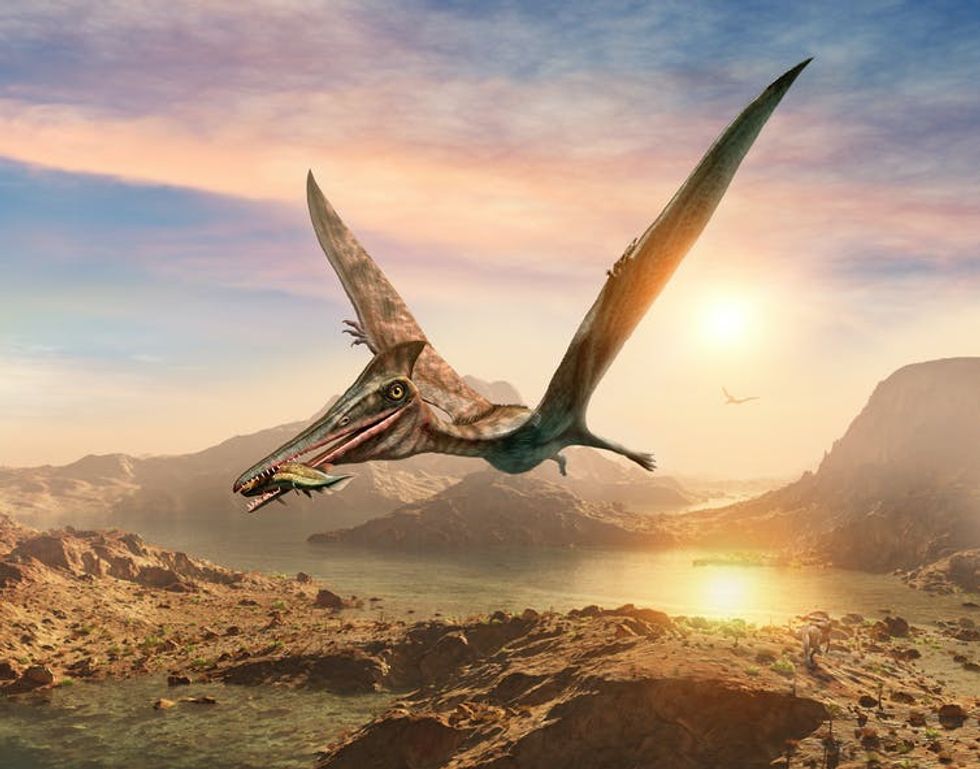




 AFP / JOEL SAGET
  AFP / MANDEL NGAN
  AFP / Tolga AKMEN
  AFP / JOEL SAGET
  POOL/AFP / JACK HILL
  European Southern Observatory/AFP/File / M. Kornmesser
  NASA/AFP/File / Lynette Cook
  EUROPEAN SOUTHERN OBSERVATORY/AFP/File / -