U.S. Sen. John Cornyn said Friday he would oppose any effort to redirect Hurricane Harvey relief funds to pay for a border wall — a move thathe and fellow Republican U.S. Sen. Ted Cruz agreed was unlikely to happen.
There were reports Thursday that the Trump administration was considering using some of the $13.9 billion in disaster relief money that Congress approved for Texas and other states to construct Trump's long-sought border barrier. Friday marked the 21st day of a federal government shutdown over Trump's demands for border wall dollars.
"I will oppose any reprogramming of Harvey disaster funds," Cornyn told reporters after a joint appearance with Cruz in Austin. "We worked very hard to make sure that the victims of Hurricane Harvey — their concerns are addressed and Texas is able to rebuild. And I think we are all together on that."
Cruz, who spoke with reporters alongside Cornyn, said he did not believe the Trump administration "is going to do anything to reduce the funding for Hurricane Harvey relief." Cornyn said he agreed.
"I think some of these reports are overstated," Cruz said. "I don't think we're going to see that money jeopardized in any way."
Cruz and Cornyn appeared together at the Texas Public Policy Foundation's 2019 Policy Orientation a day after joining Trump for a visit to McAllen, where he continued to make the case for a border wall amid the shutdown.
Disclosure: The Texas Public Policy Foundation has been a financial supporter of The Texas Tribune, a nonprofit, nonpartisan news organization that is funded in part by donations from members, foundations and corporate sponsors. Financial supporters play no role in the Tribune's journalism. Find a complete list of them here.
Two firefighters died and nearly 50 people were injured in a massive gas explosion that gutted the ground floor of a building in a central Paris shopping district on Saturday, authorities said.
The accident occurred with Paris under security lockdown for a ninth consecutive Saturday of “yellow vest” protests, with large parts of the French capital blocked off by riot police.
“As firemen were looking for a gas leak in the building, a dramatic explosion took place,” Interior Minister Christophe Castaner said, adding that one of the firemen had been buried under debris for several hours.
Castaner said on his Twitter feed that two firefighters had died, and that 10 people, including one firefighter, had serious injuries. Another 37 people had lighter injuries, he said. Earlier he had told reporters that two civilians had also died.
Just hours after the blast, thousands of yellow vest protesters marched noisily but peacefully through the Grands Boulevards shopping district of northern Paris, just a few hundred yards from the scene of the explosion.
In recent years, France has suffered a string of deadly Islamist militant attacks in Paris, Nice, Marseille and elsewhere but authorities quickly ruled out foul play.
“A this stage we can say it (the gas blast) is clearly an accident,” Paris prosecutor Remi Heitz told reporters.
A police source said the explosion tore apart a bakery on the rue Trevise and witnesses said the force of the blast shattered nearby storefronts and rocked buildings hundreds of meters away.
More than 200 firefighters joined the rescue operation and two helicopters landed on the nearby Place de l’Opera to evacuate victims. Ambulances struggled to access the blast area because of police barriers set up to contain any violence by yellow vest protesters.
An eyewitness at a hotel nearby said he saw flames envelop the ground floor of the building blown out by the blast.
“There was broken glass everywhere, storefronts were blown out and windows were shattered up to the third and fourth floors,” said 38-year-old David Bangura.
He said that as he approached the scene, a woman was crying for help from the first floor of a building: “Help us, help us, we have a child”.
Reporting by Geert De Clercq, Caroline Paillez, Emmanuel Jarry and Benoit Tessier; Editing by Mark Heinrich and Ros Russell
An attorney for R. Kelly on Friday called a new documentary series about the R&B singer a “for-profit hit piece,” and said the latest accusations of abuse by the Grammy-winning musician were a “complete fabrication.”
The six-hour documentary “Surviving R. Kelly,” which aired earlier this month on U.S. cable channel Lifetime, includes allegations from multiple women who accuse Kelly of sexual misconduct, sometimes with minors.
Kelly, 52, the Chicago singer and record producer best known for his hit song “I Believe I Can Fly,” has for years denied accusations of abuse, including those made in the new documentary.
Steve Greenberg, an attorney for Kelly, said in an interview on Friday that there was no evidence to support the accusations contained in the documentary, calling it a “for-profit hit piece full of falsities, full of mistakes.”
The Lifetime series featured interviews with several women making on-camera allegations of sexual, mental and physical abuse by Kelly, as well as interviews with some of his former managers and producers.
The latest accusations echo similar ones against the singer dating back 25 years. After the documentary aired, Chicago’s top prosecutor called on potential victims and witnesses to come forward.
“We cannot seek justice without you,” Cook County State’s Attorney Kim Foxx said this week at a news conference.
According to media reports, prosecutors in Georgia have contacted an attorney for an Atlanta-area couple who appeared in the documentary and accuse Kelly of brainwashing their daughter.
Reuters was unable independently to verify the accusations in the documentary and could not immediately reach prosecutors for comment. In 2008, the singer was tried and acquitted on child pornography charges in Chicago.
“There’s women saying things, which is of course their prerogative, but there is no evidence that any of it happened,” Greenberg said of the documentary.
Kannie Yu LaPack, a spokeswoman for Lifetime, said: “The women’s stories speak for themselves.”
Lifetime is part of A&E Networks, which is a joint venture between Hearst Communications and Walt Disney Co.
The series has been a hit for the network, which said the documentary’s Jan. 3 premiere attracted 1.9 million viewers and the network’s biggest audience in two years among adults 25 to 54 and other age groups.
After the documentary aired, singer Lady Gaga vowed to remove a duet she recorded with Kelly from streaming services and never collaborate with him again.
Reporting by Lisa Richwine; Additional reporting by Dan Whitcomb; Editing by Bill Tarrant and Daniel Wallis
President Donald Trump on Friday said he is planning changes to H-1B visas, which are issued temporarily to highly educated immigrants so they can work in specialty occupations, that would create simplicity, certainty and a possibility that the workers could become U.S. citizens.
“H1-B [sic] holders in the United States can rest assured that changes are soon coming which will bring both simplicity and certainty to your stay, including a potential path to citizenship. We want to encourage talented and highly skilled people to pursue career options in the U.S.,” Trump said in an early morning tweet.
Trump, a Republican, and Democrats in the U.S. Congress are at an impasse, as refuses to end the longest shutdown in federal government history until he secures $5.6 billion to build a wall along the country’s southern border.
While Trump typically depicts undocumented immigrants and asylum seekers attempting to enter the country through Mexico as criminals and terrorists, he frequently praises those applying for H-1Bs, who must hold a bachelor’s degree or higher. Competition is tough for the temporary visas. In 2018, the United States hit the limit on the number of H-1Bs it could issue, 65,000, by the first week of April, according to the Department of Homeland Security.
Indian scientists have protested about claims made at a local science conference that rubbish the work of some of the world’s greatest physicists and suggest modern breakthroughs such as in-vitro fertilization were in fact invented in ancient India.
In a lecture at the Indian Science Congress and posted on YouTube, one speaker, Kannan Jegathala Krishnan said Isaac Newton was wrong about gravity, Albert Einstein made a “big blunder” and questioned Stephen Hawking’s achievements.
Another speaker, G. Nageswara Rao, a vice-chancellor at Andhra University in southern India, used stories from Indian epics Ramayana and Mahabharata as proof the people of ancient India had aircraft, test-tube babies and that stem-cell research “was done in this country thousands of years ago”.
While organizers of the congress have promised to make changes for next year’s event following the criticism, Soumitro Banerjee, a physics professor and general secretary of non-profit Breakthrough Science Society, told Reuters the comments lent respectability to absurd theories.
Scientists in Kolkata and five other cities carried placards and held silent demonstrations on Monday against the comments, he said.
“This is very harmful for the growth of scientific temper because these ideas are being propagated through the Science Congress which gives it a respectability,” said Dhruba Mukhopadhyay, a retired professor and the president of the BSS, said.
The conference’s organizer, the Indian Science Congress Association, will soon issue a statement condemning this episode, said Premendu P. Mathur, a general secretary at the body and a professor of biochemistry and molecular biology.
“From next year we have decided that all the people, even top scientists, who want to interact with anybody at the Science Congress, would be asked to submit their abstracts, not to deviate from their abstracts and we will place one of our members there as a moderator.”
The annual Indian Science Congress, which this year ran over five days at a university in northern Punjab state, ended on Monday.
Reporting by Sankalp Phartiyal; Editing by Alison Williams
As people adopt their resolutions for the year, it is likely that many more will reconsider their social media use.
However, as a scholar of social media and religion, I’d argue that rather than just stop using social media, people could use it to improve their overall well-being. Here are three ways to do so.
1. Be active
Studies have shown that there is a big difference between passive social media use and active use. Scrolling through a newsfeed and merely looking at what others have posted is considered passive social media use.
Conversely, commenting on posts, sharing articles and creating posts constitute active social media use. Research has found that actively using social networking sites can contribute to feelings of social connectedness. This can contribute to a sense of overall well-being.
On the other hand, a study found that passive Facebook use increases feelings of envy. Researchers asked participants to sit in a laboratory and passively use Facebook by only browsing and not commenting, sharing or liking content. Participants passively using Facebook were found to have an increase in their feelings of envy.
2. Focus on meaningful engagement
Social media sites allow users to engage in various types of communication. There are impersonal forms of communication such as the single click “Like” button and more personal forms of communication such as direct messaging and comments.
Direct messaging and comments can help with a deeper level of engagement.
Research has found that direct communication on Facebook can have a positive psychological impact on individuals. A direct message can often lead to feelings of social support and encouragement. It has been found to be particularly helpful when people already share a connection. Direct messaging and personalized comments can provide a deeper level of engagement.
One of these studies showed that commenting on a post, instead of pressing the like button, could improve the mood of the person who made the original post. In one such example, a respondent in the study described how personalized comments, even trivial ones about funny cat videos, can result in feelings of support.
Similarly, research has shown that social networking sites can provide social support to those who have recently lost a job.
3. Use social media for professional purposes
According to researchers in Germany, Sonja Utz and Johannes Breuer, using social networking sites for professional purposes can result in “informational benefits” such as knowing what is happening in one’s field and developing professional connections.
For example, these scholars found that people who use social networking sites for professional purposes report having greater access to information about timely innovations in their field than nonusers. A similar study of academics in the United Kingdom found that 70 percent of participants had gained valuable professional information through Twitter.
Researchers, however, have found that these professional benefits require active use of social networking sites. “Frequent skimming of posts,” as Utz and Breuer explain, can lead to “short time benefits.” What is more important, however, are “active contributions to work-related discussions.”
Indeed, there are those who recommend curtailing use of social media and focusing instead on real-world relationships. But, as with everything else, moderation is vital.
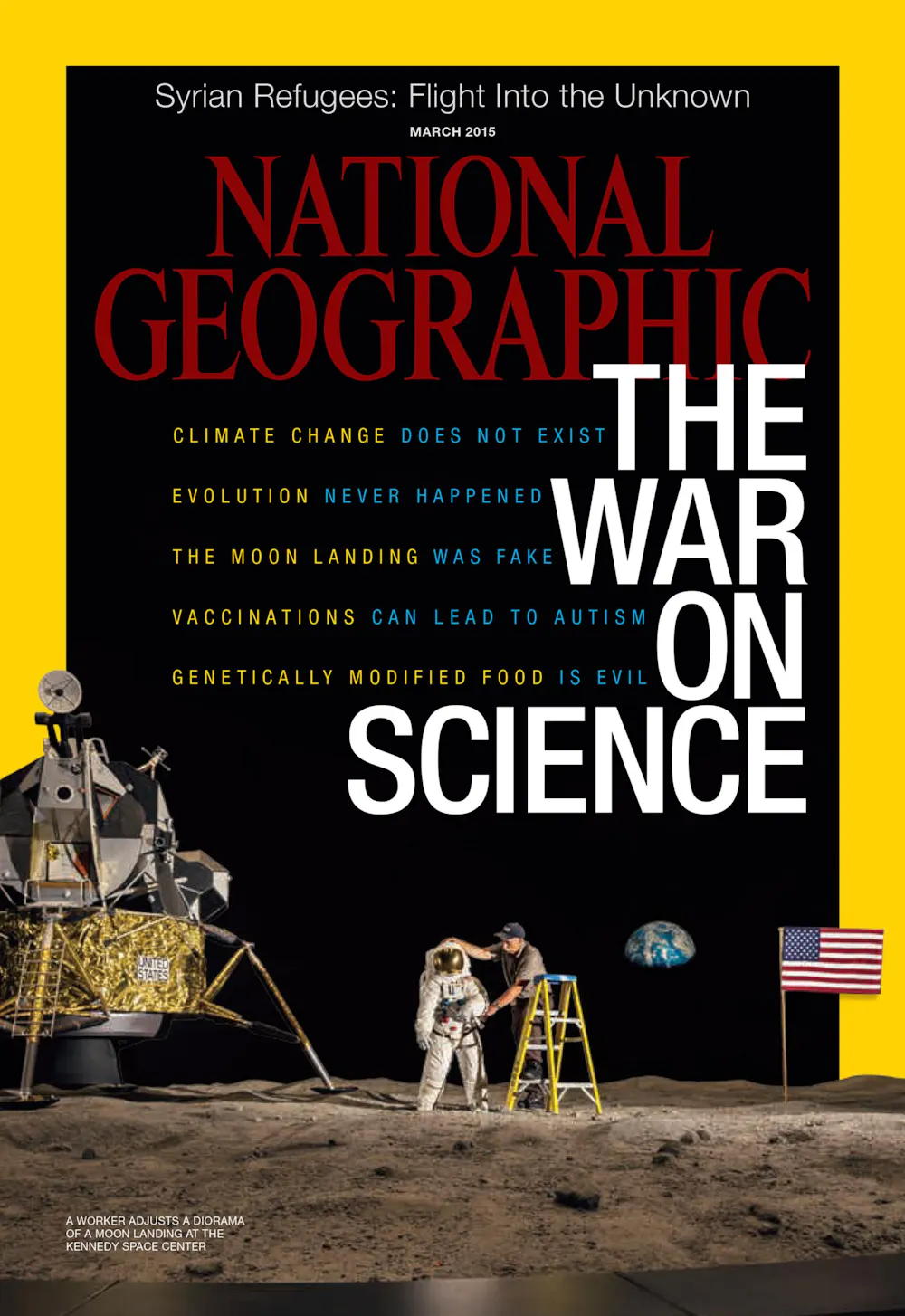
National Geographic’s March 2015 cover story provided a thoughtful discussion around the question of “Why Do Many Reasonable People Doubt Science?” The actual cover, however, simply said “The War on Science.”
That article never actually uses the term “war on science” but claiming the existence of a such a conflict has become quite common.
There are books to tell readers “who’s waging it,” “why it matters,” and “what we can do about it” and many opinion articles and editorials in reputable publications describing its battles.
While we may fully agree as individuals that current approaches to science policy seem deeply problematic, we also wonder as communication scholars whether it makes strategic sense to call the current situation a “war.” Communication experts have long expressed concerns that framing an issue as a conflict might make finding a reasonable path forward harder by suggesting that people need to choose sides and vanquish their opponents in order to succeed.
Building on such arguments, our new research suggests that Americans may see scientists’ choice to accuse conservatives of waging a “war on science” as relatively aggressive compared to potential alternative ways of describing the current situation. In turn, this perceived aggressiveness may harm the credibility of scientists in conservative audiences that already have doubts about them.
Are these ground troops pushing back against a ‘war on science?’
Framing is how communicators put an issue in context – whether naively or on purpose. For years, communication scholars have criticized journalists for frequently framing issues as conflicts or games rather than trying to find more meaningful ways to understand disagreement. For example, researchers have argued that too much media coverage of climate change focuses on the “fight” between conservatives and liberals. This kind of framing problem isn’t exclusive to science-related coverage – but science communicators don’t need to contribute to the problem.
For our study, we surveyed 1,024 American adults who were part of an online panel, selected to be similar to the U.S. population in terms of age, gender, education and political ideology. We randomly assigned participants to read one of three different versions of a blog post about science or an article about baseball. Then we asked them a series of questions about their perception of scientists and other topics.
We adapted the science article from a 2017 Scientific American blog that framed the Trump administration’s approach to scientific evidence as a “war on science.” The article called the administration liars, talking about specific “attacks” and trying to rally scientists to fight back.
We trimmed this initial article for length and then changed some wording to make two alternate versions. Rather than a war, one framed the current situation as either a “challenge for science,” while the other used the frame of a “neglect of science.”
The “challenge for science” article kept some of same aggressive tone as the original article, calling out the White House for lying, but replacing war-related terms such the “attack on science” with the “challenge for science.” In contrast, the article that framed the administration as neglectful took a less aggressive tone, though still addressed the same ideas using the same structure.
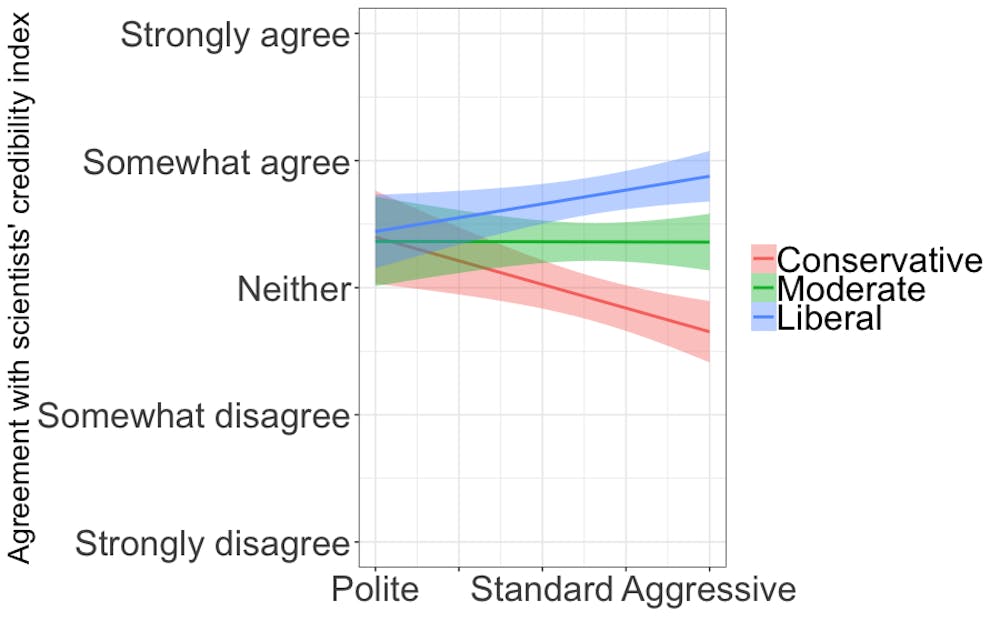
What we ultimately found was that the level of perceived aggressiveness coupled with the “war on science” framing generally led conservatives, liberals and moderates to rate the credibility of scientists differently.
When liberals viewed the “war on science”-framed article as an aggressive message, their ratings of scientists’ credibility increased. On the other hand, when viewed as aggressive, the “war on science” framing pushed down conservatives’ perceptions of scientists’ credibility. While not everyone saw the same content as aggressive, when they did, it affected credibility perceptions.
When respondents read the article with the ‘war on science’ frame, liberals and conservatives diverged in how much credibility they gave scientists based on how aggressive they perceived the writing to be. This pattern wasn’t as evident when respondents read similar articles with the ‘challenge for science’ or ‘neglect of science’ framing.
The differences are fairly small, but we only showed respondents a single article.
Researchers’ understanding is that communication effects like these work cumulatively. So continued exposure to something like war framing might be expected to gradually increase the ideological differences that we found and that seems to be appearing in the available long-term data and associated research.
Scientists can’t count on high confidence ratings continuing forever.
The pattern is still faint, and average reported confidence in scientists – which seems conceptually similar to credibility – has remained stable over time since the late 1970s. Less than 1 in 10 Americans say they have “hardly any” confidence in the scientific community.
But no one should take this stability for granted. The medical community, for example, has seen its confidence rating decline. Less than 1 in 10 Americans said they had “hardly any” confidence in medicine during the 1970s and into the 1990s, but views have deteriorated in recent decades.
And the current results build on some of our own past work showing that aggressive attacks on those who oppose technologies such as genetically engineered food or vaccines may also push down perceptions of scientists.
There may be times when an aggressive tone and conflict-framing is helpful for getting one’s existing supporters to donate money or perform some other behavior. But we have not seen any evidence that it helps expand the scope of support.
Our hope is to encourage science communicators to make choices about things like framing purposefully and to encourage research into approaches that increase the number of friends of science.
In making this argument, we’re mindful of examples such as the LGBT community’s efforts to stay away from conflict framing in its efforts to build support and lessen opposition to same-sex marriage. Rather than asking people to pick a side, the LGBT community framed marriage as a simple issue of love being love, not a fight for rights.
Aggressive tactics can come into play when those running for political office use personal attacks and negative advertising to gain advantage against their opponents. Although such an uncivil approach can damage the image of the candidate making the attacks, he or she has time to rebuild their image with supporters before the next election.
In order to have a positive impact, the science community cannot rely on aggressive communication tactics. Science needs continuous and broad support, across the ideological spectrum, to engage in research and discovery and to see that these discoveries are put to use.
As Americans increasingly buy and install smart devices in their homes, all those cheap interconnected devices create new security problems for individuals and society as a whole. The problem is compounded by businesses radically expanding the number of sensors and remote monitors it uses to manage overhead lights in corporate offices and detailed manufacturing processes in factories. Governments, too, are getting into the act – cities, especially, want to use new technologies to improve energy efficiency, reduce traffic congestion and improve water quality.
The number of these “internet of things” devices is climbing into the tens of billions. They’re creating an interconnected world with the potential to make people’s lives more enjoyable, productive, secure and efficient. But those very same devices, many of which have no real security protections, are also becoming part of what are called “botnets,” vast networks of tiny computers vulnerable to hijacking by hackers.
Botnets have caused problems on the internet, from sending vast amounts of spam mail to disrupting websites around the world. While traditionally most botnets are comprised of laptop and desktop computers, the growth of unsecured devices such as industrial sensors, webcams, televisions and other smart home devices is leading to a growing disruptive capability.
Tiny computers everywhere
The “internet of things” includes countless types of devices – webcams, pressure sensors, thermometers, microphones, speakers, stuffed animals and many more – made by a vast array of companies. Many of these manufacturers are small and unknown, and don’t have popular brands or public reputations to protect. Their goals are to produce lots of devices to sell as cheaply as possible. Customers’ cybersecurity isn’t a real concern for them.
These devices’ variety means they’re useful for lots of things, but also means they have a wide range of vulnerabilities. They include weak passwords, unencrypted communications and insecure web interfaces. With thousands, or hundreds of thousands, of identically insecure devices scattered all over the world, they’re a wealth of targets ripe for the hacking.
If, for instance, a manufacturer has set an unchangeable administrative password on a particular type of device – it happens more often than you might think – a hacker can run a program searching the internet for those devices, and then logging in, taking control and installing their own malicious software, recruiting the device into a botnet army. The devices run normally until the hackers issue instructions, after which they can do more or less anything a computer might do – such as sending meaningless internet traffic to clog up data connections.
Blocking internet access
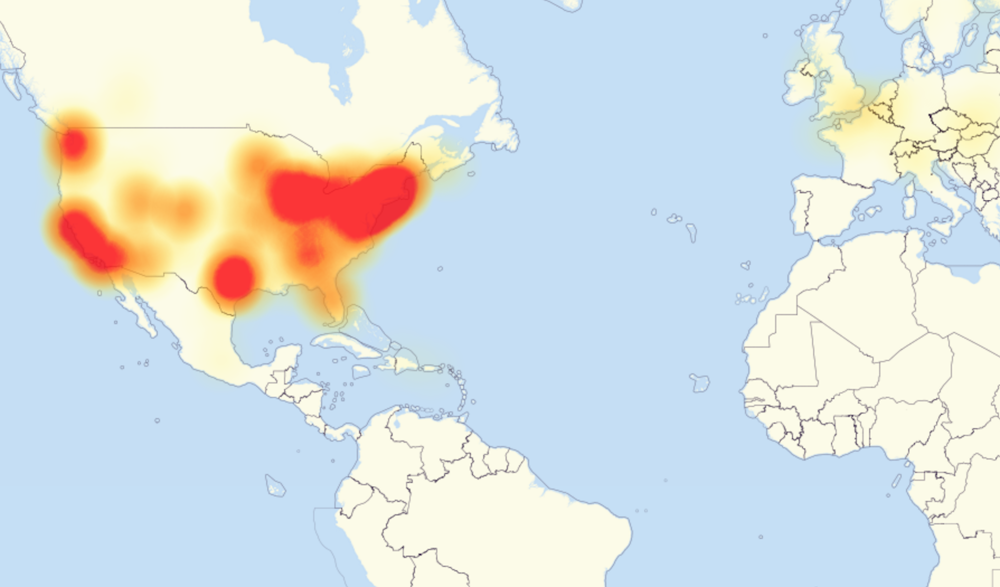
That type of attack when emanating from thousands of devices at once, called a “distributed denial of service,” can shut down companies’ servers or even block wide swaths of the internet from being publicly accessible. A major DDoS attack in 2016 interrupted connections to Amazon, Netflix and Paypal from customers on the east coast of the U.S.
A botnet took down connections through a major internet company in October 2016.
That attack was linked to a botnet-control software program created by three teenagers seeking to use more than 100,000 hijacked webcams and other internet-connected devices from around the world to gain an advantage over other players of the “Minecraft” online video game.
The size and scale of these attacks – and the broad range of devices that can contribute to them – make this both a private problem and a public one. People want to secure the devices in their homes and pockets, of course. Yet the same networks that stream television shows and music also link burglar alarms to police, manage traffic lights in congested areas and let self-driving cars talk to each other.
All that activity can be drowned out if hackers flood the internet, or sections of it, with meaningless messages. Traffic would stall across towns, even counties, and police officers would have a hard time communicating with each other to try to straighten everything out. Even small devices, in their hundreds of thousands, all around the world, can work together to have huge repercussions both online and in the physical world.
Charles T. Harry, Associate Research Professor of Public Policy; Director of Operations, Maryland Global Initiative in Cybersecurity; Senior Research Associate, Center for International and Security Studies, University of Maryland
California Governor Gavin Newsom capped a busy first week in office on Thursday by proposing $144.2 billion in general fund spending for the most populous U.S. state, highlighted by increased expenditures in healthcare and education.
Newsom’s fiscal blueprint assumes continued economic growth of at least 3 percent a year but cautions a recession could transform an existing budget surplus of more than $21 billion left by his predecessor and fellow Democrat, Jerry Brown, into a $40 billion deficit over three years.
“We’re assuming we’re going to continue the economic expansion,” Newsom said during his budget presentation in Sacramento. “I know that send shivers up some people’s spines because we are 10 years into this recovery.”
Increased revenues have allowed California to maintain budget surpluses after the state posted huge deficits following the Great Recession beginning in 2008 forced sharp cuts in education and health care.
With additional bond fund revenue and “special fund” allocations of $64.8 billion, total state spending proposed by Newsom for the upcoming fiscal year that begins in July would come to $209 billion.
The blueprint includes $13.6 billion Newsom has proposed setting aside for what he called “budget resiliency,” with those monies earmarked to pay down unfunded retirement liabilities, to build on California’s rainy-day cash reserve and to retire some of the state’s debt.
Newsom said such measures were intended to ensure that the state remains on sound fiscal footing to “make the California dream available to all.
The general fund would include a record $80.7 billion in spending for public school education from kindergarten through 12th grade, which Newsom said would rank as the largest such expenditure in state history. That tally amounts to an increase of $5,000 per student compared with spending levels seven years ago, the budget said.
Budget highlights include $750 million to expand full-day kindergarten, $402 million for community colleges, including a second year of tuition-free education to full-time students, and $125 million to help phase in universal preschool for all income-eligible 4-year-old children over the next three years.
The budget also calls for an overall increase in health and human services spending of 8 percent over the current fiscal year, and $1 billion to double the state’s earned income tax credit for low-income families.
Subsidized premiums would be increased under Covered California, the state’s version of Obamacare, while expanding Medi-Cal, the state’s medical plan for the poor. The proposed Medi-Cal expansion would extend coverage to roughly 138,000 young adult immigrants, from age 19 through 25, who are in the country illegally.
Reporting by Sharon Bernstein in Sacramento, California; writing by Steve Gorman; Editing by Bill Tarrant and Lisa Shumaker
Self-described computer whiz Christian Rodriguez told jurors on Thursday how he had a nervous breakdown from the stress of cooperating with the FBI to hack into the secure communication system he built for accused Mexican drug lord Joaquin “El Chapo” Guzman.
On trial in U.S. federal court in Brooklyn since November, Guzman, 61, was extradited to the United States in 2017 to face charges of trafficking cocaine, heroin and other drugs into the country as leader of Mexico’s Sinaloa Cartel.
The witness testimonies have given a glimpse into the secretive and often violent workings of the cartel, one of the most powerful drug trafficking operations in the world.
It was the second day of testimony for prosecution witness Rodriguez, 32, who said he worked for Guzman from 2008 to 2012 and built a system allowing members of the cartel to communicate securely using private servers, Nokia phones and Blackberries.
The Colombian-born Rodriguez told jurors he was approached in Bogota in 2011 by FBI agents who told him they knew he worked for Guzman and that he was in “serious trouble.” Rodriguez said he agreed to cooperate with them the same day.
He gave the FBI the passwords to the secure servers he built for Guzman, as well as for software he secretly installed on some of his associates’ phones that allowed Guzman to spy on them, Rodriguez has testified.
The value of Rodriguez’s assistance to prosecutors became obvious this week, as jurors were presented with a slew of Guzman’s phone calls and text messages intercepted thanks to his cooperation.
Much of the evidence in the trial so far has consisted of spoken testimony from witnesses whose credibility Guzman’s lawyers have done their best to undermine. Many of the intercepted communications jurors heard this week, however, appear unambiguously to show Guzman discussing high-volume drug trafficking and bribing officials.
Guzman’s lawyers have portrayed their client as a scapegoat for what they have called Sinaloa’s real leader, Ismael “El Mayo” Zambada, who also faces U.S. charges but remains at large.
Rodriguez said he fled to the United States in fear of his life after learning that Guzman’s associates knew he was cooperating with the FBI. He said he later had a nervous breakdown from stress, was hospitalized and underwent electroconvulsive treatment.
Under cross-examination by one of Guzman’s lawyers, Eduardo Balarezo, Rodriguez admitted family difficulties also contributed to his stress and nervous breakdown.
To protect Rodriguez, court sketch artists have been ordered not to draw his face, and photos released of him have been pixilated.
Late in the day, Alex Cifuentes, a member of the Colombian drug trafficking family that Rodriguez said introduced him to Guzman, took the stand. Dressed in prison garb, he said he worked for Guzman from 2007 until his 2013 arrest.
Cifuentes, who pleaded guilty to U.S. drug charges and is cooperating with prosecutors, is expected to continue testifying on Monday.
The trial began Nov. 13 and is expected to last a few more weeks. Guzman faces life in prison if convicted.
Reporting by Brendan Pierson in New York; Editing by Anthony Lin and Rosalba O'Brien
The U.S.-led coalition against Islamic State has begun the process of withdrawing from Syria, a spokesman said on Friday, indicating the start of a U.S. pullout that has been clouded by mixed messages from Washington.
President Donald Trump announcement last month that he had decided to withdraw 2,000 U.S. troops stunned allies that have joined Washington in the battle against Islamic State in Syria. Top U.S. officials were shocked too, among them Defense Secretary Jim Mattis, who quit in protest.
The coalition “has begun the process of our deliberate withdrawal from Syria. Out of concern for operational security, we will not discuss specific timelines, locations or troop movements,” Colonel Sean Ryan said.
Russia, which has deployed forces into Syria in support of the Damascus government, said on Friday it had the impression that the United States wanted to stay despite the announced withdrawal of U.S. troops, RIA news agency reported.
The decision has injected new uncertainties into the eight-year long Syrian war and a flurry of contacts over how a resulting security vacuum will be filled across a swathe of northern and eastern Syria where the U.S. forces are stationed.
On the one hand, Turkey aims to pursue a campaign against Kurdish forces that have partnered with the United States, and on the other the Russia- and Iran-backed Syrian government sees the chance to recover a huge chunk of territory.
U.S. National Security Adviser John Bolton suggested on Tuesday that protecting Washington’s Kurdish allies would be a pre-condition of the U.S. withdrawal. That drew a rebuke from Turkish President Tayyip Erdogan who called his comments “a serious mistake”.
U.S. Secretary of State Mike Pompeo, who has been touring the Middle East this week to reassure allies of Washington’s commitment to regional security, said on Thursday the withdrawal would not be scuppered despite the Turkish threats.
The Kurdish groups that control the north have turned to Moscow and Damascus in the hope of striking a political deal that will stave off Turkey and shield their autonomy in the north.
Turkey views the U.S.-backed YPG Syrian Kurdish militia as an extension of the Kurdistan Workers’ Party (PKK), which has waged a 34-year insurgency in Turkey for Kurdish political and cultural rights, mostly in southeastern areas near Syria.
A top Kurdish politician told Reuters last week the Kurds had presented Moscow with a road-map for a deal with Damascus. Syria’s deputy foreign minister said on Wednesday he was optimistic about renewed dialogue with the Kurds.
Election results leave Congo with uncertainty
Foreign Minister Jean-Yves Le Drian of France, which is part of the U.S.-led coalition, welcomed what he believed was a slower withdrawal by the U.S after pressure from its allies.
“They have said that the pullout will be done in a slower way ... in all likelihood because of the various pressure that it might have had including from France. President Macron spoke to him (Trump) several times and it seems that there has been a change that I think is positive,” he said in a television interview on Thursday.
In a rare acknowledgment that French troops were also in Syria, he said they would leave when there is a political solution in the country. “Obviously when there is a political solution, we will withdraw,” he said without elaborating.
Reporting by Tom Perry in Beirut, John Irish in Paris and Andrey Ostroukh in Moscow; Editing by Janet Lawrence, Jon Boyle and Peter Graff
The world's oceans are heating up at an accelerating pace as global warming threatens a diverse range of marine life and a major food supply for the planet, researchers said Thursday.
The findings in the US journal Science, led by the Chinese Academy of Sciences, debunk previous reports that suggested a so-called pause in global warming in recent years.
The latest technology shows no such hiatus ever existed, raising new concerns about the pace of climate change and its effect on the planet's main buffer -- the oceans.
"Ocean heating is a very important indicator of climate change, and we have robust evidence that it is warming more rapidly than we thought," said co-author Zeke Hausfather, a graduate student in the Energy and Resources Group at the University of California, Berkeley.
About 93 percent of excess heat -- trapped around the Earth by greenhouse gases that come from the burning of fossil fuels -- accumulates in the world's oceans.
The latest report relied on four studies, published between 2014 and 2017, that gave more precise estimates of past trends in ocean heat, allowing scientists to update past research and hone predictions for the future.
A key factor in the more accurate numbers is an ocean monitoring fleet called Argo, which includes nearly 4,000 floating robots that "drift throughout the world's oceans, every few days diving to a depth of 2,000 meters (yards) and measuring the ocean's temperature, pH, salinity and other bits of information as they rise back up," said the report.
Argo "has provided consistent and widespread data on ocean heat content since the mid-2000s," it said.
The new analysis shows warming in the oceans is on pace with measurements of rising air temperature.
And if nothing is done to reduce greenhouse gases, "models predict that the temperature of the top 2,000 meters of the world's oceans will rise 0.78 degrees Celsius by the end of the century," it said.
The thermal expansion -- water swelling as it warms -- would raise sea level 12 inches (30 centimeters), above any sea level rise from melting glaciers and ice sheets.
"While 2018 will be the fourth warmest year on record on the surface, it will most certainly be the warmest year on record in the oceans, as was 2017 and 2016 before that," Hausfather said.
"The global warming signal is a lot easier to detect if it is changing in the oceans than on the surface."
Las Vegas police have asked soccer star Cristiano Ronaldo to submit a DNA sample as part of their investigation into accusations of rape made against the Juventus forward.
Ronaldo's lawyer, Peter Christiansen, played down the significance of the warrant sent to authorities in Italy, telling AFP in a statement on Thursday it was standard procedure.
"Mr Ronaldo has always maintained, as he does today, that what occurred in Las Vegas in 2009 was consensual in nature, so it is not surprising that DNA would be present, nor that the police would make this very standard request as part of their investigation," the statement said.
A former American model, Kathryn Mayorga, 34, of Las Vegas, accused Ronaldo in a complaint filed last year in Nevada of raping her on June 13, 2009 just before he joined Real Madrid from Manchester United.
Ronaldo, 33, has vehemently denied the allegations and has been backed by his current club.
Mayorga alleges that the sportsman raped her at a Las Vegas hotel and she was reportedly paid $375,000 to keep quiet.
Ronaldo's lawyers have said that the non-disclosure agreement signed with the former model is "by no means a confession of guilt."
Mayorga's attorney has previously said that the model agreed to an out-of-court settlement to keep her name from going public but was inspired to speak out by the #MeToo movement.
She met Ronaldo at a Vegas nightclub, according to her complaint, and accompanied him and other people to his hotel suite where the alleged attack took place.
Mayorga's attorney could not immediately be reached for comment on Thursday.












_-_21_October_2016.png)