French Prime Minister Edouard Philippe and Paris Mayor Anne Hidalgo led commemorations on Tuesday to mark the third anniversary of the co-ordinated Islamic State attacks on Paris in November 2015 that killed 130 people.
Outside the Bataclan theater, where 90 people were gunned down during a rock concert, the names of those who died were solemnly read out. Dignitaries, including London Mayor Sadiq Khan, stood on the street in silence with heads inclined.
The attacks, which began with suicide blasts outside the Stade de France during a soccer match attended by then President Francois Hollande and continued with several mass shootings and a suicide bombing at cafes and restaurants in the city, were the deadliest in France since World War Two.
As well as the 130 people killed, more than 400 were injured, many of them seriously. Seven attackers, most of whom had French or Belgian citizenship, were killed. Several of them had fought in Syria and all were Islamic State adherents.
Earlier on Tuesday, French Interior Minister Christophe Castaner warned that the threat of terrorist attacks was still high, even if Islamic State has been weakened greatly over the past year or more and driven out of its strongholds in Syria and Iraq.
“The threat remains elevated even if it has changed,” he told BFM TV. “At the same time, our intelligence and our ability to intervene has grown stronger, with extra recruitment and powers given to the DGSI,” he said, referring to France’s domestic security and intelligence agency.
Islamic State claimed responsibility for the Paris attacks, saying they were retaliation for France’s participation in airstrikes against Islamic State targets in Syria and Iraq.
Writing by Luke Baker; Editing by Emelia Sithole-Matarise
U.S. President Donald Trump attacked his French counterpart on Tuesday in a series of tweets that underscored how much the once-friendly ties between the two leaders have soured, just two days after returning from Paris.
In five posts sent on the same day that French officials marked the anniversary of the 2015 terrorist attacks that killed 130 people in Paris, Trump blasted the key U.S. ally over its near defeat to Germany in two world wars, its wine industry and Macron’s approval ratings.
Trump returned to Washington from a weekend in Paris to commemorate the 100th anniversary of World War One where strained relations between the American president and European allies was on full display.
On Tuesday, Trump cited Macron’s “low approval rating” and unfair trade practices, and defended his absence from a commemoration event on Saturday saying the U.S. Secret Service had vetoed driving to the venue due to poor weather.
Trump pointed to Macron’s recent comments about Europe’s need to protect itself, writing that “it was Germany in World Wars One & Two - How did that work out for France? They were starting to learn German in Paris before the U.S. came along. Pay for NATO or not!”
“By the way, there is no country more Nationalist than France, very proud people-and rightfully so!” Trump wrote in a series of tweets, ending with “MAKE FRANCE GREAT AGAIN!”
Asked about Trump’s tweets, a key adviser to Macron said the French president had briefed Trump and his chief of staff during the Paris trip to reassure them that “that France is not about to make a choice between a European defense system and a multilateral approaches.”
Reporting by Susan Heavey in Washington and Luke Baker in Paris; Editing by Jeffrey Benkoe
U.S. soybean farmer Mike Schlosser does not expect President Donald Trump’s trade war with China, the single biggest headwind to his business, to end any time soon. But he is among many in farm country who expect at least some good news this year - in the form of a new Farm Bill.
Congress comes back on Tuesday for the lame-duck session after Democrats in last week’s mid-term elections gained control of the U.S. House of Representatives. Lawmakers have said passing the critical piece of agricultural legislation is their highest priority.
That would provide some comfort to farmers who for the past several months have been crushed by the loss of export markets due to the trade wars and are keen for a legislative backstop if the trade disputes linger.
“It’s our safety net,” Schlosser, of North Dakota, said. “We could use all the help we can to eliminate any uncertainty in times like this,” he said.
The Farm Bill provides funding for an array of programs important to farmers, including crop subsidies, rural development programs and support accessing export markets. The latest bill, passed in 2014, expired on Sept. 30 after talks over its replacement broke down.
At issue was a bitter partisan debate over a provision in the draft of the new bill that would have imposed stricter work requirements for recipients of food stamps. The Republican-led House of Representatives passed an $867 billion bill in June with the tougher requirements, over the objections of Democrats. The Senate, meanwhile, passed its own bipartisan version that excluded them.
With Democrats in control of the House, the deadlock could be resolved, several senior lawmakers said last week, even as Trump reiterated his desire for stricter work requirements in the bill.
Curt Mether, a corn and soybean farmer from Iowa, said he hoped Trump would back down. “I think President Trump will be willing to step down on the work requirements issue in the end as he understands the House will be Democrat-controlled,” he said.
He noted a new farm bill could help farmers survive the ongoing trade dispute, which has driven China, traditionally the biggest buyer of U.S. agriculture exports, mostly out of the market.
“Some of our export programs are funded through the Farm Bill. While we are negotiating with China, it is really important that we get all the trade we can with other countries,” he said.
Bob Hemesath, an Iowa corn and hog farmer, agreed. “I’m hopeful... Amid the trade tariffs, without a farm bill, we would not have access to market development programs, and these are crucial,” he said.
Dairy farmers, whose trade with Mexico and Canada was hit by tariffs over the summer and have yet to recover despite a new North American trade deal, have also called on lawmakers to settle the deal on the Farm Bill.
“Given the sustained low prices dairy farmers have faced, coupled with uncertainty in agricultural trade policy, it is more important than ever that Congress quickly enact the 2018 Farm Bill before adjourning for the year,” said Jim Mulhern, president and CEO of the National Milk Producers Federation.
Reporting by Humeyra Pamuk; Editing by Dan Grebler
A U.S. federal judge in Montana halted construction of TransCanada Corp’s Keystone XL oil pipeline on Thursday, saying a U.S. environmental analysis “fell short of a ‘hard look’” at the cumulative effects of greenhouse gas emissions and the impact on Native American land resources.
The ruling is the latest delay to the project, a decade in planning, which was revived by U.S. President Donald Trump after being halted by his predecessor, Barack Obama.
WHAT IS KEYSTONE XL?
KXL, as it is known, is a proposed $8 billion, 1,180 mile (1,900 km) pipeline that would carry heavy crude to Steele City, Nebraska, from Canada’s oil sands in Alberta. Planned by Canada’s TransCanada, KXL would provide a shortcut to carry more Canadian oil to U.S. markets, complementing the existing Keystone line than runs from Alberta to Steele City and then Gulf Coast refineries.
WHY IS IT NEEDED?
Crude production in Alberta’s oil sands is expanding faster than pipeline capacity, creating a bottleneck that has driven down prices. Canada’s heavy crude now fetches a fraction of the benchmark U.S. light oil price, and some producers have curtailed production. The steep discount has stripped billions of dollars from the Canadian economy by some estimates.
WHAT IS THE NATURE OF OPPOSITION?
Environmental groups have campaigned against pipelines to carry crude from Canada’s oil sands, saying extraction methods used in the region harm the environment more than conventional oil drilling.
In Nebraska, landowners blasted what they saw as heavy-handed efforts by TransCanada to force the pipe through ecologically sensitive areas.
WHAT OTHER OBSTACLES HAS IT FACED?
Obama, a Democrat, axed the project in 2015, saying Canada would reap most of the economic benefits while the project would add to greenhouse gas emissions. President Donald Trump, a Republican, pushed to approve KXL soon after he took office, saying it would create U.S. jobs. In 2017, a presidential permit allowed the line to move forward, and several environmental groups sued the U.S. government.
The Nebraska Public Service Commission issued an approval late last year for an alternative route, a ruling that environmental groups are challenging.
WHAT ARE THE POLITICAL IMPLICATIONS?
In Washington, the judge’s ruling on Thursday was a blow to Trump, who critics say is trying to force an unpopular project on the American people.
In Ottawa, pressure is mounting on Canadian Prime Minister Justin Trudeau to get a pipeline built to help Canadian producers sell their oil at higher prices while building support for other steps to reduce greenhouse gas emissions before an election expected next year.
In summer, Trudeau’s government bought the floundering Trans Mountain pipeline project, hoping to get it built.
WHAT’S NEXT?
U.S. District Court Judge Brian Morris ordered the federal government to conduct a more thorough environmental analysis. Separately, TransCanada has said it expects a decision on routing from the Nebraska Supreme Court by the first quarter of 2019.
TransCanada has yet to make a final investment decision to proceed with the project, even though it had started construction. It said last week that it is also seeking partners to finance KXL’s construction.
Reporting by Rod Nickel in Winnipeg, Manitoba; Editing by David Gregorio
The U.S. government has also made a second, more surprising, announcement: It’s granting eight countries waivers that will let them keep on buying Iranian petroleum.
Since I’m a historian of energy and U.S.-Iranian relations, I’ve been monitoring how the Trump administration’s policy toward Iran has affected global oil markets. I believe that these new sanctions do not serve U.S. energy interests because they may spark price increases that would punish American consumers. More generally, this move illustrates what I see as the incoherence of Trump’s energy policies and international diplomacy.
Taking aim at oil exports
Since Iran first became a major oil producer in the 1930s, its government has depended on oil and gas revenue for most of its budget. When the Obama administration imposed tough economic sanctions on Iran in 2012, to force Tehran to the nuclear bargaining table, the Middle Eastern country’s exports declined sharply.
The U.S. lifted those sanctions after Iran agreed to the Joint Comprehensive Plan of Action, an international agreement that placed restraints on Iran’s nuclear program. As a result, its overseas oil sales shot up in 2016 and 2017.
But now President Donald Trump, who has derided the agreement since his electoral campaign, is bringing the hammer back down.
Saudi Arabia claims it can pump an extra 2 million barrels per day. But data from the Energy Information Administration indicates that Saudi Arabia will only have the potential to increase its daily production by 1.2 million barrels in 2019. That’s a dangerously slim margin.
Energy dominance
The Trump administration has an insurance policy against the tightening oil market: its “energy dominance” policy and higher domestic production levels.
Crude oil exports are way up too, thanks to the repeal of of a 40-year ban on most of those shipments in late 2015.
With domestic production booming, there’s a chance that the U.S. could be insulated from shocks to the global oil market.
But compared to Saudi Arabia, Russia and other major producers, America still sells relatively little crude to other countries and it imports far more oil than it exports.
What’s more, U.S. oil comes from hundreds of smaller fields, which makes it hard to easily cut or increase output. As a result, the notion that the U.S. can serve as a “swing producer” to restrain global oil price volatility is, in my opinion, unrealistic.
One way that the Trump administration could help is by encouraging energy conservation. Instead, it’s done the opposite by encouraging more fossil fuel investment than ever. Developing more oil fields may boost U.S. production, but it will also deepen American dependence on gasoline and diesel, making the U.S. economy more vulnerable to disruptions in the global market.
No end game
So why did the Trump administration give eight of Iran’s biggest customers, China, South Korea, Taiwan, India, Greece, Turkey, Japan and Italy waivers?
Perhaps it recognized the risks tied to squeezing Iran’s oil out of the markets altogether. Secretary of State Mike Pompeo said that waivers were granted after each country promised to continue cutting Iranian imports over time.
Trump has admitted that he was “going a bit slower” on Iran. “I don’t want to lift oil prices,” he said.
He took this position despite reported protests among Iran hard-liners like National Security adviser John Bolton. Pompeo, another hardliner, defended the waivers as part of a broader strategy of pressure on Iran. He rejected the idea that this was a retreat.
But should the Trump administration change course again, cutting off much more of Iran’s access to global oil markets at a time when the world’s spare capacity is dangerously low, it could lead to much higher gas prices in the U.S. and elsewhere.
And that’s the fundamental contradiction at the heart of U.S. oil policy. Punishing Iran by choking off its access to global petroleum markets will end up punishing U.S. consumers. They will have to pay more at the pump and higher oil prices will make just about every purchase more expensive.
Jacobs is a messianic Jew and part of a group called Jews for Jesus. Here is why their relationship with Jews is so fraught.
Messianic Jews
Messianic Jews consider themselves Jewish Christians. Specifically they believe, as do all Christians, that Jesus is the son of God, as well as the Messiah, and that he died in atonement for the sins of mankind.
There are approximately 175,000 to 250,000 messianic Jews in the U.S, and 350,000 worldwide. About 10,000 to 20,000 live in Israel. According to Dan Juster, a theologian who founded a major messianic Jewish congregation, there are currently about 300 congregations in the United States, and about half of the attendants are Gentiles, or ethnically non-Jewish.
And most of these groups consider the conversion of ethnic Jews specifically – that is, people with at least one Jewish parent – to messianic Judaism a central part of their mission.
Messianic Jews and Jewish messianism
Belief in a Messiah who will redeem the Jewish people and thereby usher in a new, more humane era is very much a Jewish concept. However, there are deep theological differences between Jews and Christians regarding exactly who is a Messiah, what a Messiah should do and even how central a Messiah should be to their traditions.
According to both the Hebrew Bible and Jewish oral tradition, a Messiah is a king, a warrior, a political figure or a revolutionary whose mission is divine and specific to the Jews. But the leader is neither divine nor a savior concerned with the afterlife of humanity. Neither is a Messiah worshiped as a deity.
According to the Hebrew Bible and Jewish oral tradition, a Messiah could be a king, a warrior, a political figure or a revolutionary.
This leader’s job is to facilitate the return of the Jews to the land of Israel, not in the afterlife but in the temporal world. Therefore, redemption does not entail atonement for sins, but is a liberation from exile and a return to self-rule in Israel.
One doesn’t need to be Jewish to be a Messiah. The Persian King Cyrus is referred to as a “Messiah” in the Hebrew Bible because he allowed the Jews to return to the land of Israel, signaling the end of what is known as the Babylonian Exile in the sixth century B.C.
And Cyrus is not the only figure to be called a Messiah. Bar Kohkbah, the warrior and revolutionary who led the Jewish revolt against Rome from A.D. 132 to 135, was also believed to be a possible Messiah because he sought to eject Roman rule from Israel and return the Jews to Jerusalem. The fact that Bar Kohkbah did not successfully defeat Rome ultimately meant he did not turn out to be a Messiah – but he certainly took on the job of a Jewish Messiah.
There are multiple forms of Jewish messianism, but none of them believe that a messianic figure – if such a person exists – will be divine.
Contemporary Judaism’s many branches do not agree on when or if a Messiah will appear at all, especially since the creation of the Israeli state in 1948. This is in large part because the traditional job of a Messiah – the restoration of the Jewish state – has already been accomplished. Some Jews do believe that a Messiah will come, but the signs that would foretell have not appeared yet.
Also, many Jews have rejected the idea of an individual Messiah in favor of the idea that humans themselves, through acts of social justice or tikkun olam, will mend the world and bring about a “messianic age” wherein life for Jews and in fact humanity improves for the better.
Christianity’s redefinition of the nature and role of a Messiah is its most important point of departure from Judaism, and has accounted for much of the tension between Jews and Christians historically.
Jews do not share the Christian belief that Jesus was divine. This difference in belief is grounded in the Jewish assertion that there is only one God, who can never be human, even though God may reveal himself in multiple ways. Historically, this created an insurmountable theological barrier between Jews and Christians.
Conversion of Jews
Although Jewish Christians have technically been around since the death of Jesus, the more modern form of the movement has its roots in late 19th-century Europe, when anti-Semitic persecution was on the rise in Russia and large numbers of Jews immigrated to the United States.
The sole focus of some missions based in England and the U.S. was the conversion of the Jews to Christianity. One such mission, the London Society for Promoting Christianity Amongst the Jews, writes scholarPatricia A. Power, met in Boston in 1816.
Its objective, as she says, “was to encourage Gentiles to take the task of Jewish evangelism seriously.”
Jews for Jesus is an inheritor of this objective. It began, as Power explains, as a small group with dedicated followers and became “a multimillion dollar evangelistic machine that aggressively, and with savvy, marketed Jesus as the Jewish Messiah to an astonished and often hostile Jewish community.”
Jews for Jesus’s controversial founder, Moishe Rosen, who died in 2010, adopted some of the practices of the “Jesus People” movement – a religious movement of the 1960s that sought to return to the original life of early Christians – for the conversion of Jews. While appearing to reject anti-Semitism, he portrayed Judaism as an incomplete tradition practiced by people who misunderstand their own scriptures and needed to be saved through conversion to Christianity.
Misinterpreting scriptures?
According to Jews for Judaism, an organization that provides support and education for Jews who have been targeted for conversion, missionaries like Jews for Jesus are often aggressive and manipulative in their pursuit of Jewish conversions to Christianity.
Jews for Judaism alerts Jews to misinformation that might take scriptures out of context.
On its website, Jews for Judaism alerts Jews to the most common form of misinformation that involves taking the Jewish scriptures out of context – tactics that have been denounced by Jews and Christiansalike. Loren Jacobs was defrocked by the Union of Messianic Jewish Congregations for accusations of libel 15 years ago “after becoming involved in a bitter theological debate with other members of the group.”
What makes the targeting of Jews for conversion to Christianity particularly painful and damaging is that for over a thousand years, Jews were persecuted, first at the hands of a Christian Roman Empire and then the Church, because Christians did not believe that Jewish scriptures contained truths claimed by another religion.
Prayers like the one said by Loren Jacobs are a powerful reminder of that long and violent history.
As you read this, a strange object that looks like a 2,000-foot floating pool noodle is drifting slowly through the central north Pacific Ocean. This object is designed to solve an enormous environmental problem. But in so doing, it brings attention to a number of others.
There are an estimated five trillion pieces of plastic floating on and in the world’s oceans. The massive pool noodle will move through the Great Pacific Garbage Patch, driven by the wind and currents and picking up the plastic it encounters along the way. Ocean Cleanup, the organization that developed the device, promises “the largest cleanup in history.”
If it works, the device – blandly named System 001 – could make a dent in the enormous amount of ocean-borne plastic. But once that plastic is collected the options are not good. That’s where an environmental ethicist like me starts thinking about where this plastic will end up next. The ocean is better off without it, of course, but the plastic problem has many more layers than it first appears.
The struggle of sorting
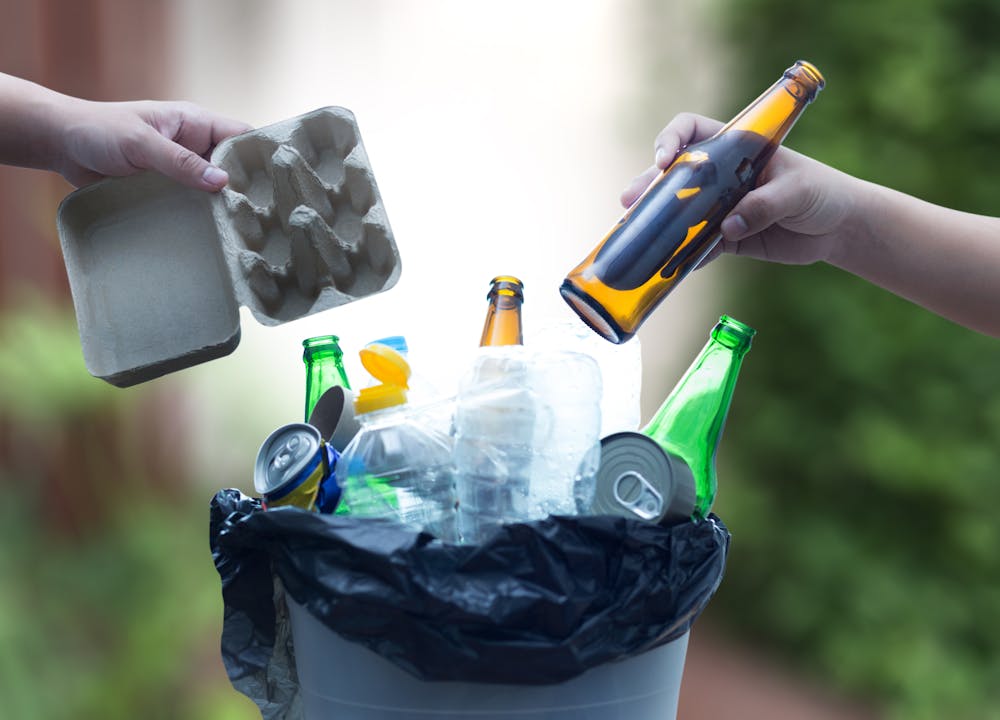
Recycling plastic is only possible if it can be meticulously separated into its various chemical types. What people generally describe with the single word “plastic” encompasses seven main types of materials – the ones used to make soda bottles, trash bags, cling wrap, shopping bags, yogurt containers, fishing nets, foam insulation and non-metal parts of many household appliances. Recycling each of these types, which you might know by their acronyms – such as PETE, LDPE, PVC, PP and HDPE – requires a different chemical process.
Sorting materials is one of the most difficult challenges in recycling.
That’s why many household recycling programs ask residents to sort their plastics – and why communities that let people put recyclables of all types into one big bin employ people and machines to sort it after it’s collected.
Sorting won’t be easy with the plastic in the ocean. All the different kinds of plastic are mixed up together, and some of it has been chemically and physically broken down by sunlight and wave action. Much of it is now in tiny pieces called microplastics, suspended just below the surface. The first difficulty, but by no means the last, will be sorting all that plastic – plus seaweed, barnacles and other sea life that may have attached itself to the floating debris.
Recycling or downcycling?
Ocean Cleanup is working on how best to reprocess, and brand, the material it collects, hoping that a willing market will emerge for its uniquely sourced product. Even if the company’s engineers and researchers can figure out how to sort it all, there are physical limitations to how useful the collected plastic will be.
The act of recycling involves grinding up materials into very small pieces before melting and reforming them. An inescapable part of that process is that every time plastic is recycled, its polymers – the long chemical sequences that provide its structure – become shorter.
Generally speaking, lighter and more flexible types of plastic can only be recycled into denser, harder materials – unless large amounts of new virgin plastic are added to the mixture. After one or two rounds of recycling, the possibilities for reuse become very limited. At that point, the “downcycled” plastic material is formed into textiles, car bumpers or plastic lumber, none of which end up anywhere else but the landfill. The plastic becomes garbage.
Plastic composting
What if there were a way to ensure that plastic was genuinely recyclable over the long term? Most bacteria can’t degrade plastics because the polymers contain strong carbon-to-carbon chemical bonds that are different from anything bacteria evolved alongside in nature. Fortunately, after being in the environment with human-discarded plastics for a number of decades, bacteria seem to be evolving to use this synthetic feedstock that pervades modern life.
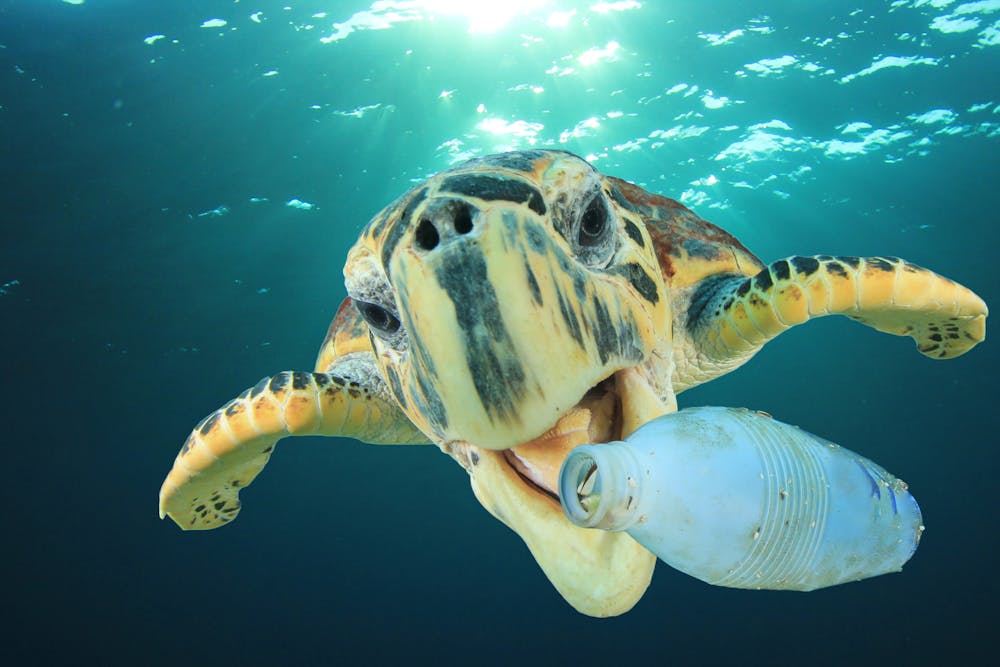
Sea turtles have not yet evolved to eat plastic – but some bacteria have.
In 2016, a team of biologists and materials scientists found a bacterium that can eat the particular type of plastic used in beverage bottles. The bacteria turns PET plastic into more basic substances that can be remade into virgin plastics. After identifying the key enzyme in the bacteria’s plastic-digestion process, the research team went on to deliberately engineer the enzyme to make it more effective. One scholar said the engineering work has managed to “overtake evolution.”
At this point, the breakthroughs are only working in laboratory conditions and only on one of the seven types of plastics. But the idea of going beyond natural evolution is where the ears of an environmental philosopher go on alert.
Synthetic enzymes and bacteria
Discovering the plastic-eating bacterium and its enzyme took a lot of watching, waiting and testing. Evolution isn’t always quick. The findings suggest the possibility of discovering additional enzymes that work with other plastics. But they also raise the possibility of taking matters into our own hands and designing new enzymes and microbes.
Already, completely artificial proteins coded by synthetically constructed genes are acting like artificial enzymes and catalyzing reactions in cells. One researcher claims “we can develop proteins – that would normally have taken billions of years to evolve – in a matter of months.” In other labs, synthetic genomes built entirely out of bottles of chemicals are now capable of running bacterial cells. Entirely synthetic cells – genomes, metabolic processes, functional cellular structures and all – are thought to be only a decade away.
This coming era of synthetic biology not only promises to change what organisms can do. It threatens to change what organisms actually are. Bacteria will no longer just be naturally occurring life forms; some, even many, of them will be purpose-built microbes constructed expressly to provide functions useful to humans, such as composting plastic. The border between life and machine will blur.
The plastics polluting the world’s oceans need to be cleaned up. Bringing them back to land would reinforce the fact that even on a global scale, it’s impossible to throw trash “away” – it just goes somewhere else for a time. But people should be very careful about what sort of technological fixes they employ. I cannot help but see the irony of trying to solve the very real problem of too many synthetic materials littering the oceans by introducing to the world trillions of synthetically produced proteins or bacteria to clean them up.
Amid signs that negotiations between North Korea and the U.S. are stalling, analysts say Pyongyang still sees its nuclear arsenal as a key tool in securing its national safety and winning concessions from international rivals.
Just as the United States has doubled down on its sanctions on Pyongyang, North Korean leader Kim Jong Un has not retreated from his pledge to expand his operational force of nuclear bombs and ballistic missiles, increasing his leverage under any still-elusive denuclearization deal.
A U.S. think tank said on Monday it had identified at least 13 of an estimated 20 active, undeclared missile bases inside North Korea, underscoring the challenge for American negotiators hoping to persuade Kim to give up his weapons programs.
As time goes by, North Korea’s likely expansion of its arsenal could force Washington to rethink its insistence on full denuclearization, said Moon Hong-sik, a research fellow at the Institute for National Security Strategy in Seoul.
“This is the choice the United States has to make: whether they keep pursuing the ideal of ‘complete, verifiable, irreversible denuclearization,’ or take this dilemma into consideration and make a compromise for limited denuclearization,” he said.
U.S. President Donald Trump met Kim at an unprecedented summit in Singapore in June where they agreed to “work toward complete denuclearization of the Korean Peninsula.
But with scant sign of progress on negotiations since and recent high-level meetings canceled, Trump said last week he’s now in “no rush” and still wants to meet with Kim for a second time.
U.S. officials have said sanctions forced North Korea to the negotiating table and vowed to keep pressure until complete denuclearization. But North Korea has credited its nuclear and missile breakthroughs for providing it the standing to meet the world’s largest powers.
Kim’s own words suggest Pyongyang will continue with production and development of the nuclear program even as it negotiates with Washington on denuclearization, experts say.
“In the 2018 New Year address, Kim Jong Un called for shifting to full-scale production and deployment of nuclear weapons and missiles,” said Joshua Pollack, a senior research associate at the U.S.-based James Martin Center for Nonproliferation Studies (CNS).
“He’s never said or done anything since then to contradict that.”
North Korea has not tested a nuclear bomb or ballistic missile since last year, and has said it has shuttered its main nuclear test site with plans to dismantle several more facilities.
North Korea recently warned, however, it could restart its nuclear program if the United States does not drop its campaign of “maximum pressure” and sanctions.
“NORTH KOREA NEVER PROMISED”
Monday’s report by the Washington, D.C.-based Center for Strategic and International Studies (CSIS), sparked media coverage calling it a “great deception” by the North Koreans.
But South Korea’s presidential Blue House said without an actual deal to violate, Pyongyang has broken no promises.
“North Korea has never promised to shut down this missile base,” Blue House spokesman Kim Eui-kyeom said. “It has never signed any agreement, any negotiation that makes shutting down missile bases mandatory... the fact that such a missile base exists shows the necessity for negotiations to be achieved quickly.”
Asked about the report, Trump’s national security adviser John Bolton told reporters in Singapore on Tuesday that Trump “has given North Korea an incredible opportunity to walk through a door to a different future if they denuclearize...but they still need to do that.”
The activity at the missile bases is one of several examples why American officials may be reluctant to lift any sanctions, said Shin Beom-chul, director of the Center for Security and Unification at Seoul’s Asan Institute for Policy Studies.
“In short, from the CSIS report we can infer that first, North Korea is not sincere enough with negotiating and second, there’s no change in their nuclear capacity,” he said.
U.S. officials have discussed possible clandestine enrichment sites for nuclear fuel, and in July, analysts at CNS used commercial satellite imagery to conclude that North Korea was “completing a major expansion of an important factory for producing solid rocket motors for... nuclear-armed missiles”.
In April, ahead of his meeting with Trump, Kim told a gathering of ruling party leadership the nuclear arsenal represented a “great victory” and announced there was no need for further tests of nuclear weapons or ballistic missiles.
In the speech, however, Kim also hinted at nuclear weapons playing an important role long into the future, calling them a “powerful treasured sword for defending peace” that would “reliably guarantee” a dignified and happy life for generations of North Koreans.
“Note the description of nuclear weapons as the only firm security assurance,” Pollack said. “They are not seeking any ‘security assurance’ other than the indefinite possession of nuclear weapons.”
Additional reporting by Jeongmin Kim and Joyce Lee in Seoul and John Geddie in Singapore. Editing by Lincoln Feast
An exceptionally rare 19-carat pink diamond goes under the hammer in Geneva Tuesday, when it could fetch $50 million (44 million euros), setting a new record for a stone of its kind.
The Pink Legacy used to belong to the Oppenheimer family, which for decades ran the De Beers diamond mining company, but auction house Christie's refused to say who the current owner was.
Christie's international head of jewelry, Rahul Kadakia, described The Pink Legacy as "one of the world’s greatest diamonds".
The rectangular-cut diamond has been graded "fancy vivid" -- the highest possible grade of colour intensity.
Christie's has noted that in the salesroom, fancy vivid pink diamonds over 10 carats are "virtually unheard of" and that only four vivid pink diamonds or over 10 carats have ever been offered at auction.
One of them, the nearly 15-carat Pink Promise, was sold last November at a Christie's auction in Hong Kong for $32.5 million. That amounts to $2.176 million per carat, which remains the world auction record price per carat for any pink diamond.
- Record price possible -
Eddie LeVian, CEO of jewelers Le Vian, said that record could fall at Tuesday's auction, which is being held at the ultra-luxurious Four Seasons des Bergues hotel on the banks of Lake Geneva.
"We've recently witnessed a meteoric rise in the number of the world's ultra-high net worth individuals who view rare, natural fancy color diamonds as investments," Le Vian said in a statement.
"I therefore believe the Pink Legacy will beat the current world auction record," he added.
AFP / Fabrice COFFRINI The Pink Legacy diamond could fetch a record sum at Tuesday's auction
The stone was discovered in a South African mine around a century ago and was probably cut in the 1920 and has not been altered since, Christie's said.
"Imagine a domino that you have cut the corners off of," Jean-Marc Lunel, an international jewelery specialist at Christie's, recently told AFP, pointing out that the cut is a "classical so-called emerald cut", which stands out from the typical, more rounded, multi-facetted cuts used today.
The classic rectangular cut is traditionally used for white stones, but is rare for pink diamonds.
Christie's said the Pink Legacy is "the largest and finest Fancy Vivid Pink diamond ever offered at auction by the company," calling the stone "incomparable."
"It is probably the most beautiful (specimen) ever presented at public auction," Lunel said.
The number of international students entering U.S. colleges and universities has fallen for the second year in a row, a nonprofit group said on Tuesday, amid efforts by the Trump administration to tighten restrictions on foreigners studying in the United States.
New enrollments for the 2017-18 school year slumped 6.6 percent compared with the previous year, according to an annual survey released by the Institute of International Education. That follows a 3.3 percent decline in new international students tallied in the 2016-17 academic year.
Several factors are driving the decrease. Visa and immigration policy changes by the Trump administration have deterred some international students from enrolling, college administrators and immigration analysts said.
A strong dollar has made U.S. college tuition relatively more expensive, Canadian and European universities are competing fiercely for the same students and headlines about mass shootings also may have deterred some students, said Allan Goodman, president of IIE.
“Everything matters from safety, to cost, to perhaps perceptions of visa policy,” Goodman said. “We’re not hearing that students feel they can’t come here. We’re hearing that they have choices. We’re hearing that there’s competition from other countries.”
International students have become an important funding source for American colleges as traditional revenue sources, such as state funding, come under pressure. Most undergraduate foreign students do not qualify for need-based financial aid and must pay close to full tuition and fees to attend U.S. schools.
Similar to previous years, the largest numbers of students came from China, India and South Korea, which together made up 56.1 percent of all international students.
IIE did not track new international student numbers before the 2004-05 school year, but Goodman said the recent declines in new enrollments were comparable to the period after the Sept. 11, 2001 attacks. The annual survey of foreign-student enrollment is funded by the U.S. State Department.
Some immigration policy experts and college administrators attribute the decline to the Trump administration’s drive to restrict immigration and an overall sense of a U.S. political climate that is hostile to immigrants and foreigners.
“It is not a welcoming environment,” said Doug Rand, a former White House official working on immigration issues during the Obama administration.
He noted that Trump has moved to restrict the issuance of skilled-worker visas and permanent residency, which many incoming students may apply for in the future.
“It’s an act of willful ignorance to suggest that our immigration policies aren’t having a direct impact on foreign student enrollment,” Rand said.
Caroline Casagrande, a State Department official, said the “flattening” in international student enrollments began with the 2015-2016 year, prior to the start of the Trump administration. That year, new enrollments still increased by 2.4 percent compared with the prior year.
“The U.S. Department of State is committed to facilitating the legitimate travel to the United States of individuals who want to study in U.S. academic institutions,” Casagrande said during a phone call with reporters. “It’s quite frankly unwarranted to say that it is completely the result of a political environment.”
Cary Jensen, assistant vice provost for international advocacy and engagement at the University of Rochester in New York, said international students had been receiving more scrutiny from the U.S. government since the Sept. 11 attacks, but that “this last year and a half has just taken it to another level.”
Jensen said a major issue facing American universities was the lack of clarity surrounding the Trump administration’s policies, in part due to lengthy court battles over policies like Trump’s travel ban on people from several Muslim-majority countries.
“That has kind of been the worst part of this, is the uncertainty,” Jensen said. “That breeds fear and people tend to overreact.”
The administration is pursuing concrete steps to restrict visa policy regarding international students. Last month, it said it would seek to establish a fixed maximum period of stay for international students. Students currently can stay for an indefinite duration of study, and exchange advocates worry such a change would make it harder to recruit students and limit their flexibility once they are in the country.
In August, the administration changed the way international and exchange visitors are found to accrue “unlawful presence,” a violation that could result in being barred from the country for up to 10 years. Several colleges sued over the change, arguing it would cause the “banishment of untold numbers of international students and exchange visitors acting in good faith.”
The total number of new international students in the United States in 2017-2018 grew by 1.5 percent to a record high of nearly 1.1 million, but it was the smallest year-over-year increase since 2005. The growth in total enrollment was driven by a nearly 16 percent increase in the number of students opting to remain in the United States after finishing their studies for short-term work known as “optional practical training.”
Reporting by Yeganeh Torbati; Editing by Marla Dickerson and Dan Grebler
The U.S. Conference of Catholic Bishops will delay action to deal with a crisis involving sexual abuse of minors by clergy until after a global meeting in February at the request of the Vatican, conference president Cardinal Daniel DiNardo said on Monday.
The Catholic Church worldwide is reeling from crises involving sexual abuse of minors, deeply damaging confidence in the Church in the United States, Chile, Australia, Ireland and elsewhere.
Cardinal DiNardo of Galveston-Houston said the Congregation for Bishops in Rome had sent a letter asking U.S. bishops to wait until after the Vatican-convened global meeting on sex abuse takes place in February.
“We have accepted with disappointment this particular event that took place this morning,” Cardinal DiNardo of Galveston-Houston said at a media conference on Monday, the opening day of the conference. “We have not lessened in any of our resolve for actions.”
In the United States, 13 state attorneys general have launched statewide investigations into sexual abuse by clergy.
In August, an 884-page report made public by Pennsylvania Attorney General Josh Shapiro stated that Roman Catholic priests in the state sexually abused nearly 1,000 children over a 70-year period and silenced victims through “the weaponization of faith” and a systematic cover-up campaign by their bishops.
The conference of bishops had expected to focus this week on a measures to combat abuse, including establishing a new code of conduct, according to a September statement.
“We humbly welcome and are grateful for the assistance of the whole people of God in holding us accountable,” the statement said.
Terry McKiernan, co-director of victims’ advocacy group BishopAccountability.org, said the Pope’s intervention in this week’s conference was a frustrating setback.
“This situation is so terrible that the only way that it’s really going to be solved is if bishops convincingly demonstrate their remorse and concern,” McKiernan told Reuters in a phone interview.
DiNardo called the delay “a bump in the road” on Monday but said it does not reflect U.S. bishops’ lack of determination to deal with the issue.
“We were all set to move to reach an action stage here this week,” DiNardo said. “I don’t look upon any of this as a change in direction for the Catholic bishops of the United States.”
Reporting by Gabriella Borter; Editing by Susan Thomas
Tributes poured in Monday for Stan Lee -- the co-creator of iconic superheroes including Spider-Man, The Hulk and the X-Men -- following his death at age 95.
These are some of the ways in which the Marvel Comics legend is being remembered:
- Wolverine -
"We've lost a creative genius. Stan Lee was a pioneering force in the superhero universe. I'm proud to have been a small part of his legacy and... to have helped bring one of his characters to life. #StanLee #Wolverine" -- Hugh Jackman, actor who played Wolverine
- Iron Man -
GETTY IMAGES NORTH AMERICA/AFP/File / Jesse GrantActor Robert Downey Jr (L) with Lee
"I owe it all to you,,, Rest In Peace Stan..." -- Robert Downey Jr, actor who played Iron Man
- Captain America -
"There will never be another Stan Lee. For decades he provided both young and old with adventure, escape, comfort, confidence, inspiration, strength, friendship and joy. He exuded love and kindness and will leave an indelible mark on so, so, so many lives. Excelsior!!" -- Chris Evans, actor who played Captain America
- Spider-Man -
"How many millions of us are indebted to this guy, none more so than me. The father of Marvel has made so many people so incredibly happy. What a life and what a thing to have achieved. Rest in peace Stan." -- Tom Holland, actor who played Spider-Man
GETTY IMAGES NORTH AMERICA/AFP/File / Frazer HarrisonActor Mark Hamill (R) and Lee
- The Jedi -
"His contribution to Pop Culture was revolutionary & cannot be overstated. He was everything you hoped he would be & MORE. I loved this man & will never stop missing him. They say you should never meet a childhood idol. They are wrong. #RIPStanTheMan." -- Mark Hamill, actor who played Luke Skywalker
GETTY IMAGES NORTH AMERICA/AFP/File / KEVIN WINTERCartoonist Frank Miller (R) and Lee
- Fellow cartoonist -
"Devastated by my pal Stan's passing. He was a childhood inspiration, an instructor to me when I was just getting started and a genuinely sweet man. Will miss him terribly." -- Frank Miller, cartoonist
- The Hulk -
"You let us be extra human... superhuman even. I am deeply honored to have been a small part in the Stan Lee constellation." -- Mark Ruffalo, actor who played The Hulk
- The Wasp -
"I believe with all my heart that #StanLee would want to be celebrated today. Even through your tears, let's flood the internet with all the artwork, good, great or awful, that's ever been created in Stan's name." -- Evangeline Lilly, actress who played The Wasp
GETTY IMAGES NORTH AMERICA/AFP/File / Charley GallayMarvel Studios president Kevin Feige (L) and Lee
- Marvel Studios -
"No one has had more of an impact on my career and everything we do at Marvel Studios than Stan Lee. Stan leaves an extraordinary legacy that will outlive us all. Our thoughts are with his daughter, his family, and his millions of fans. #ThankYouStan #Excelsior!" -- Kevin Feige, head of Marvel Studios
- The Academy -
"Today, we lost a real-life superhero. Stan Lee, thank you for everything." -- The Academy of Motion Picture Arts and Sciences
- Astrophysicist -
"Born before Edwin Hubble discovered the expanding universe, he ultimately created an expanding universe of his own - one of scientifically literate superheroes such as Spider-Man , The Hulk, Iron Man, & Black Panther. Stan Lee RIP: 1922 - 2018." -- Neil deGrasse Tyson
Myanmar authorities and citizens leapt to the defence of Aung San Suu Kyi Tuesday after Amnesty International stripped her of its top award over indifference to atrocities committed against Rohingya Muslims, doubling down on support for the civilian leader in the face of global ire.
Suu Kyi's international reputation as a rights icon is in pieces and Amnesty's move is the latest in a string of rescinded accolades.
Canada revoked her honorary citizenship last month and the US Holocaust Museum in March took back an award named after concentration camp survivor Elie Wiesel.
Institutions that once showered Suu Kyi with titles are rapidly distancing themselves from a leader they argue is doing little in the face of alleged genocide and ethnic cleansing against its Rohingya minority.
Amnesty's "Ambassador of Conscience Award" was bestowed in 2009 and other recipients include Nelson Mandela, Malala Yousafzai and Ai Wei Wei.
"Today, we are profoundly dismayed that you no longer represent a symbol of hope, courage, and the undying defence of human rights," Amnesty International chief Kumi Naidoo said in a letter to Suu Kyi released by the group.
"Amnesty International cannot justify your continued status as a recipient of the Ambassador of Conscience award and so with great sadness we are hereby withdrawing it from you."
But domestically, Suu Kyi remains popular across vast swathes of Myanmar and within her party, the National League for Democracy, which won elections in 2015 ending decades of military-backed rule.
The stripping of awards not only harms the "dignity" of Suu Kyi, but also that of all NLD members, the party's spokesman Myo Nyunt told AFP, adding he thought this was all part of a wider conspiracy.
"All these organisations are working for the Bengalis who have left the country in order to get citizenship," he said, using a pejorative term for the Rohingya that is widely accepted in Myanmar and falsely implies they are illegal immigrants from Bangladesh.
Deputy Minister for Information Aung Hla Tun told AFP he was personally sad and disappointed by Amnesty's announcement and said Suu Kyi was being treated "unfairly".
Such moves would only "make the people love her more", he added.
People on the street in Yangon were defiant.
"Their withdrawal is pretty childish. It's like when children aren't getting along with each other and take back their toys," 50-year-old Khin Maung Aye said.
"We don't need their prize," said Htay Htay, 60.
More than 720,000 Rohingya were driven over the border to Bangladesh in a crackdown that started in August 2017, and refugees have detailed horrific testimony of murder, rape, torture and arson.
The military says it was defending itself against Rohingya militants.
UN investigators have called for top generals to be prosecuted for genocide and accused Suu Kyi's government of complicity, though has stopped short of calling for her to be hauled before a court.
Suu Kyi became a democracy icon after spearheading the opposition movement to the feared military junta, which resulted in her spending some 15 years under house arrest before her release in 2010.
She has yet to comment on Amnesty's decision herself but has in the past shrugged off questions about withdrawn awards.
Calls to revoke Suu Kyi's 1991 Nobel Peace Prize have been rebuffed by the committee that oversees it.
Some think, however, that Amnesty's move will be taken more personally because she became a cause celebre for the rights group during her house arrest.
"This is effectively an excommunication of Suu Kyi from the pantheon of human rights champions," Yangon-based independent analyst David Mathieson said, adding that the decision would "sting".









 AFP / Fabrice COFFRINI
  GETTY IMAGES NORTH AMERICA/AFP/File / Jesse Grant
 GETTY IMAGES NORTH AMERICA/AFP/File / Frazer Harrison
 GETTY IMAGES NORTH AMERICA/AFP/File / KEVIN WINTER
 GETTY IMAGES NORTH AMERICA/AFP/File / Charley Gallay