Russia’s Vladimir Putin said on Thursday that U.S. President Donald Trump listened to him and was keen to improve battered U.S.-Russia ties despite the complicated domestic political situation in the United States.
Putin, who was speaking at a discussion forum in the Black Sea resort of Sochi, made the comments when asked if he agreed that Trump only listened to himself.
Putin said he thought the U.S. president wanted to stabilize the troubled relationship between Moscow and Washington and said it was not true that Trump only listened to himself.
“Maybe he acts like that with someone else, but in that case they are to blame. I have a completely normal and professional dialogue with him and of course he listens. I see that he reacts to his interlocutor’s arguments,” said Putin.
The Russian leader said it was normal they disagreed about many things, something he said was normal in discussions with foreign leaders.
President Vladimir Putin said on Thursday that Islamic State (IS) militants had seized nearly 700 hostages in part of Syria controlled by U.S.-backed forces and had executed some of them and promised to kill more.
Speaking in the Black Sea resort city of Sochi, Putin said the hostages included several U.S. and European nationals, adding that Islamic State was expanding its control in territory on the left bank of the River Euphrates controlled by U.S. and U.S.-backed forces.
Putin did not specify what the militants’ demands were.
“They have issued ultimatums, specific demands and warned that if these ultimatums are not met they will execute 10 people every day. The day before yesterday they executed 10 people,” Putin told the Valdai discussion forum in Sochi.
The TASS news agency reported on Wednesday that IS militants had taken around 700 hostages in Syria’s Deir-al Zor province after attacking a refugee camp in an area controlled by U.S.-backed forces on Oct.13.
TASS said the militants had kidnapped around 130 families and taken them to the city of Hajin.
Reporting by Gleb Stolyarov in Sochi; Additional reporting by Polina Devitt in Moscow; Writing by Tom Balmforth; Editing by Andrew Osborn
A man identified by the Turkish government as a suspect in what is believed to be the gruesome torture and murder of Washington Post journalist Jamal Khashoggi has reportedly died in what is being described as a "suspicious" car crash, according to a report out of the Middle East.
"Meshal Saad M. Albostani, one of the 15 suspects who were inside the Saudi consulate when missing journalist Jamaal Khashoggi entered, has died in a suspicious traffic accident," the Turkish newspaper Yeni Şafak reports. "Claims are circulating that Albostani, who is a lieutenant of the Saudi Royal Air Forces, could have been silenced."
Yeni Şafak is a conservative paper that is aligned with Turkish president and strongman Recep Tayyip Erdoğan, who some call a dictator.
Russian state media propaganda outlet RT News, which the U.S. Dept. of Justice considers a foreign agent, calls Albostani's death unconfirmed.
"The unconfirmed death of Bostani has already prompted accusations on social media that a cover up was underway by those who orchestrated Khashoggi's disappearance."
Citing the Yeni Safak report, UK tabloid The Sun asks if the car crash was a "hit job?"
His body was reportedly cut up while he was still alive.
Saudi Crown Prince Mohammad bin Salman (MBS) is believed to have ordered the journalist's murder, and sent the hit squad to the Saudi consulate in Turkey.
The United States opposes a plan by South and North Korea to set up a no-fly zone over their heavily fortified border, the latest sign of a rift between Seoul and its top ally, two sources familiar with the matter told Reuters.
Washington and Seoul both publicly insist they are on the same page about dealing with Pyongyang. But behind the scenes, there are growing signs of disagreement as South and North Korea forge ahead with plans to defuse military tensions and rebuild economic ties.
The military accord, sealed during last month’s summit in Pyongyang, is one of the most concrete agreements between the neighbors this year. But U.S. officials have raised concerns that it could undermine defense readiness and comes without substantial progress on denuclearization.
The pact includes a halt in “all hostile acts,” a no-fly zone around the border and a gradual removal of landmines and guard posts within the Demilitarised Zone.
U.S. Secretary of State Pompeo expressed “discontent” with the agreement during a phone call, South Korea’s Foreign Minister Kang Kyung-wha said last week in a rare disclosure of discord between the allies.
The United States was not likely to openly protest against an inter-Korean initiative, Seoul officials said, but its deep involvement in sanctions enforcement and military operations give it leverage to delay or change the policy.
The no-fly zone is a key sticking point for the U.S. because it would effectively prevent close air support drills, the sources said, adding that Pompeo raised the issue during the call with Kang. Both sources spoke on condition of anonymity because of the sensitivity of the matter.
The zone, effective Nov. 1, will extend 40 kilometers north and south from the Military Demarcation Line in the East and 20 kilometers in the West for fixed-wing aircraft.
The agreement also bars live-fire drills involving fixed-wing aircraft and air-to-ground guided weapons in the no-fly area. South Korea and the United States had held such drills regularly until halting joint exercises in June.
There are different restrictions on helicopters, drones and balloons, with exemptions for commercial and non-military operations such as medical, disaster and agricultural uses.
In close air support, airplanes provide firepower for troops who may be operating near enemy forces. Most fighter jets that U.S. forces operate in South Korea, such as the F-16, can play that role, one of the sources said.
An official at Seoul’s foreign ministry said Pompeo had not been “fully briefed” when he complained about the inter-Korean deal, and called back that day to wish Kang good luck with the summit.
The U.S. State Department declined to comment.
Pentagon spokesman Lieutenant Colonel Christopher Logan declined to comment on the agreement but said the Department of Defense backs efforts to reduce military tensions.
The department “remains in full support of our diplomats as they work to achieve the verified denuclearization of the DPRK as agreed to by Chairman Kim (Jong Un),” Logan said, referring to North Korea by its official name, the Democratic People’s Republic of Korea.
A spokesman at South Korea’s defense ministry said Seoul cooperates closely with Washington and the U.S.-led United Nations Command (UNC).
SIGNS OF DISCORD
South Korea has held more than 50 rounds of talks this year with the UNC, which oversees affairs in the DMZ, to facilitate the inter-Korean commitments but has not yet secured its full support, according to Baek Seung-joo, a lawmaker of the opposition Liberty Korea Party.
On Tuesday, North and South Korea held their first three-way talks with the UNC to discuss “practical” steps to facilitate the military pact, but did not announce any concrete measures, Seoul’s defense ministry said.
“They’re not even close to an agreed definition of ‘hostile acts’”, said Baek, who served as a vice defense minister in 2013-15.
“The agreement would make it impossible to carry out air cover and overall exercises, and it would hurt the alliance’s reconnaissance capabilities,” Baek said.
But the UNC is taking a cautious approach so as not to kindle anti-U.S. sentiment among a public supportive of the two Koreas’ push for peace, Baek said.
While maintaining that it remains in lockstep with Washington, the administration of South Korea’s Moon Jae-in has forged ahead with efforts to engage with the North, even as critics accused Moon of focusing on feel-good theatrics at the expense of progress.
Kim vowed to work toward denuclearization during his unprecedented June summit with U.S. President Donald Trump. But Pyongyang’s actions have fallen short of U.S. demands for irreversible steps to scrap its arsenal, including a full disclosure of nuclear facilities and materials.
“The alliance is being undercut for the sake of confidence-building with the North, while there is little progress on the nuclear issue, which is the root cause of the longstanding tensions,” Baek said.
Reporting by Hyonhee Shin; Additional reporting by Idrees Ali and David Brunnstrom in WASHINGTON; Editing by Gerry Doyle
The duelling sides in today’s cultural wars about “Western civilization” are united in one thing, at least - each is inclined to gloss over the extent to which “Western civilisation” has always been deeply complex and divided.
The fact that leading conservatives like Edmund Burke or Joseph de Maistre, as well as revolutionaries like Karl Marx or Rosa Luxembourg, all belong to “Western civilization” ought by itself to give the protagonists pause.
But take the 18th century enlightenment, for example, since it is a period of Western history central to these debates. In ways that might have surprised Voltaire and his friends, today the Right is laying claim to “the enlightenment”, for its advocacy of freedoms of speech and religion, and as a distinguishing marker of “the West”, against the rest. Parts of the Left want to denounce “the enlightenment”, for its supposed naive faith in reason and support for European imperialism.
So, does the thought and writing of this extraordinary cultural period actually fit either mould?
Commissioned and coauthored by an Abbé, Guillaume-Thomas de Raynal, with notable help from leading enlightenment philosophes, the book was central to the enlightenment on any reckoning. In the decades after it was released, it was reprinted some 30 times in France and North America.
Despite everything we might expect today, the book represents one of history’s most forthright attacks on European colonisation, inspiring François-Dominique Toussaint Louverture, leader of the 1791-1804 Haitian revolt which overthrew French colonial rule.
“Among enlightenment publications none … had a greater effect on both sides of the Atlantic and the rest of the world,” writes leading scholar, Jonathan Israel.
In a famous passage, written by Denis Diderot, the History of Two Indies calls for a
Where is he, this great man that nature owes its offended, oppressed and tormented children? … There is no doubt that he will appear, he will show himself, and he will raise the sacred flag of liberty … The Spaniards, the Portuguese, the English, the French, the Dutch, all their tyrants will fall prey to arms and flames … The old world will join the new world in applause. The name of the hero who will have re-established human rights will be blessed and memorials glorifying him will be erected everywhere.
After Diderot finished ghostwriting its 1780 edition, History of the Two Indies is unflinching in its attacks on the slave trade, and the greed, arrogance and violence colonisation has unleashed:
Settlements have been formed and subverted; ruins have been heaped on ruins; countries that were well peopled have become deserted… It seems as if from one region to another prosperity has been pursued by an evil genius that speaks our several languages, and which diffuses the same disasters in all parts.
There are laws of fair dealing that apply to all peoples, irrespective of colour or creed, The History of Two Indies argues. If a territory is unoccupied, it may be occupied. If it is partly occupied, the unoccupied parts may be peaceably occupied, with the consent of the previous inhabitants. If the territory is occupied, the newcomer must ask and submit to the hospitality of the hosts, who can also refuse it.
Beyond this, there is an inalienable right to resistance, grounded in a common human nature. In the remarkable words of the Tahitian elder in Diderot’s 1772 Supplement to Bougainville’s Voyage:
We are a free people; and now you have planted in our country the title deeds of our future slavery. You are neither god nor demon. Who are you then to make slaves? … ‘This country is ours.’ This country is yours? And why? Because you have set foot there? If a Tahitian landed one day on your shores, and scratched on one of your rocks or on the bark of one of your trees, ‘This country belongs to the people of Tahiti,’ what would you think? … the Tahitian you want to seize like a wild animal is your brother. You are both children of nature. What right do you have over him that he does not have over you?
It is such moral reciprocity, blind to race or religion, that underlines the History of the Two Indies’ opposition to colonisation, and denunciation of European actions, nearly 200 years before the advent of post-colonialism and post-modernism.
“O Barbaric Europeans!” Diderot writes:
I have not been dazzled by the splendour of your deeds. Their success has not obscured their injustice … if I cease for one moment to see you as so many flocks of cruel and ravenous vultures, with as little morality and conscience as those birds of prey, may this work and my memory … become objects of the utmost contempt and execration.
As Sankar Muthu has commented, for the enlightenment philosophes, Western civilisation was not yet “fit for export”.
But today, The History of Two Indies is hardly remembered at all — even as New Rights and Lefts debate opposing visions of Western civilisation, and throw around competing visions of “the enlightenment” that equally pass over Raynal’s work.
Perhaps history serves us better when it is able to contest, not confirm our certainties. And that is one, unsettling message that the critical study of any lasting civilisation teaches us.
Toronto has seen a stark rise in gun violence and homicides this year. The numbers raise questions about responses to violence by politicians in Canada’s largest city.
Mayor John Tory, who seems poised to coast to re-election on Oct. 22, is morally outraged. His knee-jerk response to the violence this summer, however, led him to call young African-Canadian men “thugs” and “sewer rats.” Tory also used terms such as “profoundly anti-social,” and “gangsters” in reference to specific acts of gun violence.
Manufacturing fear of “the other” is an instrument of authoritarian social control. Language is key to the art of governance in a liberal democracy. It is how political elites manage their public impressions. Some of them, as sociologist Charles Tilly explains, are able to conceal totalitarian tendencies this way to maintain a “protection racket.”
George Orwell’s dystopian satire Nineteen Eighty-Four accurately described how governing elites can perfect the use of language with visceral meanings that stand in for critical analysis. Fear-mongering, labelling and stigmatizing is useful to disarm a complacent citizenry who don’t demand or exercise vigilance over their liberties and rights.
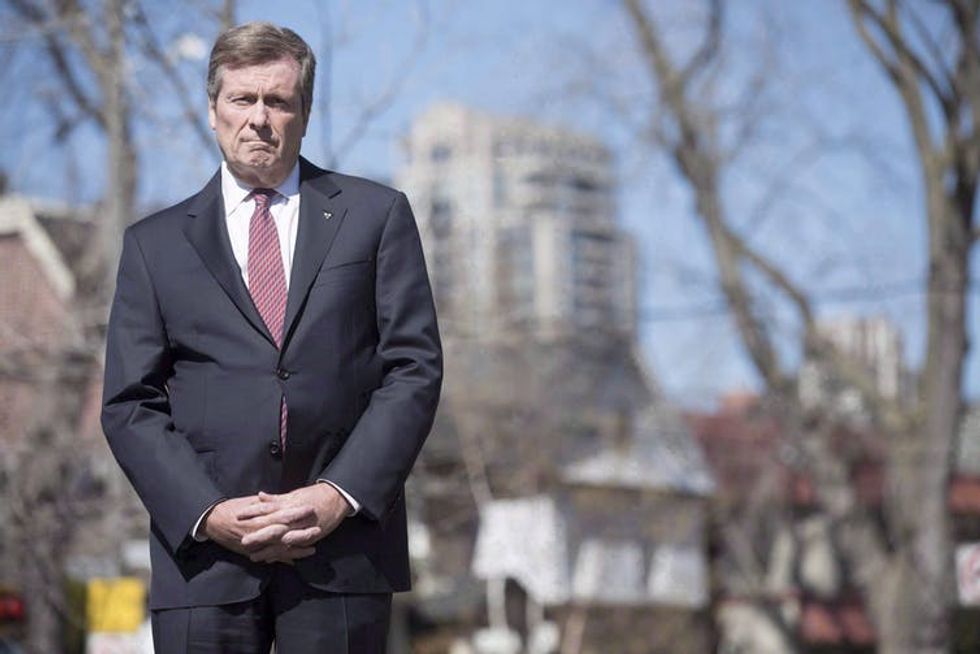
Mayor John Tory stands in front of the media in Toronto on April 18, 2017. Tory says there is ‘no easy answer’ or magic wand to reduce gun violence in the city.
THE CANADIAN PRESS/Chris Young
In a political world, where words are pregnant with moral meanings, language is not innocent of racist content. Race-code words can trigger deep seated feelings of revulsion and give permission to vent frustration on targets lacking economic, social and political power.
With Black people as folk-devils, crises — either concocted or inflamed — are used to manipulate the public into believing that “safety” can be guaranteed by ceding rights to wise politicians and self-restraining police forces.
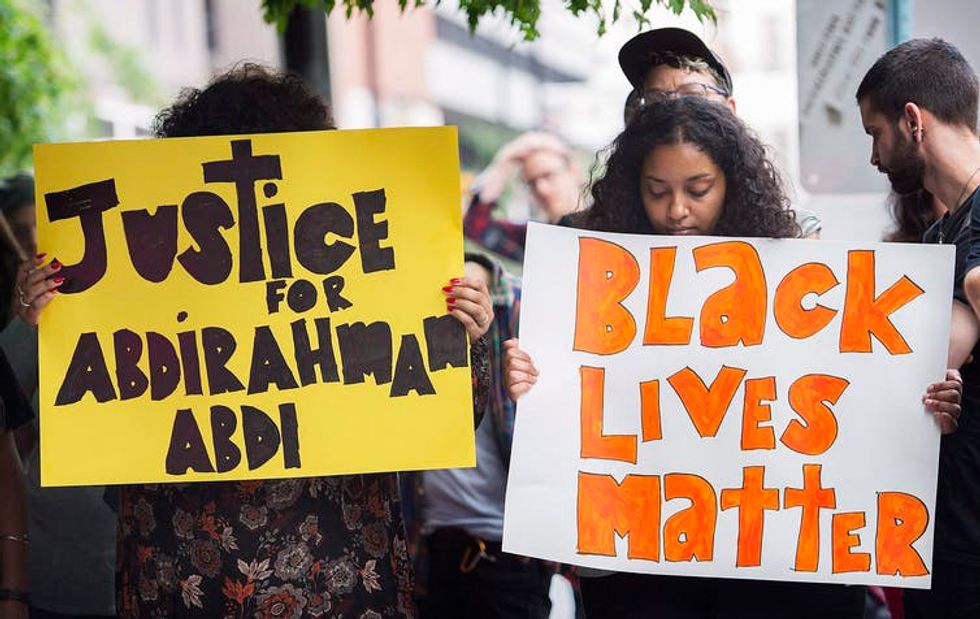
People gather in Montréal, Thursday, July 28, 2016, to denounce the death of Abdirahman Abdi who was killed after a confrontation with police in Ottawa.
THE CANADIAN PRESS/Graham Hughes
History shows this path can lead to a police state that’s created and emboldened through the collective loss of civil liberties and legal rights. The chief tactic to achieve this end is to mobilize the class, ethnic and racial biases of the majority to gain their support for “safety” securing methods.
“…the manner in which the police currently use them makes them somewhat menacing…For example, information that a young Black man has just committed a robbery in a given zone does not authorize police officers to stop any young Black man…
LaForme issued a warning from the bench that no cop or politician will ever listen to:
"If the manner in which these … cards are currently being used continues; there will be serious consequences ahead. They are but another means…to mask discriminatory conduct…”
He also added:
“…daily tracking of the whereabouts of persons — including many innocent law-abiding persons — has an aspect to it that reminds me of former government regimes that I am certain all of us would prefer not to replicate.”
Toronto Mayor John Tory brought in a policy in 2017 intended to restrict arbitrary police checks, but there have been questions about whether anything has actually changed.
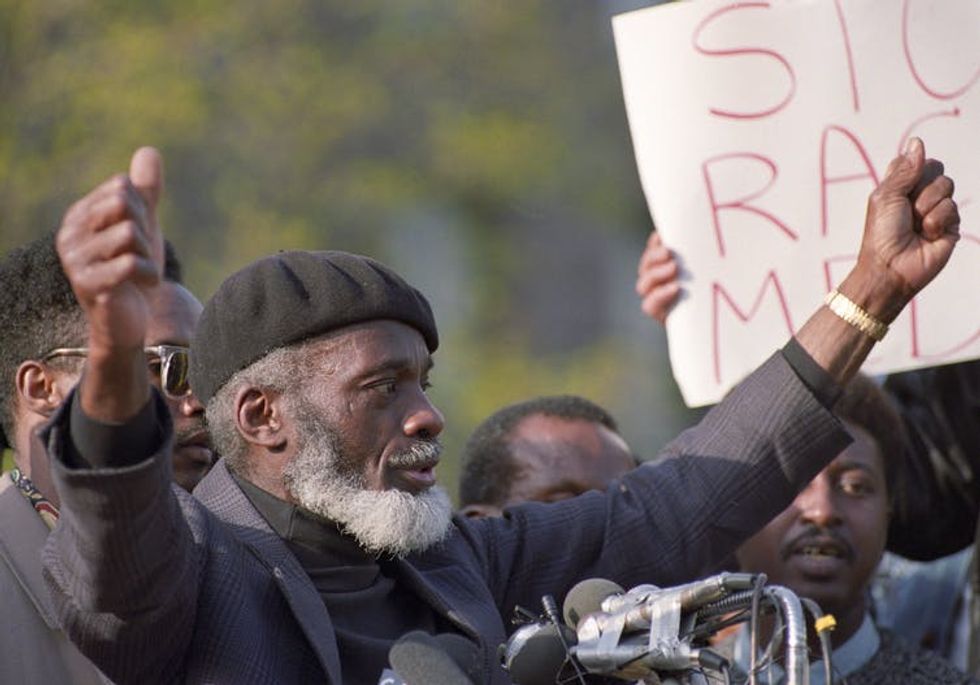
Dudley Laws, a founding member of the Black Action Defence Committee, speaks to an anti-racism rally at Queen’s Park in Toronto on May 8, 1992. Laws died in 2011 at the age of 76.
The Canadian Press/Hans Deryk
In the white Canadian imagination, there isn’t a type for Paul Bernardo, Russell Williams, Luka Magnotta, Marc Lepine and Justin Bourque, nor for the police who have killed young men like Andrew Loku, Jermaine Carby and Kwasi Skene-Peters.
Both politicians and journalists working in the corporate news media need to be more mindful of how they characterize rare and traumatic events; they require sober rather than salacious descriptions that fan flames of hate.
Elites define the problems and the solutions
In the contest between the haves and have-nots, the “winners” end up defining the problems and they also claim ownership of competency to find the solutions to those problems. Cultural theorist Stuart Hall calls the winners “primary definers:” they are usually corporate and political elites.
Because “primary definers” have the authority to command and influence, they win the “hierarchy of credibility.” They manipulate reality through derogatory language directed at disfavoured groups to gain consent to diminish rights and constrain liberties.
Within this hierarchy, the number two spot goes to law-makers and enforcers. Down the ladder, next come the activists and grassroots folks. These groups, on the tiers of credibility, publicly debate and privately negotiate who best understands our problems.
The “winning” definitions and solutions — especially when they do not address complexities and contradiction — can spark the next crisis. In other words, it’s “blowback,” where the solution metastasizes and amplifies the initial problem.
The future is not yet written
The future of the young men labelled “thugs” is not yet determined.
We have collectively allowed the gutting of the social welfare state. We have allowed the disinvestment of programs for marginalized youth and communities. We have allowed unemployment, poverty and substandard housing to occur by policy. If there are “thugs,” we are surely them.
With the hindsight of history and hard-won rights, we should know that we cannot content ourselves with the comfort that our authoritarian-type leaders will make things right. It is vital that we accept the responsibility and resist giving in to anxiety, fear and hatred.
One place to start is to challenge and resist politicians and media elites who use racist crime discourse to gain the public’s consent.
Turkey, Russia and Iran have actively involved themselves in the Syrian conflict, each with their own divergent interests. Moscow and Tehran have put their support behind the regime of the Syrian president, Bashar al-Assad, hoping it retains its influence over the strategic Syrian region. Meanwhile, since the very beginning of the crisis in 2011, Turkey has been obsessed with removing Assad.
So far, the three countries have managed to accommodate their various aims. And the meetings between the three powers in 2017 and 2018 – in Sochi, Astana, Tehran and then again in Sochi – have all played a part in this. In fact, it appears that Russian president Vladimir Putin’s main strategy since 2017 has been the continuation of this accommodation.
On September 17, for example, Putin and his Turkish counterpart, president Erdogan, met in Sochi to discuss Syria’s rebel-controlled Idlib province. Interestingly, at that meeting, Putin renounced his plan (announced in Tehran on September 7) to stage an all-out assault on Idlib. This was an apparent concession, as Turkey had opposed the plan at the Tehran summit and had called for a ceasefire instead. Back then, Putin had ignored Turkey’s objections and underlined his view that the elimination of terrorists in the region was the priority. Consequently, his latest concession looks like a significant volte face.
At their 2017 Astana summit, Russia, Iran and Turkey had all declared four regions – Idlib province, eastern Ghouta, northern rural Homs, and southern Syria (to include Quneitra and parts of Daraa governorate) – as de-escalation zones. But the Syrian regime, with the cooperation of Russia and Iran, subsequently launched offensives into some of these regions on the pretext of eliminating terrorist groups. One by one, the regions set up as de-escalation zones have been devastated.
Amberin Zaman, a columnist for Al-Monitor’s Turkey Pulse, argues that a full-scale assault in Idlib would result in the Erdogan government losing its sway over the rebels in the area and make Turkey a potential target for more radical jihadists. According to some sources, for example, nearly 60% of Idlib is controlled by the HTS, a radical jihadist group designated as a terrorist organisation by the United Nations.
Moreover, an invasion such as that tabled by Russia would likely cause another massive influx of refugees from Idlib into neighbouring countries – especially Turkey – and from there on into Europe. Russia’s bullish stance on Idlib has therefore also been condemned by the Western members of the UN Security Council.
Putin’s game plan
The question is whether these criticisms were behind Putin scrapping his decision to invade or whether he has another motive.
At their September summit, Putin and Erdogan agreed there should be a demilitarised buffer zone established in Idlib by October 15, separating the rebels from Assad’s government forces. Erdogan said:
The opposition will remain where they are, but the [radical] groups that we will determine jointly with Russia won’t be allowed to operate. The boundaries of the demilitarised zone will be supervised jointly.
Nevertheless, one thing is clear – while Turkey has managed temporarily to stall an invasion of Idlib, Russia will be keeping a close eye on the situation. The deal requires those designated “radical” rebels to withdraw from the demilitarised zone – and if they don’t, Russia and Assad will have a pretext to return to their original plan.
Doubtless Russia will also incrementally apply pressure on Erdogan, at least tactically, by making Turkey responsible for removing the “radical” jihadist groups from Idlib. This would make Turkey more vulnerable to terrorist attacks, and a vulnerable Turkey would need further help from Russia, as the new hegemon of the region.
It is clear, therefore, that Putin’s strategy is not merely to support his main ally, the Assad regime, in Syria. It is also to use the conflict to break the influence of the Western alliance in the region and tie NATO member Turkey more closely to Moscow. It seems that Russia has never abandoned its Cold War strategy to invest in growing tensions between NATO allies.
Indeed, Cengiz Çandar, a veteran Turkish journalist and author, theorises that Putin is prioritising this dismembering of the Western alliance over supporting the Syrian regime, its traditional ally. In this context, the recent Sochi summit can be seen as Putin’s way of bringing Erdogan closer to Russia. This, it seems, is Putin’s “grand strategy”.
Breaking NATO
Although Turkish interests in Syria appear to conform with those of the West and NATO, this growing asymmetric dependence on Russia is forcing Erdogan to make concessions to Russia at many levels, from security to the economy. Turkey’s recent move to purchase S400 air defence missiles from Russia is one example of many. In fact, the trajectory of this asymmetric dependency is raising the question of whether Turkey is becoming a Russian proxy. A Russian proxy which is also a NATO member would be the very thing Russia wants in order to gain further leverage in its global contest with the US and NATO.
From NATO’s perspective, the political rapprochement between Russia and Turkey has so far been seen as tactical. But the conversion of this rapprochement into a growing asymmetric interdependence that favours Russia is casting doubt on Turkey’s already fragile commitment to the Western alliance. And, as Turkey gets ever more sucked into the Syrian conflict, so it becomes harder for Erdogan to disengage from Putin. With the Syrian conflict right on its borders, and Russia and Iran increasingly shaping the region’s politics, Turkey is becoming beholden to NATO’s enemies.
The situation suggests that to achieve security within its borders Turkey may be asked to resign itself to the desires of these two powers – two powers that would do anything to weaken the West and NATO.
In the literary world and among those for whom fiction is an interest beyond simply reading books, a great deal of attention will be given to the winner of 2018’s Man Booker Prize, Milkman, by Anna Burns. The chair of the judges, philosopher Kwame Anthony Appiah, said Burns’ novel, about a young woman being sexually harassed by a menacing older man and set in Northern Ireland, “is a story of brutality, sexual encroachment and resistance threaded with mordant humour”.
Of course, each year, following the announcement of the longlist in July, the shortlist in September and finally the winner in October, a discussion takes place as to what each announcement might mean. As the Man Booker is the most prestigious, remunerative and talked about literary prize in the UK, this “what does it mean?” can be made to reach into just about every crevice of contemporary culture.
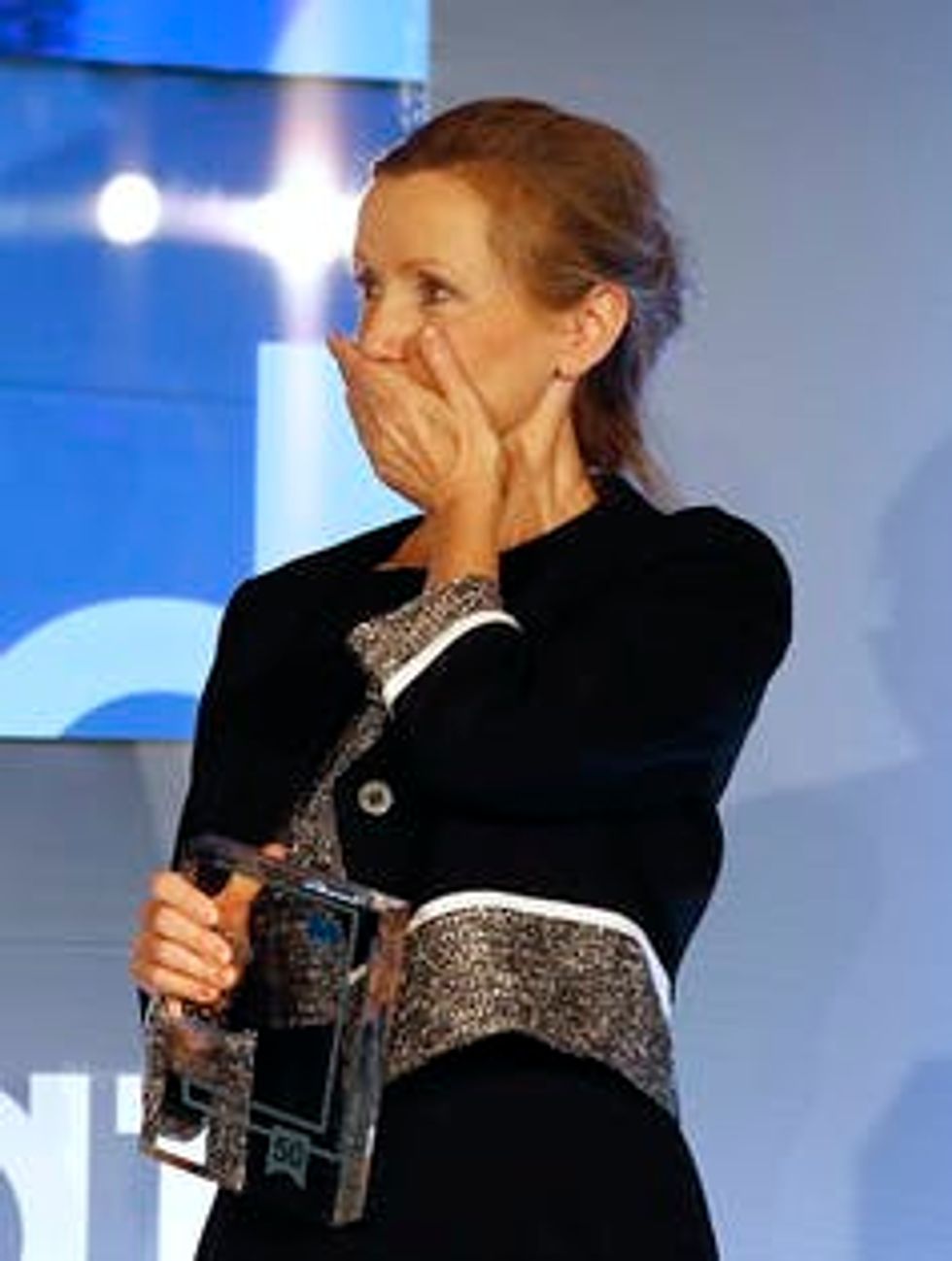
Anna Burns wins the 2018 Man Booker for Milkman.
Frank Augstein/PA
This year has been no exception – discussion of the longlist was dominated by the inclusion of a graphic novel, Nick Drnaso’s Sabrina, and discussion of the shortlist by the presence or absence of millennial writers. Discussion of Milkman will no doubt be dominated by the history of Northern Ireland, by #MeToo and by the fact that Burns is the first UK-born winner for six years.
In these accounts, the significance of the prize is restricted to thinking about those novels that reach the long or shortlist or the one that is declared the final winner. But a range of work from various wings of literary studies over the past few years can help us to answer the question of what winning means in other, perhaps more challenging, ways.
1. It’s a competition
The underlying claim of James F. English’s pioneering 2009 work in the sociology of literature, The Economy of Prestige: Prizes, Awards and the Circulation of Cultural Value, is that both the power of and the problem with prizes consists in the way they equate “the artist with the boxer or discus thrower”. Prizes are competitions.
But while the publicity might go to the winning writers, the real winners are the publishers, who need not just the increased sales and chances of film and TV adaptations that are likely to follow, but also the less tangible boost to their authority and prestige given by a prize. The real winners are also more likely to be not just any publishers, but those that have already been successful. As the novelist Joanna Walsh, among others, has noted, the Man Booker rules make submissions from small publishers very tricky because of the size of the print run required and the amount of money that involves. Because of this, a win can be a drain rather than a boost, and costs can outstrip sales if you don’t win.
2. A competition that maintains a monopoly
It’s not just that the competition is hard for small presses to enter – the big publishers have an near monopoly. In the 50 years that the prize has existed, literary publishing in English has been transformed from being made up of numerous independent companies, often family run, to being almost entirely dominated by the “big five”. These are Penguin Random House, Hachette, HarperCollins, Macmillan and Simon & Schuster. And, further, each of these is itself owned by a multinational media conglomerate.
As the sociologist John Thompson noted in his book, Merchants of Culture: The Publishing Business in the Twenty-First Century, the economies of scale made possible through mergers and acquisitions have created this almost complete monopoly. But through publishing via supposedly “separate” imprints, the big five have maintained an aura of smallness which is more conducive to the “creativity” on which their profits are ostensibly based.
Over the past 20 years, while 12 different publishers appear to have published the novels which were awarded the Prize, six of these wins were for imprints belonging to Penguin Random House. This monopoly is maintained through the prize’s rules for submissions – the number of novels a publisher can submit is directly tied to the number of longlisted novels they have had over the past few years. An imprint already marked as prestigious is more likely to win again.
3. It maintains a certain model of publishing
In his article about Amazon and its relation to contemporary literary fiction, US literary scholar Mark McGurl suggests the extent to which reading of material normally scorned by the literary critic can deliver new insights.
And close reading of the Man Booker’s rules of eligibility – while perhaps dry in comparison to reading the winner on the bus or with a reading group – is also revealing. It shows that it is not just a competition for a small number of large publishers, but that the prize is largely about the maintenance of a certain idea of publishing, too.
The rules of eligibility are almost entirely now about the publisher, rather than the novel or novelist – and key to them is the exclusion of anything with a whiff of self-publishing about it. In order to be eligible, a publisher has to prove that they are based in the UK or Ireland, but the only way of proving this is by having the accoutrements of the conventional publisher. Eligible submissions must come from publishers with ISBNs and head offices who use retail outlets for print books and who publish at least two literary novels a year. Rule 1g, through its strange, uncomfortable tautology, betrays something of just what is at stake in this: “Self-published novels are not eligible where the author is the publisher.”
What the various methods of literary studies can suggest, then, is that, contrary to nearly everything written elsewhere about the Man Booker Prize, it arguably doesn’t really matter which novel wins. Whichever wins, I’d suggest that the real winner is an intensely conventional notion of publishing. It’s an idea of publishing where sales and prestige are the most important consequences of winning prizes and where a few very large publishers dominate.
And, to continue that domination, the most novel uses of contemporary technology, which can open up spaces for the most innovative aesthetic forms become illegitimate. If you want to see examples of this kind of work, look to the recently published novel, Gaudy Bauble, by Isabel Waidner (published by Dostoyevsky Wannabe) – a book of experimental writing published in an innovative way. Under the current rules, such novels could never gain the coverage and attention offered by the Booker. And that’s a great pity.
When we think of slavery, many of us think of historical or so-called “traditional forms” of slavery – and of the 12m people ripped from their West African homes and shipped across the Atlantic for a lifetime in the plantations of the Americas.
Debt bondage often ensnares both children and adults. In Haiti, for example, many children are sent to work by their families as domestic servants under what’s known as the Restavek system – the term comes from the French language rester avec, “to stay with”. These children, numbering as many as 300,000, are often denied an education, forced to work up to 14 hours a day and are sometimes victims of sexual abuse.
Slavery is a daily reality for 10m children around the world.
Then, as now, race is not always the main reason for enslaving someone. In the past, those who were living in poverty, who did not have the protection of kinship networks, those displaced by famine, drought or war were often caught up in slavery.
In the UK, nail salons, restaurants, music festivals and farms have all be found to have people working in slavery. Victims of human trafficking come from all parts of the world and all walks of life. There isn’t just one type of modern day slavery, it takes many forms.
Your gadgets could be to blame
The demand for certain types of goods has propelled slavery’s numbers. In the past, the desire for sugar drove the growth in slavery. Now, the global consumption of electronic goods has exacerbated slavery in the Coltan mines of the Democratic Republic of Congo. Many slaves or trafficked victims are often exploited in mining for gold, coltan, molybdenum, niobium, tin – which can be used in electronic goods sold around the world.
According to Save the Children, 5,000 to 6,000 young children work in the Coltan mining industry, surrounded by armed guards to prevent their escape. Much of the profit from this trade goes to fund ongoing militia warfare in Central Africa.
Research has found children as young as seven mining cobalt used in smartphones.
Shutterstock
Traditional slavery still exists
Chattel slavery (where one person is the property of another) is illegal but still exists especially in the West African country of Mauritania – where abolitionists’ efforts to stamp out the practice have been in vain.
The organisation Fight Slavery Now says that today at least 90,000 Mauritanians are the property of others, while up to 600,000 men, women and children are in a bonded labour situation – up to 20% of the population.
Now, as in the past, not all slaves are forced into slavery. Historically, some experienced such severe poverty that they had no choice but to sell themselves to be bound to another person. And similar cases still happen around the world today.
Brick kiln workers in India are incredibly vulnerable to slavery.
Shutterstock
It involves global movement
Long distance movement is common in slavery of the past and the present. For West Africans in the pre-modern era, the journey across the Atlantic must have been unimaginable.
Today, labourers move around the world freely looking for work, but some end up caught in slavery-like situations. They are promised a good job with decent conditions and wages, but instead are trapped in a cycle of debt and despair, where they are bound to their employer with no chance of escape.
Many of the workers constructing the stadia for the Qatar World Cup in 2022 come from South Asia. Amnesty International says these workers often have their meagre wages docked unjustly, their passports seized and are forced to work in life-threatening conditions.
Slave soldiers fight in wars
One similarity between historic and modern slavery is the use of enslaved labour, especially children, in armies.
Over four centuries ago, Christian children were valued as soldiers in the army of the Ottoman Empire. The children were taken from their homes, forced to convert to Islam and put to work in the military.
Slavery was never abolished
Today, an active abolition movement still exists. It applies lessons from the earlier abolition movement that ended the transatlantic slave trade – which recognised the importance of victim stories as a powerful tool to raise awareness.
Just as Africans such as Olaudah Equiano became part of the abolition movement in 18th-century London when they talked about their lives as slaves, so today, the benefit of encouraging survivors to share their stories is recognised.
In the 1790s, to persuade the British government to end slavery in the British Empire, female abolitionists organised boycotts of sugar that had been produced using slave labour and instead bought “fair trade” produce. Similarly, today, manufacturers and growers recognise that guaranteeing a product as fair trade – and free from slavery – will help their goods sell.
Slavery still exists in many forms today, and the impacts it has on millions of people are no less devastating than they were in the past. Yet ordinary people can use their power as consumers to combat modern slavery, simply by paying attention to what they buy, and raising awareness among their friends, family and colleagues.
The price of beer could double under unchecked climate change, as droughts and extreme temperatures cause barley yields to drop. That’s one conclusion of research we recently published in Nature Plants.
We first became curious about barley, and the beer it produces, as this relatively minor crop was clearly affected by climate extremes yet had never caught the attention of climate scientists. And, unlike many other food crops, barley grown for beer is required to meet very specific quality parameters. Malted barley gives beer much of its flavour, yet if it is too hot or there isn’t enough water during critical growing stages, the malt cannot be extracted.
This is why we gathered a team of scientists based in China, the UK and the US to assess what extreme drought and heat events may mean for beer supplies and prices. We were interested specifically in what would happen to barley when there was both extreme drought and heat during the growing season, something that will become more common thanks to global warming. We then modelled what this would mean for barley yields in 34 world regions which either produce or drink a lot of beer.
In more optimistic scenarios, where emissions are brought under control and warming is kept at a manageable level (what climate scientists refer to as RCP2.6), droughts and heatwaves might occur together in about 4% of the years. In the worst case scenario, where emissions and temperatures keep increasing, such extremes might occur in 31% of the years.
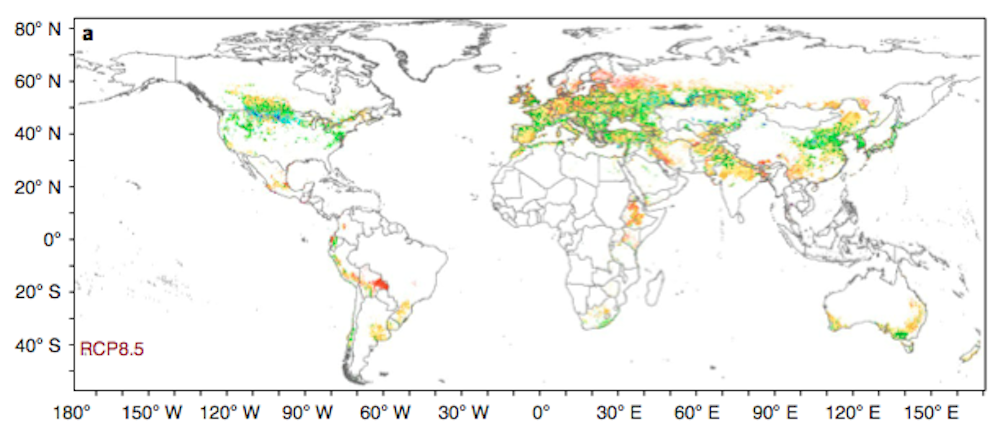
These are global average results, however, which can hide significant regional variation. In affected years, barley yields would drop the most in tropical areas of Central and South America, and in Central Africa, for instance. In the same years, yields in temperate Europe would decrease moderately, or even increase in parts of the US or Russia.
Barley yields under an optimistic climate change scenario, compared to average yields 1981–2010.
Xie et al/Nature Plants
But the overall trend is clear: at a global level, barley yields will at best – under the optimistic scenario – decrease by 3%. And in the worst case scenario, yields will fall 17%.
The ‘worst case’ scenario would be devastating for barley.
Xie et al/Nature Plants
From barley to beer
We know that climate change will mean less barley – but what about beer? One factor to consider is that barley is mostly used to feed livestock, and beer is ultimately more dispensable than meat. This means declining yields will hit beer production extra hard.
Ultimately, our modelling suggests that during the most severe climate events, the price of beer would double and global consumption would decline by 16%, or 29 billion litres. That is roughly equal to the total annual beer consumption of the US. Even under the optimistic scenario of less extreme climate change, beer consumption would still drop by 4%.
Again, price and consumption changes would vary widely from country to country, with the greatest price increases being concentrated in relatively affluent and historically beer-loving countries. In Ireland, for example, the price of a beer bottle would double under extreme climate change. In less wealthy countries, people would simply drink less beer under those circumstances. We predict a 32% drop in Argentina, for example.
Better start saving.
PHTGRPHER_EVERYDAY/Shutterstock
It is possible that more drought- or heat-tolerant barley cultivars may be developed in future, which would reduce the risk of climate change to supplies of beer. But these and other technological developments, or increases in stockpiling (or even prioritising beer over livestock), were beyond the scope of our study.
While previous research has looked in detail at what climate change means for essentials like wheat or rice, less attention has been paid to so-called “luxury goods”. In our study, we took beer as one such example, to highlight the ways climate change will affect our lives.
We hope our results might attract further attention from various beer-lovers who actually have the power to do something about global warming. Seeing that climate change is affecting our lives in more ways than we imagined before, they might start to think about further strengthening global efforts to reduce emissions.
The Oct. 2 disappearance of Saudi Arabian journalist Jamal Khashoggi at his country’s consulate in Istanbul has put a spotlight on the deteriorating relations between Turkey and the Persian Gulf kingdom.
Articles based on anonymous accounts from Turkish officials report that Turkey has video and audio proof that Saudi Arabian agents detained, murdered and dismembered Khashoggi, a sharp critic of his government who lived in Washington, D.C. Turkish President Recep Tayyip Erdoganraised the stakes even further when he said that a search of the Saudi consulate showed evidence of toxic materials that were painted over.
The affair is just the latest to drive a wedge between the two key Middle Eastern powers – countries that have in the past shared close ties to each other and to the United States.
How did their friendship turn frosty?
I’ve been studying and writing about the region for decades. And like with many other relationships in the Middle East, it’s complicated – and that’s why the current crisis could lead to a surprising twist.
Early days
Although diplomatic relations between the Republic of Turkey and the Kingdom of Saudi Arabia were established in 1932, neither country showed much interest in the other until the late 1960s.
Turkey’s secular ruling elite was more keen to have strategic and economic ties with the West than to the Arab world. Turkey joined the NATO alliance in 1951 – two years after its formation – and maintained good relations with Israel from the start, much to the disappointment of Saudi Arabia and other Arab countries.
This began to change in the ‘60s and '70s when Turkey made two moves that led to stronger relations with Saudi Arabia and resulted in increased trade. In 1969, it joined the nascent Organization of Islamic States, based in Saudi Arabia and intended to be a “collective voice of the Muslim world.” And in 1975, Turkey initiated diplomatic relations with the Palestine Liberation Organization, which sought to end the occupation of Palestinian territories in Israel.
Relations continued to improve in the 1980s but deteriorated in the '90s when the kingdom took Syria’s side in several disputes with neighbor Turkey.
These ups and downs in Saudi-Turkish relations were partly a result of Turkey’s political instability, including several military coups in the '80s and '90s. Relations tended to improve when Islamist or civilian parties – which felt close cultural and religious links with Turkey’s Muslim neighbors – were in power but worsened after the military deposed them.
King Abdullah shake hands with Erdogan during the first visit of a Saudi monarch to Turkey since 1966.
Relations between the two countries found a firmer footing after the Justice and Development Party – commonly known as the AKP – gained power in Turkey in 2002 and continued to improve throughout the decade.
In contrast to the secular governments that had ruled Turkey since 1923, the AKP and its leader Erdogan put a high priority on building stronger relationships with its Arab and Muslim neighbors.
The U.S. invasion of Iraq in 2003 and the resulting change in the balance of power in the region brought Turkey and Saudi Arabia even closer together. Both were concerned about Iraq falling into the hands of their common rival, Iran, whose military and political influence increased as a result of the invasion. They also wanted to contain Iran’s influence in Syria and Lebanon.
As a result of these closer ties, in August 2006 the late King Abdullah became the first Saudi leader to visit Turkey since 1966 and made another trip the following year. In return, then-Prime Minister Erdogan visited Saudi Arabia four times from 2009 to 2011.
The high-level diplomatic contacts fostered growing business and investment. Turkish exports of textiles, metals and other products to Saudi Arabia soared from US$397 million in 2000 to $3.6 billion in 2012. And Saudi businessmen who felt unwelcome in the U.S. and Europe after 9/11 saw Turkey as an attractive destination.
A springtime chill in the air
Relations took a sharp turn in the 2011, starting with the Arab spring uprisings that led to the overthrow of governments in Tunisia, Egypt and Libya.
This disagreement came to a peak when Mohammad Morsi, who was closely affiliated with the Muslim Brotherhood, won that Egypt’s first post-Hosni Mubarak election in 2012. Erdogan supported Morsi and the Muslim Brotherhood’s rise to power, which was opposed by Saudi Arabia and other Gulf States like the United Arab Emirates. These countries had a long history of hostility towards Muslim Brotherhood activities throughout the Arab world and were concerned that these victories would energize the movement in their own countries.
The rift between Turkey and Saudi Arabia intensified after a military coup ousted Morsi in 2013. Erdogan strongly condemned it and gave the Muslim Brotherhood refuge in Turkey, while Saudi Arabia offered billions in financial aid to cement Egypt’s new military rulers.
Relations took another hit in 2014 when Saudi Arabia actively undermined Turkey’s bid to become a nonpermanent member of the United Nations’ Security Council.
More recently, Saudi Arabia and Turkey found themselves on opposite sides over the Qatar crisis in June 2017. Saudi Arabia, Bahrain, the UAE and Egypt severed all ties with Qatar – and tried to enforce an economic blockade – over the latter’s support for the Muslim Brotherhood and other Islamist groups. They were also upset with Qatar’s refusal to terminate its ties with Iran.
Turkey reacted by expanding its engagement with Qatar, offering economic aid and sending more troops to its small military base in that country. Indeed, Turkish food shipments to Qatar played a crucial role in its ability to withstand the blockade.
Jamal Khashoggi, missing since Oct. 2, is believe to have been killed.
That might not, however, be the case. The Turkish government is trying to balance multiple conflicting goals in the way it handles this crisis.
On the one hand, it is trying to show a full commitment to discovering what happened and has put enormous pressure on Saudi Crown Prince Mohammed bin Salman by leaking details of his government’s involvement. But I believe it is also mindful of preventing a further escalation of tensions with Saudi Arabia, which remains a major investor in Turkey.
Meanwhile, Turkey is struggling with a severe financial and external debt crisis at the moment and is desperately trying to attract foreign capital. A withdrawal of Saudi investment or tourists could worsen the crisis.
Former USA Gymnastics president Steve Penny, who resigned from his post last year, was arrested Wednesday in connection with the Larry Nassar molestation scandal, US media reported.
The arrest came after Penny was indicted three weeks ago by a grand jury on felony charges of allegedly tampering with evidence in the sexual assault investigation of former gymnastics doctor Nassar, the Huntsville Item newspaper reported.
Penny was arrested by a police task force in Gatlinburg, Tennessee and is awaiting extradition to Texas, prosecutors said in a press release Wednesday night.
According to the indictment, Penny is alleged to have tampered with evidence during the investigation of Nassar by ordering the removal of documents from the Karolyi Ranch in Walker County, Texas that were related to the activities of Nassar at the ranch. The indictment alleges the removal of the documents was done to destroy or hide the documents and impair the investigation.
"During the investigation by the Texas Rangers and the Walker County Sheriff?s Office, several sources reported that Penny ordered the removal of the documents from the ranch after learning that an investigation was underway," the Item quoted Walker County district attorney David Weeks saying.
The documents in question were from the Korolyi Ranch, the base for the gold-medal winning US Olympic teams. It is also the location where several athletes say Nassar molested them.
In February, Nassar was sentenced to 40 to 175 years in prison after he pled guilty to molesting 10 girls.
Penny could be facing between two to 10 years in jail on a third degree felony charge.
"Deputy U.S. Marshals and task force officers from the Southern District of Texas and the Eastern District Tennessee worked tirelessly to locate Penny," US Marshal for the Eastern District of Tennessee David Jolley said in a news release. "Good police work ensured that Penny was swiftly and safely apprehended. He will now face the charges against him."
Penny's arrest also comes a day after the newly appointed interim president and chief executive of USA Gymnastics, Mary Bono, resigned just days after being named to the job following stinging criticism by Olympic stars Simone Biles and Aly Raisman.
The 56-year-old Bono drew the ire of Olympic superstar Biles over a tweet posted by Bono last month in which she was critical of apparel maker Nike following the company's ad campaign featuring ex-NFL star Colin Kaepernick.
Penny's arrest and Bono's resignation are further blows to USA Gymnastics, which has lurched from one self-inflicted crisis to the next as it struggles to rebuild in the aftermath of the Nassar sex abuse scandal.
French Economy Minister Bruno Le Maire said Thursday he was pulling out of a major investment conference in Saudi Arabia over the disappearance of Saudi journalist Jamal Khashoggi.
"I won't go to Riyadh next week," Le Maire told France's Public Senat TV channel, adding that "the current circumstances do not allow me to go to Riyadh".
The minister echoed President Emmanuel Macron's remarks last week on Khashoggi's disappearance, calling it a "very serious" matter.
"The important thing now is that the full truth of this affair be known," said Le Maire, who said he informed his Saudi counterpart on Wednesday of his decision.
Khashoggi, who was living in self-imposed exile in the United States where he contributed to the Washington Post, vanished after entering the Saudi consulate in Istanbul on October 2.
He was critical of some of Saudi Arabia's policies.
Turkish officials claim he was killed and dismembered in the consulate by a hit squad which arrived from Riyadh -- claims denied by the Saudi government.
Le Maire's decision to pull out of the October 23-25 Future Investment Initiative in Riyadh -- dubbed the "Davos in the Desert" -- follows that of International Monetary Fund (IMF) chief Christine Lagarde.
The IMF said Wednesday that Lagarde had "deferred" her trip to the Middle East, without giving an explanation.
US Treasury Secretary Steven Mnuchin has said he will decide on Thursday whether to attend.
Several Western business titans and media groups have already pulled out of the conference organized by Saudi Arabia's sovereign wealth fund.
Like other Western allies of the world's biggest oil exporter, France had embraced Saudi Arabia's powerful new de facto ruler, Crown Prince Mohammed bin Salman, as a reformer.
Macron hosted the 33-year-old prince for a private dinner at the Louvre museum when he visited Paris in April.
Saudi Arabia was the second-biggest purchaser of French weapons between 2008 and 2017, after India, signing deals for some 12 billion euros ($13.8 billion) in French weaponry.