A magnitude 6.4 earthquake struck on Sunday near the native Alaskan village of Kaktovik and part of the Arctic National Wildlife Refuge where the Trump administration plans to allow oil drilling, but no injuries or damage were reported.
The temblor, which occurred just before 7 a.m. (1500 GMT), was the most powerful on record to hit Alaska’s oil-producing North Slope, said Paul Huang, a seismologist and deputy director of the National Tsunami Warning Center in Palmer, Alaska.
No tsunami alert was generated, though ground motion was felt as far away as Fairbanks, Alaska, nearly 400 miles (644 km) to the south.
The quake had no impact on operations of the Trans Alaska Pipeline system that carries North Slope crude 800 miles (1,300 km) to the marine terminal at Valdez, according to a statement from Alyeska, the consortium that runs the pipeline.
Alyeska said it would conduct follow-up inspections of the pipeline and related facilities. Inspection teams likewise found nothing amiss at the Prudhoe Bay oil field about 85 miles (137 km) to the east, said Megan Baldino, a spokeswoman for BP Exploration (Alaska) Inc, which operates the field.
The quake, initially measured at a magnitude 6.5, was followed by a series of aftershocks, the largest of which was a 6.0 tremor, according to the U.S. Geological Survey.
The main earthquake was centered 40 miles (64 km) southwest of Kaktovik, a coastal Inupiat village of about 260 residents at the northern edge of the Arctic National Wildlife Refuge (ANWR).
State emergency officials said they had no reports of damage, but locals in Kaktovik said the tremor did not pass unnoticed.
“I felt a little shaking and felt dizzy, and felt the shelves shaking,” said Archie Brower, assistant manager at the Kaktovik Kikiktak grocery.
The epicenter also lies near an area the U.S. Interior Department plans to lease for petroleum exploration along ANWR’s coastal plain, which had been off-limits to fossil fuel development until a provision was enacted as part of President Donald Trump’s 2017 tax bill.
The vast and environmentally pristine coastal plain, wedged between the Beaufort Sea and Brooks Range mountains, is prized for its importance to caribou, polar bears and other wildlife but is believed to hold billions of barrels of oil.
“Scientifically, however, this region is poorly understood and the behavior of the fault or faults responsible for today’s earthquake are not known,” the Alaska Earthquake Center in Fairbanks said in a bulletin.
Strong earthquakes are not uncommon in seismically active Alaska, but they tend to occur in remote, sparsely populated regions where there is little or no damage.
Reporting by Yereth Rosen in Anchorage; Writing by Steve Gorman; Editing by Cynthia Osterman
Singer Aretha Franklin, a multiple Grammy award-winner star whose legacy stretches back decades, is gravely ill and surrounded by relatives, a reporter and family friend wrote on his website Monday.
The 76 year-old "Queen of Soul" Franklin, known for hits such as "Respect" (1967) and "I Say a Little Prayer" (1968), "is gravely ill in Detroit. The family is asking for prayers and privacy," wrote Roger Friedman on the Showbiz 411 website.
Franklin, who was diagnosed with cancer in 2010, last performed in November 2017 for the Elton John AIDS Foundation in New York. Her final public performance was in Philadelphia in August 2017.
"It was a miraculous show as Aretha was already then fighting exhaustion and dehydration," Friedman wrote, describing the Philadelphia performance.
Throughout her lengthy career Franklin accumulated 18 Grammy awards, including one for Lifetime Achievement.
Franklin's hits include "(You Make Me Feel Like) A Natural Woman" (1968), "Day Dreaming" (1972), "Jump to It" (1982), "Freeway of Love" (1985), and "A Rose Is Still A Rose," (1998).
In 1987 she became the first woman inducted into the Rock and Roll Hall of Fame.
"I Knew You Were Waiting for Me," a duet she sang with the late British singer George Michael, was one of her Grammy-winning hits.
In 2005 Franklin was awarded the Presidential Medal of Freedom -- the highest award for an American civilian -- by then-president George W. Bush.
And in January 2009 Franklin sang at Barack Obama's presidential inauguration.
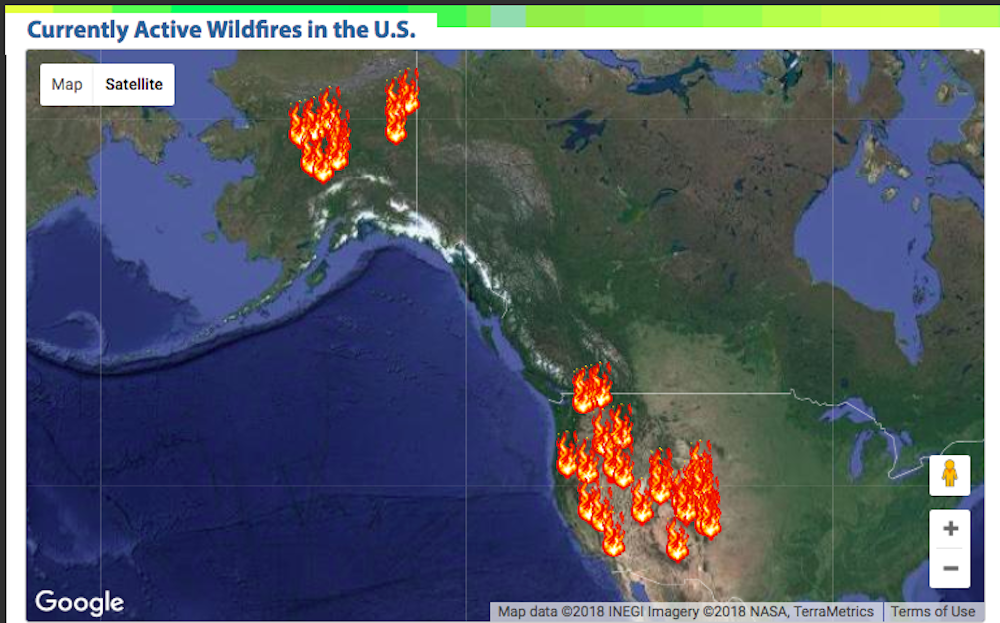
These burn forests, houses and other structures, displace thousands of people and animals, and cause major disruptions in people’s lives. The huge burden of simply firefighting has become a year-round task costing billions of dollars, let alone the cost of the destruction. The smoke veil can extend hundreds or even thousands of miles, affecting air quality and visibility. To many people, it has become very clear that human-induced climate change plays a major role by greatly increasing the risk of wildfire.
Yet it seems the role of climate change is seldom mentioned in many or even most news stories about the multitude of fires and heat waves. In part this is because the issue of attribution is not usually clear. The argument is that there have always been wildfires, and how can we attribute any particular wildfire to climate change?
As a climate scientist, I can say this is the wrong framing of the problem. Global warming does not cause wildfires. The proximate cause is often human carelessness (cigarette butts, camp fires not extinguished properly, etc.), or natural, from “dry lightning” whereby a thunderstorm produces lightning but little rain. Rather, global warming exacerbates the conditions and raises the risk of wildfire.
Even so, there is huge complexity and variability from one fire to the next, and hence the attribution can become complex. Instead, the way to think about this is from the standpoint of basic science – in this case, physics.
This year is proving to be another active wildfire season.
To understand the interplay between global warming and wildfires, consider what’s happening to our planet.
The composition of the atmosphere is changing from human activities: There has been over a 40 percent increase in carbon dioxide, mainly from fossil fuel burning since the 1800s, and over half of the increase is since 1985. Other heat-trapping gases (methane, nitrous oxide, etc.) are also increasing in concentration in the atmosphere from human activities. The rates are accelerating, not declining (as hoped for with the Paris agreement).
The flows of energy through the climate system are schematically illustrated with numbers on the top-of-atmosphere values and net energy imbalance at the surface.
Trenberth et al 2009
Heat-trapping gases in the atmosphere act as a blanket and inhibit the infrared radiation – that is, heat from the Earth – from escaping back into space to offset the continual radiation coming from the sun. As these gases build up, more of this energy, mostly in the form of heat, remains in our atmosphere. The energy raises the temperature of the land, oceans and atmosphere, melts ice, thaws permafrost, and fuels the water cycle through evaporation.
Moreover, we can estimate Earth’s energy imbalance quite well: It amounts to about 1 watt per square meter, or about 500 terawatts globally.
While this factor is small compared with the natural flow of energy through the system, which is 240 watts per square meter, it is large compared with all other direct effects of human activities. For instance, the electrical power generation in the U.S. last year averaged 0.46 terawatts.
The extra heat is always the same sign and it is spread across the globe. Accordingly, where this energy accumulates matters.
Heat also accumulates in melting ice, causing melting Arctic sea ice and glacier losses in Greenland and Antarctica. This adds water to the ocean, and so the sea level rises from this as well, rising at a rate of over 3 milimeters year, or over a foot per century.
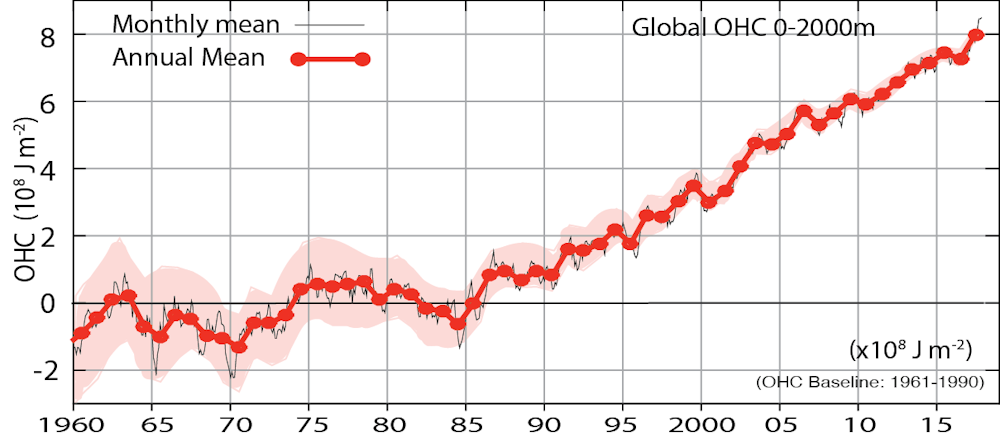
Global ocean heat content for the top 2000 meters of the ocean, with uncertainty estimates by the pink region.
On land, the effects of the energy imbalance are complicated by water. If water is present, the heat mainly goes into evaporation and drying, and that feeds moisture into storms, which produce heavier rain. But the effects do not accumulate provided that it rains on and off.
However, in a dry spell or drought, the heat accumulates. Firstly, it dries things out, and then secondly it raises temperatures. Of course, “it never rains in southern California” according to the 1970s pop song, at least in the summer half year.
So water acts as the air conditioner of the planet. In the absence of water, the excess heat effects accumulate on land both by drying everything out and wilting plants, and by raising temperatures. In turn, this leads to heat waves and increased risk of wildfire. These factors apply in regions in the western U.S. and in regions with Mediterranean climates. Indeed many of the recent wildfires have occurred not only in the West in the United States, but also in Portugal, Spain, Greece, and other parts of the Mediterranean.
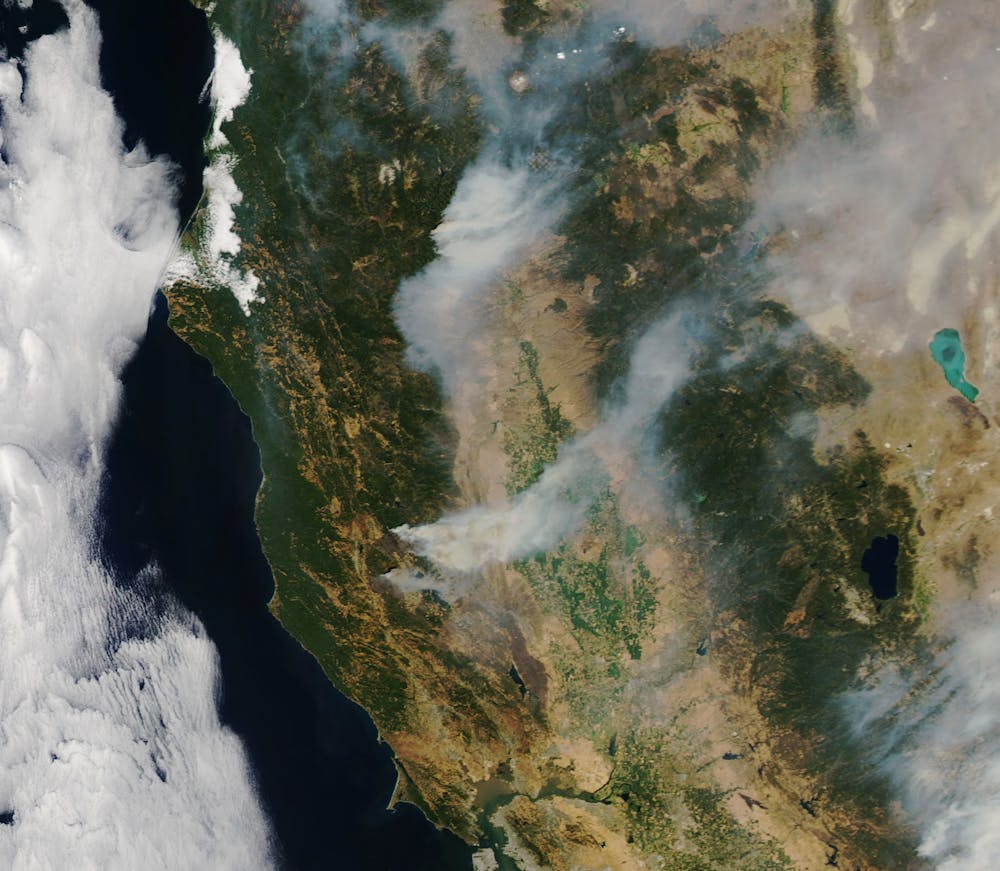
A satellite image of the Carr Fire in California. Drought conditions, in addition to a lot of dead trees and vegetation, are contributing to another year of severe wildfires.
The conditions can also develop in other parts of the world when strong high pressure weather domes (anticyclones) stagnate, as can happen in part by chance, or with increased odds in some weather patterns such as those established by either La Niña or El Niño events (in different places). It is expected that these dry spots move around from year to year, but that their abundance increases over time, as is clearly happening.
How big is the energy imbalance effect over land? Well, 1 Watt per square meter over a month, if accumulated, is equivalent to 720 Watts per square meter over one hour. 720 Watts is equivalent to full power in a small microwave oven. One square meter is about 10 square feet. Hence, after one month this is equivalent to: one microwave oven at full power every square foot for six minutes. No wonder things catch on fire!
Attribution science
Coming back to the original question of wildfires and global warming, this explains the argument: there is extra heat available from climate change and the above indicates just how large it is.
In reality there is moisture in the soil, and plants have root systems that tap soil moisture and delay the effects before they begin to wilt, so that it typically takes over two months for the effects to be large enough to fully set the stage for wildfires. On a day to day basis, the effect is small enough to be lost in the normal weather variability. But after a dry spell of over a month, the risk is noticeably higher. And of course the global mean surface temperature is also going up.
“We can’t attribute a single event to climate change” has been a mantra of climate scientists for a long time. It has recently changed, however.
As in the wildfires example, there has been a realization that climate scientists may be able to make useful statements by assuming that the weather events themselves are relatively unaffected by climate change. This is a good assumption.
Also, climate scientists cannot say that extreme events are due to global warming, because that is a poorly posed question. However, we can say it is highly likely that they would not have had such extreme impacts without global warming. Indeed, all weather events are affected by climate change because the environment in which they occur is warmer and moister than it used to be.
In particular, by focusing on Earth’s Energy Imbalance, new research is expected to advance the understanding of what is happening, and why, and what it implies for the future.
North and South Korea agreed Monday to hold a summit in Pyongyang in September after high-level talks in the Demilitarized Zone that divides the peninsula.
The two sides "agreed at the meeting to hold a South-North summit in Pyongyang in September as planned", the joint statement said, without giving a precise date.
A trip by the South's President Moon Jae-in to the North's capital would be the first such visit for more than a decade, as the diplomatic thaw on and around the peninsula builds.
But despite the rapprochement, international sanctions against the North for its nuclear and missile programmes have kept economic cooperation between the two Koreas from taking off, while little progress has been made on the key issue of Pyongyang's denuclearisation.
"The September summit can be viewed as North Korea's strategy to find a breakthrough in its stalled talks with the US," said Asan Institute of Policy Studies analyst Go Myong-hyun.
"For South Korea, President Moon wants to improve inter-Korean ties but that's hard without progress in US-North Korea talks," he told AFP.
At the historic first summit between Moon and the North's leader Kim Jong Un in Panmunjom in April they agreed the South's president would visit Pyongyang during the autumn.
The first South Korean president to go to the North's capital was Kim Dae-jung, who met the current leader's father and predecessor Kim Jong Il in 2000 and later won the Nobel Peace Prize, in part for his efforts at inter-Korean reconciliation.
Pyongyang saw a second inter-Korean summit in 2007, when Roh Moo-hyun also met Kim Jong Il.
But relations subsequently soured as the North accelerated its pursuit of nuclear weapons and the South elected conservative governments.
Monday's high-level talks, taking place on the northern side of the truce village in the Demilitarized Zone, were proposed by the North last week as it lashed out at Washington for pushing ahead with sanctions.
Afterwards the North's chief delegate Ri Son Gwon said the meeting had gone well and the date for the summit was "ready", but they had not announced it as "reporting would be more fun when reporters are curious".
Earlier he used a proverb describing a very intimate friend to refer to inter-Korean ties, saying: "We have opened an era where we are advancing hand in hand rather than standing in each other's way."
The summit would probably be held after the 70th anniversary of the North's foundation on September 9, the South's presidential office suggested.
"It would be difficult in early September, which means until September 10," Moon's spokesman Kim Eui-kyeom told reporters, citing a "reason all reporters can guess".
Pyongyang has previously lavishly celebrated the occasion with military parades or mass games involving thousands of people performing acrobatic choreography in unison, and is expected this time to hold its first mass games for five years, boosting tourism revenues.
- Rapid rapprochement -
The rapid rapprochement between the two neighbours began this year ahead of the Winter Olympics in the South and paved the way for a landmark meeting between Kim and US President Donald Trump in Singapore in June.
Cross-border exchanges between the two Koreas have significantly increased since then, with the neighbours planning to hold reunions for war-separated families next week for the first time in three years.
YONHAP/AFP / -South Korean Unification Minister Cho Myoung-gyon is leading the South's delegation
But although Trump touted his summit with Kim as a historic breakthrough, the nuclear-armed North has since criticised Washington for its "gangster-like" demands of complete, verifiable and irreversible disarmament.
Meanwhile the US has urged the international community to maintain tough sanctions on the isolated regime -- Seoul has caught three South Korean firms importing coal and iron from the North last year in violation of the measures.
Experts say Moon could try to act as a mediator between the US and North Korea, having salvaged the Singapore meeting when Trump abruptly cancelled it.
"They are trying to send a message externally that the North-South dialogue momentum has been established and that it will be maintained regardless of the outcome of US-North Korea talks," said analyst Go.
"Whether that is true is in doubt but they are trying to indirectly pressure the US, especially on sanctions, by showing an improvement in North-South ties and that peace has been established between them."
Moon and Kim agreed at their summit in April to officially declare an end to the 1950-53 Korean War, which concluded with an armistice instead of a peace treaty, by the end of the year.
But Harry Harris, the US ambassador to South Korea, said Monday it was too soon for such a declaration, Yonhap reported.
"It's too early for that even as we seek improvement in relations between the North and the South and between the North and the United States," Harris said, adding the allies share the "same goal" of the "final, fully verified denuclearisation" of the peninsula.
Trinidad-born British author V.S. Naipaul, who won the Nobel Prize for literature in 2001, has died at his home in London aged 85, the BBC reported on Saturday.
Vidiadhar Surajprasad Naipaul, who began writing in the 1950s, won numerous coveted literary awards during his career during which he wrote critically acclaimed novels such as “A House for Mr Biswas”, “In a Free State” and “A Bend in the River”.
In a statement, his wife Nadira Naipaul called him a “giant in all that he achieved” and said he had died surrounded by “those he loved having lived a life which was full of wonderful creativity and endeavor”, the BBC said.
Born in Trinidad in 1932 into an Indian family, Naipaul was raised in relative poverty. He moved to England at 18 after receiving a scholarship to University College, Oxford.
He wrote his first novel while at Oxford, but it was not published. He left university in 1954 and found a job as a cataloguer in London’s National Portrait Gallery.
His first published novel, �”The Mystic Masseur”, written in 1955, was poorly received at first but the following year won the first of his literary awards, the John Llewellyn Rhys Memorial Prize for young authors.
He received a knighthood from Queen Elizabeth in 1989.
“When I learnt to write I became my own master, I became very strong, and that strength is with me to this very day,” he told Reuters in 2010.
Police were called on a white man who purchased breakfast for an "Indigenous Elder" at an A&W fast food restaurant.
Nick Driedger, the white man who had police called on him, told APTN News that the incident in Carston, Alberta was "clearly racist."
He recounted the woman asking the couple in line ahead of him for a meal. When it was his turn at the counter, he added a sandwich for the woman.
“She just wanted a meal,” he explained.
The worker who called police allegedly said that loitering concerns were the basis of a store policy to ban people buying meals for others.
“I was furious,” he said. “I think it’s a basic human right to eat.”
The worker also claimed the woman was "menacing."
“This is a little lady, maybe 100 pounds with a walker," he estimated. "She couldn’t be menacing to anyone."
Royal Canadian Mounted Police responded to the call briefly, but did not even interview Driedger.
“They just kind of shook their heads,” he said.
“For me to get all this attention for something that Indigenous people face every day it isn’t right,” Dreidger concluded. “It says a lot about our social norms.”
The Republican congressman representing Charlottesville, Virginia made stunning claims about the deadly 2017 "Unite the March" of white nationalists.
Rep. Tom Garrett, Jr. (R-VA) is former assistant attorney general serving his first term in Congress. In May, Rep. Garrett announced he would not seek reelection.
"Let me give you breaking news here, back to Charlottesville," he told CNN anchor Ryan Nobles.
"I sat in a closed session briefing -- probably two months ago -- about Charlottesville, with the director of the FBI amongst others, and asked if Russian intermeddling had do with fomenting the flames of what happened in Charlottesville," he said.
"I was told, 'Yes, it did.' I was asked if this was classified, they said, 'No, it is not.' I waited until today," he explained.
"This is what happens, Russian intermeddling is seeking to pit Americans against under Americans to undermine confidence in western style democracies, it's done so in Baltic states, it's done so in western Europe, it will continue to do so," Garrett continued.
"They're trying to make the world safer for kleptocrats and oligarchs and dictators like Putin and they use things like this racial divisive fight -- which ignores the commonalities we as Americans have with each other, regardless of race, ethnicity, religion -- this is the sort of thing they do," he continued.
"As a member of Homeland Security, seriously that's what scares me most," he concluded.
Tesla Inc and Chief Executive Elon Musk were sued twice on Friday by investors who said they fraudulently engineered a scheme to squeeze short-sellers, including through Musk’s proposal to take the electric car company private.
The lawsuits were filed three days after Musk stunned investors by announcing on Twitter that he might take Tesla private in a record $72 billion transaction that valued the company at $420 per share, and that “funding” had been “secured.”
In one of the lawsuits, the plaintiff Kalman Isaacs said Musk’s tweets were false and misleading, and together with Tesla’s failure to correct them amounted to a “nuclear attack” designed to “completely decimate” short-sellers.
The lawsuits filed by Isaacs and William Chamberlain said Musk’s and Tesla’s conduct artificially inflated Tesla’s stock price and violated federal securities laws.
Tesla did not respond to a request for comment on the proposed class-action complaints filed in the federal court in San Francisco. The company is based in nearby Palo Alto, California.
Short-sellers borrow shares they believe are overpriced, sell them, and then repurchase shares later at what they hope will be a lower price to make a profit.
Such investors have long been an irritant for Musk, who has sometimes used Twitter to criticize them.
Musk’s Aug. 7 tweets helped push Tesla’s stock price more than 13 percent above the prior day’s close.
The stock has since given back more than two-thirds of that gain, in part following reports that the U.S. Securities and Exchange Commission had begun inquiring about Musk’s activity.
Musk has not offered evidence that he has lined up the necessary funding to take Tesla private, and the complaints did not offer proof to the contrary.
But Isaacs said Tesla’s and Musk’s conduct caused the volatility that cost short-sellers hundreds of millions of dollars from having to cover their short positions, and caused all Tesla securities purchasers to pay inflated prices.
Tesla’s market value exceeds $60 billion, and its shares closed Friday up $3.04 at $355.49.
According to his complaint, Isaacs bought 3,000 Tesla shares on Aug. 8 to cover his short position.
The proposed class period in Isaacs’ lawsuit runs from the afternoon of Aug. 7 through the next day, and in Chamberlain’s lawsuit runs from Aug. 7 to Aug. 10.
The cases are Isaacs v Musk et al, U.S. District Court, Northern District of California, No. 18-04865; and Chamberlain v Tesla Inc et al in the same court, No. 18-04876.
Reporting by Jonathan Stempel in New York; Additional reporting by Peter Henderson in San Francisco; Editing by Rosalba O'Brien, Toni Reinhold
Turkish President Tayyip Erdogan on Saturday said it was wrong of the United States to try to bring Turkey into line with threats, a day after President Donald Trump doubled tariffs on Turkish metal imports as the row between the two NATO allies deepened.
The two governments have been at odds over a wide range of topics - from diverging interests in Syria, to Turkey’s ambition to buy Russian defense systems, and the case of evangelical pastor Andrew Brunson, who is on trial in Turkey on terrorism charges.
“You can never bring this nation in line with the language of threats,” Erdogan told a crowd of supporters in the Turkish town of Unye on the Black Sea coast. “I am once again calling on those in America: It is a pity that you choose a pastor over your strategic partner in NATO,” he said.
After almost 20 months in a Turkish jail, Brunson was moved to house arrest in July by a court. Since then Trump and his vice president Mike Pence have repeatedly called for his release while Ankara said the decision was up to the courts.
Washington in response sanctioned two Turkish ministers and Trump on Friday announced it was doubling the tariffs on steel and aluminum imports from Turkey, saying relations with Ankara were “not good at this time”.
The ailing Turkish lira, which had already lost one third of its value this year largely over worries about Erdogan’s wider control of the economy, crashed further to a fresh record low, at one point losing 18 percent, its biggest fall since 2001.
A meeting on Friday unveiling a new economic approach by Turkey’s finance minister Berat Albayrak, Erdogan’s son-in-law, did little to offer support for the free-falling lira as investors sought concrete steps such as an interest rate hike to restore confidence.
Erdogan on Saturday repeated a call to Turks to help support the lira to win what he described was a “war of independence”.
“If there are dollars under your pillow, take these out. If there are euros, take these out .. Immediately give these to the banks and convert to Turkish lira and by doing this, we fight this war of independence and the future. Because this is the language they understand,” he said.
VOLATILE REGION
An important emerging market, Turkey borders Iran, Iraq and Syria and has been mostly pro-Western for decades. Financial upheaval risks further destabilizing an already volatile region.
Erdogan has cast the recent slide in the lira as a war and without naming countries said supporters of a failed military coup two years ago, which Ankara says was organized by a U.S.-based Muslim cleric, were attacking Turkey in new ways since his re-election two months ago.
In an opinion piece in the New York Times, he warned the U.S. that Ankara had other alternatives as allies.
“Before it is too late, Washington must give up the misguided notion that our relationship can be asymmetrical and come to terms with the fact that Turkey has alternatives. Failure to reverse this trend of unilateralism and disrespect will require us to start looking for new friends and allies,” Erdogan said.
Turkey, home to the Incirlik air base which is used by U.S. forces in the Middle East, has been a NATO member since the 1950s. It is host to a critical part of the Western alliance’s missile defense system again Iran.
In a separate opinion piece in the pro-government newspaper Daily Sabah, Erdogan’s spokesman Ibrahim Kalin said Turkey’s efforts to solve the crisis with diplomatic methods have been dismissed by the Trump administration, warning that Washington might completely lose Ankara as an ally.
“The U.S. runs the risk of losing Turkey as a whole. The entire Turkish public is against U.S. policies that disregard Turkey’s legitimate security demands. Threats, sanctions and bullying against Turkey will not work,” he said.
Reporting by Humeyra Pamuk; Editing by Andrew Bolton
The estranged son of a northern California city police chief was formally charged on Friday with attempted robbery and abuse of a 71-year-old Sikh man who was beaten and spat upon in an unprovoked attack caught on video, prosecutors said.
Tyrone McAllister, 18, whose parents assisted police in tracking him down following Monday’s attack in the town of Manteca, about 75 miles east of San Francisco, was arraigned in San Joaquin County Superior Court and ordered held on $300,000 bond.
Court records show a public defender was appointed to represent McAllister, and he was scheduled to return to court on Aug. 17. No plea was entered.
A second suspect, identified by authorities only as a 16-year-old boy, was also arrested and charged as a juvenile, but the status of his case was not immediately known.
A video of the attack, which occurred in a park and was recorded by a security camera on a nearby house, was posted online by municipal authorities.
It showed the two assailants confronting the victim, who was wearing a turban and walking alone on a sidewalk. The pair are seeking kicking the man and knocking him to the ground, before robbing him and spitting on him.
Following McAllister’s arrest on Wednesday, the police department of Union City, just outside San Francisco, posted a an open letter on its Facebook page from its chief, Darryl McAllister, acknowledging that his son had been arrested in the attack.
“Words can barely describe how embarrassed, dejected, and hurt my wife, daughters, and I feel right now. Violence and hatred is not what we have taught our children; intolerance for others is not even in our vocabulary, let alone our values,” the police chief wrote.
The police chief said he and his wife had helped the Manteca police locate his son, who the elder McAllister said “began to lose his way a couple of years ago while he was a juvenile, running away and getting involved in a bad crowd.”
While neither suspect was charged with a hate crime, activists say the attack followed a number of beatings of U.S. Sikhs over the past decade.
Groups that track hate crimes say assailants have sometimes mistaken followers of Sikhism, a faith that originated in the Punjab region of the Indian subcontinent, for Muslims, who have also been targeted in hate crimes.
“The behavior we witnessed on the video does not represent who we are as a community,” District Attorney Tori Verber Salazar said in a brief videotaped statement of her own that was posted after Friday’s arraignment and translated into Punjabi.
Reporting by Makini Brice in New York; Additional reporting by Steve Gorman in Los Angeles
Los Angeles' CBSLA reported that 51-year-old Forrest Gordon Clark initially refused to leave his jail cell to appear before his judge. Once he did, he was recorded standing with his back facing the front of the court and said he was hiding his face for fear of "retaliation."
CBSLA noted that Clark — who has been linked to the QAnon conspiracy theory as well as other alt-right claims — called the arson charges against him "lies" before claiming that he could "easily" pay his $1 million bond.
"I can handle a million right now easily," the arson suspect said.
The fire began in Holy Jim Canyon in Corona California where Clark lived, and the report noted that of the five cabins that were burned in the blaze that began earlier in the week, only the suspect's remains standing.
Volunteer Fire Chief Mike Milligan, another resident of the canyon, said he's known Clark for 20 years and that he's had a history of mental illness and hospitalization. Milligan said he received a text from Clark that said "It’s all going to burn."
The volunteer fire chief also noted that all of the residents in the 14 cabins in Holy Jim Canyon were afraid of Clark.
You can watch footage of the suspect's bizarre court appearance below, via ABC 10:
A United Airlines flight attendant is accusing the airline of failing to protect her from sexually explicit pictures that a pilot posted of her online, according to a lawsuit filed in a San Antonio, Texas, federal court.
The lawsuit, filed by the U.S. Equal Employment Opportunity Commission (EEOC), said United failed to prevent and correct the pilot’s behavior, even after the flight attendant made numerous complaints.
United said in an emailed statement that it had reviewed the allegations in the complaint and disagreed with the EEOC’s description of the situation, without providing further detail.
“United does not tolerate sexual harassment in the workplace and will vigorously defend against this case,” spokeswoman Erin Benson said in the statement. She said the airline could not comment further. The EEOC could not be reached for a response.
The flight attendant and pilot were in a relationship while working for the airline. She ended the relationship after he refused to stop the posts, which included her name, occupation and home airport, the lawsuit said.
According to the complaint, one post told prospective airline passengers to “look for her when you fly!” because she was the “new reason to ‘Fly the Friendly Skies,’” in reference to United’s advertising slogan.
The posts, made on various websites, were seen by co-workers and adversely affected the flight attendant’s working environment, according to the lawsuit.
The EEOC is seeking damages for the flight attendant and asked the court to order United to eliminate and prevent sexual harassment in the workplace.
According to the lawsuit, the pilot retired in 2016. United declined to comment.
Reporting by Tracy Rucinski in Chicago; Additional reporting by Daniel Wiessner in New York; Editing by Matthew Lewis
For years, Canadian pressure on human rights in Saudi Arabia had elicited no more than a standard rejection. But all that changed last week, when a Canadian complaint was translated into Arabic and set off a diplomatic row.
When Riyadh responded to a call from Canadian Foreign Minister Chrystia Freeland to release civil society activists with an abrupt severing of diplomatic and trade ties, Canadian officials were left scrambling to understand what had happened.
What Ottawa did not anticipate was that in the eyes of the Saudis they had crossed a red line.
On Aug. 2, Freeland tweeted in English and French, calling for the release of two jailed Saudi human rights activists. The following day, Canada's foreign affairs department sent another tweet, urging Saudi Arabia to "immediately release" those and other activists.
That was translated into Arabic by its embassy in Riyadh and sent out on Aug. 5 to its approximately 12,000 followers.
The reaction from Saudi Arabia was swift. Hours after the Arabic tweet, the Saudi government recalled its ambassador, barred Canada’s envoy from returning and placed a ban on new trade.
Two Gulf sources said it was the tweet from the embassy that upset Saudi officials the most.
“Matters were being handled through usual channels but the tweet was a break with diplomatic norms and protocol,” said one of the sources, speaking on condition of anonymity because of the sensitivity of the issue.
The sources did not clarify exactly how the tweet broke with diplomacy, but regional experts said it was the step of sending it to a domestic audience that would have angered Saudi officials.
“The Saudi retaliation took some time to allow for political talks in closed doors,” Salman al-Ansari, founder of the Washington-based Saudi American Public Relation Affairs Committee, said.
“They thought the Canadians would take steps to back off, but all of a sudden they tweeted it in Arabic. This was a very provocative action by the Canadians to try to embarrass the Saudis in front of their people. The Saudis did not take this lightly at all.”
Saudi Foreign Minister Adel Jubeir raised the issue of the Arabic tweet in a call with Freeland on Tuesday, and complained about interference, a person familiar with the matter who declined to be named said.
Canadian officials say there was nothing remarkable about the Arabic tweet, which merely repeated Ottawa’s stated position in a common practice for delegations abroad.
Canada has raised the issue of civil society activist detentions before. As recently as May, Canada’s Riyadh embassy tweeted in English its concern about activist arrests and said it was “crucial that the rule of law” be respected, with no public Saudi response.
‘COLLATERAL DAMAGE’
The outsized reaction to the tweet underscores how the kingdom is taking a much harsher stance against what it perceives as Western interference in its internal affairs on issues like human rights, perhaps emboldened by Washington’s willingness under Donald Trump to de-emphasize rights issues when it comes to its allies.
Riyadh and Washington have been enjoying an exceptionally close relationship – tense during the administration of former U.S. President Barack Obama – as both Saudi Crown Prince Mohammed bin Salman and Trump share similar concerns about Iran. By contrast, Trump and Trudeau locked horns during the G7 summit in June in an unusually public manner.
The U.S. State Department this week urged the two sides to use diplomacy to resolve the dispute.
“Canada is collateral damage,” said Thomas Juneau, an assistant professor and Middle East expert at the University of Ottawa. “This fundamentally is not about Canada. This is about Saudi Arabia wanting to send a broader message to its neighbors, to other democracies.”
Canadian foreign affairs officials including Freeland, who were gathered at a Vancouver hotel for a conference on Sunday, were taken aback by the Saudi reaction and left scrambling. Canada, government insiders said, was still unclear on what steps it can take to “fix its big mistake”, as a Saudi official called it.
“I don’t think we have a conclusive understanding as of right now,” said a Canadian government source. “There may be the need for another call (between Freeland and Jubeir). We’re also obviously talking to our partners about it. We do not wish to have bad relations with them (the Saudis).”
Inside Saudi Arabia, the measures were supported by a media campaign criticizing Canada’s human rights record and praising the Saudi ruler’s firmness in “protecting the kingdom’s sovereignty.”
Saudi state television channels aired reports on the struggle of indigenous people in Canada and said they had been historically subject to discrimination. Other reports listed “the worst Canadian prisons” and described harsh prison conditions.
Thousands of Twitter accounts bearing Saudi flags tweeted on the dispute, elevating the phrase “Saudi Arabia expels the Canadian ambassador” to one of the world’s most popular hashtags. Many of the tweets used suspiciously similar language, often a sign of a coordinated campaign by bots, or automated accounts.
Saud al-Qahtani, a senior royal court adviser, tweeted a link announcing the decision to ban new trade on Monday along with the hashtag “Saudi first” - echoing a phrase popularized by Trump.
Reporting by David Ljunggren in Ottawa, Aziz El Yaakoubi in Riyadh and Katie Paul in Dubai; Additional reporting by Ghaida Ghantous in Dubai, Yara Bayoumy in Washington and Allison Martell in Toronto; Writing by Amran Abocar; Editing by Rosalba O'Brien





 In particular, by focusing on
  YONHAP/AFP / -