The nightmare scenario for computer security - artificial intelligence programs that can learn how to evade even the best defenses - may already have arrived.
That warning from security researchers is driven home by a team from IBM Corp. who have used the artificial intelligence technique known as machine learning to build hacking programs that could slip past top-tier defensive measures. The group will unveil details of its experiment at the Black Hat security conference in Las Vegas on Wednesday.
State-of-the-art defenses generally rely on examining what the attack software is doing, rather than the more commonplace technique of analyzing software code for danger signs. But the new genre of AI-driven programs can be trained to stay dormant until they reach a very specific target, making them exceptionally hard to stop.
No one has yet boasted of catching any malicious software that clearly relied on machine learning or other variants of artificial intelligence, but that may just be because the attack programs are too good to be caught.
Researchers say that, at best, it’s only a matter of time. Free artificial intelligence building blocks for training programs are readily available from Alphabet Inc’s Google and others, and the ideas work all too well in practice.
“I absolutely do believe we’re going there,” said Jon DiMaggio, a senior threat analyst at cyber security firm Symantec Corp. “It’s going to make it a lot harder to detect.”
The most advanced nation-state hackers have already shown that they can build attack programs that activate only when they have reached a target. The best-known example is Stuxnet, which was deployed by U.S. and Israeli intelligence agencies against a uranium enrichment facility in Iran.
The IBM effort, named DeepLocker, showed that a similar level of precision can be available to those with far fewer resources than a national government.
In a demonstration using publicly available photos of a sample target, the team used a hacked version of videoconferencing software that swung into action only when it detected the face of a target.
“We have a lot of reason to believe this is the next big thing,” said lead IBM researcher Marc Ph. Stoecklin. “This may have happened already, and we will see it two or three years from now.”
At a recent New York conference, Hackers on Planet Earth, defense researcher Kevin Hodges showed off an “entry-level” automated program he made with open-source training tools that tried multiple attack approaches in succession.
“We need to start looking at this stuff now,” said Hodges. “Whoever you personally consider evil is already working on this.”
Reporting by Joseph Menn; Editing by Jonathan Weber and Susan Fenton
Every summer the U.S. Central Plains go dry, leading farmers to tap into groundwater to irrigate sorghum, soy, cotton, wheat and corn and maintain large herds of cattle and hogs. As the heat rises, anxious irrigators gather to discuss whether and how they should adopt more stringent conservation measures.
They know that if they do not conserve, the Ogallala Aquifer, the source of their prosperity, will go dry. The Ogallala, also known as the High Plains Aquifer, is one of the largest underground freshwater sources in the world. It underlies an estimated 174,000 square miles of the Central Plains and holds as much water as Lake Huron. It irrigates portions of eight states, from Wyoming, South Dakota and Nebraska in the north to Colorado, Kansas, Oklahoma, New Mexico and Texas in the south.
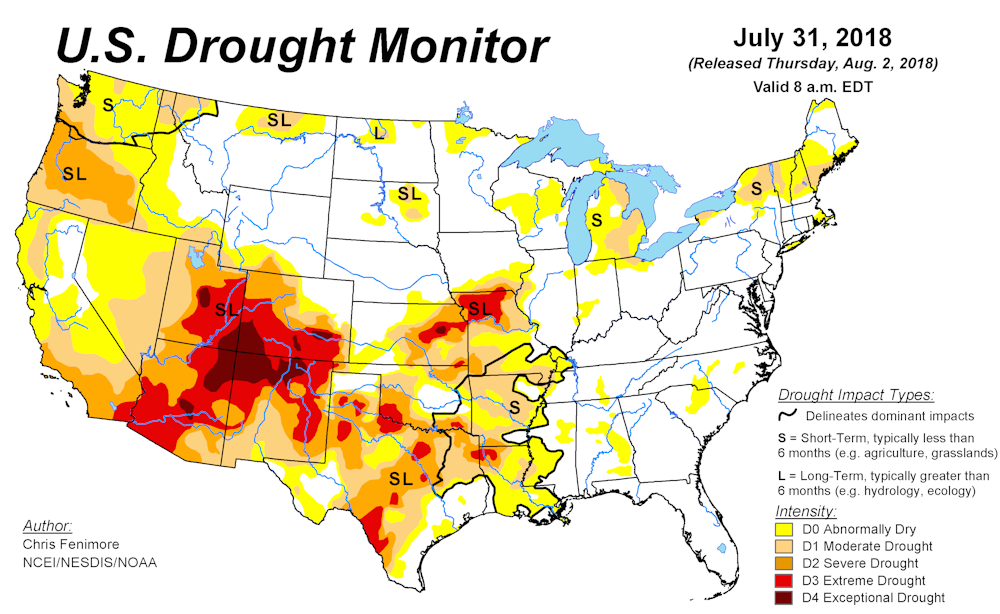
But the current drought plaguing the region is unusually strong and persistent, driving farmers to rely more on the aquifer and sharpening the debate over its future. A current assessment by the U.S. Drought Monitor, published by the University of Nebraska-Lincoln, the United States Department of Agriculture and the National Oceanic and Atmospheric Administration, shows large swaths of the southern plains experiencing drought ranging from “severe” to “exceptional.”
These worrisome prospects form the dramatic backdrop to “Ogallala: Water for a Dry Land,” now out in its third edition. In it, my fellow historians John Opie and Kenna Lang Archer and I set current debates over the Ogallala Aquifer in the context of the region’s equally conflicted past.
Draining the source
In the 1880s, farmers in the region asserted that there was a steady movement of water beneath their feet, which they called “underflow,” from the Rockies east. Geologist F.N. Darton of the U.S. Geological Survey located the first outlines of the aquifer near Ogallala, Nebraska. His discovery nourished the ambitions of farmers and irrigation promoters. One booster, William E. Smythe, visited Garden City, Kansas, and cheered the irrigated future. Pumping underground water, he told his audience, would build “little homes of pleasing architecture. We will surround them with pretty lawns and fringe them with trees and hedges … in a new Kansas dedicated to industrial independence.”
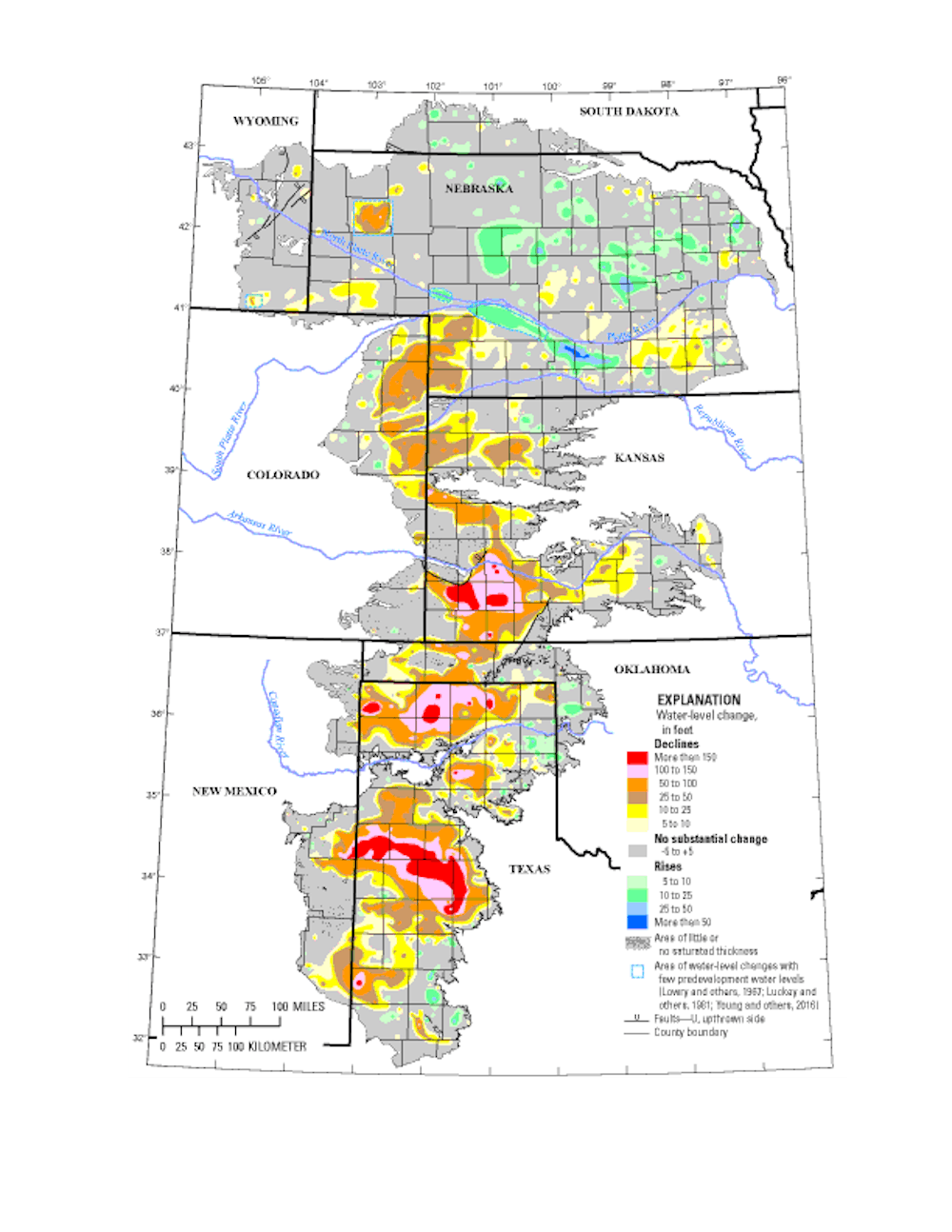
Ogallala Aquifer water-level changes from predevelopment (about 1950) to 2015.
That bucolic vision took decades to realize. Windmills could only pump so much water, which constrained the amount of land farmers could put into production. And the Ogallala’s sand and gravel composition slowed the downward flow of surface waters to refill it, even in wet seasons.
This did not matter until farmers started adopting better drilling technology, gas-powered water pumps and high-tech irrigation systems after World War II. These advances turned the Central Plains into the world’s breadbasket and meat market, annually generating US$20 billion worth of foodstuffs.
As more pumps were drilled into the aquifer to capture its flow, some started to come up dry, which led to more drilling and pumping. Between the late 19th century and 2005, the U.S. Geological Survey estimates irrigation depleted the aquifer by 253 million acre-feet – about 9 percent of its total volume. And the pace is accelerating. Analyzing federal data, The Denver Post found that the aquifer shrank twice as fast from 2011 through 2017 as it had over the previous 60 years.
This is not the first time that humans have pushed ecosystems on the Central Plains to the breaking point. Starting in the late 19th century, settler-colonists plowed up native grasses that protected the soil. When a series of intense droughts struck in the 1930s, dried-out topsoil was primed to erode in the infamous Dust Bowl. Howling windstorms widely known as “black blizzards” blotted out the sun, blowing away exposed soil and displacing much of the human population.
Farmers who hung on through World War II placed their hope in highly engineered solutions, such as high-powered pumps and center-pivot irrigation systems. These innovations, along with ongoing experiments to determine the most profitable kind of crops to grow and animals to raise, profoundly altered global food systems and the lives and livelihoods of Plains farmers.
Today some advocates support a similar fix for farmers’ water needs: The so-called Great Canal of Kansas, which would pump vast quantities of water from the Missouri River in the east over 360 miles west to the most arid Kansas counties. However, this project could cost up to $20 billion to build and require annual energy outlays of $500 million. It is unlikely to be constructed, and would be a Band-aid solution if it were.
Crop circles in Finney County, Kansas, denote irrigated plots using water from the Ogallala Aquifer.
In my view, Plains farmers cannot afford to continue pushing land and water resources beyond their limits – especially in light of climate change’s cumulative impact on the Central Plains. For example, a recent study posits that as droughts bake the land, lack of moisture in the soil actually spikes temperatures. And as the air heats up, it further desiccates the soil.
This vicious cycle will accelerate the rate of depletion. And once the Ogallala is emptied, it could take 6,000 years to recharge naturally. In the words of Brent Rogers, a director of Kansas Groundwater Management District 4, there are “too many straws in too small of a cup.”
Some far-sighted farmers are responding to these interlocking challenges. Even as they pursue efficiencies in irrigation, many are shifting from water-intense crops like cotton to wheat. Still others, notably in west Texas, are converting back to non-irrigated dryland agriculture – a recognition of the stark limitations of irrigation dependency. Farmers who are depleting other aquifers in Latin America, eastern Europe, the Middle East and Asia could face similar choices.
Whether these initiatives will become widespread, or can sustain agriculture on the Central Plains, is an open question. But should instead farmers and ranchers drain the Ogallala Aquifer in pursuit of quick profits, the region may never recover.
President Donald Trump said on Tuesday his administration will be making an announcement next week on reducing drug prices, but he did not offer any specifics.
Speaking at a meeting of business leaders at his New Jersey club, Trump said drug prices are too high. “We are announcing something next week which is going to get them down really substantially.”
(Reporting by James Oliphant; Writing by Eric Beech; Editing by Sandra Maler)
China’s business ties with Iran are open, transparent and lawful, its foreign ministry said on Wednesday, after U.S. President Donald Trump said companies doing business with Iran would be barred from the United States.
New U.S. sanctions on Iran have taken effect despite pleas from Washington’s allies.
Iran dismissed a last-minute offer from the Trump administration for talks, saying it could not negotiate while Washington had reneged on a 2015 deal to lift sanctions in return for curbs on Iran’s nuclear program.
Trump decided this year to pull out of the agreement, ignoring pleas from the other world powers that had co-sponsored the deal, including Washington’s main European allies, Britain, France and Germany, as well as Russia and China.
Beijing has cultivated close commercial links with Tehran, especially in the energy sector.
“China has consistently opposed unilateral sanctions and long-armed jurisdiction,” the Chinese foreign ministry said in a faxed statement to Reuters, responding to questions on the new U.S. sanctions and Trump’s threats on firms doing business with Iran.
“China’s commercial cooperation with Iran is open and transparent, reasonable, fair and lawful, not violating any United Nations Security Council resolutions,” it added.
“China’s lawful rights should be protected.”
China, Iran’s top oil customer, buys roughly 650,000 barrels a day of crude oil from Tehran, or 7 percent of China’s total crude oil imports. At current market rates, the imports are worth some $15 billion a year.
State energy firms CNPC and Sinopec have invested billions of dollars in key Iranian oil fields such as Yadavaran and North Azadegan and have been sending oil to China.
European countries, hoping to persuade Tehran to continue to respect the nuclear deal, have promised to try to lessen the blow of sanctions and to urge their firms not to pull out.
But that has proven difficult, and European companies have quit Iran, arguing that they cannot risk their U.S. business.
Few American companies do much business in Iran so the impact of sanctions mainly stems from Washington’s ability to block European and Asian firms from trading there.
Among large European companies that have suspended plans to invest in Iran are France’s oil major Total and its big carmakers, PSA and Renault .
Reporting by Ben Blanchard; Additional reporting by Chen Aizhu; Editing by Nick Macfie
When Judge T.S. Ellis began Paul Manafort's trial, he made the prosecution agree that the trial would have little to nothing to do with the 2016 Trump campaign. But during her Tuesday night show, MSNBC’s Rachel Maddow pieced together the ways many of Manafort’s transactions seem to be finding their way back to President Donald Trump.
It was common knowledge, the host pointed out, that Paul Manafort was paid handsomely by former Ukrainian Viktor Yanukovych. But the testimony of the former campaign chairman's associate Rick Gates revealed that the ex-Ukrainian leader also paid Manafort 4 million euros to manage his policies — policies that Maddow noted soon veered away from the European Union and directly towards Russia.
"The reason Yanukovych was thrown out of office in a popular uprising of the Ukrainian people is because once he was in office, he turned hard-line away from the EU and toward Moscow," the host said. "Apparently, while we just learned today, Paul Manafort was being paid 4 million [euros] a year to advise him on how he should govern."
Maddow shared an anecdote from David Corn and Michael Isikoff's book "Russian Roulette" in which a State Department official, upon learning Manafort was running the campaign for the Republican presidential nominee, thought "Manafort? He's been a Russian stooge for 15 years!"
She went on to outline a number of other strange happenings — like how the day Manafort quit the Trump campaign, he also opened an LLC that soon borrowed $16 million from a tiny Chicago bank meant for veterans. That same bank and those same loans bizarrely ended up in both a Chicago divorce settlement and an email that mentioned him sent from Gates to Manafort in late November 2016.
As Maddow explained, previous reporting revealed that a man named Steven Calk was seeking the position of Secretary of the Army. Loans from the small Chicago bank that loaned Manafort's LLC appeared in Calk's divorce settlement — and an email introduced as evidence on the stand today revealed that long after Manafort left the campaign, he emailed Gates about the same man.
That email, the host said, showed "the Trump campaign apparently selling this would-be job offer to run the Army."
Maddow explained how all of the pieces finally came together today while Gates took the stand. But one moment caught her by surprise.
The MSNBC host read a transcript of an exchange where a defense attorney asked if Gates had been questioned by other investigators about the Trump campaign. Gates said he was. Prosecutors objected to the line of questioning and the judge asked that the lawyers approach the bench.
The conversation with the judge that followed fell between pages 1399 and 1425 of the transcript of the trial. It's noted that those pages are now "filed under seal."
"Six pages sealed and we're not allowed to see what happened next," Maddow noted. "The judge brings the lawyers to discuss it without the jury hearing. It does not end up in the transcript and we don't know what happened. Then they adjourn for a long recess thereafter."
There are several parts of the Manafort case that harken back to the Trump campaign, despite the judge's decision to distance the line of questioning, Maddow explained.
"Why are they then also objecting to any further discussion about the Trump Campaign during the trial?" she closed with the question. "But something important is about to happen."
Chief Executive Elon Musk said on Twitter he is considering taking Tesla Inc private at $420 per share as the electric car maker faces the challenges of fast growth and financial constraints, sending its shares up more than 6 percent.
At $420 per share, a deal would represent a 22.8 percent premium to Tesla’s closing price on Monday, making it one of the biggest go-private deals with a price tag of about $72 billion.
"Am considering taking Tesla private at $420. Funding secured," Musk said on Twitter. bit.ly/2Om3gn3
When asked on Twitter whether he was serious, Musk replied: “Yes.... It saves a lot of headaches.”
Tesla did not immediately respond to a request for clarification.
Tesla’s shares jumped to $362.74 in afternoon trading. The company had a market value of $58 billion as of Monday’s close. Musk owns nearly 20 percent of the company.
Earlier in the day, the Financial Times reported that Saudi Arabia’s sovereign wealth fund, overseen by Crown Prince Mohammed bin Salman, has built an undisclosed stake of between 3 and 5 percent stake in Tesla.
Musk has been under intense pressure this year to prove he can deliver on his promise to turn his money-losing company into a profitable higher-volume manufacturer, a goal that has propped up Tesla shares and resulted in a market value higher than that of General Motors Co.
“I believe Tesla considers Tweets as public disclosure. I think he’s serious. Plus this is short squeeze rocket fuel after a nice quarter,” said analyst Chaim Siegel from Elazar Advisors.
A short squeeze is a trading scenario that occurs from time to time in heavily shorted stocks, when bearish traders are forced to buy shares to avoid big losses - something that ends up pushing the stock only higher.
Short interest in Tesla on Monday stood at nearly $12 billion, equivalent to 28 percent of its float, according to S3 Partners, a financial analytics firm.
The U.S. Securities and Exchange Commission allows companies to use social media outlets like Facebook and Twitter to announce key information in compliance with its fair disclosure rules so long as investors have been alerted about which social media outlets will be used to disseminate such information.
The SEC did not immediately respond to a request for comment on Musk’s tweet.
George Galliers of Evercore ISI said he believed the tweet was serious.
“I can’t believe this is something to bluff or make fun of. Given his historic frustration with short sellers, analysts and certain parts of the press, it is perhaps also not surprising that he has given consideration to taking the company private,” Galliers said.
“Details, structure, participants and how the valuation has been determined remain to be seen.”
Reporting by Sonam Rai in Bengaluru, Alexandria Sage in San Francisco and Pete Schroeder in Washington; editing by Saumyadeb Chakrabarty
Former Trump campaign chairman Paul Manafort’s right-hand man testified at trial on Tuesday that Manafort instructed him not to tell their firm’s bookkeeper about payments from accounts in Cyprus that held millions of dollars in earnings from consulting work for pro-Russian politicians in Ukraine.
Rick Gates, the U.S. government’s star witness in Manafort’s trial on tax fraud and bank fraud charges, told a federal court jury in Alexandria, Virginia, that there were hundreds of emails showing Manafort approved payments out of the Cypriot accounts.
Gates’ testimony on the trial’s sixth day was part of the prosecution’s effort to prove that Manafort was responsible for financial maneuverings that he and other witnesses have testified include filing false tax returns and failing to report foreign bank accounts.
Gates, Manafort’s long-time business partner, is expected to face a tough cross-examination later on Tuesday by defense lawyers in the first trial to arise from Special Counsel Robert Mueller’s investigation into Russian interference in the 2016 U.S. election. The Kremlin denies election meddling.
While outside the scope of the trial, Mueller is also investigating whether Trump campaign members coordinated with Moscow, an allegation President Donald Trump denies.
Manafort’s defense is seeking to pin the blame on Gates himself, who has acknowledged embezzling from Manafort’s firm.
Manafort, 69, has pleaded not guilty to 18 counts of bank fraud, tax fraud and failing to disclose foreign bank accounts.
Gates, who also was an official on Trump’s campaign, pleaded guilty in February to lying to investigators and conspiring to defraud the United States and agreed to cooperate.
On Tuesday, Gates also testified about “modified” invoices for payments to U.S. vendors that he said he created at Manafort’s request. The invoices were created to meet document requirements of a bank, Gates said, adding that the payments were legitimate.
He testified about a complex scheme in which earnings from Manafort’s political work in Ukraine would be paid by Ukrainian businessmen using companies in Cyprus to other Cyprus-based companies controlled by Manafort.
Prosecutors showed contracts laying out that Manafort would be paid $4 million a year in quarterly installments of $1 million, all channeled through Cyprus. The funds were logged as loans, but Gates testified they were in fact compensation to Manafort.
Money from the Ukraine work dried up after pro-Russian President Viktor Yanukovych was forced from power in 2014, Gates testified. A $1 million payment for work in 2014 was “significantly past due” and “Mr. Manafort was quite upset the money had not been sent,” Gates told the court.
Manafort’s Kiev-based aide Konstantin Kilimnik was able to collect $500,000, Gates said, but “to my knowledge it was never paid in full.” Kilimnik was indicted in the Mueller investigation in June.
Gates, 46, testified on Monday that he helped falsify Manafort’s tax returns and hide his foreign bank accounts. He testified that he has met with prosecutors about 20 times. It is unclear what other information he may have provided to Mueller’s team.
Gates admitted on Monday that he did steal money through inflated expense reports, but he said it was hundreds of thousands of dollars, not millions as defense lawyers stated.
Manafort’s lawyers are expected to use the theft to try to undermine Gates’ credibility as a witness. They also are likely to bring up his making false statements to investigators.
One issue that could be a challenge for prosecutors on Tuesday is the extent to which they are allowed to admit evidence about Manafort’s Ukraine work and the oligarchs who paid him. On Monday, U.S. District Judge T.S. Ellis repeatedly clashed with prosecutors about the relevance of such testimony and once again urged them to speed things along.
Reporting by Sarah N. Lynch, Nathan Layne and Karen Freifeld; Writing by Warren Strobel; Editing by Grant McCool
US President Donald Trump on Tuesday said that sanctions reimposed on Iran were the "most biting ever" as he warned other countries from doing business with Tehran.
"The Iran sanctions have officially been cast. These are the most biting sanctions ever imposed, and in November they ratchet up to yet another level," he wrote in an early morning tweet.
"Anyone doing business with Iran will NOT be doing business with the United States. I am asking for WORLD PEACE, nothing less."
The sanctions reimposed on Tuesday -- targeting access to US banknotes and key industries such as cars and carpets -- were unlikely to cause immediate economic turmoil.
Iran's markets were actually relatively buoyant, with the rial strengthening by 20 percent since Sunday after the government relaxed foreign exchange rules and allowed unlimited, tax-free gold and currency imports.
But a second tranche coming into effect on November 5 covering Iran's vital oil sector, could be far more damaging -- even if several key customers such as China, India and Turkey have refused to significantly cut their purchases.
Trump's contempt for the nuclear deal dates back to his time as presidential candidate and on May 8, he made good on a pledge to pull America out of the international agreement.
The unilateral withdrawal came despite other parties to the agreement -- Britain, China, France, Germany, Russia and the EU -- pleading with Trump not to abandon the pact aimed at blocking Iran from acquiring a nuclear weapon.
National Basketball Association star LeBron James won praise on Monday from an Ohio school district for his support of disadvantaged children in his hometown of Akron, after U.S. President Donald Trump attacked him in a weekend tweet questioning his intelligence.
The president lashed out at James after the three-time NBA champion was interviewed by CNN’s Don Lemon largely to tout a public school in Akron, Ohio that his foundation helped to open last week. During the interview James said sports was something that unites Americans but that Trump “used sport to kind of divide us,” drawing the retaliatory tweet from the president.
The “I Promise” public school in Akron, which opened last week, will offer classes for “at-risk” students in the third and fourth grades and add first and second grades the following year, the foundation website said. The school will be finished by 2022 with first through eighth grades.
James also promised a free bicycle and helmets for students and vowed to pay tuition to the University of Akron for I Promise graduates, among other things.
“Anyone that’s done what LeBron James has done for the past decade to 15 years for our children to prepare them to flourish in life has to be an intelligent person,” Akron Public Schools spokesman Mark Williamson said in a telephone interview on Monday. “He’s a bright guy, end of story.”
The comment came after Trump on Friday had tweeted “Lebron James was just interviewed by the dumbest man on television, Don Lemon. He made Lebron look smart, which isn’t easy to do. I like Mike!”
The president’s “I like Mike!” comment was an apparent reference to the perennial sports debate over whether six-time NBA champion Michael Jordan, or James, a four-time league most valuable player, was the NBA’s all-time best player.
Jordan, who rarely wades into the political fray, and other U.S. athletes rallied to James’ defense on Saturday, praising him for his work in his community.
James, a persistent critic of Trump and prominent supporter of Hillary Clinton in the 2016 presidential election, last month announced his decision to leave the Cleveland Cavaliers for a second time, this time to play for the Los Angeles Lakers.
In response to Lemon asking what James would say to the president if he were sitting right there, the NBA star said: “I would never sit across from him. ... I’d sit across from Barack though,” referring to Trump’s predecessor, Barack Obama.
Trump has lambasted National Football League players who knelt during playing of the national anthem as a form of protest against law enforcement’s treatment of racial minorities. And he has disinvited championship teams whose members have been critical of him from traditional White House visits.
U.S. first lady Melania Trump also appeared to take exception with her husband’s attack on James.
“It looks like LeBron James is working to do good things on behalf of our next generation and just as she always has, the first lady encourages everyone to have an open dialogue about issues facing children today,” a statement issued by Melania Trump’s spokeswoman said.
The spokeswoman did not immediately respond to a question on whether the first lady planned to visit the I Promise school.
LeBron James Family Foundation did not immediately respond to a request for comment on Monday.
Williamson called James a great role model. “He’s never let our children down. Not once. He’s never let these kids down,” he said.
Reporting by Makini Brice in Washington and Suzannah Gonzales in Chicago; Editing by Frank McGurty and Bill Berkrot
Singing show tunes and "America the Beautiful" next to letters spelling "TREASON" in front of the White House, several Broadway stars lent their voices Monday to the latest protest against Donald Trump's presidency.
Actress, comedian and TV personality Rosie O'Donnell, who has had a decade-long feud with Trump, joined about 30 singers and musicians in rousing renditions of stage staples including "Everybody Rejoice," from "The Wiz," and songs from "Les Miserables" and other productions.
The presence of Emmy Award winner O'Donnell, 56, lent star quality to the series of protests outside the mansion's gates, where resisters to Trump's presidency have gathered for more than three straight weeks of rowdy nightly demonstrations.
"We are so thrilled to finally be here at the 'Kremlin annex' on night 22," O'Donnell told the crowd, which responded with a cheer.
"Let the president know in no uncertain terms that we are alive, awake, and we are woke. We are not going away!"
The president was not at the White House during the protest, vacationing instead at his golf club in Bedminster, New Jersey.
His job approval rating has consistently been underwater since he took office in January 2017.
On Sunday, about three weeks after his widely panned Helsinki summit with Russian President Vladimir Putin, his disapproval rating stood at 54 percent, versus 41 percent approval.
Jessie Harris, a 16-year-old from Herndon, Virginia, is too young to vote, but she said she came to the White House -- draped in a Trump puppet costume -- to express her dismay about the administration's actions on immigration.
"I'm upset and angry at the way he's treated people... and I think this is the place to say your grievances and get it all out," she said.
Several people in the crowd chanted "Impeach 45!" and "Lock him up!" Others held signs that read "The Lyin' King" and "Traitor to the Planet."
John Aravosis, who has helped organize the protests, said he was stunned at how the movement has persisted.
"After Helsinki, we saw how disastrous it was going," and when Democratic strategists suggested on social media that a message could be sent if people gathered en masse outside the president's window, "we all said, what the hell, let's show up," Aravosis told AFP.
Trump has faced mounting criticism over his embrace of Putin, whose government is accused of interfering in the 2016 US election, and his verbal attacks on the media and the special prosecutor conducting the Russiainvestigation.
Women suffering heart attacks in hospital emergency rooms in the United States are more likely to die if their doctor is a man than a woman, warned a study Monday.
The study was based on more than 500,000 patients admitted to hospital emergency departments for acute myocardial infarction -- a medical term for heart attack -- in Florida between 1991 and 2010.
Researchers at Harvard University found a "stark" difference in survival according to whether the patient's and doctor's gender matched.
Namely, when women were treated by female doctors, "there was a significant and positive effect" on survival, said the study in the Proceedings of the National Academy of Sciences.
Almost 12 percent of patients die when rushed for emergency treatment for a heart attack.
Matching female doctors to female patients "reduced the probability of death by 5.4 percent, relative to this baseline," it said.
By another way of looking at the data, "female patients treated by male physicians were 1.52 percent less likely to survive than male patients treated by female physicians."
Previous studies have shown that women are more likely than men to die of heart attacks.
But why? Some experts have suggested it may be because women's symptoms are different than men's, or that they tend to delay treatment more often than men.
This study offers a new explanation for why gender inequality in heart attack mortality persists.
"Most physicians are male, and male physicians appear to have trouble treating female patients," said the report.
Researchers found that the more women a male doctor treated in his life, the less likely his female patients were to die.
However, this presented a "catch-22" because it suggests a certain number of women must die so that the doctor could learn from his mistakes.
"This decrease may come at the expense of earlier female patients," said the report.
One problem is that most doctors are male, so matching female doctors to female patients just isn't possible much of the time.
The solution may be simply to add more female doctors in emergency departments, researchers argued.
"Given the cost of male physicians' learning on the job, it may be more effective to increase the presence of female physicians."
The United States re-imposed a wave of tough, unilateral sanctions against Iran on Tuesday, bringing back into effect harsh penalties that had been lifted under a historic, multi-party nuclear agreement that President Donald Trump abandoned in May.
The first of two rounds of US sanctions kicked in at 12:01 am (0431 GMT), targeting Iran's access to US banknotes and key industries, including cars and carpets.
Iranians are already seeing the effects of the sanctions, with Iran's rial currency losing around half its value since Trump announced the US would withdraw from the 2015 nuclear accord.
Trump's contempt for the nuclear deal dates back to his time as presidential candidate and on May 8, he made good on a pledge to pull America out of the international agreement.
He blasted the agreement yet again Monday, calling it a "horrible, one-sided deal (that) failed to achieve the fundamental objective of blocking all paths to an Iranian nuclear bomb."
The unilateral withdrawal came despite other parties to the agreement -- Britain, China, France, Germany, Russia and the EU -- pleading with Trump not to abandon the pact aimed at blocking Iran from acquiring a nuclear weapon, and highlights the US leader's go-it-alone style and his distaste for multilateral agreements.
In an executive order Monday, Trump said the sanctions seek to pile financial pressure on Tehran to force a "comprehensive and lasting solution" to Iranian threats, including its development of missiles and regional "malign" activities.
The European Union's diplomatic chief Federica Mogherini said the bloc, as well as Britain, France and Germany, deeply regretted Washington's move.
"We are determined to protect European economic operators engaged in legitimate business with Iran," she said in a statement.
Many large European firms are leaving Iran for fear of US penalties, and Trump warned of "severe consequences" against firms and individuals that continued to do business with Iran.
The impact of the return of sanctions has ramped up tensions inside Iran, which has seen days of protests and strikes in multiple towns and cities over water shortages, high prices and wider anger at the political system.
Severe reporting restrictions have made it impossible to verify the swirl of claims coming through social media.
- 'Remove the knife' -
Iranian Presidency/AFP / -Iranian President Hassan Rouhani has been skeptical about Trump's latest offer for talks
Trump said he was open to reaching a more comprehensive deal with Iran "that addresses the full range of the regime's malign activities, including its ballistic missile program and its support for terrorism."
But Iranian President Hassan Rouhani was unimpressed by the offer.
"If you're an enemy and you stab the other person with a knife, and then you say you want negotiations, then the first thing you have to do is remove the knife," the Iranian leader said in an interview on state television.
"They want to launch psychological warfare against the Iranian nation," Rouhani said. "Negotiations with sanctions doesn't make sense."
John Glaser, director of foreign policy studies at the Cato Institute, noted that the US sees the sanctions "as a tool to pressure Iran to come back to the negotiating table to rehash the nuclear deal on terms more to Trump's liking. That is not going to happen."
AFP / Simon MALFATTOKey economic statistics about Iran
The second phase of US sanctions, which takes effect November 5 and will block Iran's oil sales, is due to cause more damage, though several countries including China, India and Turkey have indicated they are not willing to entirely cut their Iranian energy purchases.
Iran's Foreign Minister Mohammad Javad Zarif told reporters the global reaction to Trump's move showed that the US was diplomatically "isolated," but acknowledged the sanctions "may cause some disruption."
Rouhani's government has taken emergency measures to stem the collapse of the rial ahead of the return of sanctions.
A Chinese state newspaper on Tuesday described as “wishful thinking” U.S. President Donald Trump’s belief that a fall in Chinese stocks was a sign of his winning the trade war and an example of his “ability to elasticize the truth.”
The commentary in the official China Daily comes as rhetoric in state media, which is actively controlled by Beijing, has taken an increasingly aggressive stance against Trump, a shift from their previous approach, which mostly limited direct criticism to U.S. policies.
On Monday, the Communist Party’s People’s Daily newspaper singled out Trump, saying he was starring in his own “street fighter-style deceitful drama of extortion and intimidation."
China proposed retaliatory tariffs on $60 billion worth of U.S. goods ranging from liquefied natural gas (LNG) to some aircraft on Friday, following a proposal by the administration of U.S. President Donald Trump for a higher 25 percent tariff on $200 billion worth of Chinese imports.
The paper referred to a Saturday Tweet by Trump which said “Tariffs are working far better than anyone anticipated. China market has dropped 27 percent in last four months.”
China’s stock market was performing poorly before the administration’s tariff attack, said the China Daily, and is due in part to Beijing’s attempts to cut corporate debt.
The U.S. trade deficit climbed $3 billion to $46.3 billion in June, the first increase in four months, the U.S. Commerce Department said on Friday, undermining Trump’s claim that “tariffs are working big time” said the paper.
Trump has repeatedly criticized China for its trade deficit with the U.S., which he feels is a sign of unfair trade practices.
Despite the tariffs, China’s exports are expected to have grown in July, according to a Reuters poll of economists.
Reporting by Engen Tham in Shanghai; Editing by Sam Holmes





 Whether these initiatives will become widespread, or can sustain agriculture on the Central Plains, is an open question. But should instead farmers and ranchers drain the Ogallala Aquifer in pursuit of quick profits, the region may never recover.
 Iranian Presidency/AFP / -
 AFP / Simon MALFATTO