A Chinese state newspaper on Tuesday described as “wishful thinking” U.S. President Donald Trump’s belief that a fall in Chinese stocks was a sign of his winning the trade war and an example of his “ability to elasticize the truth.”
The commentary in the official China Daily comes as rhetoric in state media, which is actively controlled by Beijing, has taken an increasingly aggressive stance against Trump, a shift from their previous approach, which mostly limited direct criticism to U.S. policies.
On Monday, the Communist Party’s People’s Daily newspaper singled out Trump, saying he was starring in his own “street fighter-style deceitful drama of extortion and intimidation."
China proposed retaliatory tariffs on $60 billion worth of U.S. goods ranging from liquefied natural gas (LNG) to some aircraft on Friday, following a proposal by the administration of U.S. President Donald Trump for a higher 25 percent tariff on $200 billion worth of Chinese imports.
The paper referred to a Saturday Tweet by Trump which said “Tariffs are working far better than anyone anticipated. China market has dropped 27 percent in last four months.”
China’s stock market was performing poorly before the administration’s tariff attack, said the China Daily, and is due in part to Beijing’s attempts to cut corporate debt.
The U.S. trade deficit climbed $3 billion to $46.3 billion in June, the first increase in four months, the U.S. Commerce Department said on Friday, undermining Trump’s claim that “tariffs are working big time” said the paper.
Trump has repeatedly criticized China for its trade deficit with the U.S., which he feels is a sign of unfair trade practices.
Despite the tariffs, China’s exports are expected to have grown in July, according to a Reuters poll of economists.
Reporting by Engen Tham in Shanghai; Editing by Sam Holmes
The "tweet-fession," the host joked, completely blew out of the water the White House and Donald Trump Jr's initial excuse that the meeting was "primarily about the adoption of Russian children."
After reading the tweet while doing his signature Trump impression, Colbert translated using the same voice.
"OK, totally legal, actually great, everybody does it, I wasn't there, put my son in jail," the host said, mimicking the tweet's tone.
The "biggest takeaway," Colbert noted, is that Trump "is straight-up admitting that this was a meeting with representatives of the Russian government to get information on an opponent — also known as collusion."
The planet urgently needs to transition to a green economy because fossil fuel pollution risks pushing the Earth into a lasting and dangerous "hothouse" state, researchers warned on Monday.
If polar ice continues to melt, forests are slashed and greenhouse gases rise to new highs -- as they currently do each year -- the Earth will pass a tipping point.
Crossing that threshold "guarantees a climate 4-5 Celsius (7-9 Fahrenheit) higher than pre-industrial times, and sea levels that are 10 to 60 meters (30-200 feet) higher than today," cautioned scientists in the Proceedings of the National Academy of Sciences.
And that "could be only decades ahead," they said.
- What is 'Hothouse Earth'? -
"Hothouse Earth is likely to be uncontrollable and dangerous to many," said the article by scientists at University of Copenhagen, Australian National University and the Potsdam Institute for Climate Impact Research in Germany.
Rivers would flood, storms would wreak havoc on coastal communities, and coral reefs would be eliminated -- all by century's end or even earlier.
Global average temperatures would exceed those of any interglacial period -- meaning warmer eras that come in between Ice Ages -- of the past 1.2 million years.
Melting polar ice caps would lead to dramatically higher sea levels, flooding coastal land that is home to hundreds of millions of people.
"Places on Earth will become uninhabitable if 'Hothouse Earth' becomes the reality," said co-author Johan Rockstrom, executive director of the Stockholm Resilience Centre.
- Where is the tipping point? -
Researchers suggest the tipping point could come once the Earth warms to 3.6 Fahrenheit (2 Celsius) over pre-industrial times.
The planet has already warmed 1 C over pre-industrial times, and is heating up at a rate of 0.17 C per decade.
"A 2 C warming could activate important tipping elements, raising the temperature further to activate other tipping elements in a domino-like cascade that could take the Earth System to even higher temperatures," said the report.
This cascade "may tip the entire Earth system into a new mode of operation," said co-author Hans Joachim Schellnhuber, director of the Potsdam Institute for Climate Impact Research.
Experts also worry about phenomena like wildfires, which will spread as the planet gets hotter and drier and have the potential to accelerate carbon dioxide buildup and global warming.
- How they calculated this -
The "Perspective" article is based on previously published studies on tipping points for the Earth.
The scientists also examined conditions the Earth has seen in the distant past, such as the Pliocene period five million years ago, when CO2 was at 400 ppm like today.
During the Cretaceous period, the era of the dinosaurs some 100 million years ago, CO2 levels were even higher at 1,000 ppm, largely due to volcanic activity.
AFP / Simon MALFATTOClimate 'tipping points': the earth's ticking timb bombs
To state that 2 C is a no-return threshold "is new," said Martin Siegert, co-director of the Grantham Institute at Imperial College London, who was not involved in the study.
The study authors "collated previously published ideas and theories to present a narrative on how the threshold change would work," he said.
"It's rather selective, but not outlandish."
- How to stop it -
People must immediately change their lifestyle to be better stewards of the Earth, the researchers said.
Fossil fuels must be replaced with low or zero emissions energy sources, and there should be more strategies for absorbing carbon emissions such as ending deforestation and planting trees to absorb carbon dioxide.
Soil management, better farming practices, land and coastal conservation and carbon capture technologies are also on the list of actions.
Yet even if humans stopped emitting greenhouse gases, the current warming trend could trigger other Earth system processes, called feedbacks, driving even more warming.
These include permafrost thaw, deforestation, loss of northern hemisphere snow cover, sea ice and polar ice sheets.
Researchers say it's not certain that the Earth can remain stable.
"What we do not know yet is whether the climate system can be safely 'parked' near 2 C above preindustrial levels, as the Paris Agreement envisages," said Schellnhuber.
Former Trump campaign aide Rick Gates testified on Monday at the bank and tax fraud trial of his former business partner Paul Manafort that he committed crimes with Manafort.
Gates is the prosecution’s star witness against Manafort, President Donald Trump’s former campaign chairman.
Reporting by Sarah N. Lynch; Writing by Eric Beech; Editing by Tim Ahmann
Rick Gates, a star prosecution witness in the tax and bank fraud trial of former Trump campaign chairman Paul Manafort, is due to testify on Monday, a defense lawyer said.
Manafort lawyer Kevin Downing said Gates would be the next witness called in the federal trial in Alexandria, Virginia. Gates is cooperating with an investigation by U.S. Special Counsel Robert Mueller and will be called to testify against his former boss.
Reporting by Sarah N. Lynch, Nathan Layne, Karen Freifeld; Writing by Doina Chiacu; Editing by Lisa Lambert
Robert Redford says he is retiring, at least as an actor. The 81-year-old Oscar winner has said the upcoming movie "Old Man & His Gun" will be his last acting gig.
"Never say never, but I pretty well concluded that this would be it for me in terms of acting, and (I'll) move towards retirement after this 'cause I've been doing it since I was 21," he told Entertainment Weekly.
"I thought, well, that's enough. And why not go out with something that's very upbeat and positive?" he added.
In "The Old Man & The Gun," directed by David Lowery, the Californian star plays Forrest Tucker, the real-life career criminal who robs banks and escapes prison.
"To me, that was a wonderful character to play at this point in my life," he told Entertainment Weekly. Tucker's crime spree lasted more than 60 years. Redford began his own acting career in the 1960s.
He co-stars with Sissy Spacek and the film will be released in the United States on September 28.
But asked if his prospective retirement would extend to directing, Redford was tight lipped. "We'll see about that," he said.
Redford won an Academy Award in 1981 for best director for "Ordinary People" and has a string of other directing credits, including the critically claimed "A River Runs Through It" and "Quiz Show".
As an actor, he remains best known for his break-out role in "Butch Cassidy and the Sundance Kid," as well as "The Sting" and "All the President's Men."
Redford also founded the Sundance Institute in Utah for aspiring filmmakers and its annual film festival is one of the most influential in the world.
Facebook Inc has asked large U.S. banks to share detailed financial information about their customers, as part of an effort to offer new services to users, The Wall Street Journal reported on Monday, citing people familiar with the matter.
The financial information asked from the banks include card transactions and checking account balances, according to the report.
Facebook, which is trying to deepen user engagement, has asked JPMorgan Chase, Wells Fargo & Co, Citigroup Inc and U.S. Bancorp to discuss potential offerings it could host for bank customers on Facebook Messenger, the newspaper reported.
The social media company said it wouldn’t use the bank data for ad-targeting purposes or share it with third parties, the WSJ said.
Reporting by Nikhil Subba in Bengaluru; Editing by Shounak Dasgupta
If Iran wants to avoid the reimposition of U.S. sanctions it should take up President Donald Trump’s offer to negotiate, White House national security adviser John Bolton said on Monday.
Asked in an interview on Fox News what the leaders of Iran could do, Bolton said: “They could take up the president’s offer to negotiate with them, to give up their ballistic missile and nuclear weapons programs fully and really verifiably not under the onerous terms of the Iran nuclear deal, which really are not satisfactory.”
“If Iran were really serious they’d come to the table. We’ll find out whether they are or not.”
Reporting by Doina Chiacu; Editing by James Dalgleish
Police in the U.S. kill on average more than 1,000 men per year, or about three men per day. According to our estimates, police are responsible for about 8 percent of all adult male homicide deaths in the U.S. each year.
These estimates come from our study, published on July 19. We relied on novel unofficial data collected through Fatal Encounters, a systematic review of media and public records searches by researchers and journalists. Our team of sociologists with expertise on race and health, which includes Hedwig Lee at Washington University in St. Louis, used these new data to estimate Americans’ underlying risk.
Our analysis shows that risk of police-involved death is two times higher than indicated by official data sources.
Despite in-depth news coverage, you might not find these names in official databases of police-involved deaths collected by the Bureau of Justice Statistics or the National Vital Statistics System. Police agencies are not required to submit information about killings to the federal government, and coroners often do not accurately classify deaths caused by police. Because police departments can choose whether to report these data, they often fail to do so. These gaps leave federal data on police killings – and thus the public’s understanding of these events – relatively thin.
Journalists, academics and activists have started independent data collection efforts to meet the shortcomings of federal data on police-involved deaths. Projects like Fatal Encounters, which leverages public records and media coverage in an attempt to document every person killed in an interaction with police, have made it possible to speak more precisely about the nature of police-involved deaths in the U.S.
These data allow researchers, for the first time, to reliably measure how often individuals die in interactions with the police and quantify racial and regional differences.
We used Fatal Encounters’ records of police killings documented between 2012 and 2018 to provide a new set of estimates for all U.S. counties by race. Fatal Encounters documented 9,795 police-involved deaths during this period. Men comprised 88 percent of the deaths.
After excluding cases in which police use of force was not the direct cause of death – generally suicides and vehicular collisions – we identified 6,295 adult male victims of police homicide killed over this six-year period, or about 1,000 per year.
Individuals in large, central metropolitan areas are generally at the highest risk of being killed by police, at about one death per year per 100,000 men.
However, about two-thirds of all police-involved killings happen in suburbs, smaller cities and rural counties. In rural areas, police are responsible for more than 10 percent of all homicides with adult male victims.
Our analysis shows that about 0.7 white men per 100,000 are killed by police annually. Latino and black men are killed at higher rates, at about one death per 100,000 men and 2.2 deaths per 100,000 men per year, respectively. This means that black men are, on average, three times more likely to be killed by police than are white men. Latino men’s risk of being killed by police is about 40 percent higher than the risk faced by white men.
Racial differences in risk vary across U.S. states. Black men face the highest risk of being killed by police in Oklahoma, while Latino risk is highest in New Mexico. White risk is also exceptionally high in Oklahoma.
Though men are around 10 times more likely to be killed by police than are women, racial inequality in risk extends across gender. Using these same data, we estimate that black women and American Indian and Alaska Native woman are at much higher risk of being killed by police than are white women.
Our research adds to the increasing scholarly consensus that the U.S. criminal justice system is a key social determinant of health. Our study indicates that contact between civilians and law enforcement exposes individuals to a nontrivial risk of premature death.
For this reason, we believe that police killings should be considered a public health concern. Public health agencies and researchers should play an increased role in collecting data on police-involved deaths and police use of force. Conversations about the incredibly high homicide rate in the U.S. must acknowledge that police are responsible for about one in 12 of those deaths. Reducing overall homicide risk, particularly among men of color, appears to require reform that explicitly targets interactions between police and civilians.
At the now infamous Helsinki press conference held after the summit meeting between Presidents Trump and Putin, Trump indicated he was impressed with Putin’s denial of Russian interference in the 2016 U.S. election.
“I have great confidence in my intelligence people,” Trump said, “but I will tell you that President Putin was extremely strong and powerful in his denial.”
Strength and power have been key to Putin’s political brand ever since August 1999, when he was appointed as Russia’s prime minister by President Boris Yeltsin.
Putin makes strongman politics look effortless, and President Trump could not be clearer in his expressions of admiration and trust for his more experienced counterpart. From over two decades studying communist and post-communist politics, I believe there is value in looking past Putin’s confident self-projection and examining the machinery behind it.
As a former KGB officer and head of FSB, Russia’s national security agency, President Putin has professional roots in deception, disinformation and violence beyond the imagination and experience of most Americans outside the intelligence community. His 18-year record in public life provides high-profile cases where he has been equally “strong and powerful” in undermining truth – and targeting those who expose him.
Truth, lies and consequences
Here is a short catalog of Putin’s most glaring lies, as well as his actions against those who challenged him.
His subsequent strong leadership during the Chechen War was key to his election as president in March 2000.
Yet forensics, eyewitness accounts and whistleblower revelations all indicated that Russia’s security service, the FSB, planted the Ryazan bomb.
The commission established to investigate the FSB’s role in all the bombings discontinued its work in 2003 when two key members died violent deaths. Deputy Sergei Yushenkov was gunned down, and investigative journalist Yuri Shchekochikhin died in a hospital from an “unknown allergen” that shut down all his vital organs. FSB whistleblower Alexander Litvinenko, who directly accused Vladimir Putin of involvement in the apartment bombings, was poisoned in London in 2006.
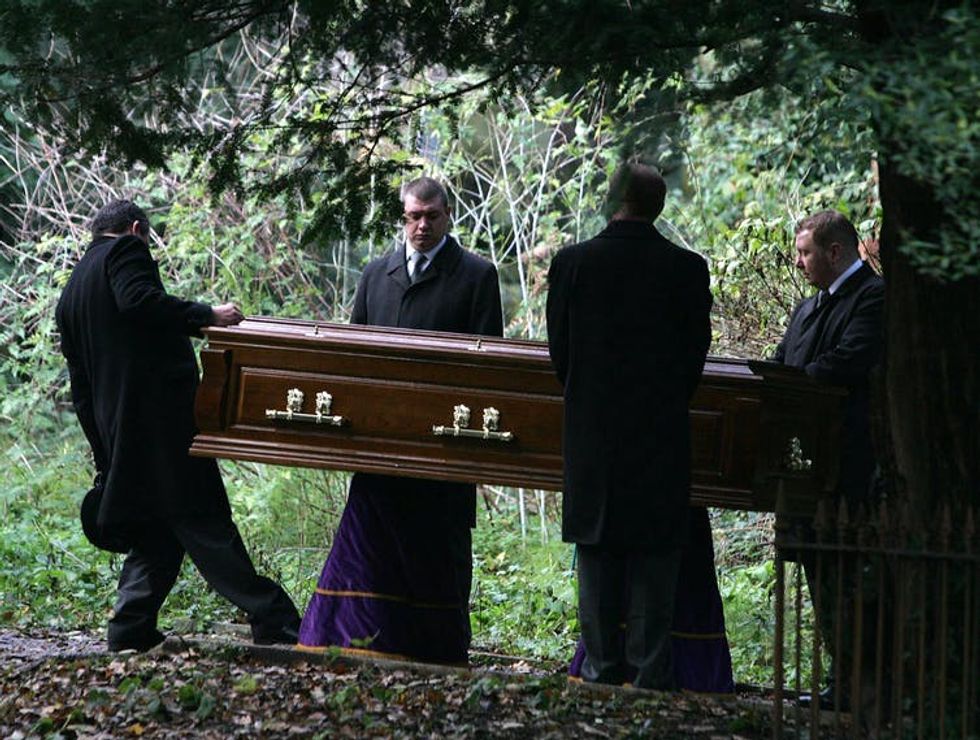
A British inquiry found that the Russian secret service killing of Putin critic Alexander Litvinenko was ‘probably approved … by President Putin.’
AP/Cathal McNaughton
2. In 2004, Chechen terrorists took hostage hundreds of schoolchildren and their teachers in a school in Beslan in North Ossetia.
Russian authorities refused to negotiate and instead deployed military forces to storm the school. More than 330 people died and another 550 were wounded. Among the dead were 184 children.
Putin was adamant that the use of force was justified and necessary in the face of terrorism, and used Beslan to increase centralized Kremlin power. He rejected a European Court of Human Rights judgment that Russian authorities used excessive force against their own citizens.
3. In 2005, the American-born British CEO of Moscow-based investment fund Hermitage Capital, Bill Browder, was denied re-entry to Russia, and declared a threat to national security.
Browder’s tax attorney Sergei Magnitsky then uncovered a US$230 million tax fraud scheme against Hermitage Capital. Magnitsky’s work revealed high-level government collusion in the criminal looting of public assets.
After taking the allegations public, Magnitsky was arrested in Moscow on fabricated charges and detained for 11 months prior to trial. He was repeatedly abused in jail, including denial of treatment for chronic health conditions. Eventually he was beaten to death.
Browder has subsequently pursued justice for Magnitsky, advocating for the worldwide adoption of the Magnitsky Act. The act was passed by the U.S. Congress in 2012 to sanction individual Russians involved in human rights abuses.
following the Magnitsky act’s passage and the Russian Duma’s subsequent retaliatory ban on American adoptions of Russian orphans. Putin said, “Magnitksy … was not tortured — he died of a heart attack.”
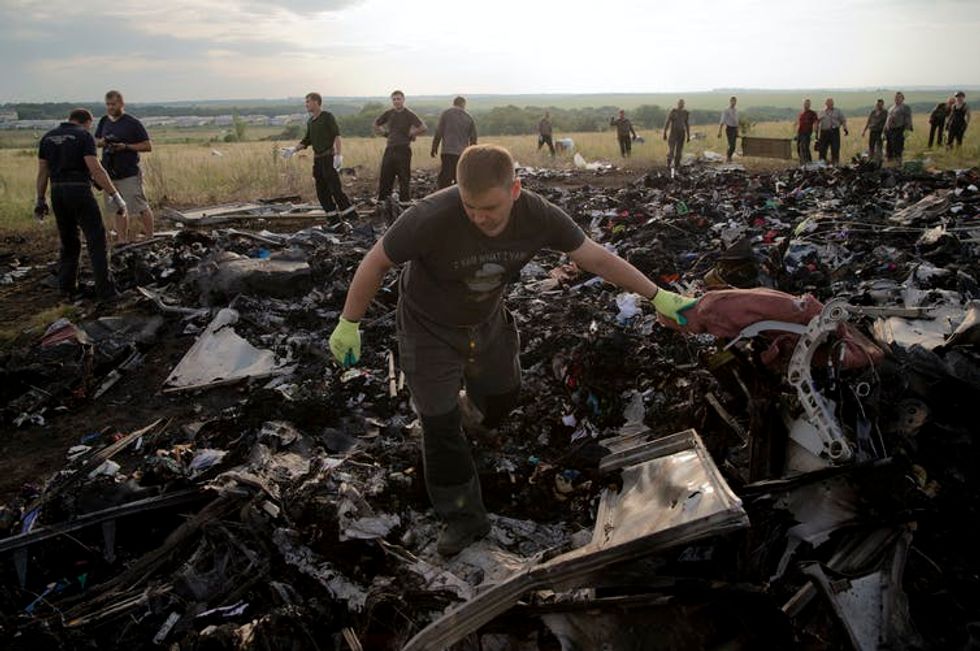
4. On July 17, 2014, Malaysia Airlines Flight MH17 was shot down over Ukraine, killing all 298 people aboard.
Putin denied the U.N. finding that the Russian military had shot down a civilian plane, killing all 298 people on board.
AP/Vadim Ghirda
In May 2018, a U.N.-backed Joint Investigation Teamconcluded that the Russian 53rd Anti-Aircraft Missile Brigade, based in Kursk, had fired a missile and brought down the plane.
In direct contradiction of the forensic evidence, Putin flatly denied any Russian involvement in shooting down MH17.
That denial comports with Putin’s long-time denial that Russian forces invaded Ukraine in 2014 – one of 10 false Russian claims about Ukraine identified and debunked by the U.S. State Department. That report is no longer available on the U.S. government website.
5. In February 2015, Russian opposition leader Boris Nemtsov was assassinated in Moscow. Just before his death, Nemtsov had taped a television interview in which he discussed his investigations into Russian war crimes in Ukraine, and called President Putin “our expert in lying. He is a pathological liar.”
After Nemtsov’s death, President Putin assured Nemtsov’s mother, “We will do everything to ensure that the perpetrators of this vile and cynical crime and those who stand behind them are properly punished.”
Nemtsov’s relatives and allies insist on Putin’s complicity and have called the investigation and prosecution of five killers a cover-up. Video evidence and the journalistic investigation into the details of Nemtsov’s murder, likewise, see the highly organized hit involving multiple gunmen and vehicles as the work of a professional intelligence organization like the FSB.
Connecting the dots
The risks for individual Russians challenging Putin’s lies are clear. One journalist has listed 34 suspicious deaths since 2014.
Those killed have nonetheless left an evidentiary trail for a host of contemporary writers like Masha Gessen, David Satter and Peter Pomerantsev. Those writers, and others, detail how Putin has built enormous wealth and power by deploying violence and deception to control the political narrative and disable or eliminate meaningful opposition.
President Trump respects that strength and at times, seems even to envy it. How, then, does he interpret this array of evidence of serial lying and complicity in multiple critics’ violent deaths?
He might conclude that all of these independently produced, empirically-grounded investigations are somehow part of a grand deep-state conspiracy to defame or discredit a man of integrity who can and should be taken at his word.
That conclusion, though, would dishonor the ordinary and extraordinary Russians who have stood up to the deception and violence of President Putin’s regime, risking or losing their lives as a result. It’s the responsibility of the American president to acknowledge this. By virtue of the office he holds, President Trump has the ability to stop being played by Putin, and speak truth to power.
At least 82 people were killed when Indonesia’s resort island of Lombok was hit by a powerful magnitude 7.0 earthquake on Sunday, triggering widespread panic as thousands fled their homes for emergency shelters as buildings collapsed.
The death toll is expected to rise with hundreds injured and thousands of houses damaged, the National Disaster Mitigation Agency said in a statement on Monday.
Singapore Law and Home Affairs Minister K. Shanmugam, who was on the 10th floor of a hotel in the Lombok town of Mataram at the time of the quake, wrote on Facebook that his room shook violently and walls cracked.
“It was quite impossible to stand up. Heard screams. Came out, and made my way down a staircase, while building was still shaking. Power went out for a while. Lots of cracks, fallen doors,” he wrote.
Most of the victims were killed by falling rubble in northern and western parts of Lombok.
An initial tsunami warning of waves of up to half a metre was issued following the quake but later withdrawn.
Lombok was hit by another powerful 6.4 quake a week earlier on July 29, killing 17 people and injuring hundreds of people.
More than 100 aftershocks have rattled Lombok since the quake, which was so powerful it was felt on the neighbouring island of Bali.
“The night condition and some disconnected communication lines pose some challenges in the field. Death count is expected to increase still,” the disaster management agency said.
I Nyoman Sidakarya, head of Mataram’s search and rescue agency, told TvOne, authorities will evacuate around 700 tourists and local residents from the nearby Gili Islands.
“We will evacuate people off of the three Gili islands. Some of them are hurt and are in shock,” Sidakarya said in the televised interview.
One person in Gili Air was killed, he said, but details about the victim is unknown yet.
Saffron Amis, a British student visiting the Gili Islands off the northwest coast of Lombok, told Reuters by text message that dozens of tourists were evacuated to a hill after the quake.
The quake struck Lombok in the early evening at a depth of 10 km (6 miles).
Most of Lombok suffered power cuts, local media reported.
Travellers at the international airports in Lombok and Bali were thrown into panic and there was minor damage to the buildings but operations were not disrupted, officials said.
The quake was felt for several seconds in Bali, where people ran out of houses, hotels and restaurants.
“All the hotel guests were running, so I did too. People filled the streets,” said Michelle Lindsay, an Australian tourist. “A lot of officials were urging people not to panic.”
Other witnesses said the initial quake grew in intensity over several seconds, rattling windows and doors, and there were many aftershocks.
Additional reporting by Tabita Diela, Jessica Damiana, Agustinus Beo Da Costa, Fransiska Nangoy and Kanupriya Kapoor; Writing by Kanupriya Kapoor and John Chalmers; Editing by Bill Trott, Susan Thomas and Michael Perry
Every time an image of U.S. President Donald Trump appears on TV in South Korea, 69-year-old Vietnam War veteran Chung Seung-jin solemnly salutes.
The U.S. flag Chung keeps in his home in Seoul gets similar respect every morning.
“I salute President Trump and the U.S. flag every day to show how much I trust him,” Chung told Reuters as he attended a recent anti-North Korea rally in sweltering summer heat in downtown Seoul.
“I salute to pay respect to Mr Trump, supporting his reign as the leader of the world and guardian of liberty.”
For many South Korean conservatives who liked Trump’s initial tough talk against North Korea’s Kim Jong Un, his abrupt embrace of the autocratic leader at their historic Singapore summit in June was nothing short of a betrayal.
Trump, who ridiculed Kim as “rocket man” last year, has since called the North Korean leader “funny” and “smart” and even praised his ability to retain his authoritarian grip on power.
“Trump said Kim is an ‘amazing leader’, thus legitimizing him. This makes us, the patriotic citizens, feel betrayed,” said Cho Won-jin, leader of the right-wing Korean Patriots’ Party.
But for a colorful handful of Trump supporters who gather regularly on the streets of Seoul to call for aggressive action against North Korea, faith in the U.S. president is unshaken.
“I have saluted Trump today as always with utmost sincerity,” said 76-year-old demonstrator Lee Yoon-jo, nodding at a large picture of a beaming Trump at a demonstration in downtown Seoul.
As he saluted, demonstrators held giant U.S. and South Korean flags in front of the U.S. embassy, alongside banners in Korean and English reading “The United States is a thankful brother country that has been devoted to a free Korea”.
Gratitude for U.S. support in the 1950-1953 Korean War as well as anti-communist rhetoric used by the South’s military rulers in the 1970s still resonate with many older South Koreans, said analyst Jeong Chan-dae of Sungkonghoe University.
“To these elderly conservatives, the U.S. is more than just an ally and more of a ‘savior’,” he said.
Holding a faded black-and-white photograph from his time he fought alongside American allies in the Vietnam War in 1968, Chung said: “Without the U.S., South Korea would never have been able to exist.”
Trump and Kim met in Singapore in June, where they announced an agreement in which Kim reaffirmed his “unwavering” commitment to denuclearize. Little progress on that front has been made in the weeks since.
A Gallup Korea poll conducted just after the summit found 48 percent of South Korean conservatives thought the meeting went well, compared to 79 percent of progressives.
Standing on a corner in Seoul, surrounded by flags and anti-North Korean banners, the small knot of demonstrators are unfazed by the shift in tone, noting that Trump could still resort to “regime change” if a denuclearisation deal doesn’t pan out.
“President Trump has always masterfully guided and protected South Korea and the free world and always will,” Lee said, again giving a military salute. “Thank you, Mr President.”
Reporting by Jeongmin Kim and Minwoo Park; Writing by Josh Smith; Editing by Nick Macfie
The United States intends to fully enforce sanctions due to be reimposed against Iran early this week on orders from U.S. President Donald Trump, Secretary of State Mike Pompeo said on Sunday.
Washington’s so-called “snapback” sanctions are due to be reinstated against Tehran at 12:01 a.m. EDT on Tuesday, a U.S. Treasury official said, speaking on condition anonymity.
Pompeo, speaking with reporters returning with him from an Asian trip, said the White House would detail implementation of the measures on Monday morning.
“It’s an important part of our efforts to push back against Iranian malign activity,” he said. “The United States is going to enforce these sanctions.”
Despite opposition from European allies, Trump in May pulled the United States out of a 2015 deal between world powers and Tehran under which international sanctions were lifted in return for curbs on Iran’s nuclear program.
Trump had denounced the deal reached under his White House predecessor, Barack Obama, as one-sided in Iran’s favor.
Starting this week, Washington will reimpose sanctions on Iran’s purchases of U.S. dollars, its trade in gold and precious metals, and its dealings with metals, coal and industrial-related software.
The United States has told other countries they must halt imports of Iranian oil starting in early November or face U.S. financial measures.
Iranian President Hassan Rouhani said last week that Trump’s repudiation of the deal was illegal and Iran would not yield to Washington’s renewed campaign to strangle Iran’s vital oil exports.
Iran will ease foreign exchange rules, state TV reported on Sunday, in a bid to halt a collapse of the rial currency, which has lost half its value since April due to fears about the return of U.S. sanctions.
Referring to recent sporadic protests in Iranian cities, Pompeo said: “The Iranian people are not happy - not with the Americans but with their own leadership. They’re unhappy with the failure of their own leadership to deliver the economic promises that their leadership promised them.”
Pompeo said the United States wants “the Iranian people to have a strong voice of who their leadership will be,” although he stopped short of calling for regime change in Tehran.
He later said in a message on Twitter that the United States was “deeply concerned about reports of Iranian regime’s violence against unarmed citizens” and urged respect for human rights.
Protests broke out on Sunday for a sixth night in Iranian cities, including Kazeroon in the south, according to social media. Authorities reported the first fatality among protesters, with the shooting of a man in Karaj, west of Tehran. But they denied security forces were involved, Iranian news agencies reported
The protests have often begun with slogans against the high cost of living and alleged financial corruption but quickly turned into anti-government rallies.
Pompeo said it would require “enormous change” by Iran to get out from under renewed U.S. sanctions. “They have got to behave like a normal country,” he said, describing Iranian leaders as “bad actors.”
He alluded to Trump’s suggestion last week of the potential for future negotiations with Tehran, a notion that senior Iranian officials quickly rejected.
“We are happy to talk if there’s an arrangement that is appropriate, that could lead to a good outcome,” he said. “Perhaps that will be the path the Iranians choose to move down with. There’s no evidence to date of their desire to change to change their behavior.”
Reporting By David Brunnstrom; additional reporting by Lesley Wrougton in Washington; Writing by Matt Spetalnick; Editing by Bill Trott




 AFP / Simon MALFATTO
 For this reason, we believe that police killings should be considered a public health concern. Public health agencies and researchers should play an increased role in collecting data on police-involved deaths and police use of force. Conversations about the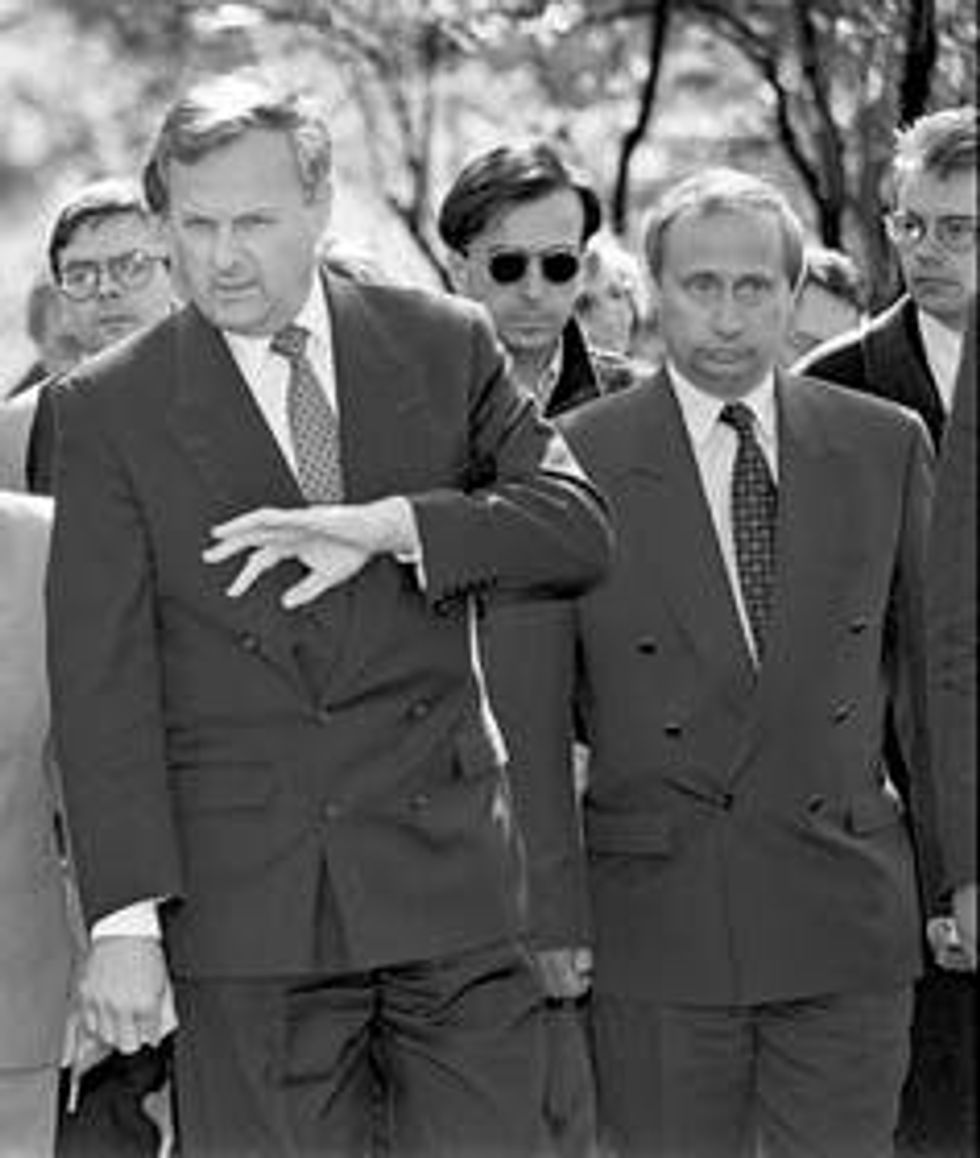
 That conclusion, though, would dishonor the ordinary and extraordinary Russians who have stood up to the deception and violence of President Putin’s regime, risking or losing their lives as a result. It’s the responsibility of the American president to acknowledge this. By virtue of the office he holds, President Trump has the ability to stop being played by Putin, and speak truth to power.