NASA is preparing to send a probe closer to the Sun than any other spacecraft has ventured, enduring wicked heat while zooming through the solar corona to study this outermost part of the stellar atmosphere that gives rise to the solar wind.
The Parker Solar Probe, a robotic spacecraft the size of a small car, is slated to launch from Cape Canaveral in Florida, with Aug. 6 targeted as the launch date for the planned seven-year mission. It is set to fly into the Sun’s corona within 3.8 million miles (6.1 million km) from the solar surface, seven times closer than any other spacecraft.
“To send a probe where you haven’t been before is ambitious. To send it into such brutal conditions is highly ambitious,” Nicola Fox, a project scientist from the Johns Hopkins University Applied Physics Laboratory, told a news conference on Friday.
The previous closest pass to the Sun was by a probe called Helios 2, which in 1976 came within 27 million miles (43 million km). By way of comparison, the average distance from the Sun for Earth is 93 million miles (150 million km).
The corona gives rise to the solar wind, a continuous flow of charged particles that permeates the solar system. Unpredictable solar winds cause disturbances in our planet’s magnetic field and can play havoc with communications technology on Earth. NASA hopes the findings will enable scientists to forecast changes in Earth’s space environment.
“It’s of fundamental importance for us to be able to predict this space weather, much like we predict weather here on Earth,” said Alex Young, a solar scientist at NASA’s Goddard Space Flight Center in Maryland. “In the most extreme cases of these space weather events, it can actually affect our power grids here on Earth.”
The project, with a $1.5 billion price tag, is the first major mission under NASA’s Living With a Star program.
The probe is set to use seven Venus flybys over nearly seven years to steadily reduce its orbit around the Sun, using instruments designed to image the solar wind and study electric and magnetic fields, coronal plasma and energetic particles. NASA aims to collect data about the inner workings of the highly magnetized corona.
The probe, named after American solar astrophysicist Eugene Newman Parker, will have to survive difficult heat and radiation conditions. It has been outfitted with a heat shield designed to keep its instruments at a tolerable 85 degrees Fahrenheit (29 degrees Celsius) even as the spacecraft faces temperatures reaching nearly 2,500 degrees Fahrenheit (1,370 degrees Celsius) at its closest pass.
Reporting by Joey Roulette; Editing by Will Dunham
The U.S. oil and gas industry is lobbying against tighter sanctions on Russia that could impact U.S. investments there, congressional sources said on Friday.
The U.S. Senate has revived a bill, called DETER, that would allow for swift sanctions if Moscow was found meddling in future U.S. elections. Both Democrats and Republicans are looking to redress what they consider President Donald Trump’s weak stance on accusations of Russian interference in the 2016 election when he met Russian President Vladimir Putin on Monday.
Top U.S. energy company Exxon Mobil is among the firms that have previously opposed U.S. sanctions on Russia. Opponents claim sanctions unfairly penalize U.S. companies while allowing foreign energy rivals such as Royal Dutch Shell and BP to operate in the world’s biggest oil producer.
Western powers imposed sanctions in 2014 after Russia’s annexation of Crimea.
Democratic Senator Chris Van Hollen told Reuters on Friday there was growing bipartisan support for his DETER bill.
When asked whether energy industry lobbyists were either opposing the bill or seeking revisions, Van Hollen said that “a range of issues need to be discussed including ... ones related to U.S. and European energy projects.”
Van Hollen said that while he was willing to address “reasonable concerns” from industry representatives and other lawmakers, the legislation needed to be robust enough to discourage Moscow from meddling in future U.S. elections.
“Don’t trip the wire because if you do, sanctions are automatic and harsh” should be the message, Van Hollen said.
He said he had not been directly contacted by energy lobbyists.
Lobbyists representing oil and gas firms with interests in Russia were opposing the legislation, two Senate aides said. They did not mention specific companies and spoke anonymously because private conversations were still underway.
One of the Senate aides said the U.S.-Russia Chamber of Commerce was raising concerns about the legislation.
The chamber describes itself as a non-profit organization headquartered in Houston that promotes trade between Russia and the United States. Its members include Shell, Exxon Mobil, and Chevron.
Chamber representatives and the three energy companies did not respond to requests for comment.
Exxon has already taken a hit because of sanctions. In February, the firm said it would exit some joint ventures with Russia’s Rosneft.
The company still has operations in Russia, including an oil venture on an island in the North Pacific called Sakhalin.
Reporting by Richard Cowan and Timothy Gardner, Writing by Richard Cowan; Editing by Mary Milliken and Rosalba O'Brien
I am a researcher who has studied poverty for nearly 20 years in Cleveland, a city with one of the country’s highest rates of poverty. While the council’s conclusion makes for a dramatic headline, it simply does not align with the reality of poverty in the U.S. today.
What is poverty?
The U.S. federal poverty line is set annually by the federal government, based on algorithms developed in the 1960s and adjusted for inflation.
In 2018, the federal poverty line for a family of four in the contiguous U.S. is $25,100. It’s somewhat higher in Hawaii ($28,870) and Alaska ($31,380).
However, the technical weaknesses of the federal poverty line are well known to researchers and those who work with populations in poverty. This measure considers only earned income, ignoring the costs of living for different family types, receipt of public benefits, as well as the value of assets, such as a home or car, held by families.
Most references to poverty refer to either the poverty rate or the number of people in poverty. The poverty rate is essentially the percentage of all people or a subcategory who have income below the poverty line. This allows researchers to compare over time even as the U.S. population increases. For example, 12.7 percent of the U.S. population was in poverty in 2016. The rate has hovered around 12 to 15 percent since 1980.
Other discussions reference the raw number of people in poverty. In 2016, 40.6 million people lived in poverty, up from approximately 25 million in 1980. The number of people in poverty gives a sense of the scale of the concern and helps to inform the design of relevant policies.
Both of these indicators fluctuate with the economy. For example, the poverty population grew by 10 million during the 2007 to 2009 recession, equating to an increase of approximately 4 percent in the rate.
The rates of poverty over time by age show that, while poverty among seniors has declined, child poverty and poverty among adults have changed little over the last 40 years. Today, the poverty rate among children is nearly double the rate experienced by seniors.
The July report by the Council of Economic Advisers uses an alternate way of measuring poverty, based on households’ consumption of goods, to conclude that poverty has dramatically declined. Though this method may be useful for underpinning an argument for broader work requirements for the poor, the much more favorable picture it paints simply does not reconcile with the observed reality in the U.S. today.
Deserving versus undeserving poor
Political discussions about poverty often include underlying assumptions about whether those living in poverty are responsible for their own circumstances.
One perspective identifies certain categories of poor as more deserving of assistance because they are victims of circumstance. These include children, widows, the disabled and workers who have lost a job. Other individuals who are perceived to have made bad choices – such as school dropouts, people with criminal backgrounds or drug users – may be less likely to receive sympathetic treatment in these discussions. The path to poverty is important, but likely shows that most individuals suffered earlier circumstances that contributed to the outcome.
Among the working-age poor in the U.S. (ages 18 to 64), approximately 35 percent are not eligible to work, meaning they are disabled, a student or retired. Among the poor who are eligible to work, fully 63 percent do so.
Earlier this year, lawmakers in the House proposed new work requirements for recipients of SNAP and Medicaid. But this ignores the reality that a large number of the poor who are eligible for benefits are children and would not be expected to work. Sixty-three percent of adults who are eligible for benefits can work and already do. The issue here is more so that these individuals cannot secure and retain full-time employment of a wage sufficient to lift their family from poverty.
A culture of poverty?
The circumstances of poverty limit the odds that someone can escape poverty. Individuals living in poverty or belonging to families in poverty often work but still have limited resources – in regard to employment, housing, health care, education and child care, just to name a few domains.
If a family is surrounded by other households also struggling with poverty, this further exacerbates their circumstances. It’s akin to being a weak swimmer in a pool surrounded by other weak swimmers. The potential for assistance and benefit from those around you further limits your chances of success.
Even the basic reality of family structure feeds into the consideration of poverty. Twenty-seven percent of female-headed households with no other adult live in poverty, dramatically higher than the 5 percent poverty rate of married couple families.
Poverty exists in all areas of the country, but the population living in high-poverty neighborhoods has increased over time. Following the Great Recession, some 14 million people lived in extremely poor neighborhoods, more than twice as many as had done so in 2000. Some areas saw some dramatic growth in their poor populations living in high-poverty areas.
Given the complexity of poverty as a civic issue, decision makers should understand the full range of evidence about the circumstances of the poor. This is especially important before undertaking a major change to the social safety net such as broad-based work requirements for those receiving non-cash assistance.
Art work, film memorabilia and personal items owned by the late actor Robin Williams will go under the hammer in New York this October, more than four years after his death, Sotheby's announced Friday.
The Oscar-winner, movie veteran, stand-up comedian and television star was one of Hollywood's most popular entertainers whose tragic death in August 2014 triggered an outpouring of emotion the world over.
Items owned by Williams and his second wife, film producer and philanthropist Marsha Garces Williams, will go on sale on October 4 with proceeds going to charities they championed, Sotheby's said.
The dedicated sale will include autographed scripts, awards, props, street art by Banksy, more than 40 watches, bicycles and sports memorabilia, furniture and art, the auction house said.
Lots include a Hogwarts school robe worn by Daniel Radcliffe in the 2001 movie "Harry Potter and the Sorcerer's Stone," valued between $10,000 to $15,000, and Williams's Hollywood Walk of Fame award valued at $3,000 to $5,000.
The collection will go on public view at Sotheby's on September 29 and the organizations to benefit include The Juilliard School in New York, the Wounded Warrior Project and the Challenged Athletes Foundation.
Williams won an Oscar in 1998 for "Good Will Hunting." A father of three, he was known for high-energy, rapid-fire improvisation and clowning, and starred in hit films such as "Good Morning, Vietnam" and "Mrs Doubtfire."
Marsha was his second wife. The couple were married from 1989 to 2010, and had two children together.
Williams committed suicide aged 63. His widow and third wife, Susan Schneider, later revealed that he had been suffering from Lewy body dementia, a neurodegenerative disease that alters mood, movement and provokes hallucinations.
U.S. Treasury Secretary Steven Mnuchin issued a warning to China over the recent weakness of its yuan currency on Friday, telling Reuters that the Treasury is closely monitoring the yuan for signs of manipulation.Mnuchin said in an interview in Sao Paulo, Brazil, that the yuan’s weakness would be reviewed as part of the Treasury’s semi-annual report on currency manipulation, next due on Oct. 15 based on activity for the first six months of 2018.
“There’s no question that the weakening of the currency creates an unfair advantage for them,” Mnuchin said of China. “We’re going to very carefully review whether they have manipulated the currency.”
With its head and snout covered in bony armor shaped like cones and pyramids, a spiky tank-like dinosaur unearthed in southern Utah was not just another pretty face.
Scientists on Thursday announced the discovery of fossils of a dinosaur named Akainacephalus johnsoni that lived 76 million years ago during the Cretaceous Period. It was a four-legged, armor-studded plant-eater with a menacing club at the end of its tail.
It was a member of a dinosaur group called ankylosaurs, among the most heavily armored animals ever on Earth - and for good reason, considering the predators around at the time.
The unique shape and arrangement of its head and snout armor may be its most intriguing trait, the researchers said, giving clues about the Asian ancestry of some of the ankylosaurs that roamed western North America near the end of the dinosaur era.
“Someone once told me that Akainacephalus, and ankylosaurs in general, were quite ugly and had a face only a mother could love. I must say that I wholeheartedly disagree. These are quite extraordinary and beautiful animals,” said paleontologist Jelle Wiersma of James Cook University in Australia.
Akainacephalus was a medium-sized ankylosaur, about 16 feet (5 meters) long, with a short boxy head covered in bony armor and a beak and small teeth for cropping vegetation, said paleontologist Randall Irmis of the Natural History Museum of Utah and the University of Utah.
It had a short neck and wide torso, walked on four short stout legs, and may have whacked predators with its bony tail club. It inhabited a warm, humid environment similar to southern Louisiana’s bayous, with slow-moving streams and rivers and associated swamps. The largest predators were the 30-foot-long (9-meter-long) Tyrannosaurus rex cousin Teratophoneus and 42-foot-long (13-meter-long) crocodilian Deinosuchus.
The extensive skeletal remains, including a complete skull, were excavated in Grand Staircase-Escalante National Monument.
Akainacephalus, as well as a cousin called Nodocephalosaurus that lived in New Mexico a couple million years later, possessed spiky head armor similar to Asian members of this dinosaur group. Other related North American dinosaurs such as Ankylosaurus had relatively flat armor covering the head.
This indicates Akainacephalus and Nodocephalosaurus wereclose kin to Asian ankylosaurs and that multiple emigrationevents involving this group occurred from Asia to North Americalate in the Cretaceous Period, the researchers said. This resulted in two distinct lineages in North America of club-tailed ankylosaurs.
The research was published in the scientific journal PeerJ.
U.S. Secretary of State Mike Pompeo told United Nations Security Council envoys on Friday that there needs to be “concrete actions” by North Korea before an easing of sanctions on Pyongyang can be discussed, said Dutch U.N. Ambassador Karel van Oosterom.
“The secretary made very clear we need concrete deeds, concrete actions and only then we can start the discussion,” van Oosterom told reporters after Pompeo informally briefed envoys from the 15-member council, Japan and South Korea behind closed doors at the South Korea U.N. mission.
It was not immediately clear if Pompeo elaborated on what “concrete actions.” Van Oosterom chairs the Security Council’s North Korea sanctions committee.
Reporting by Michelle Nichols; Editing by Chizu Nomiyama
U.S. President Donald Trump defended his efforts to build a relationship with Vladimir Putin in an interview broadcast on Friday after he invited the Russian leader for a second meeting in the midst of an uproar over their first.
Trump’s administration has sought to control the damage from Monday’s summit in Helsinki, where the president astonished the world and drew sharp criticism at home by siding with Putin over U.S. intelligence agencies on Moscow’s meddling in the 2016 presidential election.
As the White House tried to put some distance between the two leaders, Trump made a jarring move in the opposite direction on Thursday, offering to host Putin in Washington in the fall.
In a television interview taped on Thursday, Trump said that he and Putin, who U.S. intelligence agencies say directed interference to sway the 2016 vote toward Trump, had a rapport during their Helsinki meeting.
“Look, the fact is we got along well,” he told CNBC, adding that the two did not agree on everything.
“So I had a meeting that lasted for more than two hours. It wasn’t always conciliatory in that meeting,” Trump said, without elaborating. “We discussed lots of great things for both countries, frankly.”
Five days after the Helsinki meeting, U.S. officials and lawmakers remained in the dark about what the leaders discussed in their two-hour, one-on-one session with only interpreters present.
Trump listed on Twitter the topics he and Putin talked about, but has not given details. U.S. Secretary of State Mike Pompeo told ABC Radio Australia on Thursday the two leaders “broke some ground across a broad range” of issues. He gave no details.
Conflicting messages from the White House this week added to the confusion after Trump’s overseas trip, during which he appeared to draw closer to Russia after alienating NATO allies.
Upon returning from Helsinki, Trump said he had misspoken at a joint news conference with Putin when he questioned why Russia would have interfered in the 2016 election.
On Wednesday, the White House said Trump’s answer of “no” to a reporter who asked if Russia was still targeting the United States was just his declining to answer questions.
On Thursday, after an outcry in Congress, White House spokeswoman Sarah Sanders issued a statement that Trump “disagrees” with Putin’s proposal to have Russian officials question Americans suspected of illegal activity by Moscow, including a former U.S. ambassador to Moscow, Michael McFaul. She had said on Wednesday the proposal was being considered.
As American officials groped for information about the meeting, Moscow offered snippets of its version on Friday.
Russia’s Defense Ministry said it sent detailed proposals to Washington on organizing the return of more than 1.7 million refugees to Syria after agreements reached by Putin and Trump, RIA news agency said.
The White House and the State Department did not respond to a request for comment on the Syria proposals.
Putin also made concrete proposals to Trump about resolving the conflict in eastern Ukraine, Interfax news agency reported, citing Russia’s ambassador to the United States, Anatoly Antonov. He did not spell out what they were.
The ambassador said Russia is ready to discuss a proposed new meeting between Putin and Trump, Interfax said.
American intelligence agencies concluded last year that Russia carried out a campaign of hacking and propaganda targeting the 2016 U.S. election, seeking to sow discord and disparage Democratic candidate Hillary Clinton.
Putin has denied any such meddling. Angered by a federal Russia probe that is also examining whether Trump’s election campaign worked with Moscow, Trump has long denied any collusion and has denounced the investigation as a witch hunt.
Top U.S. intelligence officials have said Moscow is targeting congressional elections in November as well.
‘TRUMP GOT PLAYED’
Illustrating the gulf between Trump and some of his own advisers, Director of National Intelligence Dan Coats said on Thursday that he did not know what Trump and Putin discussed in their private meeting.
Coats learned of the proposed second meeting with Putin when the White House announced it on Twitter, while he was being interviewed at the Aspen conference.
With the fallout from the Putin meeting matching or eclipsing previous controversies in Trump’s turbulent 18-month presidency, critics of his performance in Helsinki included many fellow Republicans.
A Republican congressman and former CIA officer, William Hurd, wrote an opinion piece in the New York Times late on Thursday entitled, “Trump is Being Manipulated by Putin. What should we do?”
“There are a number of us who warned about this,” Mark Warner, the Senate Intelligence Committee’s top Democrat, said Friday on MSNBC. “Trump got played, he got played for a fool and he embarrassed our country and frankly embarrassed lots of my colleagues across the board – Democrats, Republicans alike.”
Reporting by Doina Chiacu and Susan Heavey in Washington, Andrey Ostroukh and Vladimir Soldatkinin in Moscow; Writing by Doina Chiacu; Editing by Frances Kerry
A man armed with a knife attacked people on a bus in the northern city of Luebeck on Friday, injuring several including one seriously before he was arrested, police and the local state prosecutor said.
The local Luebecker Nachrichten, without citing its source, said the attacker was a 34-year-old man originally from Iran who now had German nationality and had lived in Luebeck for years.
The interior minister of Schleswig-Holstein, the state where Luebeck is located, did not assume there was a terrorist motive, the local paper added.
“The exact number of injured is still unclear. There were no dead,” the police and prosecutor’s office said in a statement. “The background to the crime is still unclear and the subject of the ongoing investigation.”
The local Luebecker Nachrichten reported at least 14 people were wounded, two seriously.
On Twitter, the police said the attacker was overpowered and taken into police custody. The attack took place at 1.47 p.m. local time (1147 GMT).
“We ask for your understanding that we cannot provide any information about the identity of the suspect at the moment,” the police added on Twitter. “It is important to us to only disclose reliable information in order not to fuel speculation and not to obstruct the investigation.”
“The bus was full,” the police added, appealing to passengers who fled the scene to contact them.
Contacted by Reuters, a police spokesman declined to give any details about the attacker or number of people injured, but said police were examining a backpack he may have been carrying.
The Luebecker Nachrichten newspaper cited state prosecutor Ulla Hingst as saying: “Nothing can be ruled out, including a terrorist background.”
Luebecker Nachrichten, which said the attacker appeared to be in his mid-30s, quoted a witness as saying: “One of the victims had just given up his place to an older woman, when the attacker stabbed him in the chest.”
An area around a bus stop in the Luebeck neighborhood of Kuecknitz was sealed off by police, spokesman Dierk Duerbook told Bild.
Earlier, police in Schleswig-Holstein tweeted that there was a major police deployment under way in the city.
In April, a man drove a camper van into a group of people sitting outside a restaurant in the German city of Muenster, killing two people before shooting himself dead. There was no evidence of any link to Islamist militancy and he was not a refugee.
In Berlin in December 2016, a Tunisian whose request for asylum was turned down and who had links to Islamist militants hijacked a truck and ploughed into a crowded marketplace. Twelve people, including the man driving the truck when it was hijacked, were killed.
Reporting by Thomas Escritt, Michelle Martin and Paul Carrel, Editing by Robin Pomeroy, John Stonestreet, William Maclean
The Endangered Species Act, or “the Act,” is arguably the most important law in the United States for conserving biodiversity and arresting the extinction of species.
Congress passed the ESA in 1973 with strong bipartisan support (the House voted 355-4 in favor of the law) at the behest of a Republican president, Richard Nixon. Nixon had come to believe existing protections for threatened and endangered species were insufficient.
Nevertheless, criticism of the law has been a persistent feature of debates about whether and how to protect imperiled species. That criticism often comes from business and agricultural interests, who argue that the Act’s provisions excessively limit their ability to develop and manage private property.
We are ecologists and socialscientists whose work often intersects with the Endangered Species Act. We wanted to know: Is public support for the Act declining? And if so, why?
President Richard Nixon signs the Endangered Species Act.
Clerk of the U.S. House
Arrested development
Some members of Congress have proposed legislation to weaken the Act’s protections – and these proposals appear to be increasing. The Center for Biological Diversity, an advocacy group that supports protections for endangered species, analyzed congressional voting records and found that from the 1990s until 2010, a typical year saw roughly five proposals to amend the Act or otherwise curtail some of its protections.
Then, in 2011 the number of proposed bills to amend the Act jumped to 30 and has continued to increase. In the past two years there have been nearly 150 such efforts aimed at weakening the Act. Sponsors of such legislation have not been shy about the goals of their efforts. As Rep. Rob Bishop, R-Utah, put it, their intent is to “invalidate” the Act.
But threats to the Act are not limited to congressional actions. The Act has also been weakened by rule changes (which prescribe how to carry out the Act) adopted by the agencies charged with administering it, the National Marine Fisheries Service and U.S. Fish and Wildlife Service. One change adopted in 2016 effectively redefines endangerment in a way that could dramatically lower the standard for what measures are required to recover endangered species.
Some say these changes are needed to prevent widespread public backlash against the Act, which could lead to its unraveling.
For example, in 2015 the Obama administration proposed revising policy concerning the listing of endangered species. The proposal effectively made it harder for citizens to petition to list a species (only listed species are entitled to ESA protections). The High Country News characterized the proposal as a “preemptive strike” that was “aimed at warding off a GOP overhaul of the law.”
Similarly, some conservation professionals worry that continuing protections for controversial species such as gray wolves could “create resentments toward the species and the ESA” ultimately, undermining the effectiveness of the law.
Decades of support
In 2014, we conducted a survey of 1,287 Americans, gathering data on a variety of topics related to wildlife conservation, including support for the Act. We also gathered data from previously published studies and public polls. We found four studies or polls that assess support for the ESA spanning roughly two decades, and combined them to assess public attitudes about the Act over time.
Collectively, results indicate support for the Act has been remarkably stable over the past 20 years.
Average support in the three most recent studies, conducted in 2011, 2014 and 2015, was statistically indistinguishable from the earliest study, conducted in 1996. The data show that more than 4 in 5 Americans support the Act, while roughly 1 in 10 oppose it.
In contrast to the often-repeated statement that the Act is controversial, these data suggest that support for the law among the general population is robust and has remained so for at least two decades.
Furthermore, while some issues – for example, gun control and climate change – have become increasingly partisan, our data indicate that both self-identified conservatives as well as liberals strongly supported the ESA. Though liberals (90 percent) were more supportive of the Act than conservatives (74 percent), we found nearly 3 in 4 conservatives supported the Act, and only 15 percent opposed the law.
These results are mirrored in polls conducted in 2011 by Harris Interactive and in 2015 by Tulchin Research. Those polls found that 73 percent of Republicans and 82 percent of self-identified conservatives supported the Act, respectively. Those same polls found that 93 percent of Democrats and 96 percent of liberals supported the Act.
Agricultural and property rights advocates have long criticized the ESA, but our results show support for the ESA transcended interest groups, including agriculture (71 percent) and property rights (69 percent). This result may be explained, in part, by research showing that interest group leaders sometimes hold more extreme views than their members.
Who influences policy?
Some conservation professionals believe that continued protections for controversial species such as gray wolves could erode support for the Act and the species the law protects.
If that were so, one might anticipate less support for the Act in places where such species were listed over long periods.
However, our results show that support for the Act, trust in the U.S. Fish & Wildlife Service that administers the Act and attitudes toward wolves are equivalent in places where wolves are protected by the Act and places where wolves don’t live, and hence, are not protected.
Our results raise the question: If support for the Act transcends political ideology, party, region of the country, and even interest group – why are congressional efforts to weaken the Act increasing?
Some insight may come from political scientists who have shown that “average citizens and mass-based interest groups” have little to no influence on a wide range of policy issues.
Rather, the research suggests, policy outcomes in America are heavily influenced by “economic elites” and business interests who, by virtue of their considerable financial resources, have greater clout with, and access to, policymakers.
This could also explain why “legislators in the U.S. Congress routinely defect from their campaign promises in environmental protection, undermining the link between citizen preferences and policy choice.”
According to records compiled by the Center for Biological Diversity, as of late April 2018 there are more than 50 bills that would, if passed into law, weaken the Act in one form or another. Whether such legislation can be passed in the face of overwhelming public support remains to be seen.
The new study, published in the journal Conservation Letters, can be found here.
Russian President Vladimir Putin’s request to U.S. President Donald Trump for a joint investigation of former U.S. officials sought by the Kremlin for “illegal activities,” including a U.S. ambassador to Russia, is just the latest effort in a years-long campaign to undermine a U.S. law that imposes financial sanctions on Putin’s officials.
Putin and advocates for the Kremlin’s position had had no success with the campaign - until Trump became president. The Magnitsky Act of 2012 is the backdrop of Putin’s proposal to Trump at the Helsinki meeting earlier this week that the United States give Russian officials access to former U.S. ambassador to Russia Michael McFaul, in exchange for allowing the FBI to question 12 Russian agents recently indicted for interfering with the 2016 U.S. presidential election.
Trump was receptive to the suggestion, calling it “an interesting idea.” That created a fire storm of criticism among Republican and Democratic lawmakers alike. But on Thursday, the White House reversed course with spokeswoman Sarah Sanders saying, “It is a proposal made in sincerity by President Putin, but President Trump disagrees with it.”
By then the Russian Prosecutor-General’s office had informally proposed that the United States turn over a U.S. National Security Agency employee, a CIA agent and State Department officials, among others.
PUTIN’S IRE
The Magnitsky Act was the reaction to the 2009 suspicious death in prison of a Russian lawyer, Sergei Magnitsky, who worked for Bill Browder, a British hedge fund manager who invested in Russian companies. Magnitsky was arrested after accusing Russian law enforcement officials of a $230 million tax hoax.
U.S. government officials have long contended that Magnitsky’s arrest and prison death were retaliation against Browder for revealing state theft conducted by Kremlin officials.
The financier drew Putin’s ire after he successfully advocated in 2012 for the economic sanctions. The law freezes the bank accounts and bars entry to the United States of Russian officials who U.S. authorities said were responsible for the Russian lawyer’s suspicious death. Browder has repeatedly dismissed the Kremlin’s claims as propaganda intended to punish him for speaking out against Putin.
The law outraged Putin, who barred American adoptions of Russian children as retaliation.
UNDERMINING BILL BROWDER
By 2015, Washington lobbyist Rinat Akhmetshin, a former Soviet counterintelligence officer, and Russian lawyer Natalia Veselnitskaya began pushing a different narrative to U.S. lawmakers and journalists, according to their congressional testimony and people familiar with their advocacy.
They said Browder was the perpetrator of the fraud. Browder, they argued, had then tricked lawmakers and the Obama White House into imposing sanctions to distract and cover up his own tax fraud. And Magnitsky had not been beaten to death, they argued, saying the bruises found on his body were self-inflicted.
“NOT A SINGLE person in us government has EVER checked the magnitsky story,” Akhmetshin told Reuters in a text message Thursday.
Akhmetshin said his lobbying was done, not for the Kremlin, but for a now-defunct human rights organization called Human Rights Accountability Global Initiative Foundation in order to find a way to reinstate the adoptions. “I was working for a client, trying to expose a con,” he said.
Veselnitskaya has said she is an independent Russian lawyer who has conducted a private investigation into the Magnitsky issue because of her concern over the adoption ban. But in an April interview Veselnitskaya told NBC she has been an active informant for Russian authorities since 2013. She could not be reached for comment.
Their advocacy had no impact, and lawmakers expanded the Magnitsky sanctions in 2016.
TRUMP TOWER MEETING
In the U.S. presidential campaign that year, Akhmetshin and Veselnitskaya appeared to gain traction. At Trump Tower, they met with the Republican candidate’s oldest son, Donald Trump Jr., and Jared Kushner, Donald Trump’s son-in-law and now a senior adviser to the president - a meeting now under scrutiny in Special Counsel Robert Mueller’s investigation into Russian meddling in the 2016 election.
The conversation straddled the same subjects they had repeatedly raised with journalists and lawmakers.
Six months into his presidency, Trump was discussing the Magnitsky issue with Putin himself, during a private meeting at the Group of 20 conference in Hamburg. “I actually talked about Russian adoption with him, which is interesting because it was a part of the conversation that Don had in that meeting,” Trump told The New York Times in July 2017.
Browder denies the Kremlin’s claims. He told Reuters this week, “I’m always worried about Putin taking extrajudicial actions against me. I’m always worried about assassination and other renditions.”
But he does not think the U.S. government would give Putin what he wants. “That’s the last thing that is going to happen,” Browder said.
Reporting by Joel Schectman in Washington; Additional reporting by Andrew Osborn in Moscow and Nathan Layne in Washington; Editing by Damon Darlin and Leslie Adler
U.S. President Donald Trump on Friday reinforced his criticism of the Federal Reserve’s policy on raising interest rates, saying it takes away from the United States’ ‘big competitive edge’ and could hurt the U.S. economy.
Trump, in posts on Twitter, also accused the European Union and China of manipulating their currencies, adding: “As usual, not a level playing field.”
Reporting by Susan Heavey; Editing by Chizu Nomiyama
There were bodysuits, boots and masks galore in San Diego as thousands of comic, superhero and anime fans flocked to the opening of Comic-Con on Thursday.
Highlights of this year’s Comic-Con include the introduction of the first female “Doctor Who”, played by British actress Jodie Whittaker, and a reunion for the cast of the U.S. television drama “Breaking Bad”.
Celebrations are also being held to mark a decade of the Marvel Cinematic Universe media franchise and the 25th anniversaries of the sci-fi TV show “The X-Files”, stop-motion animated movie “The Nightmare Before Christmas”, and the blockbuster film “Jurassic Park”.
“We love the family feeling here,” said Miguel Capuchino, who was dressed as a male version of a female character from the “The Nightmare Before Christmas”.
“It’s just a bunch of geeks getting together and there’s no judging, everybody’s just very supportive”.
The annual four-day event, started as a get-together for sci-fi fans to trade comic books in 1970, is now the largest comic book convention of its kind, with over 130,000 people attending guest panels and visiting the venues featuring paintings, comics, movies, TV shows and gaming programs.
Reporting by Rollo Ross; Writing by Karishma Singh; Editing by Himani Sarkar




 Given the complexity of poverty as a civic issue, decision makers should understand the full range of evidence about the circumstances of the poor. This is especially important before undertaking a major change to the social safety net such as broad-based work requirements for those receiving non-cash assistance.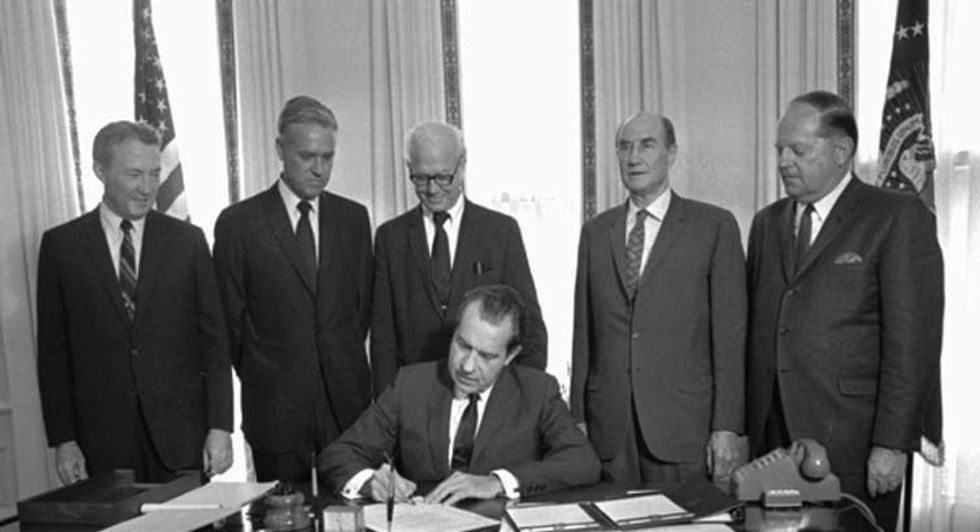
 The new study, published in the journal Conservation Letters, can be found