




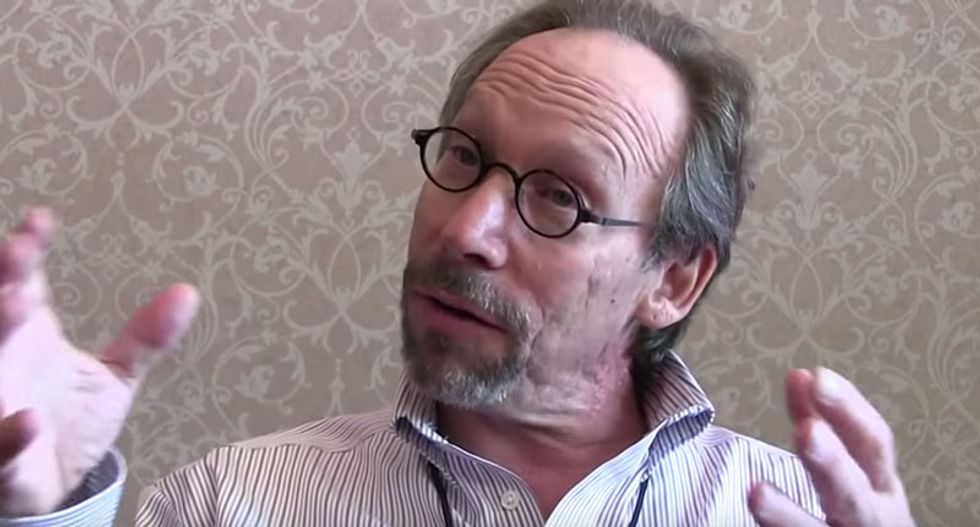
US physicist Lawrence Krauss is spreading the gospel of science to Iranians via an outlawed satellite TV network.
Krauss, a professor at Arizona State University and outspoken atheist, recently appeared on the Bread and Roses show to discuss the beauty of science, and the differences between science and religion.
The Farsi/English program is broadcast on New Channel, an outlawed 24-hour TV station that reaches Iranians via satellite TV and the Internet. Bread and Roses explains on its crowdfunding page that while their show is officially banned in Iran, many Iranians "can still access it because 40-60 percent of the population have satellite dishes."
During an interview on Bread and Roses, the physicist pointed out a fundamental difference between science and faith.
"Not knowing is fine," Krauss said. "In fact, it is a central part of science, so it makes it different than religion, because you don't make these assertions about things you can't test, nor do you claim to have absolute knowledge. We learn about the universe, and it keeps surprising us. But the Big Bang really happened... we can measure so many aspects of our universe and it was once smaller and smaller and smaller. We can go back to [the very beginning], but we can get very close."
Krauss also said humans are lucky they can understand the universe at all.
"Quantum theory is weird, but the universe is weird. That's OK. It's not surprising. In some sense, it is surprising that we understand anything about the universe, because the universe isn't created to please us. And, moreover, we evolved in the Savannah and Africa to learn how to escape lions, not to understand quantum mechanics. So it is amazing that we have been able with our brains and the techniques of modern science to learn enough about the universe to discover that at fundamental scales the universe behaves in ways that appears to be crazy."
"But, again, that's the case not because we want it to be the case, but because we measure and that is the case. And the universe is the way it is whether we like it or not," Krauss said. "I think some people find that worrisome but I find it incredibly exciting because it means we can open our mind and be surprised and learn that our myopic picture of what is supposed to be case is not always the case.
"It's not just true for physics, it's true for our ideas of society," he continued. "What we may think is right or wrong based on something people wrote thousands of years ago, we find that now we understand the universe better, those ideas are simply wrong."
Watch video below:
(The Krauss interview begins at the 10:15 mark.)
