




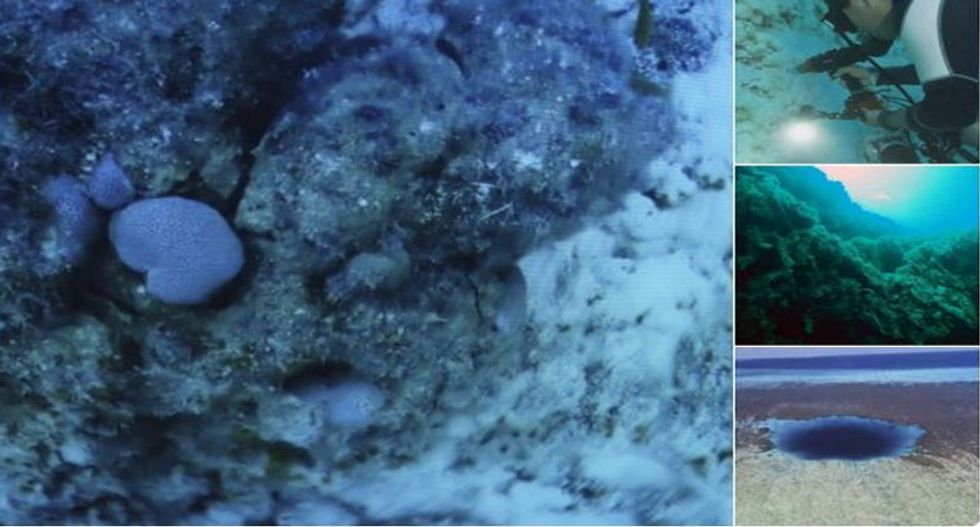
Chinese researchers claim to have found the world's deepest underwater sinkhole, known locally as Dragon Hole in the South China Sea.
After a year of exploring the blue hole, researchers at the Sansha Ship Course Research Institute for Coral Protection concluded that the “eye” of the sea measures a staggering 300 meters in depth or (984 feet), reports state-owned news agency Xinhua.
For context, the Eiffel Tower is 324 meters (1,063 feet) tall.
The hole is located in the Paracel Islands near coral reefs and is home to more than 20 species of marine life along the upper levels of the sinkhole.
Researchers sent an underwater robot to the bottom of the ocean to measure the depth of the sinkhole, which has a 130-meter diameter (427 feet).
Blue holes are large marine caverns characterized by dark blue waters in the center of the circle, ringed by light blue waters.
Underwater sinkholes form with the erosion of limestone.
When saltwater and freshwater meet in the sea, acids can eat away at limestone to create a blue hole.
The Dragon Hole now dwarfs Dean's Blue Hole in the Bahamas, which was previously referred to as the deepest known blue hole at 202 m.
The findings have spurred the local municipal government of Sansha to draft measures to study and protect what has been officially christened as the Sansha Yongle Blue Hole.
