






A new study published in Nature, the international weekly journal of science, Monday says that the proof that the climate has changed is easily observable in the placement of clouds over the globe.
"Clouds substantially affect Earth’s energy budget by reflecting solar radiation back to space and by restricting emission of thermal radiation to space," the findings outline. What makes matters worse, is that this distribution of clouds is actually making global warming even serious.
As the Washington Post explains, these cloud differentials are causing subtropical dry zones to become larger and they're making clouds taller.
“An increase of CO2 leads to cooling of the stratosphere, so it’s cooling down, the troposphere underneath is warming up, and so that means, as the clouds rise up they can rise up higher than they did before,” said the study's lead author, Joel Norris, a climate scientist at the Scripps Institution of Oceanography at the University of California.
Norris explains that as the climate changes and the Earth warms the track of storms will shift more toward the poles and ultimately the climate will begin to look more and more like south Texas, Mexico or other areas in the 20 to 30-degree latitude subtropic zones.
The researchers crafted the study from pieced together images from weather satellites between 1983 and 2009 and what they've found is that all of the models that showed what climate change would look like are represented in these images.
[caption id="attachment_839897" align="aligncenter" width="615"]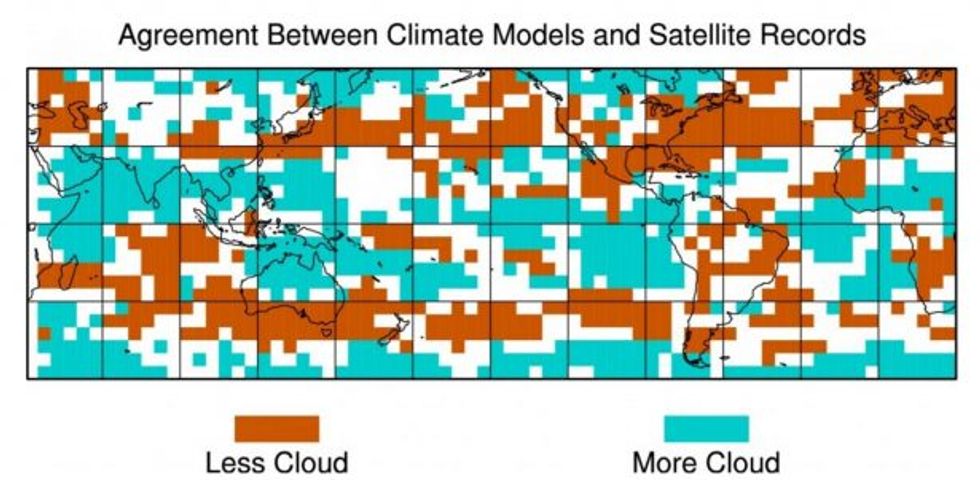 Locations where the majority of climate models and the majority of satellite records agree on how cloudiness changed from the 1980s to the 2000s, relative to the global mean change. Click to make larger. (Photo: Joel Norris via the Washington Post)[/caption]
Some clouds cool the Earth and some make the Earth warmer, it all depends on how high up in the atmosphere they are. Clouds higher up in the atmosphere trap warmth from leaving the Earth where the ones lower to the ground help shield us from the sun's rays.
"You can appreciate that if you go out on a hot and sunny day, and a cloud passes by overhead, it’s a great relief from the heat. And the reason of course is because the cloud is reflecting sunlight," Steven Platnick, a satellite researcher with NASA explained to EarthSky.
Clouds haven't disappeared, however, one only needs to look up to see that we're still okay for now. But these clouds moving toward the poles is a problem for warming as the clouds are reflecting less solar radiation that is hitting the tropics and Equator and more at the poles. So a kind of cloud blanket is forming over the poles holding warmth in, while the tropics, that need to reflect the solar radiation, are getting fewer clouds.
Fewer clouds mean more so-called "dry zones," since clouds are responsible for distributing precipitation. So areas in California that are experiencing profound drought are suffering under this new cloud distribution.
“Every observational record exhibits a decline in cloud amount or albedo [reflectivity] at mid-latitudes in both hemispheres that is nearly always statistically significant,” the study says.
