




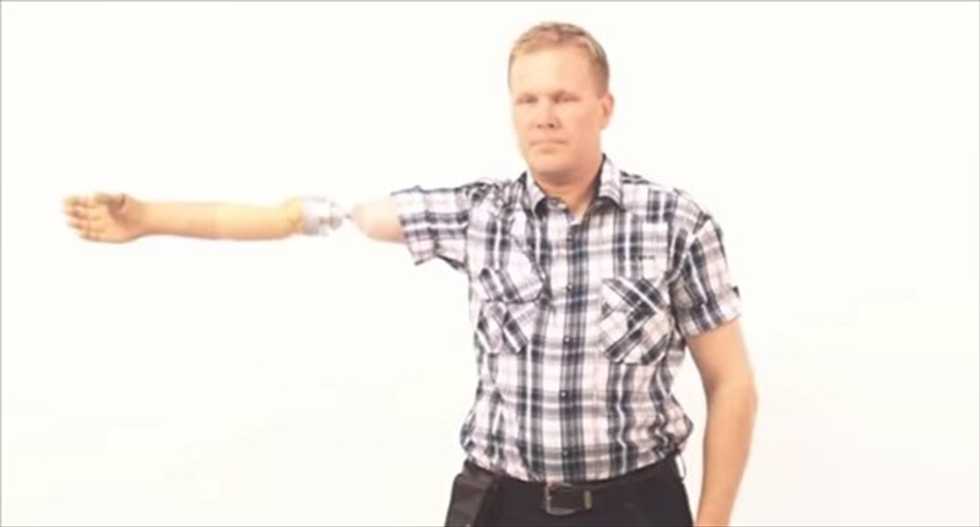
A pair of breakthroughs in the development of prosthetics are helping patients not only exert more control over their arms, but regain their sense of touch, the Daily Dot reported.
In one study, researchers at Chalmers University of Technology were able to heighten prosthetic control after developing a "percutaneous osseointegrated" interface by attaching the artificial arm directly to the subject's skeleton.
"With this interface, an artificial limb can be chronically driven by implanted electrodes in the peripheral nerves and muscles of an amputee, outside of controlled environments and during activities of daily living, thus reducing disability and improving quality of life," the group stated in a report for Science Translational Magazine.
The Chalmers team also released a video of a patient using the new interface and being able to do things like toss an object from one hand to another, since the system reduces "myoelectric interference" from his shoulder muscles.
"The opportunity to chronically record and stimulate the neuromuscular system allows for the implementation of intuitive control and naturally perceived sensory feedback, as well as opportunities for the prediction of complex limb motions and better understanding of sensory perception," their report stated.
Science Translational Magazine also released a report from a research team at Case Western University stating that they were able to help two patients regain their sense of touch in their arms, also through the use of implants.
"The two subjects reported tactile perceptions they described as natural tapping, constant pressure, light moving touch, and vibration," the Case Western team reported. "Changing average stimulation intensity controlled the size of the percept area; changing stimulation frequency controlled sensation strength."
One of the subjects, identified as Igor Spetic, also reported that the implants elminated the "phantom pain" he had experienced since losing his right hand in an industrial accident.
"Despite having phantom pain, both men said that the first time they were connected to the system and received the electrical stimulation, was the first time they’d felt their hands since their accidents," Case Western said in a statement. "In the ensuing months, they began feeling sensations that were familiar and were able to control their prosthetic hands with more -- well -- dexterity."
Footage of the Chalmers researchers' interface in action, as posted on Wednesday, can be seen below.
Video of Case Western's work with Spetic was also released online, and can be seen here.
