




The series of unfortunate events that began on Aug. 9, when a white police officer gunned down an unarmed black teenager in the street in Ferguson, Missouri, played out exactly the way we knew they would. The black teen's death was dismissed as an outcome unworthy of justice while the white police officer walked.
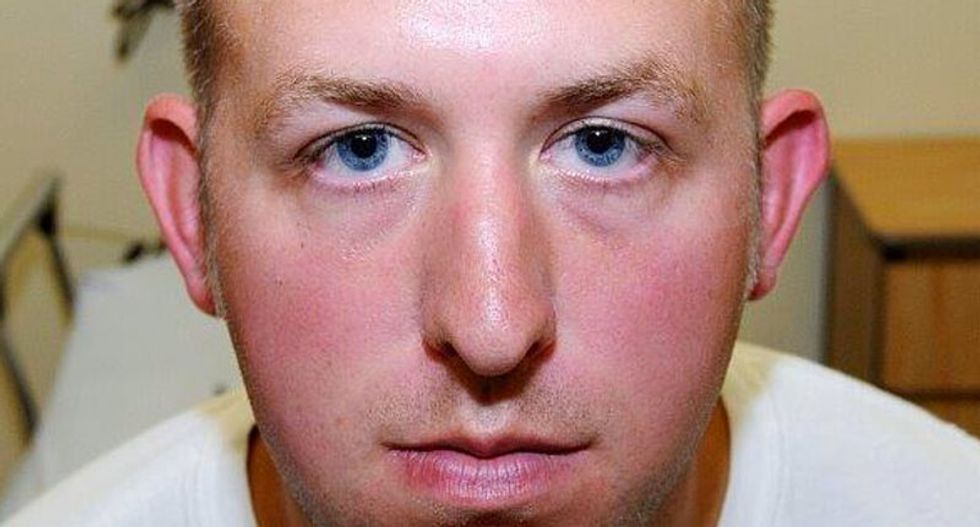
We all knew it this would end badly for everyone who is not Darren Wilson, an incompetent and panicky cop who squeezed off 12 shots, many when the victim was half a football field away, because he feared a punch from Michael Brown "could be fatal if he hit me right." Evidence of the Brown's death-dealing punching power can be seen in the medical examiner's photo seen above, although if it looks to you like someone who leaned on their own hand, elbow on the table for five minutes, you're not alone.
I don't hate cops. In fact I don't even like the word "cop," preferring 'police officer' because I have a lot of respect for anyone who takes on a thankless, mostly shitty job, that requires them to wear a six to eight pound Kevlar vest out the door everyday because someone might try to kill them. I have police officers in my extended family, one of my best friends has been a police officer for over twenty-five years, and my daughter recently graduated with a masters in criminal justice with an eye on going into federal law enforcement, although she could very well end up as a police officer. They're all good people working in a profession the public hates until they need them. Good police officers like them are hurt when bad police officers like Darren Wilson get away with murder.
You didn't need to have a background in courthouse procedures to know that something didn't seem right when St. Louis County prosecutor Bob McCulloch addressed the press Monday night. Instead of speaking as an advocate for the victim of crime who can no longer speak for himself, McCulloch sounded like a defense attorney cautiously explaining that his client was innocent all along, while inwardly suppressing his glee that he got a big win.
Wilson got away with murder because McCulloch wanted him to get away with it. He sandbagged the case instead of prosecuting it, throwing a mass of conflicting evidence at the grand jury, virtually tossing up his hands his and saying, "I don't know. What do you guys think?" The overwhelmingly white grand jury, inclined to side with a white police officer who believed his life was in imminent danger from a large black man, took the unfocused mass of testimony and conflicting statements and punted.
Questions about McCulloch were raised days after Brown was gunned down, with people clamoring for Missouri Governor Jay Nixon to appoint a special prosecutor without ties to St. Louis law enforcement to handle the case. Nixon, whose incompetence has been on display since the police went 'Armies of the Night' on Ferguson protestors months ago until his press conference a day ago, sat on his hands which seems to be the extent of his skill set as an administrator.
Given a nod and a wink, McCulloch, decided to take the case to the grand jury where he worked the almost impossible, thereby getting him off the hook for not pressing charges himself.
The prosecutor, whose police officer father was a shot down in the line of duty by an African-American man when McCulloch was only twelve, may very well have seen Michael Brown and Darren Wilson through the prism of his own life experience. As the saying goes: "revenge is a dish best served cold."
Despite the risks involved, Darren Wilson likely would have been better served had McCulloch charged him and taken him to a public trial where the whole world could see the evidence presented and the testimony given, instead of a very private and secret trial away from public scrutiny. Although McCulloch made public the transcripts, evidence, and testimony from the grand jury proceedings, what is lost is the dynamic of seeing and watching how questions are asked and answered. As we've seen countless times before, it's very likely a jury in public trial --which would doubtless have been moved -- would have let Wilson walk too, as they tend to side with police in the majority of cases where it is hard to quantify and dispute the fear of personal safety.
Not that that would have made Wilson's life post-trial any easier, as George Zimmerman can attest, but it would at least have removed the stigma of something that was hidden away from the public because it was shameful and unjust. Wilson is not off the hook yet, since the Justice Department is still mulling over federal charges, and Wilson and the Ferguson police department are undoubtedly facing a major civil suit, but his life is for all intents and purposes is over now.
Wilson is now the face of police officers gone bad, acting criminally and then walking away because a badge shields them from any repercussions of criminal activity. Previously the only image we had of Wilson was a fuzzy picture taken at an award ceremony a few years back. Now everyone in America knows his face because of the examiner's photo showing off his 'war wound.' Wilson, who just married a fellow police officer -- out on sick leave for the past few weeks due to "stress" -- a month ago will never work in law enforcement again. Despite support from some members in law enforcement, no one is going to touch the toxic cop with a history of violence. From this point forward he and his bride will spend the rest of their lives looking over their shoulder wondering where retribution will come from. They're going to be living in the cage built by his actions on Aug. 9.
From now on Wilson is going to be "Hey, aren't you that guy...?" and he'll have to wonder how it will play out from there. He's alive but his life is over and his future is full of uncertainty, fear, and paranoia.
As the saying goes: "revenge is a dish best served cold."
