




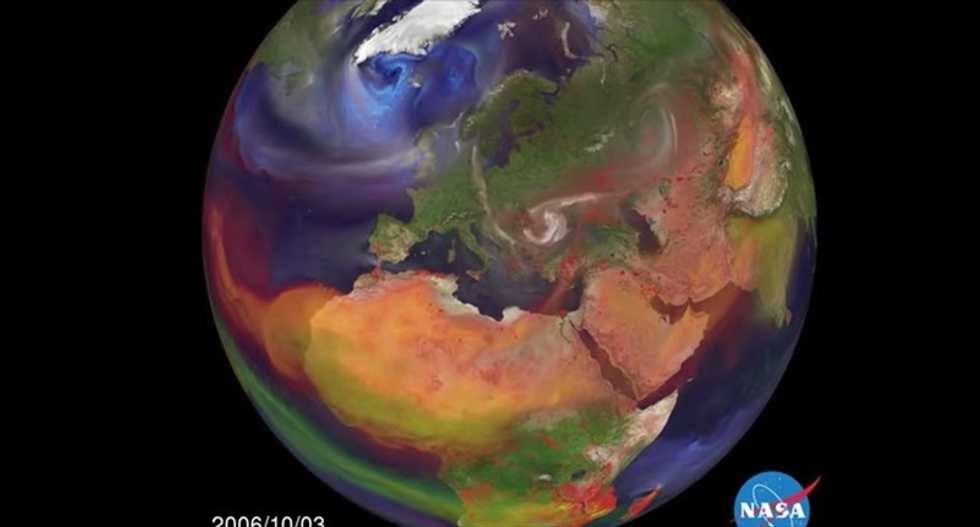
China's chronic pollution problem -- and its effect on the rest of the planet -- is vividly demonstrated in footage from NASA's Goddard Space Flight Center, Grist reported.
The footage tracks pollution particle movements between September 2006 and April 2007 with data from the agency's Earth Observer System satellite, and shows how the particles, also known as aerosols, make their way across the Pacific Ocean.
Researchers Jonathan Jiang and Yuan Wang determined that the particles' movement fuels water condensation as it goes, leading to stronger cyclones outside tropical areas.
Wang told NASA's Earth Science News that the increase in aerosol activity also impacts winter weather in the U.S., as it produces more intense storms on a weekly basis. He said he believed that an increase in "extrapacific" cyclones fueled the harsh winter storms that hit the U.S. in 2013.
"Large, convective weather systems play a very important role in Earth's atmospheric circulation," Jiang added. The duo is reportedly working on how pollution emissions from Asia affect regions outside of North America.
As Quartz reported last year, the Earth Observer System has also monitored the overall decrease of ice in the Antarctic, which parallels an increase in the amount of solar radiation hitting the region since 2000.
Watch the video demonstrating Jiang and Wang's findings, as posted online, below.
