




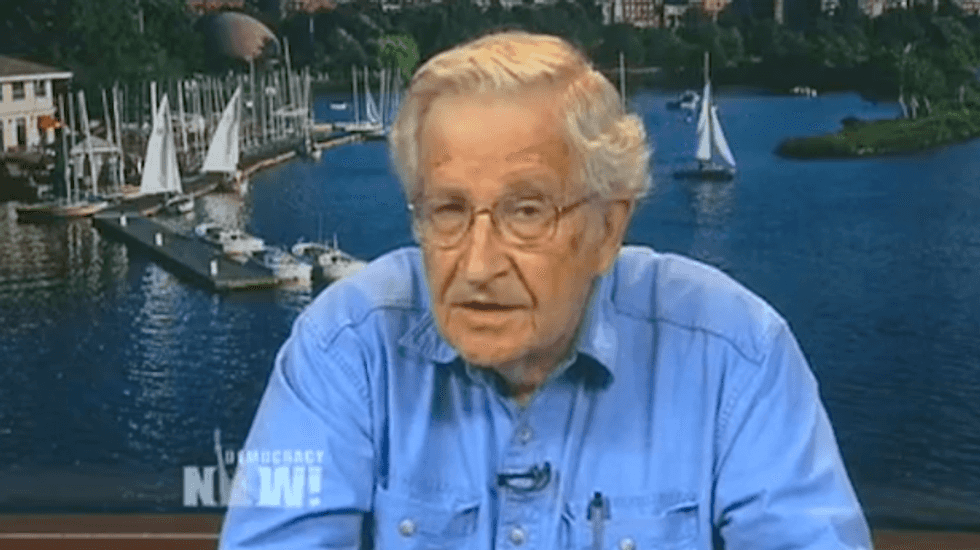
Activist and labor educator Noam Chomsky denounced what he described as the softening of the impact of slavery on U.S. history in footage posted on Tuesday by Democracy Now.
"It is a large part of the basis for our wealth and privilege," Chomsky told host Amy Goodman. "Is there a slave museum in the United States? Actually, the first one is just being established now by private—some private donor. I mean, this is the core of our history, along with the extermination or expulsion of the native population, but it’s not part of our consciousness."
Chomsky cited a book released last October by historian Edward Baptist that counters arguments that slavery was in decline as an industry before the Civil War.
What Baptist did, Chomsky said, was point out how slave owners actually managed to boost productivity to a higher degree than other industries by working their slaves almost to death.
"He also points out that the word 'torture' is not used in discussion of this period," he explained. "He introduces it should be used. I mean, these are camps that could have impressed the Nazis."
Chomsky argued that descriptions of the life and influence of Martin Luther King Jr. have been similarly downplayed, with many accounts of his work stopping after his "I Have A Dream" speech while ignoring his work on class issues, as well as the Washington D.C. march for the Poor People's Campaign he was organizing at the time of his death.
He noted that despite his death, the march went on, with the 50,000 or so participants establishing what they called a "resurrection city."
"This was the most liberal Congress in history probably, tolerated it briefly, then sent in the police in the middle of the night and drove them out of town," he told Goodman. "And that's disappeared from the rhetoric on Martin Luther King Day. So it's OK to condemn a racist sheriff in Alabama, but not us, please. Don't touch our privilege and power. And that's a large part of the background."
Watch Chomsky's remarks, as posted online on Tuesday, below.
