




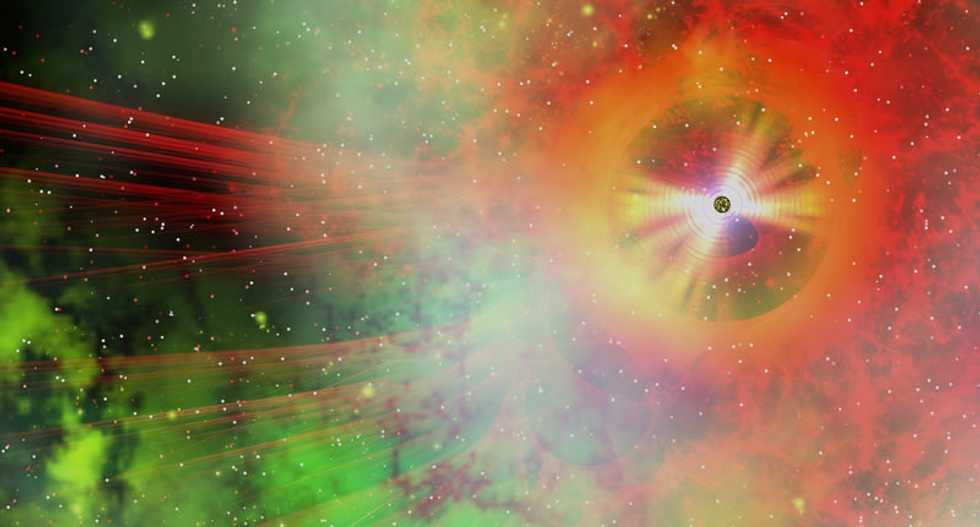
Australian scientists witnessed the same star explode not once, but four times thanks to a feature of Albert Einstein's theory of relativity that created a series of "cosmic magnifying glasses."
The exploding star -- a Type 1a supernova -- was obscured from direct observation by a cluster of galaxies whose mass was so great that it bent the light screaming out of the explosion.
In the video accompanying the press release, Brad Tucker from the Australian National University described the passage of the light through these massive galaxies as being akin to four trains all departing from the same place and headed to the same destination -- but along different routes.
The trains "leave at the same time, but some go over hills, some into valleys, some around mountains -- so they're taking different paths to get to the same destination."
The routes, in this case, are gravitational forces so massive that they have the ability to warp space-time.
Tucker described the discovery as a "dream," saying "it's the perfect set-up, you couldn't have designed a better experiment."
"You can test some of the biggest questions about Einstein’s theory of relativity all at once - it kills three birds with one stone."
Even better, Tucker said, because this "cosmic magnifying glass" made visible a supernova that would otherwise be too distant to observe, it provides researchers with a glimpse into a much different moment in the universe's formation.
"It’s a relic of a simpler time, when the universe was still slowing down and dark energy was not doing crazy stuff,” he said. “We can use that to work out how dark matter and dark energy have messed up the universe."
Watch an explanation of the "cosmic magnifying glass" via Australian National University on YouTube below.
