



The Department of Justice is stonewalling Business Insider political correspondent Natasha Bertrand's questions on the release of text messages between FBI career employees Peter Strzok and Lisa Page.
Less than 4 percent of the text messages were released to the public and Congress.
"The Justice Department recently released 375 text messages to Congress and the press that were exchanged between two career FBI employees — Peter Strzok and Lisa Page — during the presidential election," Bertrand explained. "But the department has failed to disclose a significant lingering question stemming from that release: how it chose which texts, of the more than 10,000 the department obtained over the summer, to unveil publicly.
"Nor has it released additional messages that could provide context to the ones that were shared with lawmakers and reporters last week," noted Bertrand, who is also a MSNBC contributor.
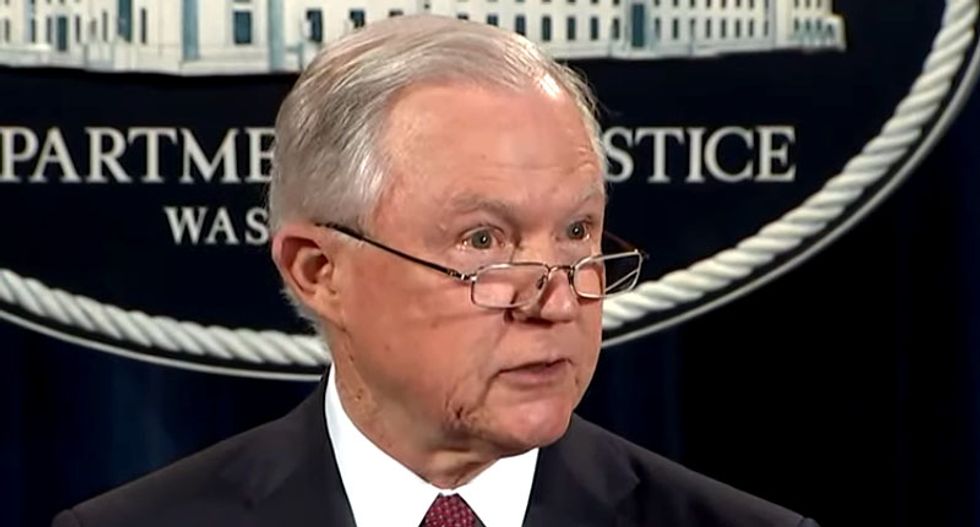
The Department of Justice, led by Attorney General Jeff Sessions, did not return Bertrand's request for comment. Bertrand has reported previously on DOJ's secret release to reporters, that DOJ claims the text messages "were not authorized" for release and additionally that DOJ Inspector General Michael Horowitz claims the department did not consult OIG prior to the release.
Former Deputy Assistant Attorney General William Yeomans questioned whether DOJ "selectively released only the most inculpatory texts."
"In my experience, it is highly unusual to release raw evidence in an ongoing investigation," Yeomans told Business Insider on Wednesday. "Avoiding the premature release of information is important as a matter of fairness to those involved in the investigation."
In the absence of comment on the process, Betrand wonders if the lack of transparency may be hiding a simple explanation.
"There is another plausible explanation for the texts, however, when all relevant context is taken into consideration. Page could have been suggesting how Strzok could hide their extramarital affair from his wife and plausibly explain why he was frequently texting on his government-issued phone," Bertrand noted. "Releasing the messages that preceded and followed Page's text could shed more light on what she meant. The DOJ — which said it released the texts to reporters in an effort to be transparent with the press — has not responded to requests from Business Insider for either the context of the conversation or an explanation for why that context was not provided."
Critics of the selective release worry it could harm the FBI and DOJ.
"This episode is especially troubling because DOJ generally goes to great lengths to protect its career attorneys and FBI agents from political interference, including this kind of premature exposure that foreseeably resulted in very visible embarrassment to agents and the FBI," Yeoman's explained. "Nothing is worse for morale and more likely to chill neutral and aggressive law enforcement than hanging agents and attorneys out to dry."
In outing the two career FBI employees for being political, DOJ may have inadvertently revealed their own political schenanigans.
Yeoman explained that, "giving the texts directly to the press is an unusual step that is inconsistent with law enforcement norms and raises concerns that the purpose was political."
