



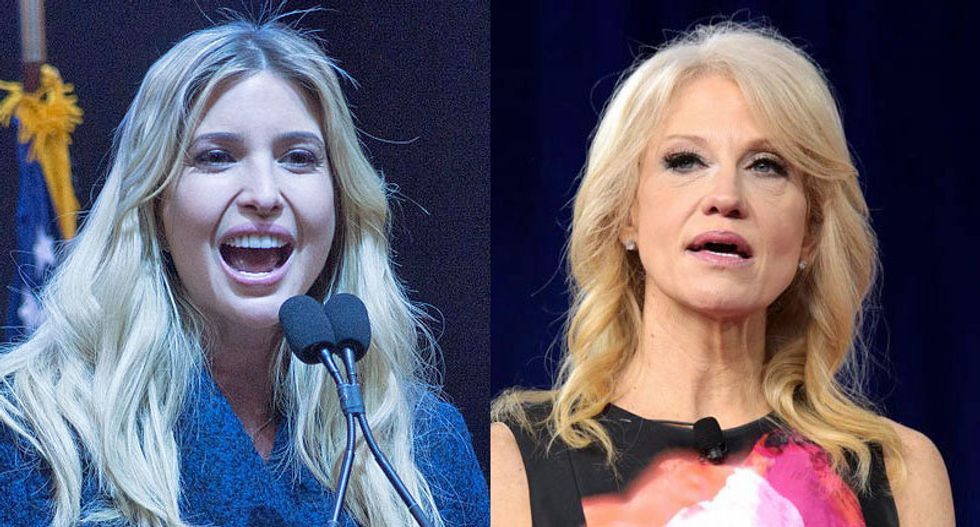
Multiple West Wing advisors sent voters scurrying to the dictionary during the first calendar year of the Donald Trump era, according to Merriam-Webster's editor-at-Large Peter Sokolowski.
Sokolowski was interviewed by National Public Radio to explain some of the top words of the year.
White House senior advisor Kellyanne Conway helped make 'feminism' the word of the year.
"The next big spike we saw was in February, when Kellyanne Conway said in an interview that she didn't consider herself a feminist," Sokolowski explained. "And that's the kind of thing that triggers dictionary curiosity because the word itself was the story."
White House senior advisor and First Daughter Ivanka Trump helped 'complicit' make the list.
"So what we have is, for example, complicit, the word that was used in a skit on Saturday Night Live about Ivanka Trump. And then the word was used in an interview with Ivanka Trump. And there in the interview she said, I don't know what complicit means," Sokolowski noted. "And you better believe that sends people to the dictionary."
Sokolowski says the dictionary has been compiling the list since 2003, but it all started decades ago.
"The real interesting story here is that we never had a measure of the public's curiosity until we put the dictionary online. And suddenly, we could see what words people were looking up and when. The first time this happened was just 20 years ago when Princess Diana died. And the word that was most looked up was paparazzi," Sokolowski recounted. "And so we were able to see what the public was really thinking about according to what they were looking up in the dictionary."
President Trump himself helped 'carnage' and 'covfefe' surge in lookups, NBC News reported. And ousted chief strategist Steve Bannon did the same for 'svengali.'
The list may be even more important in the Trump era.
"And that in an age of alternative facts and fake news, having a neutral arbiter of meaning ends up being pretty important to a lot of people. And turning to the dictionary in these moments is not just for spelling or pronunciation, but also maybe the beginning of reflection and philosophy," Sokolowski hoped. "I mean, the word love is one of the most looked-up words in the dictionary, and it's probably not for spelling."
Listen to NPR's Rachel Martin interview Merriam-Webster's editor-at-Large Peter Sokolowski:
