



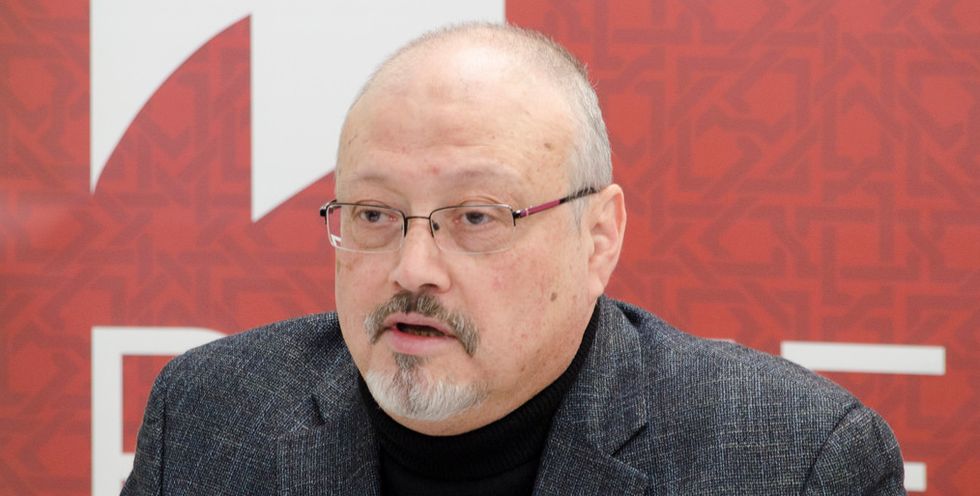
In his final column for the Washington Post, Saudi-born journalist Jamal Khashoggi envisioned an Arab world with free expression — a foreboding call in light of his likely murder at the hands of the Saudi government.
"There is only one country in the Arab world that has been classified as 'free,'" Khashoggi wrote, adding that "Jordan, Morocco and Kuwait come second, with a classification of 'partly free.'"
"The rest of the countries in the Arab world are classified as 'not free,'" he wrote.
In the Arab world, the journalist wrote, citizens are "either uninformed or misinformed" by the state-run media that "dominates the public psyche."
Khashoggi wrote of his "dear friend" Saleh al-Shehi, a celebrated Saudi writer serving a five-year prison sentence for his dissidence.
"These actions no longer carry the consequence of a backlash from the international community," he wrote. "Instead, these actions may trigger condemnation quickly followed by silence."
In an editor's note included with the column, Khashoggi's editor, Karen Attiah, wrote of the difficult path the op-ed took from draft to print.
"I received this column from Jamal Khashoggi’s translator and assistant the day after Jamal was reported missing in Istanbul," she wrote. "The Post held off publishing it because we hoped Jamal would come back to us so that he and I could edit it together. Now I have to accept: That is not going to happen. This is the last piece of his I will edit for The Post."
The column, Attiah added, "perfectly captures [Khashoggi's] commitment and passion for freedom in the Arab world."
It was "a freedom he apparently gave his life for," she noted, adding that she "will be forever grateful he chose The Post as his final journalistic home one year ago and gave us the chance to work together."
