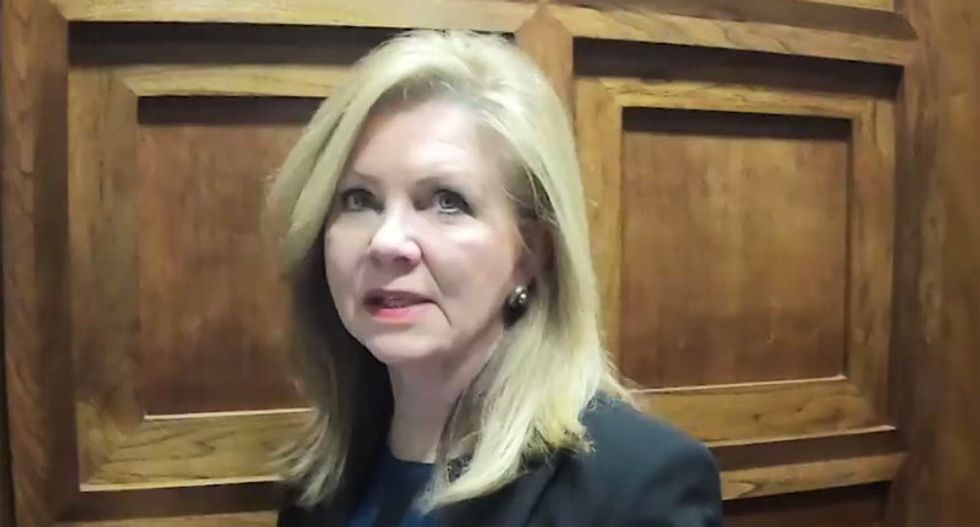
Rep. Marsha Blackburn (R) -- screenshot

At least a dozen Republican congressional campaigns used materials stolen from Democrats by Russian hackers during the 2016 election. Several other Republican campaigns received millions in contributions from an oligarch with close ties to Russian President Vladimir Putin. In 2018, the Democratic Congressional Campaign Committee called on the National Republican Congressional Committee to make a bipartisan pledge not to utilize stolen or hacked information in House elections. After months of negotiations, in September of 2018, House Republicans backed out and refused to sign the pledge. These are just some of the often-overlooked reasons why Republicans have been so reluctant to criticize President Trump’s willingness to accept “dirt” on an opposing candidate from a foreign government.
One day after Trump told ABC’s George Stephanopoulos that he wouldn’t necessarily go to the FBI in the event his re-election campaign is contacted by foreign groups, Senate Republicans killed legislation to safeguard American democracy from foreign interference.
Democratic Sen. Mark Warner, D-Va., failed in his attempt to unanimously pass a bill that would require candidates to report election assistance offered by foreign governments to federal officials. Under Warner's Foreign Influence Reporting in Elections (FIRE) Act, campaigns would have to report contacts with foreign nationals who are trying to make campaign donations or coordinate with the campaign to the Federal Election Commission, which would then notify the FBI. It’s already illegal for electoral campaigns to knowingly accept help from a foreign entity or power.
"This legislation is pretty simple, even for this body. It would require that any presidential campaign that receives offers of assistance from an agent of a foreign government has an obligation to report that offer of assistance to law enforcement, specifically the FBI," Warner said on Thursday. “We ought to make clear that if any foreign power tries to intervene again in an election, the least we can do is ask for a requirement to report it to law enforcement.”
Warner’s request for unanimous consent to pass a bill that would make it illegal not to report an offer of foreign help was blocked by Sen. Marsha Blackburn of Tennessee, a Republican elected last year. (She replaced Trump critic Bob Corker, who retired rather than run again.)
“All of us know, if you were to ever be contacted by a foreign entity, your first call is the FBI,” Blackburn had said to reporters hours before blocking the bill. “I don’t care if it’s Russia, Norway, China, whomever.”
Blackburn, who was a part of the Trump transition team, explained her objection to a bill that would make it harder for a person to cheat their way into a position as an effort to protect campaign contractors, door knockers and — most curiously — the group of undocumented immigrants known as Dreamers.
“We are all for free and fair and honest elections. These reporting requirements are over-broad," Blackburn said. "Presidential campaigns would have to worry about disclosure at a variety of levels. So many different levels.” Blackburn complained that "the unanimous consent that was presented is over-broad, and this is something should be done in a thoughtful way. It should be done in a bipartisan way."
But unanimous consent is bipartisan, by definition. If she wanted to be bipartisan, she could have allowed the law to go through. But the issue of allowing foreign interference in our elections seems wholly partisan now.
Report typos and corrections to corrections@rawstory.com.
For customer support contact support@rawstory.com.