




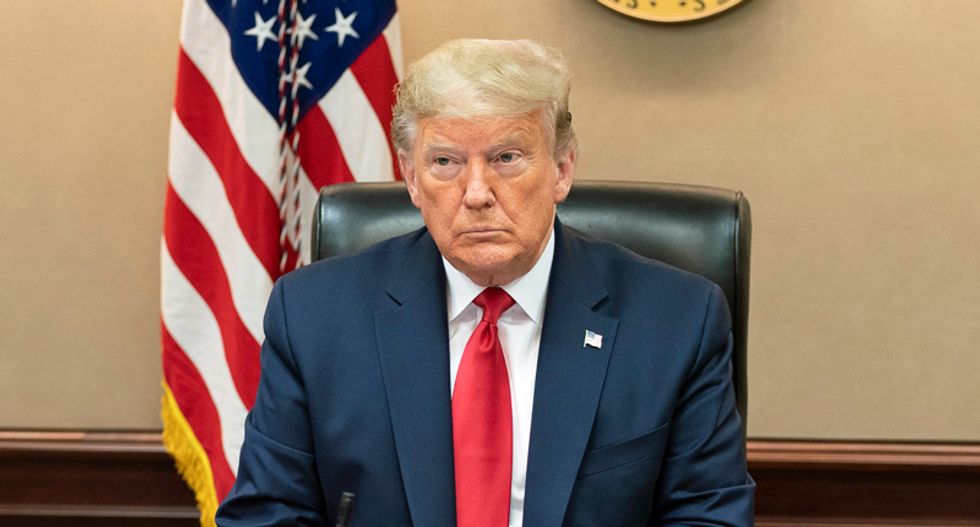
The New York Times reported Thursday that one of the greatest obstacles for President Donald Trump in responding to the coronavirus crisis has been that he is missing so many crucial staff in key positions.
There are a total of 75 senior positions in the Department of Homeland Security, 20 are either vacant or filled by "acting" officials, including acting Secretary Chad Wolf. He was the most recent Trump official who struggled under questioning by the U.S. Senate about how many respirators and protective masks were available from the federal government.
When people breached the 6-foot distance requirement to see the cherry blossoms at the Washington, D.C. Tidal Basin, there was no director at the capital region's National Park Service. The department is like many agencies, full of vacancies.
Workers at the Department of Veterans Affairs don't have any experience in disaster response. They failed to prepare for the overwhelming number of cases they would face at VA hospitals. They're desperately trying to buy medical supplies on Amazon. Senior officials said they have no idea whether they should continue to refuse care and send veterans back into the community for healthcare. They explained that they only learn about updates the news media about what they're supposed to do.
Secretary Robert Wilkie is one of those at the VA with no experience in emergency management. His second in command, however, had worked on past disasters, but he was fired recently. The head of emergency preparedness at the VA retired.
"Empty slots and high turnover have left parts of the federal government unprepared and ill equipped for what may be the largest public health crisis in a century, said numerous former and current federal officials and disaster experts," wrote the Times.
A whopping 80 percent of the senior positions at the White House below cabinet level, have turned over since Trump took over. About 500 people have left the administration since the inauguration.
In just three years, Trump is on his fourth chief of staff, his fourth national security adviser, and fifth Homeland Security secretary.
"Between Mr. Trump’s history of firing people and the choice by many career officials and political appointees to leave, he now finds himself with a government riddled with vacancies, acting department chiefs and, in some cases, leaders whose professional backgrounds do not easily match up to the task of managing a pandemic," the Times explained.
“Right now for the life of me, I don’t know who speaks for DHS,” said former Secretary Janet Napolitano, who served under President Barack Obama. “Having nonacting leadership, and I think having consistency in your leadership team and the accumulation of experience, really matters. And I think it would be fair to say the current administration hasn’t sustained that.”
People who are new to the administration or working in government don't have relationships with private sector CEOs and with lawmakers, who they would normally seek out to coordinate efforts and assistance.
Former homeland security adviser and longtime disaster expert Thomas Bossert was ousted in 2018 by John Bolton. His position was never filled, it was merely folded into the office that handles weapons of mass destruction.
For all of his scandals, Scott Gottlieb leaving the FDA put oncologist Dr. Stephen M. Hahn in charge. Hahn struggled to answer questions, while Gottlieb has been advocating for broad coronavirus testing.
Ken Cuccinelli at Homeland Security scared the public last month when he began asking for information about coronavirus on Twitter. He said he didn't have access to a Johns Hopkins University map of the virus’s spread. It prompted many to ask why Cuccinelli didn't have data from within the administration to consult.
Even the Pentagon faces problems. More than one-third of civilian positions are vacant.
Now the IRS is facing a huge responsibility of getting people the stimulus money from the package that should be passed by Congress by Friday.
"The tax collection agency has faced deep cuts to its budget over the last decade, leaving some of its technology out of date," the Times reported. "Now the IRS must cope with Tax Day being delayed by three months and a deluge of questions from confused taxpayers calling employees that are teleworking. The shortfall in staff is likely to be especially problematic as the Treasury Department tries to send stimulus money to Americans by using the IRS’s taxpayer database to track them down."
