




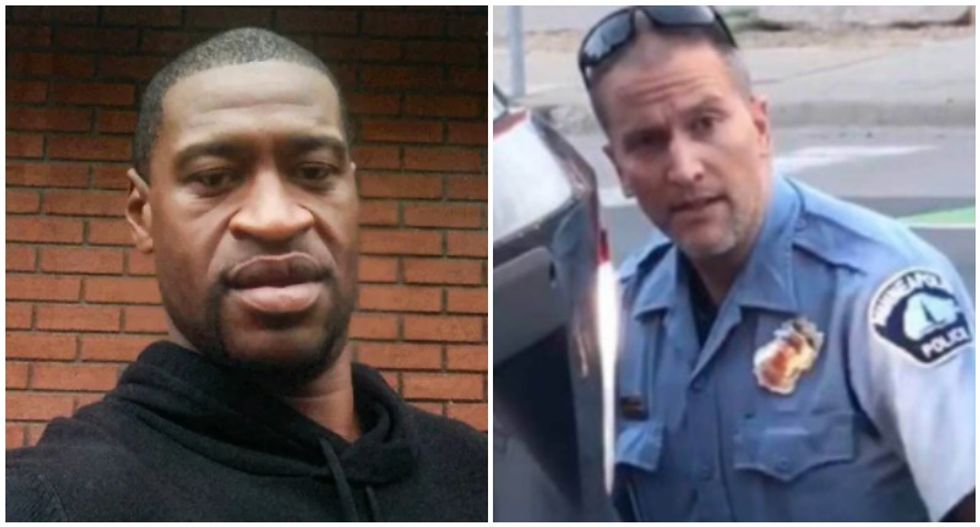
In the wake of George Floyd's death at the hands of Minneapolis police, critics are taking a close look at the technique, or lack thereof, to restrain him. Writing in the New York Times this Friday, Neil MacFarquhar writes that for police trainers and criminologists, Floyd's death "appears to be a textbook case of why many police departments around the country have sought to ban outright or at least limit the use of chokeholds or other neck restraints in recent years: The practices have led too often to high-profile deaths."
Speaking to the Times, former police trainer Mylan Masson said that the use of chokeholds and neck restraints "is a technique that we don’t use as much anymore because of the vulnerability."
According to the manual of the Minneapolis Police Department, neck restraints and chokeholds are basically reserved for when an officer feels like they're in a life or death situation. But as numerous reports have pointed out, that apparently was not the case during Floyd's arrest.
"Criminologists viewing the tape said the knee restraint not only put dangerous pressure on the back of the neck, but that Mr. Floyd was kept lying on his stomach for too long. Both positions — the knee on the neck and lying face down — run the risk of cutting off someone’s oxygen supply," MacFarquhar writes.
Nevertheless, department records show that such restraint practices continued to be used in Minneapolis.
"In 2012, there were 79 occurrences and in 2013, there were 69," MacFarquhar. "That dropped to 40 in 2018 and was back up to 56 last year. The technique was used against African-Americans far more than other groups, the records show."
Read the full op-ed over at The New York Times.
