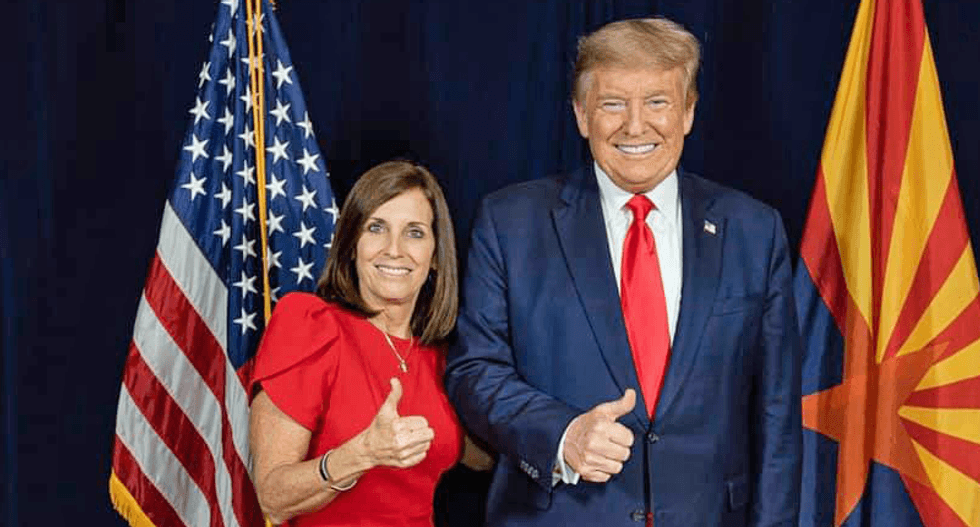
Sen. Martha McSally and Donald Trump (Facebook)

Arizona has been on the verge of turning into a blue state for years. Now even some Republicans believe that President Trump's sagging popularity amid the coronavirus pandemic and the worst economic crisis in a lifetime could flip the state to the Democrats.
Arizona has long been to Democrats what "Lucy's football was to Charlie Brown," wrote FiveThirtyEight's Nathaniel Rakich. The party has spent millions trying to win the state and media outlets have argued that "this year" would be the year Democrats finally flip Arizona since at least 2004. It hasn't happened. Democratic nominee Joe Biden would become just the second Democrat to carry the state since 1948 if he can pull off a win, and Arizona would have two Democratic senators for the first time since 1953 if Sen. Martha McSally, a Republican appointed to her seat by Gov. Doug Ducey, loses her race to retired astronaut Mark Kelly.
Unlike in past years, rising turnout, a changing electorate and Republicans' widely-criticized response to the pandemic have the GOP worried that Democrats won't just build on their 2018 success, when Sen. Kyrsten Sinema became the first Democrat to win an Arizona Senate race since the 1980s, but could even flip both chambers in the state legislature.
That's "certainly within the realm of possibility," Paul Bentz, a longtime Republican strategist at the firm HighGround, told Salon. Bentz was campaign manager for former Gov. Jan Brewer in 2010.
"There are two [State] Senate seats that are vulnerable," Bentz said, and it's the "same thing on the House side." He said he could imagine "a world in which both chambers ended up equally split … which would be unbelievable, but there's a pathway towards that. That might happen."
Democrats are "very confident" of their chances to flip the state legislature, Felecia Rotellini, the chairwoman of the Arizona Democratic Party, told Salon.
"Both chambers are on the precipice of turning blue for the first time in 50 years," she said. "We need three seats in the Senate and two in the House to gain control. We are fighting for each and every seat and the path to achieving these majorities is clear."
The fate of the state legislature is likely tied to the fortunes of Trump and McSally in the federal races. Recent polls of Arizona have been fairly split between Biden and Trump but have consistently shown McSally trailing Kelly, often by significant margins.
"I definitely think they are both in for an incredibly difficult race," Bentz said. Republicans lost their longtime voter participation advantage in 2018 and Democrats have "caught up with Republicans in the state," he said.
The pandemic has worsened the situation for the party.
"Before the pandemic, Arizona had one of the best and fastest-growing economies," Bentz said. "I definitely think the pathway for success for the president was better than it is now, especially with everything slowing down and unemployment. I think between the two … the president has a better chance of winning Arizona right now than McSally does. His base is more supportive of him."
Rotellini said that "Arizonans are fed up" with Republicans' "failure to control the spread of the virus." Along with Trump's widely-criticized federal response, Republican Gov. Doug Ducey has seen his approval rating plummet into the 30s after infections spiked following the state's early reopening.
"Arizonans know that until we get the pandemic under control, the economy can't fully recover," Rotellini said. "Arizonans are tired of the wishful thinking with no plan of how to truly curtail the spread of this virus. They want leaders who are ready to roll up their sleeves and do the work."
Arizona has been trending toward Democrats for years. Former President Barack Obama lost the state by 11 points in 2012 before Hillary Clinton narrowed the margin to three points in 2016. Two years ago, Sinema became the first Democrat to win statewide in a decade as turnout surged to the highest level in 36 years. Turnout is expected to rise even more after more than 580,000 Democrats voted in the state's presidential primary, up more than 110,000 from 2016, according to data provided by the state's Democratic Party. Democrats saw registrations grow by 9% between 2016 and 2018 and that number climbed to 16% ahead of the primary. Turnout this year was also bolstered by a surge in voting by mail. While many Arizona voters have voted by mail in the past, Democratic turnout surged from 29% in the 2018 primary to 40% in this year's primary.
Rotellini told Salon that "2018 proved that Arizona is a battleground state and that Democrats can win when we organize, invest, and build an operation to elect leaders who will put people first."
"We elected the first Democratic U.S. senator from Arizona in 30 years, secured three additional statewide victories, flipped a U.S. Congress seat blue — giving us a 5-4 Democratic congressional delegation majority — and increased Democratic representation in the state legislature," she said. "Now, in 2020, we've doubled-down on this strategy. We began organizing earlier than ever before, are building the largest Democratic organizing effort in our party's history and we have phenomenal leaders like astronaut Mark Kelly."
Rotellini said the party's investment in digital organizing has paid off amid the pandemic and organizers have seen that voters' "enthusiasm is real."
"People of all walks of life are reaching out to get involved," she said. "The election in 2016 was close, Trump only won by 3.5%, and has spent most of his administration trying to take away health care coverage from hundreds of thousands of Arizonans while he's failed to confront COVID-19. It's clear he's not up for the job. Arizonans recognize that, and they are motivated to elect new leadership."
Numerous progressive groups have worked to register hundreds of thousands of new voters. One Arizona, a group launched after the passage of SB1070, the controversial immigration law that was later struck down by the Supreme Court, organized to register previously "disenfranchised" Latino voters. The group reported registering more than 190,000 people to vote in 2018. The group had already registered 35,000 new voters before moving their operations online after the pandemic struck.
"It has been a grind to say the least but we have kept pushing since March and our coalition member organizations have stayed optimistic and creative," Montserrat Arredondo, the group's executive director, told Salon. "I think we will get close to that same number this year."
Report typos and corrections to corrections@rawstory.com.
For customer support contact support@rawstory.com.