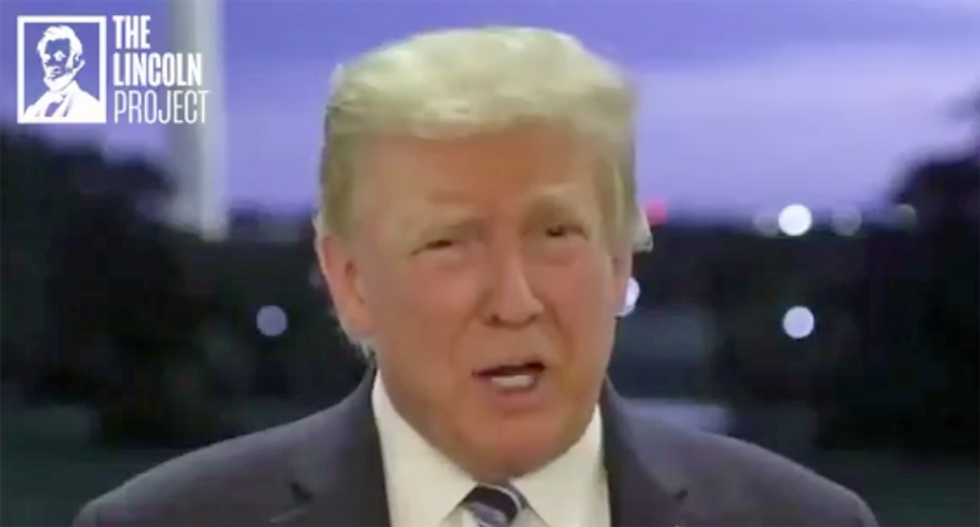
WATCH: Lincoln Project responds to Trump's new COVID message with brutal new video

WATCH: Lincoln Project responds to Trump's new COVID message with brutal new video
President Donald Trump (screengrab).

President Donald Trump's latest message on COVID-19 after being hospitalized at Walter Reed Medical Center for three nights.


Trump first pushed his news message on Twitter.

"Don’t be afraid of Covid. Don’t let it dominate your life," Trump told his 87 million Twitter followers.

He repeated the message during a video address he posted after being airlifted back to the White House from Walter Reed Hospital.

"One thing that's for certain, don't let it dominate you. Don't be afraid of it. You're going to beat it, we have the best medical equipment, we have the best medicines," Trump argued, despite the death over over 210,000 Americans.

"Don't let it dominate, don't let it take over your lives, don't let that happen," Trump instructed. "I know there's a risk, there's a danger, but that's okay."

That message was set to sad music by the Lincoln Project while photos of coffins were shown on-screen.

For customer support contact support@rawstory.com. Report typos and corrections to corrections@rawstory.com.

President Donald Trump has shown the immense power of the executive branch to stymie offshore wind development, as nearly all projects are in waters where federal agencies operate as the landlord.

Now, as the feds block new permits and dangle billion-dollar buyout offers to convince developers to walk away from their projects, state leaders are hoping some companies share their conviction that the industry can be revived after Trump leaves office.

“Any honest assessment of where we need to be to meet our climate goals depends on a thriving offshore wind sector,” said New York state Sen. Andrew Gounardes, a Democrat.

New York and many other East Coast states have set aggressive targets for offshore wind power, both to meet rising energy demands and transition to clean energy sources. But Trump’s attacks on the industry threaten to scare off companies from making the massive long-term investments required to pursue offshore wind projects.

“If there’s no business opportunity here, then they’re not going to stay here and invest here,” Gounardes said. “They’re not going to lay around with good intentions doing nothing, and we’re going to lose out because of that.”

Federal opposition

Last week, Trump’s Department of the Interior announced a $129 million deal with Duke Energy to relinquish its lease to build an offshore wind farm off the coast of North Carolina. The company pledged to reinvest the money into other forms of energy.

Since March, Trump officials have struck four such agreements totaling more than $2.5 billion to get developers to give up on their offshore wind plans. Some analysts say the federal government’s ability to blockade pending projects has caused some companies to reconsider their investments.

“If you have a lease that appears to be going nowhere for at least the next three years, you want to pivot to other options,” said Timothy Fox, managing director at ClearView Energy Partners LLC, an independent research firm. “There’s still a lot of leases out there, but the Trump administration has made this aggressive push, and we think there could be future similar announcements.”

According to Fox, developers hold leases for roughly two dozen other offshore wind areas, agreements that could be targeted for similar buyout deals.

While developers consider buyout offers from the federal government, state leaders say such deals are illegal. Seven states filed a lawsuit earlier this month saying the administration lacks the authority to cancel the leases and pay out funds, focused on a March deal with TotalEnergies to block a project off of New York.

The lawsuit challenges the administration’s use of a federal fund set aside to pay court judgments and settlements of lawsuits against the government. The deal, state attorneys general argue, “is not the result of a compromise settlement between adverse parties, but rather an agreement resulting from [federal officials’] pretextual national security concerns and TotalEnergies’ desire to receive unauthorized compensation for an expensive offshore wind lease.”

The state of California has also announced that it intends to file a lawsuit over another buyout targeting a lease area off the state’s Pacific coast.

Since taking office, Trump has halted permits and leases for other planned offshore wind projects, canceled hundreds of millions in funding to support manufacturing and ports and ended clean energy tax credits. His administration also issued stop-work orders for five offshore wind projects that were already under construction, but courts have overturned those orders and allowed work to resume.

Aside from the five wind farms currently being built, progress on dozens of other pending projects has ground to a halt.

“There’s little to be done if the federal government still controls the permits, leases and pace of development,” said Fox, the researcher.

State goals

The clash comes as many East Coast states have been counting heavily on the maturation of the offshore wind industry to meet their energy needs. Eight Atlantic states have committed to building more than 45 gigawatts of offshore wind by 2040 — enough to power more than 30 million homes. They’ve made major investments in ports, manufacturing facilities, transmission infrastructure and workforce training.

In addition to their climate goals, many states are facing surging energy demands, largely driven by data centers and artificial intelligence.

State leaders say that offshore wind farms can harness massive amounts of electricity, especially during nighttime and winter periods when solar power is in short supply. For heavily populated East Coast states, with limited areas to put sprawling energy projects on land, tapping into strong winds over the ocean has become a major part of their strategy.

“Offshore wind is key to a future that allows us to move off of fossil fuels,” said Maryland state Del. Lorig Charkoudian, a Democrat who has been a strong backer of offshore wind. “Every time the (Trump administration) makes these moves, it reminds me that their numbers show how much offshore (wind) would allow us to retire fossil fuel plants.”

Trump has long opposed offshore wind, falsely asserting that it harms whales, is unreliable and drives up energy costs. While offshore wind generation is intermittent, it has a much higher capacity factor than onshore renewables, meaning that it operates for longer periods at its maximum output level. New offshore wind projects have capacity factors that match some gas and coal-fired power plants, according to the International Energy Agency.

While still more expensive than onshore renewables, offshore wind projects globally produce electricity at a rate cheaper than natural gas and coal plants, according to Energy Solutions Intelligence, a digital consulting platform.

Backers and energy analysts say offshore wind in the U.S. should become cheaper over time as supply chains mature and investments in ports and other infrastructure pay off.

The Department of the Interior did not grant a Stateline interview request about its buyout deals for offshore wind projects, but the agency has claimed in statements that the deals will lower energy prices.

Changing plans

Many state leaders acknowledge that the delays caused by Trump’s opposition will cause them to miss their targets for building new projects over the next 5 to 10 years. But they say the industry is still essential for meeting their long-term climate goals and energy needs.

“I don’t think anyone is at the point of saying no offshore wind ever again,” said Gounardes, the New York lawmaker. “It might not be part of the alchemy in the near future, but it certainly must be part of the alchemy to meet our overall goals.”

For now, state leaders are hoping their ongoing commitments to offshore wind will convince developers to wait out the remainder of Trump’s term and stay in the U.S. market.

“[The buyouts] are a blow to the industry, but it’s not a death knell but there are other projects out there that are still in some stage of development,” said Sam Schacht, project director for offshore wind with the Clean Energy States Alliance, a nonprofit coalition of state energy agencies.

“There’s this bad news story happening about the attempts to erode these future projects, while at the same time there’s a very positive story about the projects that are under construction and producing power now and their ability to capably meet states’ power demands.”

While states play the waiting game with offshore wind, they’re making new plans to meet their energy needs in the near term. Lawmakers in Maryland have invested in battery storage, which Charkoudian described as a “no-regrets” option that can help meet energy needs today while complementing offshore wind once it comes online.

Other states, including New York and New Jersey, have looked at increasing subsidies for nuclear power.

“I wouldn’t say that they’re giving up on offshore wind, but states are pivoting to other carbon-free resources that are favored by this administration, namely nuclear power,” said Fox, the energy researcher.

THANKS FOR SUBSCRIBING! ALL ADS REMOVED!

An extremism researcher is calling Turning Point USA's decision to stream its founder's murder hearings on the dead man's own social media account "psychotic."

Turning Point USA revived Charlie Kirk's X account Monday to broadcast a week-long probable cause hearing for Tyler Robinson — the man charged with Charlie Kirk's murder. The first day's post drew 2.7 million views.

Charlie Kirk, TPUSA's co-founder, was shot and killed at a Utah Valley University event in Provo, Utah, in September 2025. Robinson faces the death penalty.

"Absolutely psychotic decision from TPUSA to livestream preliminary hearings for Tyler Robinson on the zombified account of the man he's accused of killing," extremism researcher Jared Holt wrote on Bluesky.

"Why would they do this?" Holt added in a second post. "Well, my friend, may I direct you to the ticker that says there are 112.5k views on that livestream. That is the only measure of morality/success that TPUSA considers."

University of North Georgia rhetoric professor Matthew Boedy agreed, calling it the best way to "silence Candace and the conspiracies" — a reference to right-wing podcaster Candace Owens, who has spent months pushing baseless theories that TPUSA was complicit in Charlie Kirk's killing.

"Though TPUSA emphasis on 'seeking the truth' is a bit much," Boedy added. "They are being eaten by their own conspiracy skills being used against them."

Since Charlie Kirk's death, Erika Kirk — his widow and TPUSA's new CEO — has fired more than 60 staffers in what survivors called the "TPUSA Purge," according to published reports.

"I just have a gut feeling that I was terminated from Turning Point because I am questioning the narrative of what happened to my role model and CEO, Charlie Kirk, on the day of his assassination," former TPUSA communications staffer Aubrey Laitsch said publicly after her firing.

The hearing — a proceeding to determine whether prosecutors have enough evidence to take Robinson to trial — is scheduled to continue through Friday.

Federal judges Tuesday smacked down a controversial Florida law that aimed to control what professors discuss in their classrooms.

In a blistering 2-1 decision, the Eleventh Circuit Court of Appeals torched Florida's "Individual Freedom Act," a law barring public university instructors from "endorsing" a list of eight banned concepts about race, sex, and privilege, ruling it violates the First Amendment.

The law sought to prohibit specific concepts, including that one race or sex is morally superior to others, a person is inherently racist or sexist, or that a person is an oppressor or is privileged based on their race or sex.

Judge Britt Grant wrote that the Sunshine State cannot ban instructors from endorsing viewpoints the state disfavors.

"Though the government has plenty of ways to promote its own viewpoint, puppeteering every university professor in the state is not one of them," Grant wrote.

"For its part, Florida seeks to evade any First Amendment limitations at all by rigging together several speech doctrines to create a new rule that would quietly remove all free speech protections from the classroom," according to the court opinion. "Because the government pays the professors’ salaries, Florida says, their speech is the State’s speech. Emphatically no. The Florida defendants cannot 'put together half a donkey and half a camel, and then ride to victory on the synthetic hybrid.'"

{{ post.roar_specific_data.api_data.analytics }}