


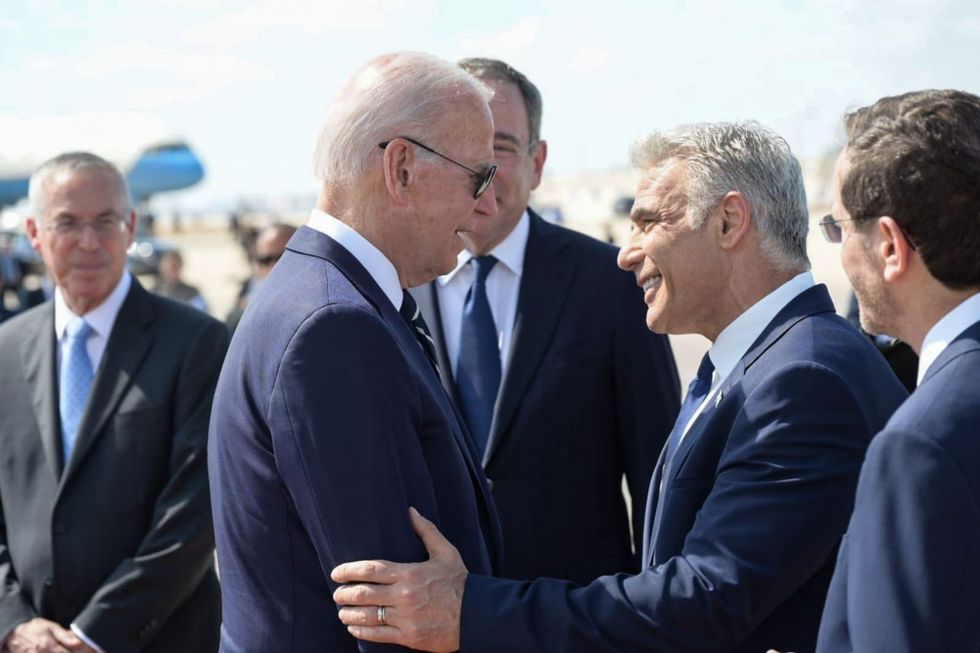
US President Joe Biden reaffirmed his support for a two-state solution to the decades-long conflict between Israel and the Palestinians as he visited the West Bank, but admitted that achieving such a durable peace was not in the cards any time soon.
"The Palestinian people deserve a state of their own that's independent, sovereign, viable and contiguous," he said after meeting with Palestinian President Mahmoud Abbas in Bethlehem on Friday.
Biden said this would lead to an "equal measure of security, prosperity, freedom and democracy" for both sides. And yet the time was not right to re-energize peace talks that have lain dormant since 2014.
"Even if the ground is not ripe at this moment to restart negotiations, the United States and my administration will not give up on bringing the Palestinians and the Israelis, both sides, closer together," he said.
A two-state solution has been sought since the mid-1970s and is seen internationally as the framework to resolve the conflict. Broadly, it envisions a sovereign Palestinian state alongside Israel with Jerusalem as their shared capital.
But the hurdles have become so high that many observers say it is no longer viable. First and foremost of the so-called "final status issues" are sharply differing ideas as to the borders and what will become of Jerusalem. Deep-seated mistrust and Israeli security concerns are also hindering progress.
Israel conquered the West Bank and East Jerusalem in 1967. Around 600,000 Israelis live there today in more than 200 settlements. In 2016, the UN Security Council described these settlements as a violation of international law.
Abbas said that peace and security in the region starts with "the recognition of the state of Palestine."
He urged Biden to press Israel to halt its expansion of settlements and begin withdrawing from the West Bank. He also demanded that Palestinian refugees be given the right to return to Israel and occupied areas.
Biden was on the third day of his first trip to the Middle East as president. While in Bethlehem on Friday, the devout Catholic visited the Church of the Nativity, where Christians believe Jesus was born.
Earlier on Friday, during a visit to Augusta Victoria Hospital in East Jerusalem, Biden promised more US financial assistance to ensure improved access to health care for Palestinians.
He said his administration would commit a total of $100 million to a network of hospitals serving Palestinians in East Jerusalem, although the aid package must still get the approval of the US Congress.
Biden also announced an additional $201 million for the UN Relief and Works Agency for Palestine Refugees to continue delivering aid services in the West Bank, Gaza, Jordan, Lebanon, and Syria.
After meeting with Israeli leaders on Wednesday and Thursday, and then top Palestinian officials on Friday, Air Force One took off from Ben Gurion Airport near Tel Aviv bound for Saudi Arabia.
His visit to the coastal city of Jeddah will be the most closely watched leg of his trip. Biden is to meet with the kingdom's leaders - including King Salman and Crown Prince Mohammed bin Salman - on Friday evening.
On Saturday, Biden planned to attend a summit of the Gulf Cooperation Council. The political and economic bloc comprises Bahrain, Saudi Arabia, Oman, Qatar, Kuwait and the United Arab Emirates.
The visit to the conservative kingdom, where political rights and civil liberties remain highly restricted, has garnered criticism in the US.
When asked, Biden would not commit at a press conference in Jerusalem on Thursday whether he would raise the brutal murder of Washington Post journalist Jamal Khashoggi with the crown prince.
US intelligence officials have concluded that the crown prince ordered the killing of Khashoggi at the Saudi consulate in Istanbul in 2018.
During the 2019 election campaign, Biden promised to hold the leadership in Riyadh accountable and to make Saudi Arabia a "pariah."
But barely four months before congressional elections, Biden is under enormous pressure back in the US because of rapidly surging fuel prices. Saudi Arabia is one of the world's largest oil producers.

