MacKenzie Scott, the ex-wife of Amazon founder Jeff Bezos, on Tuesday said she has given nearly $1.7 billion to groups devoted to race, gender and economic equality as well as other social causes.
Scott, who formerly went by the name MacKenzie Bezos, last year signed a "giving pledge" to donate the bulk of her wealth to charity.
She disclosed donations she has made to more than 100 nonprofits since then in a post on the website Medium.
"I gave each a contribution and encouraged them to spend it on whatever they believe best serves their efforts," said Scott, who was left a multi-billionaire after her divorce last year from Bezos.
"Every one of them is tackling complex challenges that will require sustained effort over many years, while simultaneously addressing consequences of the Covid-19 pandemic."
The largest portion of her philanthropy went to groups devoted to racial equity, which received slightly more than $586 million, according to the post.
Another $399 million in donations went to nonprofits focused on economic mobility, while the remainder went to causes including public health, gender equity, gay rights, democracy and the battle against climate change, the list indicated.
"Like many, I watched the first half of 2020 with a mixture of heartbreak and horror," Scott said.
"Life will never stop finding fresh ways to expose inequities in our systems; or waking us up to the fact that a civilization this imbalanced is not only unjust, but also unstable."
Twitter has announced it’s taking sweeping action to limit the reach of content associated with QAnon. Believers of this fringe far-right conspiracy theory claim there is a “deep state” plot against US President Donald Trump led by Satan-worshipping elites from within government, business and media.
Twitter has banned more than 7,000 accounts tweeting about QAnon, citing violations of its multi-account policy, coordinated abuse targeting individual victims, and attempts to evade previous account suspensions.
The platform also said it would stop circulating QAnon-related content, including material appearing in trending topics, recommendation lists and the search feature. It will also reportedly block web links associated with QAnon activity.
These actions, which could impact as many as 150,000 accounts globally, are part of Twitter’s wider crackdown on misinformation and “behaviour that has the potential to lead to offline harm”.
However, according to CNN reporter Oliver Darcy, many of the actions are not being extended to “candidates and elected officials”. Regardless, history suggests the threat of online conspiracists is a difficult one to tackle.
How it all began
QAnon began in October 2017 when an anonymous user or group of users going by “Q” began posting on the online message board 4chan. Q claimed to have access to classified information about the Trump administration and its opponents.
More than two years and 3,500 posts later, “Q” has generated a sprawling but unfounded conspiracy theory claiming the existence of a global network of political elites and celebrities who want to take down Trump. These people also supposedly run a child sex trafficking ring, among other crimes.
QAnon believers predict the secret war between the Trump administration and the “deep state” network will eventually lead to “The Storm” – a day of reckoning where Trump’s opponents will be arrested or executed.
Recently, QAnon believers have also pushed a range of baseless coronavirus conspiracies. These include claims the virus is a hoax, or a Chinese bioweapon designed to hurt Trump’s re-election chances.
Although extremism driven by conspiracy theories isn’t new, the report states the internet and social media are helping such theories reach wider audiences.
It also says online conversations help determine the targets of harassment and violence for the small subset of individuals whose beliefs translate into real-world action.
One such example came from the Pizzagate conspiracy (seen by some as a precursor to QAnon), which motivated an American man to gun down a pizza shop that was supposedly a front for a child sex trafficking ring.
QAnon likely to stay
While it’s hard to say exactly how many QAnon believers there are, the movement has thousands of followers on social media.
A recent investigation of QAnon-related pages and groups on Facebook found there are about three million followers and members in total. But there is likely significant overlap among these accounts.
According to a New York Times report citing anonymous sources, Facebook is planning to enforce similar measures to limit the reach of QAnon content on its platform. One of the largest Facebook groups dedicated to QAnon currently has more than 200,000 members.
Given QAnon’s reach, it will be difficult for Twitter to stamp it out altogether.
Social media bans are hard to maintain. Content can be shared under new accounts. New code words and hashtags can be adopted which artificial intelligence algorithms can’t detect.
For example, many QAnon believers have tried to operate unnoticed on Twitter by using the number 17 to reference “Q” (the 17th letter of the alphabet), or by writing “CueAnon” instead of “QAnon”.
Human moderators may be needed to identify such circumvention attempts. And it’s hard to say how much human resource Twitter is willing or able to devote to moderating this content.
Banned users can also enlist virtual private networks (VPNs) to change their IP addresses and bypass restrictions.
Furthermore, conspiracy theories such as QAnon are difficult to counter as they are “self-sealing”: any action against believers is interpreted as “evidence” of the theory’s validity.
This is because conspiracists often think agents of the conspiracy have unusual and extensive powers. Some QAnon believers are taking Twitter’s bans to be confirmation of a “deep state” plot against Trump.
That said, it’s possible Twitter’s measures will reduce QAnon’s visibility. A similar past crackdown by Reddit was effective in stemming QAnon activity. Before its ban in 2018, the largest QAnon subreddit had more than 70,000 members.
However, many of these users simply moved to other sites such as YouTube and Facebook – a common trend following bans.
Billionaire philanthropist Bill Gates on Thursday pushed back against some of the conspiracy theories spreading online accusing him of creating the coronavirus outbreak.
"It's a bad combination of pandemic and social media and people looking for a very simple explanation," the Microsoft founder said during a CNN Town Hall interview.
Doctored photos and fabricated news articles crafted by conspiracy theorists -- shared thousands of times on social media platforms and messaging apps, in various languages -- targeting Gates have gained traction online since the start of the pandemic.
A video accusing Gates of wanting "to eliminate 15 percent of the population" through vaccination and electronic microchips has racked up millions of views on YouTube.
"Our foundation has given more money to buy vaccines to save lives than any group," Gates said, referring to his eponymous foundation.
He has pledged $250 million in efforts to fight the pandemic, and his foundation has spent billions of dollars improving health care in developing countries over the past 20 years.
"So you just turn that around. You say, ok, we're making money and we're trying to kill people with vaccines or by inventing something," Gates continued.
"And at least it's true, we're associated with vaccines, but you actually have sort of flipped the connection," he said, adding he hopes the conspiracies don't generate "vaccine hesitancy."
Since the start of the crisis, AFP Fact Check has debunked dozens of anti-Gates rumors circulating on platforms like Facebook, WhatsApp and Instagram in languages including English, French, Spanish, Polish and Czech.
A number of accusations, including posts claiming that the FBI arrested Gates for biological terrorism or that he supports a Western plot to poison Africans, share a common thread.
They accuse the tycoon of exploiting the crisis, whether it is to "control people" or make money from selling vaccines.
"I'm a big believer in getting the truth out," Gates told CNN.
It is not the first time Gates has found himself targeted by conspiracy theorists. When Zika virus broke out in 2015 in Brazil, he was one of several powerful Western figures blamed for the disease.
Other rumors claim he is secretly a lizard, an old favorite among online trolls.
The notion of disinformation often brings to mind easy-to-spot propaganda peddled by totalitarian states, but the reality is much more complex. Though disinformation does serve an agenda, it is often camouflaged in facts and advanced by innocent and often well-meaning individuals.
As a researcher who studies how communications technologies are used during crises, I’ve found that this mix of information types makes it difficult for people, including those who build and run online platforms, to distinguish an organic rumor from an organized disinformation campaign. And this challenge is not getting any easier as efforts to understand and respond to COVID-19 get caught up in the political machinations of this year’s presidential election.
Rumors, misinformation and disinformation
Rumors are, and have always been, common during crisis events. Crises are often accompanied by uncertainty about the event and anxiety about its impacts and how people should respond. People naturally want to resolve that uncertainty and anxiety, and often attempt to do so through collective sensemaking. It’s a process of coming together to gather information and theorize about the unfolding event. Rumors are a natural byproduct.
Rumors aren’t necessarily bad. But the same conditions that produce rumors also make people vulnerable to disinformation, which is more insidious. Unlike rumors and misinformation, which may or may not be intentional, disinformation is false or misleading information spread for a particular objective, often a political or financial aim.
Disinformation has its roots in the practice of dezinformatsiya used by the Soviet Union’s intelligence agencies to attempt to change how people understood and interpreted events in the world. It’s useful to think of disinformation not as a single piece of information or even a single narrative, but as a campaign, a set of actions and narratives produced and spread to deceive for political purpose.
Lawrence Martin-Bittman, a former Soviet intelligence officer who defected from what was then Czechoslovakia and later became a professor of disinformation, described how effective disinformation campaigns are often built around a true or plausible core. They exploit existing biases, divisions and inconsistencies in a targeted group or society. And they often employ “unwitting agents” to spread their content and advance their objectives.
Black Lake in the Czech Republic was the site of a Soviet-era disinformation campaign against West Germany involving real Nazi documents and a duped Czech television crew.
Regardless of the perpetrator, disinformation functions on multiple levels and scales. While a single disinformation campaign may have a specific objective – for instance, changing public opinion about a political candidate or policy – pervasive disinformation works at a more profound level to undermine democratic societies.
Distinguishing between unintentional misinformation and intentional disinformation is a critical challenge. Intent is often hard to infer, especially in online spaces where the original source of information can be obscured. In addition, disinformation can be spread by people who believe it to be true. And unintentional misinformation can be strategically amplified as part of a disinformation campaign. Definitions and distinctions get messy, fast.
Consider the case of the “Plandemic” video that blazed across social media platforms in May 2020. The video contained a range of false claims and conspiracy theories about COVID-19. Problematically, it advocated against wearing masks, claiming they would “activate” the virus, and laid the foundations for eventual refusal of a COVID-19 vaccine.
Though many of these false narratives had emerged elsewhere online, the “Plandemic” video brought them together in a single, slickly produced 26-minute video. Before being removed by the platforms for containing harmful medical misinformation, the video propagated widely on Facebook and received millions of YouTube views.
As it spread, it was actively promoted and amplified by public groups on Facebook and networked communities on Twitter associated with the anti-vaccine movement, the QAnon conspiracy theory community and pro-Trump political activism.
But was this a case of misinformation or disinformation? The answer lies in understanding how – and inferring a little about why – the video went viral.
The video’s protagonist was Dr. Judy Mikovits, a discredited scientist who had previously advocated for several false theories in the medical domain – for example, claiming that vaccines cause autism. In the lead-up to the video’s release, she was promoting a new book, which featured many of the narratives that appeared in the Plandemic video.
One of those narratives was an accusation against Dr. Anthony Fauci, director of the National Institute for Allergy and Infectious Diseases. At the time, Fauci was a focus of criticism for promoting social distancing measures that some conservatives viewed as harmful to the economy. Public comments from Mikovits and her associates suggest that damaging Fauci’s reputation was a specific goal of their campaign.
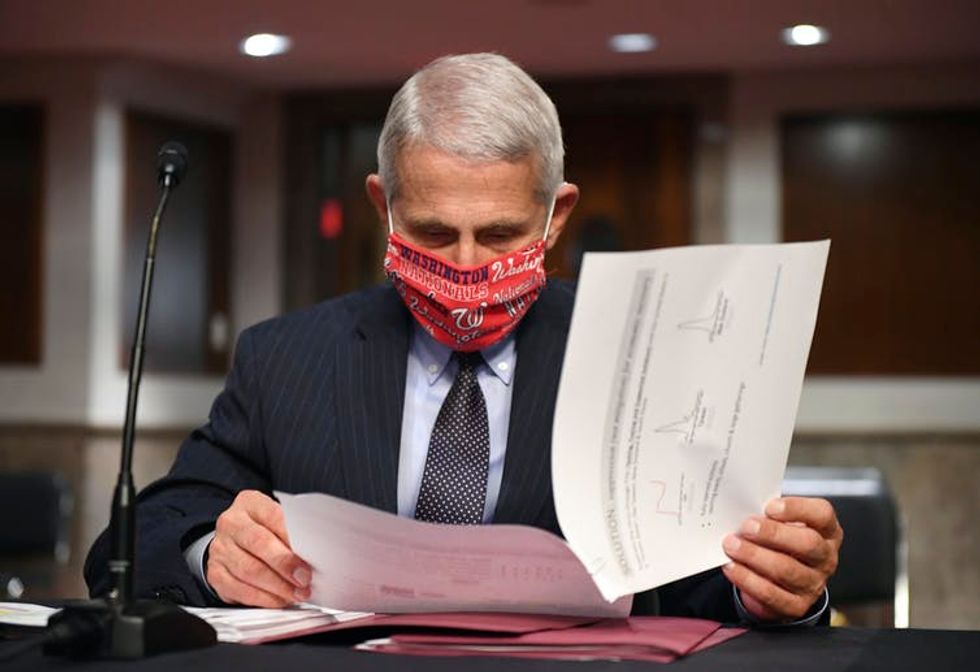
Dr. Anthony Fauci, director of the National Institute for Allergy and Infectious Diseases, preparing to testify before a Senate hearing. Fauci was a target of the Plandemic conspiracy theory video.
This background suggests that Mikovits and her collaborators had several objectives beyond simply sharing her misinformed theories about COVID-19. These include financial, political and reputational motives. However, it is also possible that Mikovits is a sincere believer of the information that she was sharing, as were millions of people who shared and retweeted her content online.
What’s ahead
In the United States, as COVID-19 blurs into the presidential election, we’re likely to continue to see disinformation campaigns employed for political, financial and reputational gain. Domestic activist groups will use these techniques to produce and spread false and misleading narratives about the disease – and about the election. Foreign agents will attempt to join the conversation, often by infiltrating existing groups and attempting to steer them towards their goals.
For example, there will likely be attempts to use the threat of COVID-19 to frighten people away from the polls. Along with those direct attacks on election integrity, there are likely to also be indirect effects – on people’s perceptions of election integrity – from both sincere activists and agents of disinformation campaigns.
Efforts to shape attitudes and policies around voting are already in motion. These include work to draw attention to voter suppression and attempts to frame mail-in voting as vulnerable to fraud. Some of this rhetoric stems from sincere criticism meant to inspire action to make the electoral systems stronger. Other narratives, for example unsupported claims of “voter fraud,” seem to serve the primary aim of undermining trust in those systems.
History teaches that this blending of activism and active measures, of foreign and domestic actors, and of witting and unwitting agents, is nothing new. And certainly the difficulty of distinguishing between these is not made any easier in the connected era. But better understanding these intersections can help researchers, journalists, communications platform designers, policymakers and society at large develop strategies for mitigating the impacts of disinformation during this challenging moment.
Facebook placed an informational disclaimer Tuesday on a post from President Donald Trump claiming mail-in voting would lead to a "corrupt" election.
The move, without removing the post, appears to follow through on the social network giant's pledge to step up efforts to fight misinformation, including from world leaders, shifting slightly from its hands-off policy on political speech.
Trump wrote on his page that mail-in voting, unless changed by the courts, "will lead to the most CORRUPT ELECTION in our Nation's History!" and added the hashtag #RIGGEDELECTION.
Facebook added an information tag which said, "Get official voting info on how to vote in the 2020 US Election" with a link to the government-sponsored USA.gov page on how to cast ballots.
Facebook has largely held firm to a policy that it would not fact-check political leaders, but it has pledged to take down any post which could lead to violence or mislead people about the voting process.
It recently promised to add labels to posts which would normally be removed for violating platform rules, but which are left online as "newsworthy," following the example of Twitter.
A coalition of activists has pressed Facebook to be more aggressive in removing hateful content and misinformation, including from the president and political leaders. Some 1,000 advertisers have joined a boycott aiming ramp up pressure on Facebook.
Twitter said Saturday that hackers "manipulated" some of its employees to access accounts in a high-profile attack, including those of Joe Biden and Elon Musk, and apologized profusely for the breach.
Posts trying to dupe people into sending the hackers Bitcoin were tweeted by the official accounts of Apple, Uber, Bill Gates and many others on Wednesday, forcing Twitter to lock large numbers of accounts in damage control.
The hack has also raised questions about Twitter’s security as it serves as a megaphone for politicians ahead of November's election.
More than $100,000 worth of the virtual currency was sent to email addresses mentioned in the tweets, according to Blockchain.com, which monitors crypto transactions.
"We know that they accessed tools only available to our internal support teams to target 130 Twitter accounts," said a statement posted Saturday on Twitter's blog.
For 45 of those accounts, the hackers were able to reset passwords, login and send tweets, it added, while the personal data of up to eight unverified users was downloaded.
Twitter said it was aware of its responsibility to its users and to society in general.
"We’re embarrassed, we’re disappointed, and more than anything, we’re sorry," Twitter said.
"We know that we must work to regain your trust, and we will support all efforts to bring the perpetrators to justice."
Twitter locked down affected accounts and removed the fraudulent tweets. It also shut off accounts not affected by the hack as a precaution.
Most of those have now been restored, Twitter said on Saturday.
For the 130 accounts that were accessed, Twitter said the hackers were able to see personal information including email addresses and phone numbers.
- 'We're sorry'-
And in cases where hackers took over an account, they may have been able to view "additional information," Twitter said without going into detail.
It did not name the employees involved in the drama.
The attack was carried out by a group of young friends -- one who lives with his mother -- with no links to state or organized crime, The New York Times reported on Friday.
The paper said it interviewed four people who participated in the hacking, who shared logs and screenshots backing up their accounts of what happened.
The young hackers said a mysterious user who went by the name "Kirk" initiated the scheme with a message and was the one with access to Twitter accounts.
They added they were only involved in taking control of lesser-known but desirable Twitter accounts, such as an "@" sign and single letters or numbers that could easily be sold, according to the report.
The hackers maintained they stopped serving as middlemen for "Kirk" when high-profile users became targets.
President Donald Trump's account, which has 83.5 million followers, was not targeted.
"The president will remain on Twitter," White House press secretary Kayleigh McEnany said. "His account was secure and not jeopardized during these attacks."
Twitter said it is limiting the information it makes public about the attack while it carries out “remediation steps” to secure the site, as well as training employees to guard against future hacking attempts.
A series of high-profile Twitter accounts were hijacked on Wednesday, with some of the platform's top voices - including U.S. presidential candidate Joe Biden, reality television show star Kim Kardashian, former U.S. President Barack Obama, billionaire Elon Musk, and rapper Kanye West, among many others - used to solicit digital currency.
The cause of the breach was not immediately clear, but the unusual scope of the problem suggested that it was not limited to a single account or service. While account compromises are not unusual, experts were surprised at the sheer scale and coordination of the Wednesday's incident.
"This appears to be the worst hack of a major social media platform yet," said Dmitri Alperovitch, who co-founded cybersecurity company CrowdStrike.
Twitter said it was investigating what it called a "security incident" and would be issuing a statement shortly. Shares in the social media company tumbled almost 5 percent in trading after the market close before paring their losses.
Some of the tweets were swiftly deleted but there appeared to be a struggle to regain control of several of the accounts. In the case of billionaire Tesla Chief Executive Elon Musk, for example, one tweet soliciting cryptocurrency was removed and, sometime later, another one appeared, and then a third.
Among the others affected: Amazon founder Jeff Bezos, investor Warren Buffett, Microsoft co-founder Bill Gates, and the corporate accounts for Uber and Apple. Several accounts of cryptocurrency-focused organizations were also hijacked.
Biden's campaign was "in touch" with Twitter, according to a person familiar with the matter. The person said the company had locked down the Democrat's account "immediately following the breach and removed the related tweet." Tesla and other affected companies were not immediately available for comment.
Publicly available blockchain records show that the apparent scammers have already received more than $100,000 worth of cryptocurrency.
Alperovitch, who now chairs the Silverado Policy Accelerator, said that, in a way, the public had dodged a bullet so far.
"We are lucky that given the power of sending out tweets from the accounts of many famous people, the only thing that the hackers have done is scammed about $110,000 in bitcoins from about 300 people," he said.
Amazon workers were given a Friday deadline to dump the TikTok mobile application because of unspecified security concerns, according to a Wall Street Journal report.
The e-commerce colossus told workers they can still access the popular video-snippet sharing platform using laptop web browsers, but will lose access to company email on smartphones that have TikTok, the Journal and other media reported.
The concern appeared to be that the TikTok mobile app could access Amazon company email, according to a copy of an internal message posted online.
"User security is of the utmost importance to TikTok -– we are fully committed to respecting the privacy of our users," a spokeswoman for the company said in reply to an AFP inquiry.
"While Amazon did not communicate to us before sending their email, and we still do not understand their concerns, we welcome a dialogue so we can address any issues they may have and enable their team to continue participating in our community."
Amazon did not immediately respond to a request for comment.
TikTok this week withdrew from Hong Kong in an exit seen partly as an effort to shake off the "label of it being a company that is controlled by China and shares data with the Chinese government," Zhu Zhiqun, a political science professor at Bucknell University in the United States, told AFP.
TikTok's parent company, ByteDance, is based in China.
The app's feeds of 15 to 60-second video clips are often fun and humorous, featuring everything from make-up tutorials to dance routines.
However, with its rising popularity in the United States, TikTok has also come under increasing scrutiny from the government here.
US President Donald Trump said this week he was considering banning it as a way to punish China over the coronavirus pandemic.
Top US lawmakers have raised concerns over the potential for TikTok to leak user data to the Chinese government.
India -- where TikTok is also wildly popular -- recently blocked the platform on national security grounds following a deadly border clash between its soldiers and Chinese forces.
TikTok staunchly denies snooping allegations.
"We have never provided user data to the Chinese government, nor would we do so if asked," a spokesman said on Wednesday.
Instagram said on Friday it would block content that promotes so-called conversion therapy, which aims to alter a person's sexual orientation or gender identity, as pressure to ban the practice grows.
The social media giant announced earlier this year it would no longer allow adverts for conversion therapy services, which can range from counseling and "praying away the gay" to electric shocks and sexual violence.
"We don't allow attacks against people based on sexual orientation or gender identity," Tara Hopkins, Instagram's public policy director for Europe, Middle East and Africa said in an emailed statement.
"(We) are updating our policies to ban the promotion of conversion therapy services."
A spokesman for Instagram, which is owned by Facebook, said it would take time to update all policies and content flagged by users may not be removed immediately.
The United Nations independent expert on sexual orientation and gender identity called last month for a global ban on conversion therapy, describing it as "cruel, inhumane and degrading".
A growing number of countries – including the United States, Canada, Chile and Mexico – are reviewing their laws. Brazil, Ecuador and Malta have nationwide bans on conversion therapy, while Germany outlawed the treatment for minors in May.
'Step in the right direction'
Instagram's move is "a step in the right direction, but we'd have to wait and see exactly what kind of actions they take," Harry Hitchens, co-founder of the campaign group Ban Conversion Therapy, told the Thomson Reuters Foundation.
Ban Conversion Therapy sent an open letter yesterday to Britain's Equalities Minister Liz Truss, urging her "to introduce a truly effective ban on conversion therapy for all lesbian, gay, bi, trans and gender diverse people in the UK".
Among those who signed the letter were musicians Elton John and Dua Lipa and writer and actor Stephen Fry.
Truss pledged in May to ban conversion therapy for sexual orientation.
In a global survey of 1,641 survivors of conversion therapy published by the United Nations in May, 46% identified the perpetrators as being medical and mental health providers, while 19% were religious authorities and traditional healers.
Bisi Alimi, a Nigerian LGBT+ activist who underwent conversion therapy aged 16, welcomed the ban but said it had been "a long time coming".
"What is missing for me in all of this conversation is the face of it, the horror of it. And I don't care how terrible it is, people need to see it and see real human beings sharing their story in public," he said.
The world’s first ever commercial high-speed internet service to use balloons to connect people to the web was launched in a remote region of Kenya’s Rift Valley this week.
Operated by Loon, part of Google parent company Alphabet, the service aims to bring affordable 4G internet to people in rural locations.
The balloons connect with internet ground stations and then communicate with each other to form a network of transmitters in the sky and initially will cover a region of 50,000 sq km, providing internet to 35,000 customers.
“Loon is finally in Kenya. Kenya being the first country in the world to commercialize the technology. This is basically base stations up even beyond where the planes are,” Joe Mucheru, Kenyan information minister, told Reuters as he launched the service on Wednesday.
Loon’s technology has been in development for a while and was first made public in 2013, but it has not been used commercially until now.
The helium-filled balloons carry a solar panel and battery, and float in the upper atmosphere, high above airplanes and weather.
They are launched from bases in California and Puerto Rico and then flown remotely to their destination
A total of 35 balloons will be used for the Kenya network, which is being run in partnership with Telkom Kenya.
“This will help me reach out to people even in the diaspora, because it has really been hard due to poor network around here,” honey vendor Dorcas Kipteroi told Reuters.
“We are sometimes left behind when it comes to communication, and you want to send some honey to people but the mode of communication becomes a challenge.”
The US House Committee on the Judiciary on Monday announced that leaders of Amazon, Apple, Facebook, and Google will testify during an antitrust investigation hearing.
The hearing, scheduled to take place July 27, comes against a backdrop of growing complaints about tech platforms that have dominated key economic sectors, and calls by some activists and politicians to break up the Silicon Valley giants
Chief executives Jeff Bezos (Amazon), Tim Cook (Apple), Mark Zuckerberg (Facebook) and Sundar Pichai (Google) will be allowed to appear virtually if they wish, according to a joint statement released by Judiciary committee chairman Jerrold Nadler and Antitrust subcommittee chairman David Cicilline.
"Since last June, the subcommittee has been investigating the dominance of a small number of digital platforms and the adequacy of existing antitrust laws and enforcement," Nadler and Cicilline said.
"Given the central role these corporations play in the lives of the American people, it is critical that their CEOs are forthcoming."
Google and Facebook, which account for the bulk of digital global advertising revenue, provide free services that have become largely dominant in their sector -- such as Google's search engine or its subsidiary, video-sharing platform YouTube.
Users' interactions with these products allow the companies to collect data profiles and sell highly targeted advertising space on a massive scale.
At Apple and Amazon, it is instead their sales platforms -- the App Store on iPhones and iPads, or Amazon's e-commerce site -- that are in the sights of sales representatives, since the two companies are both hosts and merchants.
Earlier this year, the US Justice Department said it was reviewing potential anticompetitive actions by major tech platforms, and attorneys general from the majority of US states have launched antitrust investigations of Google and Facebook.
The imposition of a sweeping national security law on Hong Kong has sent chills through Taiwan, deepening fears that Beijing will focus next on seizing the democratic self-ruled island.
China and Taiwan split in 1949 after nationalist forces lost a civil war to Mao Zedong's communists, fleeing to the island which Beijing has since vowed to seize one day, by force if necessary.
"The law makes me dislike China even more," 18-year-old student Sylvia Chang told AFP, walking through National Taiwan University in Taipei.
"They had promised 50 years unchanged for Hong Kong but they are getting all the more heavy-handed... I am worried Hong Kong today could be Taiwan tomorrow."
Over the years China has used a mixture of threats and inducements, including a promise Taiwan could have the "One Country, Two Systems" model that governs Hong Kong, supposedly guaranteeing key civil liberties and a degree of autonomy for 50 years after the city's 1997 handover.
Both Taiwan's two largest political parties long ago rejected the offer, and the new security law has incinerated what little remaining faith many Taiwanese may have had in Beijing's outreach.
Some now fear even transiting through Hong Kong, worried that their social media profiles could see them open to prosecution under the legislation.
The law "makes China look so bad, distancing themselves even further from Hong Kongers, not to mention people across the strait in Taiwan", Alexander Huang, a political analyst at Tamkang University in Taipei, told AFP.
- 'Hong Kong today, Taiwan tomorrow' -
Beijing has taken an especially hard line towards Taiwan since the 2016 election of President Tsai Ing-wen of the Democratic Progressive Party (DPP), ramping up military, economic and diplomatic pressure.
Tsai views Taiwan as a de facto independent nation and not part of "one China".
But the pressure campaign has done little to endear China to Taiwan's 23 million people.
In January, Tsai won a second term with a historic landslide and polls consistently show a growing distrust of China.
A record 67 percent now self-identify as "Taiwanese" instead of either Taiwanese-Chinese or Chinese -- a ten percent increase on the year before -- according to a routine poll conducted by the National Chengchi University.
In 1992, that figure was just 18 percent.
In recent decades Taiwan has morphed from a brutal autocracy into one of Asia's most progressive democracies.
Younger Taiwanese tend to be especially wary of its huge authoritarian neighbour.
Social media is filled with messages of support for Hong Kong's democracy movement. Some back Taiwanese independence, or highlight China's rights abuses in regions such as Tibet and Xinjiang.
Wendy Peng, a 26-year-old magazine editor who said she often shared pro-Hong Kong democracy messages on social media, said she would now avoid visiting the city.
"The national security law makes me wonder how far would China go. Right now I don't see a bottom line and there's probably none. I think it's possible they will target Taiwan next," she said.
- Universal jurisdiction -
Peng's fears are not unfounded.
As well as allowing China's security apparatus to set up shop openly in Hong Kong for the first time, Beijing's security law claims universal jurisdiction.
Article 38 says security crimes can be committed anywhere in the world by people of any nationality.
Hong Kong police have made clear that support for Hong Kong, Taiwan, Tibet or Xinjiang independence is now illegal.
University employee Patrick Wu, 31, said he would now avoid even transiting through Hong Kong.
"It's like a blanket law, whatever China wants to define and interpret," he told AFP. "I don't know if the 'Likes' or messages I have left on social media will be prosecutable."
Last week Chen Ming-tong, the minister for Taiwan's Mainland Affairs Council, accused Beijing of aiming to become a supremely powerful "heavenly empire" by ordering "subjects all over the world" to obey its law.
Lin Fei-fan, deputy secretary-general of the ruling DPP, warned that "regular Taiwanese people" might now face arrest in "manufactured cases" if they went to Hong Kong.
He cited China's jailing of Taiwanese NGO worker Lee Ming-che under the mainland's own subversion laws.
Lee was arrested in 2017 during a trip to the mainland and held incommunicado for months before his eventual fate was made public.
Sung Chen-en, a political commentator and columnist in Taipei, said Beijing's new security law "creates a great uncertainty about what can be said" far beyond Hong Kong's borders.
"If everyone is watching his own expression of opinions, it creates a chilling effect on democracy," he told AFP.
"If everybody is exercising constraint, there is no freedom at all."
Police said Thursday they had shut down an encrypted phone network used as a key tool by organized crime groups across Europe to plot assassination attempts and major drug deals.
French and Dutch police said they hacked the EncroChat network so they could read millions of messages "over the shoulders" of criminal suspects as they communicated, leading to more than 100 arrests.
EncroChat -- which sells custom encrypted phones -- sent a message to users in June warning them to throw away the devices as its servers had been "seized illegally by government entities".
The hack allowed police to "look into the heart" of organized crime groups, Wil van Gemert, Deputy Executive Director of the EU police agency Europol, told a press conference in The Hague.
The hacking of the phones allowed the "disruption of criminal activities including violent attacks, corruption, attempted murders and large-scale drug transports," Europol and the EU judicial agency added in a joint statement.
"Certain messages indicated plans to commit imminent violent crimes and triggered immediate action."
French authorities launched the investigation in 2017 after finding that EncroChat phones were "regularly" found in operations against criminal groups and that the company was operating from servers in France.
"Eventually, it was possible to put a technical device in place to go beyond the encryption technique and have access to the users' correspondence," Europol and the EU judicial agency Eurojust said in a joint statement.
Between 90 and 100 percent of EncroChat clients were linked to organized crime, according judicial sources, with around 50,000 of the phones in circulation.
- 'Power off immediately' -
Dutch police then became involved based on information shared by French police.
The statement said the investigation "made it possible to intercept, share and analyze millions of messages that were exchanged between criminals to plan serious crimes.
"For an important part, these messages were read by law enforcement in real time, over the shoulder of the unsuspecting senders."
Dutch police had busted 19 meth labs, seized thousands of kilos of crystal meth and cocaine, and arrested more than 100 people as a result of the hack, Andy Kraag, head of the police central investigations division, told the press conference.
Dutch media said two of the country's most wanted meth smugglers had been arrested as a result of the investigation.
The French and Dutch authorities defended the decision to hack into the encrypted phone network, saying it was justified by evidence that it was mainly being used for criminal ends.
"The platform targeted in this operation catered specifically to the needs of criminals," said van Gemert.
"The abuse of encryption technology is a key facilitator of criminal activity."
Encrochat, which sold its phones for around 1,000 euros each, sent what it called an "emergency" text to its users on June 13 saying it had been compromised.
"Today we had our domain seized by government entities," said the message, a picture of which was included in the statement but has also been shown on news media in recent weeks.
"You are advised to power off and physically dispose your device immediately."