Netflix has named as its new marketing chief tech industry veteran Bozoma Saint John, who becomes one of the few black women in the top executive ranks in Silicon Valley.
Saint John, who has worked at Uber and Apple, will start in August as chief marketing officer at the streaming entertainment giant, it said Tuesday.
"I'm so honored, excited and ready," Saint John said in a tweet. "Let's go Team Netflix."
The appointment comes amid intensifying calls for improved representation for black people in board rooms, and in the wake of a reckoning over racial injustice in the US led by the "Black Lives Matter" movement, which California-based Netflix has openly supported.
A section recently added to the streamer features movies and series examining the black experience in the US, race-based abuses and the fight for civil rights.
Netflix previously said it would allocate two percent of its cash holdings, an initial sum of as much as $100 million, to financial institutions and organizations that directly support black communities.
"We believe bringing more capital to these communities can make a meaningful difference for the people and businesses in them, helping more families buy their first home or save for college, and more small businesses get started or grow," they said.
According to the report, Parscale, who is the campaign manager for President Donald Trump's reelection campaign, has campaign ads for Trump running off of his personal page instead of Trump, Pence or the Trump Team campaign pages. More than $325,000 in ads dollars have been spent so far, most of it coming from recent weeks.
"Mr. Parscale is one of only three people whose Facebook and Instagram pages the campaign has used to display ads," the report explained.
Parscale has come in conflict with Trump over the past several months when a profile on the social media consultant highlighted how much money he's made off of Trump, to the tune of nearly $40 million paid to his companies through various reelection committees.
So far, Parscale has purchased a Ferarri, a Range Rover, a $400,000 boat, two million-dollar condos and a $2.4 million waterfront house in Fort Lauderdale, a Huffington Post analysis revealed in May.
It was also just two months ago that Trump threatened to sue Parscale after poll numbers showed Trump losing. He's since fallen even more in the polls since the April call that Trump has denied.
"The Trump campaign said that it was testing the use of Mr. Parscale’s page to run ads and that Mr. Parscale had received no financial gain," the Times said.
It isn't entirely accurate, as funds spent to promote ads on Parscale's page generates a higher engagement on his page, more traffic to his page and greater attention to him through his page, all of which candidates use campaign funds to garner for themselves.
Starbucks said Sunday that it will pause its advertising on social media while it studies ways to "stop the spread of hate speech" as part of a growing corporate movement.
"We believe in bringing communities together, both in person and online, and we stand against hate speech," the Seattle-based corporation, which operates thousands of restaurants around the world, said in a brief statement.
"We believe more must be done to create welcoming and inclusive online communities, and we believe both business leaders and policy makers need to come together to affect real change."
The coffee-selling giant added, "We will pause advertising on all social media platforms while we continue discussions internally, with our media partners and with civil rights organizations in the effort to stop the spread of hate speech."
Amid an intense national debate over racism and frequent eruptions of ugly, hate-filled speech on social media, Starbucks thus followed the lead of other big corporations like Unilever and Coca-Cola, which announced similar pauses on Friday.
Major social media platforms, but particularly Facebook, have faced sharp criticism for failing to eliminate racist or hate-filled posts.
Calls for an advertising boycott of Facebook next month have come from the NAACP, the big civil rights group that defends African Americans' interests, and the Anti-Defamation League, which fights anti-Semitism.
But like Coca-Cola, Starbucks said it was not joining that boycott.
The company said it would continue using social media to communicate with its clients and employees.
Starbucks, which employs large numbers of racial minorities in the US, has itself faced criticism over its handling of racial issues.
In April 2018, the arrest of two black men in a Starbucks restaurant in Philadelphia, who had made no purchases but refused to leave when asked, caused a nationwide uproar.
The men, who were marched out of the restaurant in handcuffs, were later released without charge.
The chain issued an apology, made clear that its policy going forward would not allow a repeat of the Philadelphia incident, and closed its more than 8,000 company-operated US stores to allow employees to receive racial-diversity training.
Social media platforms like Facebook, Twitter and Instagram started out as a way to connect with friends, family and people of interest. But anyone on social media these days knows it’s increasingly a divisive landscape.
Undoubtedly you’ve heard reports that hackers and even foreign governments are using social media to manipulate and attack you. You may wonder how that is possible. As a professor of computer science who researches social media and security, I can explain – and offer some ideas for what you can do about it.
Bots and sock puppets
Social media platforms don’t simply feed you the posts from the accounts you follow. They use algorithms to curate what you see based in part on “likes” or “votes.” A post is shown to some users, and the more those people react – positively or negatively – the more it will be highlighted to others. Sadly, lies and extreme content often garner more reactions and so spread quickly and widely.
A 2018 file photo showing a business center building in St. Petersburg, Russia, known as the ‘troll factory,’ one of a web of companies allegedly controlled by Yevgeny Prigozhin, who has reported ties to Russian President Vladimir Putin.
But who is doing this “voting”? Often it’s an army of accounts, called bots, that do not correspond to real people. In fact, they’re controlled by hackers, often on the other side of the world. For example, researchers have reported that more than half of the Twitter accounts discussing COVID-19 are bots.
As a social media researcher, I’ve seen thousands of accounts with the same profile picture “like” posts in unison. I’ve seen accounts post hundreds of times per day, far more than a human being could. I’ve seen an account claiming to be an “All-American patriotic army wife” from Florida post obsessively about immigrants in English, but whose account history showed it used to post in Ukranian.
Fake accounts like this are called “sock puppets” – suggesting a hidden hand speaking through another identity. In many cases, this deception can easily be revealed with a look at the account history. But in some cases, there is a big investment in making sock puppet accounts seem real.
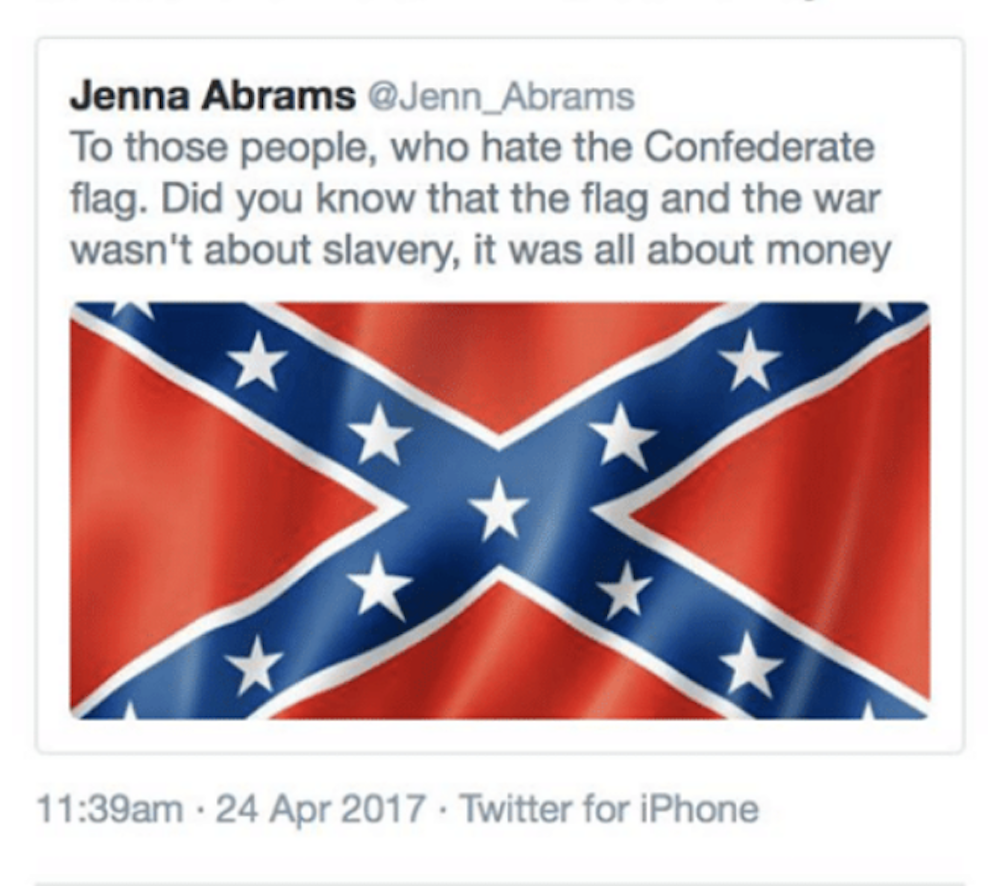
Now defunct, the ‘Jenna Abrams’ account was created by hackers in Russia.
Trolls often don’t care about the issues as much as they care about creating division and distrust. For example, researchers in 2018 concluded that some of the most influential accounts on both sides of divisive issues, like Black Lives Matter and Blue Lives Matter, were controlled by troll farms.
More than just fanning disagreement, trolls want to encourage a belief that truth no longer exists. Divide and conquer. Distrust anyone who might serve as a leader or trusted voice. Cut off the head. Demoralize. Confuse. Each of these is a devastating attack strategy.
Even as a social media researcher, I underestimate the degree to which my opinion is shaped by these attacks. I think I am smart enough to read what I want, discard the rest and step away unscathed. Still, when I see a post that has millions of likes, part of me thinks it must reflect public opinion. The social media feeds I see are affected by it and, what’s more, I am affected by the opinions of my real friends, who are also influenced.
I have focused primarily on U.S.-based examples, but the same types of attacks are playing out around the world. By turning the voices of democracies against each other, authoritarian regimes may begin to look preferable to chaos.
Founder and CEO of Facebook Mark Zuckerberg in Brussels, Feb. 17, 2020.
Platforms have been slow to act. Sadly, misinformation and disinformation drives usage and is good for business. Failure to act has often been justified with concerns about freedom of speech. Does freedom of speech include the right to create 100,000 fake accounts with the express purpose of spreading lies, division and chaos?
Taking control
So what can you do about it? You probably already know to check the sources and dates of what you read and forward, but common-sense media literacy advice is not enough.
First, use social media more deliberately. Choose to catch up with someone in particular, rather than consuming only the default feed. You might be amazed to see what you’ve been missing. Help your friends and family find your posts by using features like pinning key messages to the top of your feed.
Second, pressure social media platforms to remove accounts with clear signs of automation. Ask for more controls to manage what you see and which posts are amplified. Ask for more transparency in how posts are promoted and who is placing ads. For example, complain directly about the Facebook news feed here or tell legislators about your concerns.
Third, be aware of the trolls’ favorite issues and be skeptical of them. They may be most interested in creating chaos, but they also show clear preferences on some issues. For example, trolls want to reopen economies quickly without real management to flatten the COVID-19 curve. They also clearly supported one of the 2016 U.S. presidential candidates over the other. It’s worth asking yourself how these positions might be good for Russian trolls, but bad for you and your family.
Perhaps most importantly, use social media sparingly, like any other addictive, toxic substance, and invest in more real-life community building conversations. Listen to real people, real stories and real opinions, and build from there.
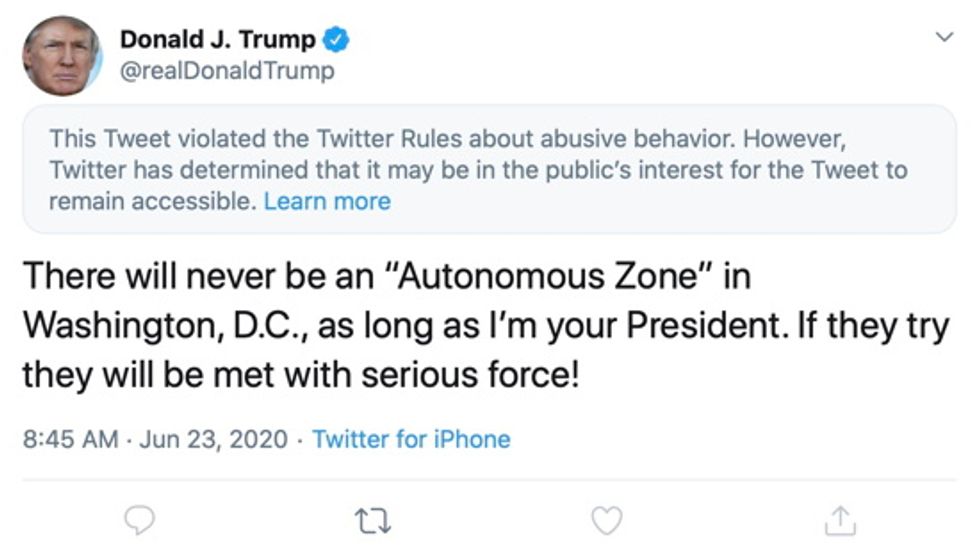
Twitter has hidden and appended a warning to one of President Donald Trump's tweets, noting it violates the company's rules. The company also flagged his remarks as "abusive" several hours after the President posted it Tuesday morning.
"We’ve placed a public interest notice on this Tweet for violating our policy against abusive behavior, specifically, the presence of a threat of harm against an identifiable group," the company's safety account said.
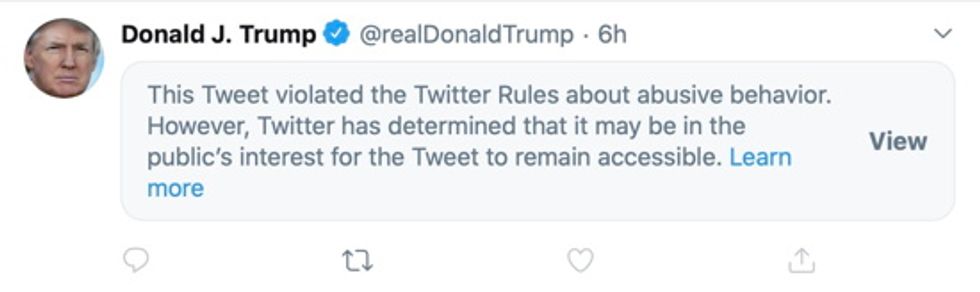
Visitors to Trump's Twitter page now see this, instead of the actual tweet:
The warning appended to Trump's tweet reads: "This Tweet violated the Twitter Rules about abusive behavior. However, Twitter has determined that it may be in the public’s interest for the Tweet to remain accessible."
This is a screenshot of the actual tweet, which can still be read, with the warning attached.
This is not the first time Twitter has been forced to flag Trump's tweets. Late last month the social media giant added a "get the facts" label to two of the President's tweets. A Twitter spokesperson explained the label was applied because the tweets “contain potentially misleading information about voting processes and have been labeled to provide additional context around mail-in ballots.”
A top German court on Tuesday ordered Facebook to stop merging data collected through its Whatsapp and Instagram subsidiaries or other websites unless users explicitly agree, in a legal victory for competition authorities.
Germany's Federal Cartel Office (FCO) had told Facebook to rein in the data collecting in a landmark decision in 2019, but the social media giant appealed the order.
In a fast-track proceeding on Tuesday, Germany's Federal Court of Justice (BGH) sided with the FCO watchdog in finding that Facebook was abusing its dominant position to force users to consent to all their data being collected.
"Facebook does not allow for any choice," presiding judge Peter Meier-Beck said in the Karlsruhe courtroom.
He said the Silicon Valley company must comply with the order while its appeal is pending in a lower court.
It is a major setback for the social media giant, which has long been under scrutiny in privacy-conscious Germany.
Facebook insisted however there would be "no immediate changes" for users in Germany and stressed that the main appeals proceedings were still ongoing.
"We will continue to defend our position that there is no anti-trust abuse," a spokesman said.
The FCO criticized Facebook in February 2019 for making the "unrestricted" data harvesting part of the website's terms of use. That meant people had to tick the box or opt out of being on Facebook altogether.
The personal data picked up through Facebook's own platform, Whatsapp, Instagram and third-party websites serve to build up a user's profile for the purposes of targeted advertising, a key income source for the group.
The Federal Cartel Office ordered the tech giant to stop combining information from Facebook and non-Facebook sources unless users gave "voluntary consent".
It also said Facebook was not allowed to exclude people from its services if they chose to refuse permission.
Facebook said at the time it disagreed with the decision, arguing the German anti-trust body was setting rules that applied "to only one company" and that it underestimated the competition it faced from rivals.
- 'Abuse of power' -
The FCO however found that Facebook was by far the biggest social network in Germany, with over 23 million daily active users representing 95 percent of the market.
Rivals like Snapchat, YouTube or Twitter "only offer parts of the services of a social network" and are not directly comparable, the authority said.
Facebook lodged an appeal against the FCO ruling with the higher regional court in Duesseldorf that is ongoing.
But Tuesday's fast-tracked decision at the BGH was aimed at settling a row about whether Facebook can keep combining data in the meantime.
FCO chief Andreas Mundt welcomed the preliminary outcome.
"When data is collected and used illegally, an anti-trust intervention must be possible to prevent an abuse of market power," he said in a statement.
Professor Rupprecht Podszun, an expert in competition law at Heinrich Heine University Duesseldorf, called Tuesday's decision a "big win" for the FCO.
The German battle against Facebook is seen as a legal first and is being closely watched at home and abroad as concern mounts about the power held by tech behemoths.
The Californian firm led by Mark Zuckerberg has repeatedly come under fire in recent years over data protection and privacy.
In one major scandal in 2018, it emerged that data belonging to tens of millions of Facebook users had been harvested by consulting firm Cambridge Analytica, and used in part to support Donald Trump's 2016 election campaign.
US President Donald Trump will prolong a ban on US employment permits to year-end and broaden it to include H1-B visas used widely in the tech industry, the White House said Monday.
A senior administration official told journalists that the move would free up 525,000 jobs, making a dent in the high unemployment rate caused by the coronavirus pandemic.
"President Trump is focused on getting Americans back to work as quickly as possible," the official said, on condition of anonymity.
Trump had endlessly touted a strong economy, but now finds himself desperate for a political boost ahead of the November election.
An executive order, expected later Monday, will extend and widen the 60-day freeze Trump placed on new work permits for non-US citizens two months ago.
The administration official said the new order would extend to the end of 2020 and include H1-B visas provided to 85,000 workers each year with special skills, many of them joining the US technology industry.
It will also cover most J visas, common for academics and researchers, and L visas used by companies to shift workers based overseas to their US offices.
The official said the order was necessary to respond to soaring unemployment that resulted from the COVID-19 shutdown.
The official stressed the H1-B visa freeze was temporary while the program is restructured, from an annual lottery that feeds coders and other specialists to Silicon Valley, to a system the gives priority to those foreign workers with the most value.
Trump "is going to prioritize those workers who are offered the highest wages," as an indicator that they can add more value to the US economy, the official said.
"It will eliminate competition with Americans... in these industries at the entry level, and will do more to get the best and the brightest."
Japan's Fugaku supercomputer, built with government backing and used in the fight against coronavirus, is now ranked as the world's fastest, its developers announced Monday.
It snatched the top spot on the Top500, a site that has tracked the evolution of computer processing power for more than two decades, said the Riken scientific research centre.
The list is produced twice a year and rates supercomputers based on speed in a benchmark test set by experts from Germany and the US.
Fugaku was jointly developed by Riken and the firm Fujitsu and has a speed of roughly 415.53 petaflops -- 2.8 times faster than the second-ranked US Summit supercomputer's 148.6 petaflops.
A supercomputer is more than 1,000 times faster than a regular computer, according to Riken.
Summit had topped the last four rankings over the previous two years.
Fugaku, meaning Mount Fuji in Japanese, has been under development for six years and is expected to start full-time operation from April 2021.
But it is already being put to work on the coronavirus crisis, running simulations on how droplets would spread on office spaces with partitions installed or packed trains with windows open.
"I hope that the leading-edge IT developed for it will contribute to major advances on difficult social challenges such as COVID-19," Satoshi Matsuoka, the head of Riken's Center for Computational Science, said in a statement.
Fugaku has also topped several other supercomputer performance rankings, becoming the first to simultaneously sit atop the Graph500, HPCG, and HPL-AI lists.
Supercomputers are vital tools for advanced scientific work because of their ability to perform rapid calculations for everything from weather forecasts to missile development.
A Riken-developed forerunner to the Fugaku has held the title of world's fastest supercomputer, but in recent years the race to develop the powerful machines has been dominated by the US and China.
Apple said Friday it was closing some stores in US states experiencing a surge in coronavirus infections, reversing course after reopening many of its retail locations.
The iPhone maker said it was closing six of its retail stores in Arizona, along with two each in North Carolina and Florida and one in South Carolina.
The stores are in states where COVID-19 infections are on the rise despite a decline in most regions of the United States
"Due to current COVID-19 conditions in some of the communities we serve, we are temporarily closing stores in these areas," an Apple spokesperson said in a statement.
"We take this step with an abundance of caution as we closely monitor the situation and we look forward to having our teams and customers back as soon as possible."
Apple closed its US stores as the pandemic hit the country, and last month began gradually reopening the locations as lockdowns and restrictions were relaxed. Some stores were boarded up or closed as a result of unrest during protests over police brutality in the past few weeks.
The tech giant said its stores would have new protocols as they reopen including limiting the number of customers who can be inside, meaning probable delays for those who spontaneously stop by for technical help from a "Genius Bar."
"It is a provocation... to all the citizens of the world who say that it is still legitimate for all the digital giants to pay their taxes."
The Trump administration on Wednesday abruptly withdrew from international negotiations over how best to tax the profits of multinational corporations such as U.S.-based tech giants Amazon and Google, leading European allies to accuse the White House of torpedoing years-long talks that were close to a resolution.
In a letter to the finance ministers of France, the U.K., Italy, and Spain obtained by the Financial Times, U.S. Treasury Secretary Steve Mnuchin said negotiations were at an "impasse" and threatened to retaliate "with appropriate commensurate measures" against any country that attempts to unilaterally move ahead digital services taxes on U.S.-based companies—a warning that sparked fears of a potentially devastating trans-Atlantic trade war.
"We were inches away from an agreement on digital taxation at a time when the digital giants are the only ones in the world to have benefited immensely from the coronavirus crisis."
—Bruno Le Maire, French finance minister"The U.S. is a rogue state," writer Nando Vila tweeted in response to news of Mnuchin's letter.
The New York Timesreported Wednesday that "several European countries, led by France, have been rolling out digital services taxes, which would fall heavily on American internet companies. Italy, Spain, Austria, and Britain have all announced plans to levy digital services taxes, which impose duties on the online activity that takes place in those countries, regardless of whether the company has a physical presence."
French Finance Minister Bruno Le Maire on Thursday denounced Mnuchin's letter as a "provocation for everyone who was negotiating in good faith" and said France will reimpose its currently suspended 3% tax on digital services if OECD nations can't reach a deal on a fair tax system by the end of the year.
"We were inches away from an agreement on digital taxation at a time when the digital giants are the only ones in the world to have benefited immensely from the coronavirus crisis," Le Maire said in a radio interview. "So it is a provocation... to all the citizens of the world who say that it is still legitimate for all the digital giants to pay their taxes. It is also a provocation to the U.S. allies. What is this way of treating U.S. allies—the British, Spanish, Italians, French—by threatening us with sanctions?"
Maria Jesus Montero, a spokesperson for the Spanish government, said Thursday that "neither Spain, nor France, nor Italy, nor Britain, no country will accept any type of threat from another country."
"We are not legislating to damage the interest of other countries," said Montero. "We are legislating so that our tax system is orderly, fair, and adapted to current circumstances."
Current rules generally allocate corporate profit for tax purposes based on where value is created. But modern multinationals—particularly ones with digital offerings—can sell their products across borders in ways that leave little taxable profit in a country where those products are consumed.
Many big European countries say that tech companies should pay more taxes in the countries where their products are consumed, something that could boost their tax revenues by billions of dollars. But the U.S. has opposed any solution that is too targeted at tech companies, where it has more to lose...
Tech companies, for their part, have opposed national digital-services taxes like France's, but have supported the OECD process, arguing that they would like to avoid a patchwork of overlapping national initiatives.
Joseph Stiglitz, a Nobel prize-winning economist and professor at Columbia University, said in an interview with the Independent Commission for the Reform of International Corporate Taxation Wednesday that the coronavirus pandemic "has helped the very companies that have been the tax avoiders," bolstering the case for measures like digital services taxes until a global tax framework is established.
"The internet companies are the big beneficiaries, because they are the people who can continue to operate... So they're the big beneficiaries of the pandemic," said Stiglitz. "Part of their advantage is they're not paying taxes. They're not paying their fair share in taxes."
"That's why the proposals—as an interim measure until we work out a whole global system—of just having a digital tax is one that had a lot of resonance before the pandemic, but now becomes an imperative," Stiglitz added.
US civil rights groups have called for advertisers to boycott Facebook in July, saying hate speech and incitement to violence are not being moderated on the platform.
The campaign comes as the social media giant faces growing pressure over its hands-off approach to misinformation and inflammatory posts, such as those by US President Donald Trump.
The #StopHateForProfit appeal -- also shared in a full-page ad taken out in the Los Angeles Times newspaper on Wednesday -- was supported by the Anti-Defamation League (ADL), the National Association for the Advancement of Colored People, ColorOfChange, FreePress and Sleeping Giants.
"Today, we ask all companies in solidarity with the American values of freedom, equality and justice not to advertise Facebook services in July," said a statement posted on the ADL website.
The group claimed the social media company made an estimated $70 billion annually from ads.
The campaign was a reaction to "Facebook's long history of allowing racist, violent and verifiably false content to run rampant on its platform."
"Let's send a powerful message to Facebook: your profits are not worth promoting hatred, intolerance, racism, anti-Semitism and violence."
The group criticized Mark Zuckerberg's decision to not moderate the US president -- only a day after the CEO again defended his decision not to limit Trump's often controversial, incendiary and inaccurate posts.
Twitter's decision in May to hide one of Trump's tweets for "glorifying violence" exposed turmoil at Facebook, with employees rebelling against Zuckerberg's refusal to sanction false or inflammatory posts by Trump.
Four Republican senators introduced a bill Wednesday aimed at limiting legal protections of Big Tech platforms if they "selectively" suppress certain content, stepping up a political battle with social media.
Senator Josh Hawley said his measure, if enacted, "gives users the right to sue if the big platforms enforce their terms unfairly or unequally."
The bill comes weeks after President Donald Trump accused social platforms of suppressing conservative political voices and signed an executive order which could eliminate the liability shield of online services for content posted by third parties despite doubts about its enforceability.
The Hawley bill, co-sponsored by fellow Republicans Marco Rubio, Tom Cotton and Mike Braun, would revise the "Section 230" legal protection mechanism for online services if they fail to act "in good faith" to moderate content.
The bill would strip the liability protection to services that "restrict access to or availability of material against a user by employing an algorithm that selectively enforces" its policies.
The legislation and executive order stem from claims by Trump and his allies that social media platforms are biased, despite his own large following on Twitter and other platforms.
"Big Tech companies like Twitter, Google and Facebook have used their power to silence political speech from conservatives without any recourse for users," Hawley said in a statement.
"Congress should act to ensure bad actors are not given a free pass to censor and silence their opponents."
Activists and legal specialists argue that Section 230 is a cornerstone of the open internet by allowing services to host content from third parties without fear of legal action.
The law allows for platforms to moderate content and remove materials deemed to be promoting hate or violence, according to Section 230 defenders. But critics across the political spectrum have said the liability shield opens the door to a range of harmful online content.
Some analysts argue that the efforts to regulate social media could be unconstitutional limits on free expression under the constitution's First Amendment.
"I see this as a straightforward First Amendment violation," Eric Goldman, director of the High-Tech Law Institute at Santa Clara University, said of the bill.
Additionally, he said the bill would lead to "an infinite number of lawsuits" against internet firms because of the vague definition of good faith actions.
US health officials have approved the first game-based treatment for children with attention deficit hyperactivity disorder, part of a trend toward "digital therapeutics" or software to address certain conditions.
The Food and Drug Administration said Monday it approved the sale by prescription of the game EndeavorRX from health tech startup Akili Interactive for children aged 8-12 who have been diagnosed with ADHD.
The FDA said this was the first digital therapeutic intended to treat ADHD, as well as the first game-based therapeutic approved for any type of condition.
The game, designed to improve cognitive function, is designed as part of a program that may also include other kinds of therapy, medication, and educational programs.
"The EndeavorRx device offers a non-drug option for improving symptoms associated with ADHD in children and is an important example of the growing field of digital therapy and digital therapeutics," said Jeffrey Shuren, director of the FDA Center for Devices and Radiological Health.
Digital therapeutics have been approved for certain treatments such as addiction disorders and are being testing for a range of other conditions from chronic pain to anxiety.
EndeavorRX allows children to control cartoon-like characters on a type of hoverboard and is designed to target and activate neural systems through sensory stimuli and motor challenges to improve cognitive functioning.
"We're proud to make history today with FDA's decision," said Eddie Martucci, chief executive officer of Akili.
"With EndeavorRx, we're using technology to help treat a condition in an entirely new way as we directly target neurological function through medicine that feels like entertainment."
The approval of EndeavorRx followed studies of some 600 children diagnosed with ADHD.
The company said the research found that after four weeks of EndeavorRx treatment, one-third of children no longer had a measurable attention deficit on at least one measure of objective attention and that about half of parents saw a meaningful change in their child's day-to-day impairments after one month of treatment with EndeavorRx.