Facebook was responding to the controversy over their hiring of a Republican opposition research firm to smear critics as anti-Antisemitic.
Facebook Chief Operating Officer Sheryl Sandberg took responsibility for the scandal -- but did not announce her retirement.
Facebook head of communications and policy Elliot Schrage admitted that the corporate Goliath did hire Definers Public Affairs, an opposition research company founded and directed by Republicans.
"We hired Definers in 2017 as part of our efforts to diversify our DC advisors after the election," Schrage wrote in a statement.
Schrage also admitted the company asked Definers Public Affairs to do work against George Soros, but denied they asked them to "distribute or create fake news."
Sandberg took ownership of the scandal, but did not resign.
"I want to be clear that I oversee our Comms team and take full responsibility for their work and the PR firms who work with us," she wrote. "I truly believe we have a world class Comms team and I want to acknowledge the enormous pressure the team has faced over the past year."
Sandberg claimed, "it was never anyone’s intention to play into an anti-Semitic narrative against Mr. Soros or anyone else."
Yet, Sandberg only apologized for the distraction.
"I know this has been a distraction at a time when you’re all working hard to close out the year — and I am sorry," she wrote. "Thanksgiving seems like the right time to say a big thank you once again."
When large companies move into an area, politicians often proclaim how the new business will create jobs, increase tax revenues, and thus lead to economic growth. This is one reason local governments offer tax incentives to businesses willing to move in.
Amazon’s decision to locate offices in Long Island City across the East River from Manhattan, and in Crystal City on the outskirts of Washington, D.C., follows this pattern. The New York location borders the largest low-income housing area in the United States, with mostly African-American and Hispanic residents whose median household income is well below the federal poverty level. These people, local politicians claim, will benefit from Amazon’s move to the neighborhood.
However, when large companies with an upscale and specialized workforce move into an area, the result is more often gentrification. As economic development takes place and prices of real estate go up, the poorer residents of the neighborhood are forced out and replaced by wealthier ones.
Is such a market-driven approach that accepts displacement ethically justifiable? And how do we even measure its costs?
Can gentrification ever be ethical?
Although politicians don’t typically frame gentrification as a question of ethics, in accepting the displacement of poor residents in favor of better-off residents they are, in effect, making an argument based on ideas of utilitarianism.
Utilitarianism, developed as a modern theory of ethics by the 19th-century philosophers Jeremy Bentham and John Stuart Mill, seeks the greatest balance of happiness over suffering in society as a whole. Utilitarianism seeks the greatest net benefit in any situation. In economics, it is often expressed in monetary terms.
A classic example is of a new dam that will generate electricity, irrigate crops and provide a new lake for recreation. But it might also displace people and flood land that is used for other purposes.
Economists might calculate the dollar cost of the dam itself, the monetary value of the land lost, and the cost to relocate displaced people. They would weigh these monetary costs against the value of the electricity gained, the increased food production, and added income from recreation.
What economists miss in these calculations are the social costs. For example, they do not count the lives disrupted through displacement, nor do they determine if the benefits of the dam are equally available to all.
Gentrification, as an economic and social phenomenon, is not limited to cities in the United States. Gentrification has become a global issue. In cities as geographically dispersed as Amsterdam, Sydney, Berlin and Vancouver, gentrification has been linked to free-market economic policies. Put another way, when governments decide to let housing and property markets exist with little or no regulation, gentrification typically flourishes.
When neighborhoods gentrify, politicians and policymakers often point to physical and economic improvements and the better quality of life for residents in an area after gentrification. For example in 1985, during a period of intense urban renewal in New York City, the Real Estate Board of New York took out advertisements in The New York Times to claim that “neighborhoods and lives blossom” under gentrification.
Through the lens of utilitarianism, one could say that the population living in neighborhoods after gentrification experience greater happiness than before.
The fallacy of this argument is, of course, that these “happier” populations are overwhelmingly not the same people as were there before gentrification. As a scholar who works on questions of ethics in the built environment, I have studied how we, as the concerned public, can better equip ourselves to see through such arguments.
Economic development in an area leads to less poverty in that area, not because the personal economic situation of poor people who live there has improved, but because the poor people have quite simply been erased out of the picture.
Erasing the working class
Urban geographer Tom Slater points to a similar disappearing act within gentrification research.
Tenants being pushed out on account of rising rents in Harlem in 2007.
Researchers once focused on the experiences of those negatively affected by gentrification. For example, one study of the Williamsburg neighborhood of Brooklyn found that gentrification commonly removed manufacturing from inner city areas, leading to blue-collar workers losing urban job opportunities.
Another study found that gentrification was associated with increased social hardships for residents. Not only did their housing expenses rise, social networks disintegrated as neighbors were forced to move elsewhere. In an examination of seven New York neighborhoods, for example, the researchers found that half of the poor households who had remained in gentrifying areas were paying more than two-thirds of their income for rent.
Where gentrification research once focused on evictions of low-income and working class residents, housing affordability problems, and torn social fabrics caused through changing neighborhoods, the talk has since turned to the experiences of the middle classes who are doing the gentrifying.
Terms like “competitive progress” and “regeneration, revitalization and renaissance” of urban neighborhoods are commonly used to describe a process whereby physically distressed areas of a city have their buildings renovated and updated.
Urban planner and best-selling author Richard Florida also focuses on the gentrifiers. In his much discussed 2002 book, Florida maintains that cities with a large gay and “bohemian” population of artists and intellectuals tend to thrive economically.
He calls this group of hip and affluent urbanites the “creative class,” and states that they are responsible for a city’s economic success. When Florida’s book came out, city leaders throughout the United States quickly seized on his ideas to promote their own urban renewal projects.
When researchers and urban leaders focus on the gentrifiers, the displaced poor and working class are doubly erased – from the gentrifying areas they once called home, and with few exceptions, from the concerns of urban policymakers.
The need to restore happiness
Amazon’s move to Washington and New York along with an influx of well-paid employees brings us back to the question of how we might apply the ethical concept of utilitarianism to understand the greatest balance of happiness over suffering for the greatest number of people.
In my view, this number must include the poor and working class. In an area threatened by gentrification, the economic and social costs for displaced residents is typically high.
To make ethical decisions, we must consider the people who suffer the consequences of rapidly rising costs in the area they call home as part of the ethical equation.
Twitter CEO Jack Dorsey has kicked up a social media storm in India after a picture of him holding a poster saying “smash Brahminical patriarchy”, referring to the highest Hindu caste, went viral.
Twitter has apologized and expressed regret over the incident, which some Indians have called “hate-mongering”.
The picture, posted on Twitter on Sunday by a journalist who was part of group of women journalists, activists and writers whom Dorsey met during a visit to India last week, had him clutching a poster of a woman holding up a banner with the line that has offended many Indians.
“The sentiments expressed on the poster do not reflect the views of Twitter as a company or Jack as the CEO, and we regret that this picture has detracted from an otherwise insightful trip to India,” a Twitter spokeswoman told Reuters via email on Tuesday.
She said Twitter had hosted a closed-door discussion and one of the participants had shared her experience as a low-caste Dalit woman. At the conclusion of the session she gifted the poster to the Twitter CEO.
Several prominent Indians, including T.V. Mohandas Pai, a former finance chief of software exporter Infosys, accused Dorsey of “hate-mongering” against Brahmins.
“Tomorrow if @jack is given a poster with anti Semitic messages in a meeting, will his team allow him to hold it up?,” Pai tweeted. “Why is that any different? Inciting hate against any community is wrong.”
Twitter India said on Monday the poster had been handed to Dorsey by a Dalit activist when it hosted the discussion with a group of women to know more about their experience using Twitter.
It added the poster was a “tangible reflection of our company’s efforts to see, hear, and understand all sides of important public conversations that happen on our service around the world”.
Late on Monday, Vijaya Gadde, legal, policy and trust and safety lead at Twitter, who accompanied Dorsey to India, apologized.
“I’m very sorry for this. It’s not reflective of our views. We took a private photo with a gift just given to us - we should have been more thoughtful,” she said in a tweet.
“Twitter strives to be an impartial platform for all. We failed to do that here & we must do better to serve our customers in India.”
Twitter, whose monthly active users globally averaged 326 million in the July-September quarter, does not disclose the number of its users in India but its executives say the country is one of its fastest-growing areas.
Its use is expected to increase further in coming months as political parties in the country of 1.3 billion try to expand their reach to voters ahead of a general election due by May.
Prime Minister Narendra Modi, with 44.4 million followers, is a Twitter enthusiast.
“I enjoy being on this medium, where I’ve made great friends and see everyday the creativity of people,” Modi tweeted last week after meeting Dorsey in New Delhi.
Reporting by Krishna N. Das; Editing by Michael Perry and Andrew Roche
Embattled Facebook CEO Mark Zuckerberg said Tuesday he has no plans to resign, sounding defiant after a rough year for the social platform.
"That's not the plan," Zuckerberg told CNN Business when asked if he would consider stepping down as chairman.
He also defended Facebook chief operating officer Sheryl Sandberg, who has drawn criticism over her handling of the social media giant's recent crises.
"Sheryl is a really important part of this company and is leading a lot of the efforts for a lot of the biggest issues we have," said Zuckerberg.
"She's been an important partner to me for 10 years. I'm really proud of the work we've done together and I hope that we work together for decades more to come."
Facebook has stumbled from one mess to another this year as it grappled with continuing fallout from Russia's use of the platform to interfere in the 2016 US presidential election, the Cambridge Analytica scandal in which user data was harnessed in a bid to help candidate Donald Trump, and a huge security breach involving millions of accounts.
Most recently, an investigative piece published last week by The New York Times said Facebook misled the public about what it knew about Russia's election meddling and used a PR firm to spread negative stories about other Silicon Valley companies and thus deflect anger away from itself.
"It is not clear to me at all that the report is right," Zuckerberg said of the Times article.
"A lot of the things that were in that report, we talked to the reporters ahead of time and told them that from everything that we'd seen, that wasn't true and they chose to print it anyway."
Zuckerberg also defended his company against the broader wave of flak it has taken this year.
"A lot of the criticism around the biggest issues has been fair, but I do think that if we are going to be real, there is this bigger picture as well, which is that we have a different world view than some of the folks who are covering us," he said.
"There are big issues, and I'm not trying to say that there aren't... But I do think that sometimes, you can get the flavor from some of the coverage that that's all there is, and I don't think that that's right either."
British Columbia’s premier said on Tuesday his government will introduce legislation next year that will require all new light-duty cars and trucks sold in the province by 2040 to be electric or zero-emission vehicles.
Premier John Horgan said the government will phase in the sales targets, which apply only to new vehicles. They will start at 10 percent by 2025, rising to 30 percent by 2030 and 100 percent by 2040.
To support the plan, British Columbia will expand its fast-charging network and spend an addition C$20 million ($15 million) this year on incentives for consumers who buy electric vehicles.
“We need to make clean energy vehicles more affordable, available and convenient,” Horgan said in a statement. He noted the targets were part of a long-term plan to achieve ambitious carbon emission reduction goals.
British Columbia offers credits of up to C$5000 for the purchase or lease of new battery electric or plug-in hybrid vehicles, and C$6000 for new hydrogen fuel cell vehicles. It plans to expand the incentive program over time.
The province follows Quebec, which passed legislation in 2016 targeting 15.5 percent of sales and leases be zero-emission vehicles by 2020. A number of U.S. states, including California, have similar laws designed to increase the supply and sales of plug-in electric vehicles.
Electric vehicle sales are booming in Canada, more than doubling in the second quarter of 2018 compared with the same period of 2017, according to clean-tech data firm FleetCarma. But demand is still far lower than for conventional vehicles.
Tesla Inc’s (7201.T) Model 3 is the most popular electric car in Canada, followed by Nissan Motor Co’s (7201.T) Leaf and General Motor’s (GM.N) Chevrolet Bolt, according to FleetCarma.
The International Energy Agency said last week that electric vehicles and more efficient fuel technology will cut transportation demand for oil by 2040 more than previously expected.
($1 = 1.3301 Canadian dollars)
Reporting by Julie Gordon in Vancouver; Editing by Dan Grebler
Apple CEO Tim Cook predicts that new regulations of tech companies and social networks to protect personal data are "inevitable."
In an interview with news website Axios being broadcast Sunday on HBO television, Cook said he expected the US Congress would take up the matter.
"Generally speaking, I am not a big fan of regulation," Cook said in an excerpt released by Axios. "I'm a big believer in the free market. But we have to admit when the free market is not working. And it hasn't worked here. I think it's inevitable that there will be some level of regulation.
"I think the Congress and the administration at some point will pass something."
Cook has previously been a proponent of self-regulation, especially as concerns user data protection.
But following the scandal that saw data consultancy Cambridge Analytica obtain data from millions of Facebook users, Cook said the industry was now "beyond" the scope of self-regulation.
Facebook has been trying to fend off concerns about how well it protects user data and defends against use of the site to spread misinformation aimed at swaying elections.
Controversies that have battered Facebook since the 2016 presidential election in the United States have raised questions over whether co-founder Mark Zuckerberg should keep his post as chief executive.
Turning to gender inequality in the workplace, Cook said the tech industry has generally been strong in diversity, even though a male-dominated culture prevails.
"I agree 100 percent from a gender point of view that the (Silicon) Valley has missed it, and tech in general has missed it," he said.
However, Cook added, "I’m actually encouraged at this point that there will be a more marked improvement over time."
Amazon may have been expecting lots of public attention when it announced where it would establish its new headquarters – but like many technology companies recently, it probably didn’t anticipate how negative the response would be. In Amazon’s chosen territories of New York and Virginia, local politicians balked at taxpayer-funded enticements promised to the company. Journalists across the political spectrum panned the deals – and social media filled up with the voices of New Yorkers and Virginians pledging resistance.
Big technology companies used to frame their projects in vaguely utopian, positive-sounding lingo that obscures politics and public policy, transcending partisanship and – conveniently – avoiding scrutiny. Google used to remind its workers “Don’t be evil.” Facebook worked to “make the world more open and connected.” Who could object to those ideals?
Scholars warned about the dangers of platforms like these, long before many of their founders were even born. In 1970, social critic and historian of technology Lewis Mumford predicted that the goal of what he termed “computerdom” would be “to furnish and process an endless quantity of data, in order to expand the role and ensure the domination of the power system.” That same year a seminal essay by feminist thinker Jo Freeman warned about the inherent power imbalances that remained in systems that appeared to make everyone equal.
The technology companies are powerful and wealthy, but their days of avoiding scrutiny may be ending. The American public seems to be starting to suspect that the technology giants were unprepared, and perhaps unwilling, to assume responsibility for the tools they unleashed upon the world.
In the aftermath of the 2016 U.S. presidential election, concern remains high that Russian and other foreign governments are using any available social media platform to sow discord and discontent in societies around the globe.
Viewing the present situation with the history of critiques of technology in mind, it’s hard not to conclude that the technology companies deserve the crises they are facing. These companies ask people to entrust them with their emails, personal data, online search histories and financial information, to the point that many of these companies proudly tout that they know individuals better than they know themselves. They promote their latest systems, including “smart speakers” and “smart cameras,” seeking to ensure that users’ every waking moment – and sleeping moments too – can be monitored, feeding more data into their money-making algorithms.
Technology firms’ responses to each new revelation fit a standard pattern: After a scandal emerges, the company involved expresses alarm that anything went wrong, promises to investigate, and pledges to do better in the future. Some time – days, weeks or even months – later, the company reveals that the scandal was a direct result of how the system was designed, and trots out a dismayed executive to express outrage at the destructive uses bad people found for their system, without admitting that the problem is the system itself.
Zuckerberg himself told the U.S. Senate in April 2018 that the Cambridge Analytica scandal had taught him “we have a responsibility to not just give people tools, but to make sure that those tools are used for good.” That’s a pretty fundamental lesson to have missed out on while creating a multi-billion-dollar company.
Rebuilding from what’s left
Using any technology – from a knife to a computer – carries risks, but as technological systems increase in size and complexity the scale of these risks tends to increase as well. A technology is only useful if people can use it safely, in ways where the benefits outweigh the dangers, and if they can feel confident that they understand, and accept, the potential risks. A couple of years ago, Facebook, Twitter and Google may have appeared to most people as benign communication methods that brought more to society than they took away. But with every new scandal, and bungled response, more and more people are seeing that these companies pose serious dangers to society.
As tempting as it may be to point to the “off” button, there’s not an easy solution. Technology giants have made themselves part of the fabric of daily life for hundreds of millions of people. Suggesting that people just quit is simple, but fails to recognize how reliant many people have become on these platforms – and how trapped they may feel in an increasingly intolerable situation.
As a result, people buy books about how bad Amazon is – by ordering them on Amazon. They conduct Google searches for articles about how much information Google knows about each individual user. They tweet about how much they hate Twitter and post on Facebook articles about Facebook’s latest scandal.
The technology companies may find themselves ruling over an increasingly aggravated user base, as their platforms spread the discontent farther and wider than possible in the past. Or they might choose to change themselves dramatically, breaking themselves up, turning some controls over to the democratic decisions of their users and taking responsibility for the harm their platforms and products have done to the world. So far, though, it seems the industry hasn’t gone beyond offering half-baked apologies while continuing to go about business as usual. Hopefully that will change. But if the past is any guide, it probably won’t.
Artificial heart valves, prosthetic hips, bedside monitors, MRI machines – these and so many other innovations that we now take for granted emerged at the interface of engineering and medicine.
In an era of big data, personalized medicine and artificial intelligence, the importance of engineering, especially in medicine, is increasing. In my own field of cardiovascular bioengineering, engineers now routinely build and run sophisticated, patient-specific computer models of blood flow in just a few hours, helping doctors diagnose and treat heart disease. These groundbreaking inventions are possible only through the contributions of multidisciplinary teams of researchers, clinicians and engineers.
The rise of biomedical engineering
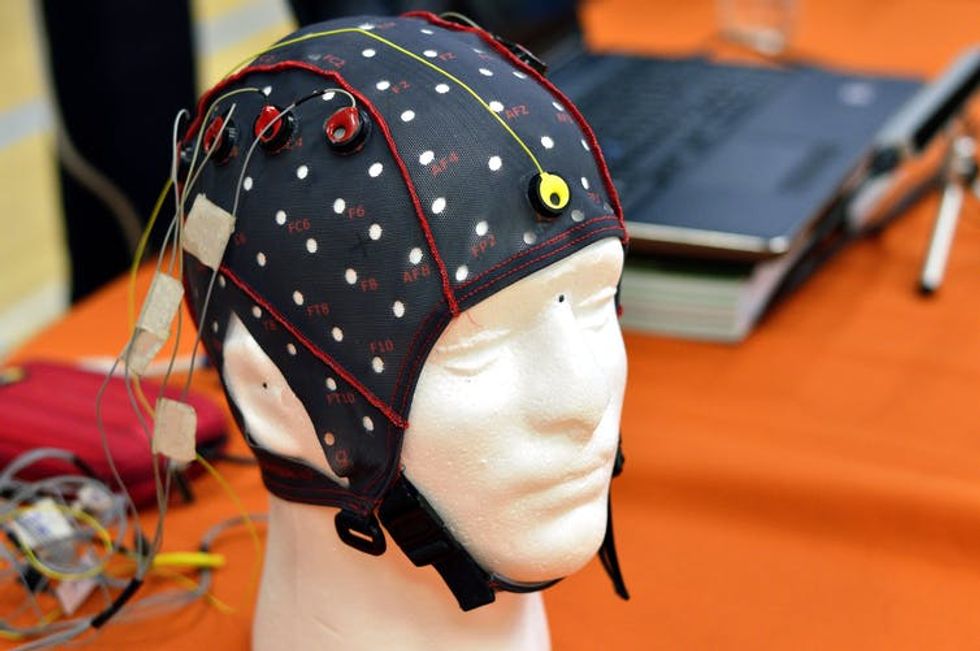
The electroencephalogram (EEG) head cap with flat metal discs (electrodes) attached to a white plastic model’s head shown in a science exhibition.
Engineering schools are preparing for this future in part through the growth of biomedical engineering, where students learn not only the tools and concepts of engineering but also how to apply those ideas to today’s medical challenges. Many aspects of modern healthcare – from designing implants that survive for decades in the body to constructing secure medical records systems – are driving the demand for biomedical engineers.
In 1974 only three engineering schools offered accredited biomedical engineering programs. Forty years later, in 2014, more than 100 accredited programs granted bachelor of science degrees in biomedical engineering or bioengineering. In line with broader trends in engineering education, these programs prepare students to collaborate by challenging them with team-based projects.
As a result, our nation’s young biomedical engineers have the engineering expertise, appreciation for collaboration and at least some of the medical vocabulary they need to communicate effectively with physicians.
A gap in medical training
Yet, nothing in my medical school curriculum was designed to help physicians develop a complementary skill set. Every physician now uses advanced technology during the course of their daily work. But only a handful have the technical vocabulary or training required to help develop it. Several medical schools have recognized the need for engineering-literate physicians, building new campuses and launching new programs that blend medical and engineering education. Yet, many of these efforts are employing an outdated, physician-centric model that envisions training one person in two disciplines, rather than preparing them to collaborate in multidisciplinary teams.
This one-person, two-discipline approach has a long history at medical schools, exemplified by prestigious M.D.-Ph.D. programs that seek to train physician-scientists who split their time between caring for patients and conducting research.
While these M.D.-Ph.D. programs have been successful in some respects, they train only a small number of doctors. As recently reported by the American Association of Medical Colleges (AAMC), M.D. and Ph.D. programs are producing approximately 600 graduates per year, a number that is limited in part by financial resources; these students represent only 3 percent of medical school graduates but receive 17 percent of non-need based medical school scholarships. Joint programs that incorporate graduate engineering degrees will be further limited by the pool of applicants qualified for both medical and graduate engineering study.
Collaboration: A proven, scalable approach
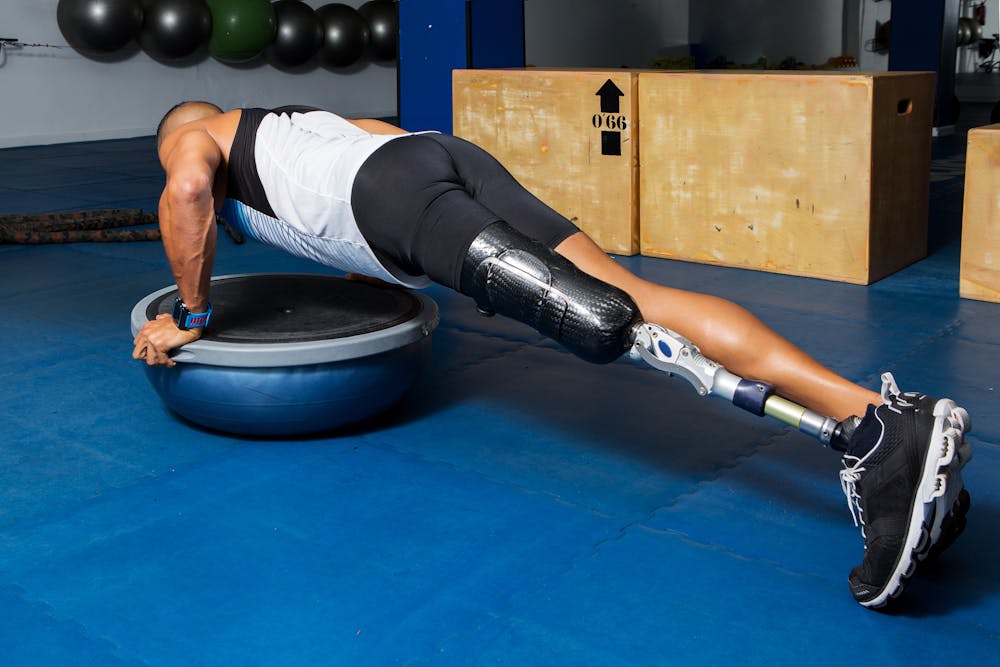
Side view of sportsman with artificial leg limb training in gym and doing push-ups on a bosu ball.
That is why we need a new approach: a proven, scalable approach at the engineering-medicine interface that teaches engineers and health care professionals to work together in teams.
At the University of Virginia, our Center for Engineering in Medicine promotes innovation by embedding engineering students into clinical environments and nursing and medical trainees into engineering laboratories. Embedded students acquire the technical vocabulary, cultural literacy and experience working in multidisciplinary teams that provide a foundation for careers in health care innovation.
Teaching engineers and health care professionals to collaborate is faster, cheaper, and more feasible than building specialty programs to train physician-engineers or launching more biomedical engineering programs. Teaching engineers and healthcare professionals to collaborate is faster, cheaper, and more feasible than
building specialty programs to train physician-engineers or launching more biomedical engineering programs. This approach builds on the experience of successful programs like Stanford Biodesign
However, many universities in America are not built to promote collaboration between the fields of engineering and medicine. In part, that is because schools devoted to agriculture and engineering are often miles from those focused on liberal arts and medicine. In situations where physical proximity is not possible, workshops, conferences, continuing medical education courses and cross-disciplinary events can spark the cross talk that catalyzes innovation.
Finding ways to reduce literal, and disciplinary, separation between engineering and medicine is essential for cultivating and expanding innovation at the interface. While new specialized training programs may play a role in this effort, promoting collaboration within the existing workforce has the potential to make a much bigger impact.
The leaders in the next wave of health care innovation will be the universities, health systems, and companies that find ways to train engineers, doctors, nurses and others to work together effectively in teams to solve tomorrow’s complex health care challenges.
Augmented reality systems show virtual objects in the real world – like cat ears and whiskers on a Snapchat selfie, or how well a particular chair might fit in a room. The first big break for AR was the “Pokémon GO” game, released in 2016 with a feature that let players see virtual Pokémon standing in front of them, ready to be captured and played with. Now, technology companies like Microsoft and Mozilla – the company behind the Firefox browser – and even retail businesses like IKEA and Lego are exploring the potential of AR.
But as an AR researcher with expertise in both industry and academia, I disagree with those optimistic views. Most people in the U.S. haven’t heard of AR – and most of those who have don’t really know what it is. And that’s just one barrier between augmented reality today and a future where it is everywhere. Overall, there are three major challenges to be overcome.
Hardware difficulties
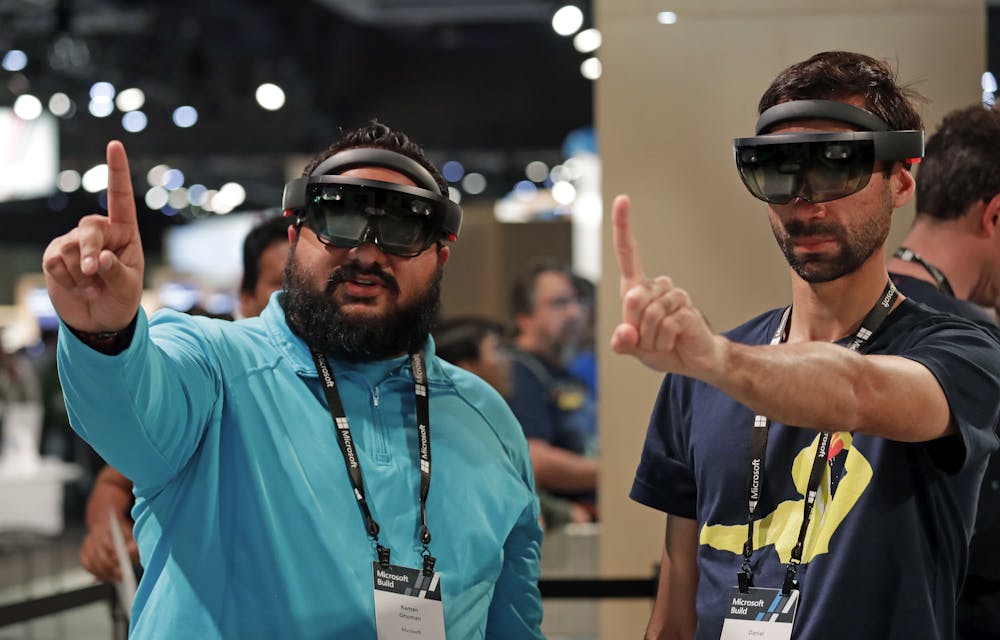
When I first tried AR glasses three years ago, they quickly overheated and shut down – even when trying to do something fairly basic, like placing two virtual objects in a room. While there has been a lot of improvement in this respect, other problems have emerged. The HoloLens system – one of the most advanced AR headsets – essentially requires a user to carry a Microsoft Kinect system and a computer on their head, which is quite heavy and limits the user’s field of view. A different issue are AR experiences that work across systems.
Microsoft’s HoloLens system requires wearing a computer on your head.
Even “Pokémon GO,” the most popular app that actually uses AR, drains smartphone batteries extremely rapidly. And the AR function doesn’t make the game much better – or really different at all – though it is neat at first to see a Pikachu standing on the lawn in front of you. With so little benefit and such a severe hit to device performance, every player I know, including me, has turned off the AR mode.
Lack of real uses so far
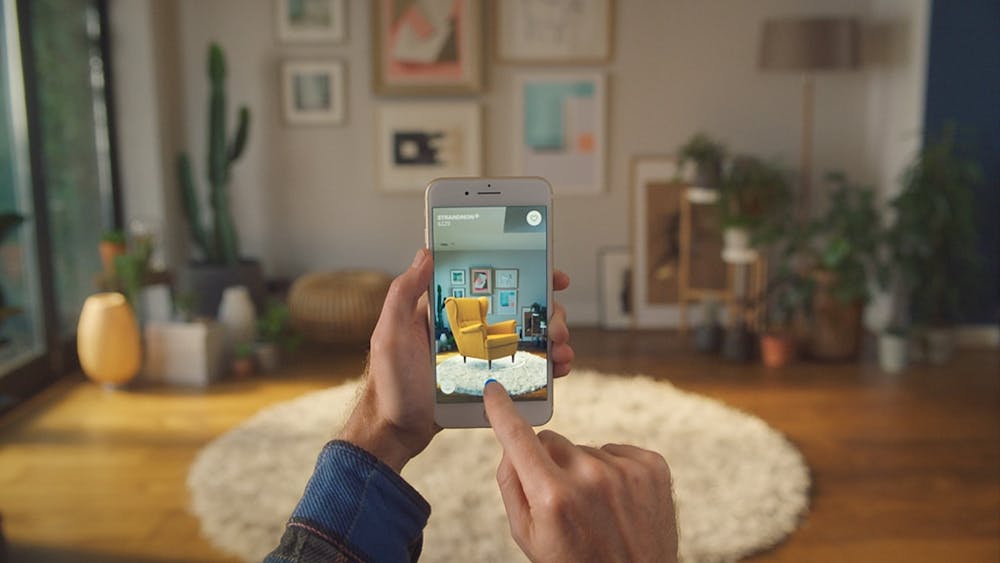
Just as people turn off AR in “Pokémon GO,” I’ve never seen or heard of anyone actually using IKEA’s furniture app as it’s allegedly intended; the app has just 3,100 reviews in Apple’s app store, far fewer than the 104,000 for “Pokémon GO.” It’s supposed to be useful to people seeking to redesign their living spaces, letting them use their smartphones to add virtual furniture to actual rooms.
Apple and Google have released AR toy and demo apps built with their new platforms ARKit and ARCore – such as playing with virtual dominos. They are engaging, and the 3D models look great. They do what they’re designed to do, but their functions aren’t especially useful.
This is partly due to the fact that AR, like the internet, is just a basic technology that needs people to create uses for it. The internet started as Arpanet in 1969, but began to grow widely only when Tim Berners-Lee invented the “World Wide Web” – a now-dated term – in 1989. And it wasn’t until the 2000s that regular people who used the internet could also create online content for others to consume. That level of development and innovation has not yet happened for AR, though Mozilla is taking initial steps in this direction by trying to bring AR to everyday web browsers like Firefox.
Marketing challenges
Even people who use Snapchat don’t think of it as an augmented reality app – though that’s exactly what it is. It’s AR technology that figures out where to put the dog ears, heart eyes or whiskers on their friends’ faces – and sends rainbow vomit out of their mouths. People who don’t know what augmented reality is, or who have never consciously experienced it – even if they use it daily – aren’t going to make a purchase just because a product has some AR capability.
Putting graphics on a Snapchat selfie involves using augmented reality.
There’s also some confusion in labeling and marketing of AR technologies. Many people have started to hear about virtual reality, which is generally an immersive fully virtual world that doesn’t include aspects of the user’s real environment. The distinctions get fuzzier with mixed reality – sometimes labeled “MR” but other times “XR.” Originally the term meant anything in between a fully real and a fully virtual experience – which could include AR. But now Microsoft is saying products and apps are MR if they provide both augmented and fully virtual experiences. That leaves customers unclear what’s being advertised – though they’ll know it might not be very useful and may run their phone batteries down quickly.
I’m with my AR-optimist friends and colleagues in seeing a lot of potential for the future, but there’s a long way to go. They – and I – are already working hard on making the hardware better, finding useful applications and clarifying product labeling. But it will take lots of this hard work and probably many more years before mainstream America lives in a truly augmented reality.
Facebook on Thursday denied allegations in the New York Times that it tried to mislead the public about its knowledge of Russian misinformation ahead of the 2016 US presidential election, but severed links with a Republican consultancy.
The Times detailed obfuscation by Facebook's top bosses on the Russia front, said the company has at times smeared critics as anti-Semitic or tried to link activists to billionaire investor George Soros, and also tried to shift public anger away toward rival tech companies.
In a statement in response, Facebook disputed "inaccuracies" in the story, but said it was ending its contract with a Republican lobbying company named in the article, Definers Public Affairs, which specializes in opposition research.
The Times, in a lengthy investigative piece based on interviews with more than 50 people both inside the company and with Washington officials, lawmakers and lobbyists, argued that Facebook's way of dealing with crisis was to "delay, deny and deflect."
Chief executive Mark Zuckerberg and chief operating officer Cheryl Sandberg were both so bent on growing Facebook that they "ignored warning signs and then sought to conceal them from public view," the report said.
On Russia, Zuckerberg declared in the fall of 2016 that it was "crazy" to think Facebook had been used to help Donald Trump win the US presidency, but the report said in-house experts knew this not to be the case.
In fact, the Times said, Facebook had amassed evidence for over a year of Russian activity through an investigation led by its former security chief, Alex Stamos.
But it was only belatedly that the company's board was informed of the full extent of the meddling, the Times said.
In its statement, Facebook said it had ended its contract with Definers as of Wednesday night. It did not explain why, but insisted it had long taken the Russia factor seriously and was committed to fighting fake news.
"We've acknowledged publicly on many occasions -– including before Congress -– that we were too slow to spot Russian interference on Facebook, as well as other misuse," it said.
"But in the two years since the 2016 presidential election, we've invested heavily in more people and better technology to improve safety and security on our services.
"While we still have a long way to go, we're proud of the progress we have made in fighting misinformation, removing bad content and preventing foreign actors from manipulating our platform."
- Going on the attack -
The Times said that when criticism of its belated Russia admission grew, Facebook mounted a lobbying campaign led by Sandberg, pushing negative stories about its political critics and making rival companies like Google and Apple look bad.
In July of this year, as a Facebook executive testified before a congressional committee, anti-Facebook demonstrators barged into the room and held up a sign depicting Zuckerberg and Sandberg -- who are both Jewish -- as the twin heads of an octopus with its tentacles around the world.
Facebook responded by lobbying a Jewish civil rights group -- the Anti-Defamation League -- to publicly label that criticism as anti-Semitic, the Times said.
Facebook was also said to have employed Definers to discredit activists, partly by linking them to the liberal, Jewish Soros, who has become a favored target of Trump supporters and far-right conspiracy groups.
The company's statement said any suggestion that its own counter-offensive embraced anti-Semitic tactics was "reprehensible and untrue."
Before and since this month's midterm elections, which saw the Democrats retake control of the House of Representatives, Facebook has shut down dozens of accounts on its own platform and on Instagram which it said were aimed at influencing the vote.
The world's most popular social media platform has been on the back foot for months, including over the allegation that data from millions of Facebook users was abused by the consultancy Cambridge Analytica to help drive Trump to the White House.
Right wing conspiracy theorist Alex Jones has been ripping off his Infowars audience for years by selling overpriced vitamin supplements of dubious effectiveness, but now security researchers have discovered that the Infowars store has been infected with malware that steals his customers' credit card information, according to Gizmodo.
The malware, known as Magecart, was discovered by Dutch security researcher Willem de Groot on every Infowars store page. The code would spring to life when customers checked out, mining their payment data and sending their credit card information every 1.5 seconds to a server located in in Lithuania.
In a statement, Jones said "only" 1,600 of his customers had been caught up in the scam, and added that he was the victim of a worldwide conspiracy.
"This latest action is a concerted effort to de-platform Infowars by big tech, the communist Chinese, and the Democratic party who have been publicly working and lobbying to wipe Infowars from the face of the earth," Jones wrote. "America is under attack by globalist forces and anyone standing up for our republic will be attacked mercilessly by the corporate press, Antifa and rogue intelligence operatives. Infowars will never surrender!"
Amazon.com Inc (AMZN.O) could announce as early as Tuesday that it has selected New York City and Northern Virginia to be the sites for its second and third headquarters, the Wall Street Journal reported on Monday.
Other cities may also receive major sites as part of Amazon’s decision that would end a more-than-year-long contest that started with 238 candidates and ended with a surprise split of its so-called HQ2, WSJ said, citing people familiar with the matter.
Amazon did not immediately respond to a Reuters request for comment.
Reporting by Ismail Shakil in Bengaluru; Editing by Sunil Nair
Some 78 million miles (126 million kilometers) from Earth, alone on the immense and frigid Red Planet, a robot the size of a small 4x4 wakes up just after sunrise. And just as it has every day for the past six years, it awaits its instructions.
Around 9:30 Mars time, a message arrives from California, where it was sent 15 minutes earlier.
"Drive forward 10 meters, turn to an azimuth of 45 degrees, now turn on your autonomous capabilities and drive."
The Curiosity rover executes the commands, moving slowly to its designated position, at a maximum speed of 35 to 110 meters (yards) per hour.
Its batteries and other configurations limit its daily drive span to around 100 meters. The most Curiosity has rolled on Mars in a day is 220 meters.
Once it arrives, its 17 cameras take shots of its environs.
Its laser zaps rocks. Other tools on board drill into a particularly interesting rock to study small samples.
Around 5 pm Martian time, it will wait for one of NASA's three satellites orbiting the planet to pass overhead.
Curiosity will then send several hundred megabytes of scientific data via large ground antennae to its human masters on Earth.
- A miniature lab -
On the ground floor of building 34 at NASA's Goddard Space Flight Center in Greenbelt, Maryland, scientists pore over Curiosity's data every day at 1 pm, in a large windowless room full of scientific instruments and computers.
The scientists are looking for any indication of life on Mars.
Inside Curiosity lies a "marvel of miniaturization," says Charles Malespin, the deputy principal investigator for Sample Analysis at Mars (SAM), a chemist's lab the size of a microwave oven.
"It's the most complicated instrument NASA has ever sent to another planet," said Malespin, who has devoted his professional life to the project since 2006.
SAM analyzes samples of Martian soil by heating them in an oven that reaches 1,800 Fahrenheit (1,000 Celsius).
The hot rocks release gas, which is separated and analyzed by instruments that offer a sample "fingerprint."
At Goddard, Maeva Millan, a French postdoctoral researcher, compares this chemical fingerprint to experiments carried out on known molecules.
When they look similar, she can say, "Ah, that's the right molecule."
It is thanks to SAM that researchers know there are complex organic molecules on Mars.
And SAM has helped scientists learn that the Martian surface -- geologically speaking -- is far younger than previously thought.
"If you're going to go to Mars, you don't want to bring stuff that's already there that you can use for resources," such as water, said Malespin.
"If you want to mine the soil and heat it up and release the water, you can bring a big oven with you and you have all the water you want."
The same goes for various materials that could be used to make rocket fuel, allowing the Red Planet to serve as a future service station for rockets.
- No joystick -
On the other side of the United States, at NASA's Jet Propulsion Laboratory in Pasadena, California, about two dozen men and women make up the team that drives Curiosity.
"My favorite part of the day (is when) I get to sit down and start looking at the imagery from Mars and understand where the rover currently is," said Frank Hartman, who has driven both Curiosity and another, older rover, Opportunity.
"And my feeling is that sometimes I'm probably the first person on Earth looking at some of these pictures."
The Mars drivers' main job is to write the sequence of commands for the rover to follow the next sol, or "day" on Mars, which lasts 24 hours and nearly 40 minutes. There is no joystick, and no real-time communication with the robotic vehicle.
There is a delay whenever drivers realize something has gone wrong, whether it's Opportunity getting buried by a Martian dust storm earlier this year, or one of Curiosity's wheels getting pierced by a sharp rock.
Or the breakdown of Curiosity's drilling machine, which happened at the beginning of this year and took a few months to resolve.
"We haven't been to any of these places before," said Hartman.
"And so we always have to be aware of the fact that we know so little about what we're encountering."
As years pass, these scientist-drivers become attached to their robots. When Opportunity went silent after 14 years of tooling around on Mars, Hartman and his colleagues felt a sense of grief.
Opportunity "retired with honor," said Hartman.
Curiosity, which landed in 2012, has so far traveled just over 12 miles (19.75 km). It must wait another year before reaching its goal, Mount Sharp.
Then, a few months later, it will lose its Martian monopoly. Two rovers -- one American and one European -- are scheduled to land on the planet in 2020.